×
Request Free Sample ×

Kindly complete the form below to receive a free sample of this Report

* Please use a valid business email

Leading companies partner with us for data-driven Insights

clients tt-cursor
Hero Background

GCC Data Historian Market

ID: MRFR/ICT/63013-HCR
200 Pages
Aarti Dhapte
October 2025

GCC Data Historian Market Research Report By Component (Software, Services), By Deployment (Cloud-based, On-Premise), By Application (Production Tracking, Environmental Auditing, Asset Performance Management, Predictive Maintenance, Others), and By End User (Oil and Gas, Marine, Chemicals, Pharmaceuticals, Paper, Pulp, Metals, Mining, Utilities, Data Centers, Others)- Forecast to 2035

Share:
Download PDF ×

We do not share your information with anyone. However, we may send you emails based on your report interest from time to time. You may contact us at any time to opt-out.

GCC Data Historian Market Infographic
Purchase Options

GCC Data Historian Market Summary

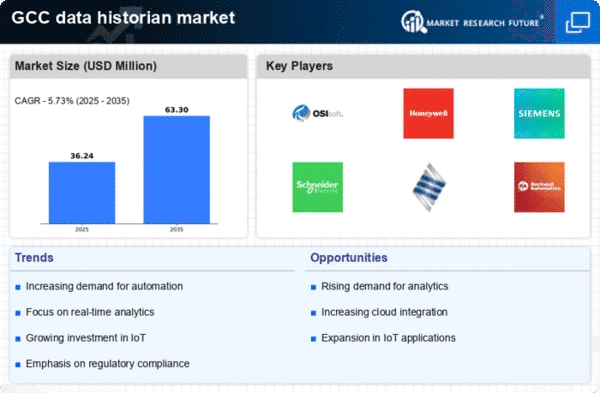
As per MRFR analysis, the GCC data historian market size was estimated at 34.28 USD Million in 2024. The GCC data historian market is projected to grow from 36.24 USD Million in 2025 to 63.3 USD Million by 2035, exhibiting a compound annual growth rate (CAGR) of 5.73% during the forecast period 2025 - 2035.

Key Market Trends & Highlights

The GCC data historian market is experiencing robust growth driven by technological advancements and increasing demand for real-time data solutions.

  • The integration of advanced technologies is reshaping the data historian landscape, enhancing data collection and analysis capabilities.
  • Regulatory compliance and data management are becoming critical as organizations seek to meet stringent industry standards.
  • The focus on sustainability and efficiency is driving investments in data historian solutions, particularly in the energy and manufacturing sectors.
  • Rising demand for real-time data analysis and increased investment in industrial IoT are key drivers propelling market growth.

Market Size & Forecast

2024 Market Size 34.28 (USD Million)
2035 Market Size 63.3 (USD Million)
CAGR (2025 - 2035) 5.73%

Major Players

OSIsoft (US), Honeywell (US), Siemens (DE), Schneider Electric (FR), Emerson (US), Rockwell Automation (US), General Electric (US), ABB (CH), Mitsubishi Electric (JP)

GCC Data Historian Market Trends

The The market is currently experiencing notable growth, driven by the increasing demand for real-time data analytics across various sectors. Organizations are recognizing the value of historical data in enhancing operational efficiency and decision-making processes. This trend is particularly evident in industries such as oil and gas, manufacturing, and utilities, where data-driven insights can lead to significant cost savings and improved performance. Furthermore, the integration of advanced technologies, such as artificial intelligence and machine learning, is transforming how data is collected, stored, and analyzed. As a result, companies are investing in sophisticated data historian solutions to harness the full potential of their data assets. In addition, the regulatory landscape in the GCC region is evolving, with governments emphasizing the importance of data management and compliance. This shift is prompting organizations to adopt robust data historian systems that not only meet regulatory requirements but also provide a competitive edge. The focus on sustainability and operational excellence is further driving the adoption of data historian technologies, as businesses seek to optimize resource utilization and minimize environmental impact. Overall, the The market is poised for continued expansion, with organizations increasingly prioritizing data-driven strategies to navigate the complexities of modern business environments.

Integration of Advanced Technologies

The data historian market is witnessing a trend towards the integration of advanced technologies such as artificial intelligence and machine learning. These innovations enable organizations to analyze vast amounts of historical data more efficiently, leading to enhanced predictive analytics and improved decision-making capabilities.

Regulatory Compliance and Data Management

As regulatory frameworks in the GCC region become more stringent, organizations are increasingly focusing on compliance and effective data management. This trend drives the demand for data historian solutions that ensure adherence to regulations while optimizing data storage and retrieval processes.

Focus on Sustainability and Efficiency

There is a growing emphasis on sustainability and operational efficiency within the data historian market. Companies are leveraging data historian technologies to optimize resource usage, reduce waste, and enhance overall performance, aligning with broader environmental goals.

GCC Data Historian Market Drivers

Adoption of Cloud-Based Solutions

The shift towards cloud-based solutions is significantly impacting the data historian market. In the GCC, organizations are increasingly migrating their data storage and analysis processes to the cloud, driven by the need for scalability and flexibility. This transition is expected to result in a market growth of around 20% over the next few years. Cloud-based data historians offer advantages such as reduced infrastructure costs and improved accessibility, enabling organizations to analyze their historical data from anywhere. As businesses continue to embrace digital transformation, the demand for cloud-based data historian solutions is likely to rise, reflecting a broader trend towards cloud adoption in various sectors. This evolution is poised to redefine how organizations manage and utilize their historical data.

Emergence of Predictive Analytics

The rise of predictive analytics is reshaping the landscape of the data historian market. Organizations in the GCC are increasingly utilizing historical data to forecast future trends and behaviors. This capability is particularly valuable in sectors such as manufacturing and energy, where predictive maintenance can lead to significant cost savings. The market for predictive analytics is anticipated to grow by approximately 15% in the coming years, driven by the need for proactive decision-making. Data historians serve as the backbone for these analytics, providing the necessary historical context for accurate predictions. As businesses seek to enhance their operational strategies through data-driven insights, the data historian market is likely to expand in response to this growing demand for predictive capabilities.

Increased Investment in Industrial IoT

The integration of Industrial Internet of Things (IIoT) technologies is significantly influencing the data historian market. In the GCC, industries are investing heavily in IIoT solutions to enhance operational efficiency and data collection processes. This investment is expected to reach approximately $5 billion by 2026, indicating a robust growth trajectory. Data historians play a crucial role in this ecosystem by aggregating and analyzing data from various IIoT devices, enabling organizations to optimize their operations. The ability to monitor equipment performance and predict maintenance needs through historical data analysis is becoming increasingly vital. Consequently, the data historian market is poised for substantial growth as more companies adopt IIoT strategies to remain competitive in their respective sectors.

Rising Demand for Real-Time Data Analysis

The data historian market is experiencing a notable surge in demand for real-time data analysis capabilities. Industries across the GCC are increasingly recognizing the value of immediate insights derived from historical data. This trend is particularly evident in sectors such as oil and gas, where operational efficiency is paramount. According to recent estimates, the market for data historians in the GCC is projected to grow at a CAGR of approximately 12% over the next five years. This growth is driven by the need for organizations to make informed decisions quickly, thereby enhancing productivity and reducing downtime. As companies seek to leverage data for competitive advantage, the The market is likely to expand significantly, reflecting the critical role of real-time analytics in modern business operations.

Growing Focus on Data Security and Privacy

As organizations in the GCC become more data-driven, the emphasis on data security and privacy is intensifying. The data historian market is responding to this trend by incorporating advanced security features to protect sensitive information. With the implementation of stringent data protection regulations, companies are compelled to ensure compliance while managing their historical data. This shift is likely to drive the adoption of data historian solutions that offer robust security measures, including encryption and access controls. The market is expected to witness a growth rate of around 10% as businesses prioritize safeguarding their data assets. This focus on security not only enhances trust among stakeholders but also positions organizations to leverage their data more effectively in a secure environment.


Market Segment Insights

GCC Data Historian Market Segment Insights

GCC Data Historian Market Segment Insights

Data Historian Market Component Insights

Data Historian Market Component Insights

The Component segment of the GCC Data Historian Market is crucial for understanding the overall dynamics and growth trajectories in the region, encompassing both Software and Services. The Software aspect plays a significant role, enabling organizations to gather, analyze, and visualize data in real-time, which is essential for optimizing operational efficiency and decision-making processes.

Given the increasing demand for data analytics and smart technologies across various industries in the GCC, Software solutions are becoming a focal point for companies looking to enhance their data capabilities. On the other hand, Services in the Data Historian Market include consulting, implementation, and maintenance, which are vital for transitioning businesses into a data-driven environment.

This segment ensures that organizations not only invest in the right technology but also apply it effectively to meet their specific needs. The emphasis on digital transformation in sectors such as oil and gas, manufacturing, and smart cities is driving the demand for both Software and Services, as companies seek to harness the power of data for improved operational strategies.

Furthermore, with the GCC countries investing heavily in infrastructure development and innovation, the significance of effective data management cannot be overstated.The Component segment continues to evolve, influenced by advancements in cloud computing and the Internet of Things (IoT), making it a pivotal area for stakeholders aiming to enhance their service offerings and competitive advantage in the GCC Data Historian Market.

Data Historian Market Deployment Insights

Data Historian Market Deployment Insights

The Deployment segment of the GCC Data Historian Market plays a crucial role in the overall dynamics of data management and analytics embraced by various industries. Cloud-based solutions are gaining traction due to their flexibility, scalability, and cost-effectiveness, allowing businesses in the GCC region to manage large volumes of data efficiently without significant infrastructure investment.

In contrast, On-Premise deployment remains popular among organizations that prioritize data security and compliance with local regulations. As GCC countries recognize the importance of data-driven decision-making, the adoption of deployment solutions that enhance real-time data access is becoming increasingly important.

Moreover, the government initiatives aimed at digital transformation and smart city projects are further propelling the demand for these solutions.This segment plays a critical role in ensuring that businesses leverage GCC Data Historian Market data effectively, ultimately contributing to enhanced operational efficiency and competitive advantage across diverse sectors, including manufacturing, energy, and utilities.The growing emphasis on data analytics in the region underscores the significance of robust deployment strategies to support informed decision-making and operational excellence.

Data Historian Market Application Insights

Data Historian Market Application Insights

The Application segment of the GCC Data Historian Market presents a diverse landscape driven by various operational demands across industries. Key areas such as Production Tracking are essential for manufacturers to optimize production lines and improve operational efficiency, ensuring timely delivery and resource allocation.

Environmental Auditing roles highlight the region's commitment to sustainability and compliance with environmental regulations, increasingly crucial in GCC nations focused on reducing their carbon footprint. Asset Performance Management is significant in enhancing the lifespan and reliability of critical assets, which is vital for industries such as oil and gas, given their infrastructure dependencies.

Predictive Maintenance is emerging as a transformative approach, allowing companies to foresee equipment failures and minimize downtime, thus supporting the region's goal of maximizing production uptime.

Additionally, the Others category encompasses various applications tailored to specific industry needs, further underscoring the versatility and adaptability of Data Historian solutions in the GCC market. These applications collectively contribute to enhancing operational resilience, transparency, and compliance in a rapidly evolving industrial environment.

Data Historian Market End User Insights

Data Historian Market End User Insights

The GCC Data Historian Market is significantly driven by various end-user sectors, which play a crucial role in shaping the landscape of data management solutions within the region. The Oil and Gas industry is a primary contributor, due to its reliance on extensive data tracking for operational efficiency and regulatory compliance.

Similarly, the Marine sector, shaped by GCC's strategic geographical positioning, requires robust data historian solutions to optimize vessel operations and ensure safety at sea. The Chemicals and Pharmaceuticals industries also exhibit a strong demand, as stringent regulatory standards necessitate comprehensive data archiving and management solutions.

Additionally, the Paper and Pulp, Metals, and Mining sectors are increasingly focusing on efficiency and sustainability, driving the need for effective data historian applications to analyze production processes and improve resource management.Utilities and Data Centers present further opportunities, as the shift towards smart grid technologies and digital transformation fuels the need for real-time data monitoring and analytics.

Common across these sectors is the increasing emphasis on leveraging data for strategic planning and operational optimization, which fosters a competitive edge in the market. Overall, these industries highlight the diverse applicability and critical need for data historian technologies within the GCC region.

Get more detailed insights about GCC Data Historian Market

Key Players and Competitive Insights

The data historian market is currently characterized by a dynamic competitive landscape, driven by the increasing demand for real-time data analytics and the integration of IoT technologies. Key players such as OSIsoft (US), Honeywell (US), and Siemens (DE) are strategically positioning themselves through innovation and partnerships. OSIsoft (US) focuses on enhancing its PI System to support advanced analytics, while Honeywell (US) emphasizes its digital transformation initiatives to optimize operational efficiency. Siemens (DE) is leveraging its expertise in automation to integrate data historian capabilities into its broader digital offerings, thereby shaping a competitive environment that prioritizes technological advancement and customer-centric solutions.

In terms of business tactics, companies are increasingly localizing manufacturing and optimizing supply chains to enhance responsiveness to market demands. The competitive structure of the market appears moderately fragmented, with several key players exerting substantial influence. This fragmentation allows for a diverse range of solutions, catering to various industry needs while fostering innovation through competition.

In October 2025, OSIsoft (US) announced a strategic partnership with a leading cloud service provider to enhance its data historian capabilities. This collaboration aims to integrate cloud-based analytics with OSIsoft's existing solutions, potentially expanding its market reach and improving data accessibility for clients. Such a move underscores the importance of cloud integration in modern data management strategies, positioning OSIsoft (US) favorably in a rapidly evolving market.

In September 2025, Honeywell (US) launched a new version of its data historian software, which incorporates advanced machine learning algorithms. This upgrade is designed to provide users with predictive analytics capabilities, enabling them to make more informed decisions based on historical data trends. The introduction of these features reflects Honeywell's commitment to innovation and its understanding of the growing need for intelligent data solutions in various sectors.

In August 2025, Siemens (DE) expanded its data historian offerings by acquiring a niche software company specializing in industrial IoT solutions. This acquisition is likely to enhance Siemens' portfolio, allowing it to offer more comprehensive data management solutions that integrate seamlessly with IoT devices. The strategic importance of this move lies in Siemens' ability to strengthen its position in the market by providing end-to-end solutions that cater to the evolving needs of its customers.

As of November 2025, current trends in the data historian market are heavily influenced by digitalization, sustainability, and the integration of AI technologies. Strategic alliances among key players are shaping the competitive landscape, fostering innovation and collaboration. The shift from price-based competition to a focus on technological differentiation and supply chain reliability is evident. Companies are likely to continue investing in innovative solutions that enhance operational efficiency and sustainability, ensuring that they remain competitive in an increasingly complex market.

Key Companies in the GCC Data Historian Market market include

Industry Developments

Tabreed, a prominent district cooling supplier in the United Arab Emirates, chose OSIsoft's PI System in April 2023 to track energy use across several facilities, providing real-time operational insights and efficiency enhancements.

ABB completed installing its Enterprise Historian system at a sizable petrochemical complex in Saudi Arabia in August 2023, allowing for comprehensive performance monitoring and data consolidation across several production facilities.

In order to facilitate edge-based data logging and hybrid-cloud analytics capabilities, AVEVA launched a cloud-enabled historian extension for its PI System in the UAE oil and gas industry in November 2023.Honeywell greatly enhanced its traceability and compliance reporting by deploying its Process Historian Database (PHD) at a water treatment facility in the United Arab Emirates by February 2024.

Siemens' Historian Connect module, which simplifies process data collecting and makes sophisticated diagnostics possible, was successfully deployed for a significant manufacturing facility in Qatar in June 2024.With improved time-series data compression and quicker query replies, GE Digital most recently introduced a Proficy Historian upgrade at a Bahraini power generation facility in January 2025.

Future Outlook

GCC Data Historian Market Future Outlook

The data historian market is projected to grow at 5.73% CAGR from 2024 to 2035, driven by increasing data analytics needs and industrial automation.

New opportunities lie in:

  • Integration of AI-driven analytics for predictive maintenance solutions.
  • Development of cloud-based data historian platforms for enhanced accessibility.
  • Expansion into emerging markets with tailored data management solutions.

By 2035, the data historian market is expected to achieve robust growth and innovation.

Market Segmentation

GCC Data Historian Market End User Outlook

  • Oil and Gas
  • Marine
  • Chemicals and Pharmaceuticals
  • Paper and Pulp
  • Metals and Mining
  • Utilities
  • Data Centers
  • Others

GCC Data Historian Market Component Outlook

  • Software
  • Services

GCC Data Historian Market Deployment Outlook

  • Cloud-based
  • On-Premise

GCC Data Historian Market Application Outlook

  • Production Tracking
  • Environmental Auditing
  • Asset Performance Management
  • Predictive Maintenance
  • Others

Report Scope

MARKET SIZE 202434.28(USD Million)
MARKET SIZE 202536.24(USD Million)
MARKET SIZE 203563.3(USD Million)
COMPOUND ANNUAL GROWTH RATE (CAGR)5.73% (2024 - 2035)
REPORT COVERAGERevenue Forecast, Competitive Landscape, Growth Factors, and Trends
BASE YEAR2024
Market Forecast Period2025 - 2035
Historical Data2019 - 2024
Market Forecast UnitsUSD Million
Key Companies Profiled["OSIsoft (US)", "Honeywell (US)", "Siemens (DE)", "Schneider Electric (FR)", "Emerson (US)", "Rockwell Automation (US)", "General Electric (US)", "ABB (CH)", "Mitsubishi Electric (JP)"]
Segments CoveredComponent, Deployment, Application, End User
Key Market OpportunitiesIntegration of advanced analytics and IoT technologies enhances data historian market potential in the GCC region.
Key Market DynamicsRising demand for real-time data analytics drives innovation in the data historian market across the GCC region.
Countries CoveredGCC

Leave a Comment

FAQs

What is the expected market size of the GCC Data Historian Market in 2024?

The GCC Data Historian Market is expected to be valued at 34.8 million USD in 2024.

What will be the projected market size of the GCC Data Historian Market by 2035?

By 2035, the GCC Data Historian Market is anticipated to reach a valuation of 86.8 million USD.

What is the expected CAGR for the GCC Data Historian Market from 2025 to 2035?

The expected CAGR for the GCC Data Historian Market from 2025 to 2035 is 8.664%.

Which major players are dominating the GCC Data Historian Market?

Key players in the GCC Data Historian Market include Siemens, AVEVA, National Instruments, ABB, and SAP.

What is the market value for software in the GCC Data Historian Market in 2024?

The market value for software in the GCC Data Historian Market is projected to be 19.2 million USD in 2024.

What will the market value for software in the GCC Data Historian Market be by 2035?

By 2035, the market value for software in the GCC Data Historian Market is expected to grow to 46.0 million USD.

What is the market value for services in the GCC Data Historian Market in 2024?

The market value for services in the GCC Data Historian Market is estimated at 15.6 million USD in 2024.

What will the market value for services in the GCC Data Historian Market be by 2035?

The market value for services in the GCC Data Historian Market is projected to be 40.8 million USD by 2035.

What are some key trends driving growth in the GCC Data Historian Market?

Key trends for the GCC Data Historian Market include increasing data analytics adoption and the growth of IoT applications.

What challenges might the GCC Data Historian Market face in the coming years?

Challenges for the GCC Data Historian Market may include data privacy concerns and integration complexities.

Download Free Sample

Kindly complete the form below to receive a free sample of this Report

Compare Licence

×
Features License Type
Single User Multiuser License Enterprise User
Price $4,950 $5,950 $7,250
Maximum User Access Limit 1 User Upto 10 Users Unrestricted Access Throughout the Organization
Free Customization
Direct Access to Analyst
Deliverable Format
Platform Access
Discount on Next Purchase 10% 15% 15%
Printable Versions