×
Request Free Sample ×

Kindly complete the form below to receive a free sample of this Report

* Please use a valid business email

Leading companies partner with us for data-driven Insights

clients tt-cursor
Hero Background

GCC Flash Chromatography Market

ID: MRFR/HC/49805-HCR
200 Pages
Garvit Vyas
October 2025

GCC Flash Chromatography Market Research Report By Technique Type (Reverse Phase, Ion Exchange, Size Exclusion, Chiral Separation) andBy End User (Pharmaceutical & Biotechnology Industries, Contract Research Organization, Others)- Forecast to 2035

Share:
Download PDF ×

We do not share your information with anyone. However, we may send you emails based on your report interest from time to time. You may contact us at any time to opt-out.

GCC Flash Chromatography Market Infographic
Purchase Options

GCC Flash Chromatography Market Summary

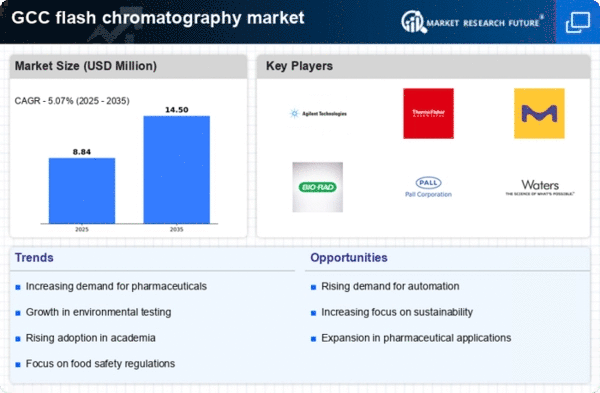
As per MRFR analysis, the GCC flash chromatography market was estimated at 8.41 USD Million in 2024. The GCC flash chromatography market is projected to grow from 8.84 USD Million in 2025 to 14.5 USD Million by 2035, exhibiting a compound annual growth rate (CAGR) of 5.07% during the forecast period 2025 - 2035.

Key Market Trends & Highlights

The GCC flash chromatography market is poised for growth driven by technological advancements and increasing demand in key sectors.

  • Technological advancements in chromatography are enhancing efficiency and accuracy in separation processes.
  • The pharmaceutical sector emerges as the largest segment, while academic and research institutions represent the fastest-growing segment.
  • Regulatory compliance and sustainability initiatives are shaping market dynamics and influencing purchasing decisions.
  • Rising demand in the pharmaceutical sector and the emergence of biopharmaceuticals are key drivers propelling market expansion.

Market Size & Forecast

2024 Market Size 8.41 (USD Million)
2035 Market Size 14.5 (USD Million)
CAGR (2025 - 2035) 5.07%

Major Players

Agilent Technologies (US), Thermo Fisher Scientific (US), Merck KGaA (DE), Bio-Rad Laboratories (US), Pall Corporation (US), Waters Corporation (US), Repligen Corporation (US), Sartorius AG (DE)

GCC Flash Chromatography Market Trends

The flash chromatography market is currently experiencing notable growth, driven by advancements in technology and increasing demand for efficient separation techniques. This method, characterized by its rapid processing capabilities, is becoming increasingly popular in various sectors, including pharmaceuticals, food and beverage, and environmental analysis. The GCC region, with its expanding research and development activities, is witnessing a surge in the adoption of flash chromatography systems. This trend is likely influenced by the region's focus on enhancing laboratory capabilities and improving analytical precision. Furthermore, the integration of automation and software solutions into flash chromatography systems appears to enhance operational efficiency, thereby attracting more users. In addition, the rising emphasis on quality control and regulatory compliance in industries such as pharmaceuticals is propelling the need for reliable separation methods. As laboratories strive to meet stringent standards, the flash chromatography market is poised to benefit from increased investments in advanced technologies. Moreover, the growing awareness of the advantages of flash chromatography, such as reduced solvent consumption and shorter analysis times, suggests a positive outlook for the market in the GCC. Overall, the combination of technological advancements and heightened regulatory demands is likely to shape the future trajectory of the flash chromatography market in the region.

Technological Advancements

Recent innovations in flash chromatography systems are enhancing their efficiency and effectiveness. The introduction of automated systems and advanced software solutions is streamlining workflows, allowing for quicker and more accurate separations. This trend is particularly relevant in the GCC, where laboratories are increasingly adopting these technologies to improve their analytical capabilities.

Regulatory Compliance

The growing focus on regulatory standards in industries such as pharmaceuticals is driving the demand for reliable separation techniques. Laboratories in the GCC are prioritizing quality control measures, which in turn boosts the need for flash chromatography systems that can meet stringent compliance requirements. This trend indicates a shift towards more sophisticated analytical methods.

Sustainability Initiatives

There is a rising awareness of environmental sustainability within the flash chromatography market. The adoption of greener practices, such as reduced solvent usage and energy-efficient systems, is becoming more prevalent. In the GCC, this trend aligns with broader sustainability goals, as organizations seek to minimize their environmental impact while maintaining high analytical standards.

GCC Flash Chromatography Market Drivers

Emergence of Biopharmaceuticals

The biopharmaceutical sector is gaining momentum in the GCC, which could have a profound impact on the flash chromatography market. As biopharmaceuticals become more prevalent, the need for effective purification and separation techniques is increasingly critical. Flash chromatography is well-suited for the purification of biomolecules, making it a valuable tool in the biopharmaceutical manufacturing process. The GCC biopharmaceutical market is expected to grow significantly, with estimates suggesting a potential market size of $5 billion by 2025. This growth is likely to drive demand for advanced chromatographic techniques, including flash chromatography, as companies seek to optimize their production processes. The emergence of biopharmaceuticals not only enhances the flash chromatography market but also encourages innovation in separation technologies.

Increased Focus on Quality Control

Quality control remains a critical aspect of various industries, including food and beverage, cosmetics, and pharmaceuticals, thereby impacting the flash chromatography market. As companies strive to meet stringent quality standards, the demand for reliable analytical methods is on the rise. Flash chromatography provides rapid and efficient separation, making it an attractive option for quality control applications. The GCC region has seen a marked increase in regulatory requirements, compelling companies to adopt advanced analytical techniques. For instance, the food and beverage sector is projected to grow at a CAGR of 6% through 2025, which may further drive the adoption of flash chromatography for quality assurance. This heightened focus on quality control is likely to enhance the market for flash chromatography systems, as industries seek to ensure product safety and compliance.

Rising Demand in Pharmaceutical Sector

The pharmaceutical sector in the GCC is experiencing a notable surge in demand for efficient separation techniques, which is likely to bolster the flash chromatography market. As the industry focuses on drug development and quality control, the need for rapid and effective purification methods becomes paramount. Flash chromatography offers a time-efficient solution, enabling pharmaceutical companies to streamline their processes. Recent data indicates that the pharmaceutical market in the GCC is projected to reach approximately $30 billion by 2025, suggesting a robust growth trajectory. This growth is expected to drive investments in advanced chromatographic technologies, thereby enhancing the flash chromatography market. Furthermore, the increasing complexity of drug formulations necessitates sophisticated separation techniques, positioning flash chromatography as a critical tool in the pharmaceutical landscape.

Technological Innovations in Chromatography

Technological innovations in chromatography are playing a pivotal role in shaping the flash chromatography market. The introduction of automated systems and advanced detection methods is enhancing the efficiency and accuracy of chromatographic processes. These innovations are particularly relevant in the GCC, where industries are increasingly adopting cutting-edge technologies to improve productivity. Recent advancements in flash chromatography systems have led to faster separation times and improved resolution, making them more appealing to various sectors. The market for chromatography equipment in the GCC is projected to grow at a CAGR of 7% through 2025, indicating a strong potential for flash chromatography systems. As industries continue to seek innovative solutions, the demand for technologically advanced flash chromatography systems is likely to rise.

Growth in Academic and Research Institutions

The expansion of academic and research institutions in the GCC is contributing significantly to the flash chromatography market. These institutions are increasingly adopting advanced analytical techniques for research purposes, particularly in chemistry and biochemistry. The emphasis on research and development is evident, with funding for scientific research in the region reportedly increasing by over 15% annually. This trend indicates a growing recognition of the importance of advanced separation techniques, such as flash chromatography, in academic research. As educational institutions invest in state-of-the-art laboratory equipment, the demand for flash chromatography systems is likely to rise. This growth in the academic sector not only supports the flash chromatography market but also fosters innovation and collaboration between academia and industry.


Market Segment Insights

Flash Chromatography Market Technique Type Insights

The GCC Flash Chromatography Market is witnessing a diverse and evolving landscape within its Technique Type segment, reflecting the increasing demand for precise separation techniques in various industries such as pharmaceuticals, food safety, and environmental analysis. Among the prominent techniques, Reverse Phase chromatography is particularly significant due to its effectiveness in separating non-polar compounds from polar ones, making it essential in the purification of complex mixtures. This method has become a go-to technique in laboratories across the GCC region, where the focus on quality and efficiency in Research and Development (R&D) is paramount.

In addition, Ion Exchange chromatography stands out for its applications in bioprocessing and water treatment, helping industries isolate charged particles, including proteins and nucleic acids. The ability to fine-tune the separation process based on ionic interactions enhances its appeal in the GCC, where water scarcity and purification technologies are critical concerns.

Size Exclusion chromatography, on the other hand, offers a unique capability to separate molecules based on their size, making it vital in the biochemical and polymer industries. As the GCC continues to invest in its manufacturing and chemical sectors, this technique supports the development of new polymeric materials and biopharmaceuticals.

Finally, Chiral Separation is gaining traction as it allows for the resolution of enantiomers, crucial for the pharmaceutical industry to create effective and safe medications. Given the GCC's growing focus on developing a diversified economy that includes biotechnology and pharmaceuticals, this technique holds a prominent position. Overall, the GCC Flash Chromatography Market segmentation based on Technique Type illustrates a robust growth avenue driven by technological advancement and a rising commitment to innovation across various sectors.

As the market evolves, these techniques are integral to meeting stringent regulations and quality standards, contributing to the enhancement of product development and safety in the region.

Flash Chromatography Market End User Insights

The ser segment of the GCC Flash Chromatography Market plays a pivotal role in driving the adoption of chromatographic techniques across various industries. The Pharmaceutical and Biotechnology Industries constitute a major portion of this segment, where the need for high purity and efficient separation processes is paramount for drug development and production. These industries rely heavily on flash chromatography for purification processes, enabling faster and more cost-effective outcomes, thus enhancing productivity. Contract Research Organizations are also significant contributors, as they provide essential research and development services to pharmaceutical companies, utilizing flash chromatography for its speed and efficiency in compound separation.

Additionally, the Others category encapsulates various sectors, including academic and research institutions, where flash chromatography is increasingly being used for teaching and research purposes to develop new methodologies and novel compounds. The GCC region's focus on advancing its healthcare sector and investing in biotechnology is expected to bolster the growth of this segment, making flash chromatography an essential tool in laboratories. 

Improved regulatory frameworks and governmental initiatives aimed at enhancing healthcare services further present opportunities for market growth, ensuring that the ser segment remains a cornerstone of the GCC Flash Chromatography Market dynamics.

Get more detailed insights about GCC Flash Chromatography Market

Key Players and Competitive Insights

The flash chromatography market exhibits a dynamic competitive landscape characterized by rapid technological advancements and increasing demand for efficient separation techniques. Key players such as Agilent Technologies (US), Thermo Fisher Scientific (US), and Merck KGaA (DE) are at the forefront, leveraging innovation and strategic partnerships to enhance their market positions. Agilent Technologies (US) focuses on integrating advanced software solutions with its chromatography systems, aiming to streamline workflows and improve user experience. Meanwhile, Thermo Fisher Scientific (US) emphasizes sustainability in its operations, aligning product development with eco-friendly practices, which resonates well with the growing environmental consciousness among consumers. Merck KGaA (DE) appears to be concentrating on expanding its product portfolio through strategic acquisitions, thereby enhancing its competitive edge in the market.

The business tactics employed by these companies reflect a concerted effort to optimize supply chains and localize manufacturing processes. The market structure is moderately fragmented, with several players vying for market share, yet the influence of major companies remains substantial. This competitive environment fosters innovation, as companies strive to differentiate their offerings through technological advancements and enhanced service delivery.

In September 2025, Agilent Technologies (US) announced the launch of its latest flash chromatography system, which incorporates AI-driven analytics to optimize separation processes. This strategic move is likely to position Agilent as a leader in the market, as it addresses the increasing demand for automation and efficiency in laboratory settings. The integration of AI not only enhances operational efficiency but also provides users with valuable insights, potentially reducing time-to-results significantly.

In October 2025, Thermo Fisher Scientific (US) unveiled a new line of eco-friendly chromatography consumables, which are designed to minimize environmental impact without compromising performance. This initiative underscores the company's commitment to sustainability and may attract environmentally conscious customers, thereby expanding its market reach. The introduction of these products aligns with global trends towards greener laboratory practices, suggesting a proactive approach to market demands.

In August 2025, Merck KGaA (DE) completed the acquisition of a smaller chromatography firm, which specializes in innovative separation technologies. This acquisition is expected to enhance Merck's capabilities in flash chromatography, allowing it to offer a broader range of solutions to its customers. The strategic importance of this move lies in Merck's ability to integrate new technologies and expertise, thereby strengthening its competitive position in a rapidly evolving market.

As of November 2025, the flash chromatography market is increasingly defined by trends such as digitalization, sustainability, and the integration of AI technologies. Strategic alliances among key players are shaping the competitive landscape, fostering collaboration that enhances innovation and market responsiveness. Looking ahead, it appears that competitive differentiation will increasingly pivot from price-based strategies to a focus on technological innovation, reliability in supply chains, and sustainable practices. This shift may redefine how companies position themselves in the market, emphasizing the importance of adaptability and forward-thinking strategies.

Key Companies in the GCC Flash Chromatography Market market include

Industry Developments

In recent months, the GCC Flash Chromatography Market has witnessed strategic developments and significant advancements. There has been a notable increase in market valuation for companies such as SigmaAldrich and Agilent Technologies, crediting this growth to rising demand for chromatographic techniques across pharmaceuticals and environmental testing sectors. 

In July 2023, Merck Group expanded its offerings in the region through the acquisition of a local laboratory equipment supplier, enhancing its presence in the GCC. Significant technological progress has also been seen with Thermo Fisher Scientific advancing its flash chromatography systems, which cater to increasing efficiency in research and development activities.

In February 2022, Waters Corporation announced plans to establish a new distribution center in Saudi Arabia, aiming to enhance supply chain capabilities and market reach. Additionally, collaborations between players like BioRad Laboratories and government research institutions have intensified, driving innovation in analytical methods. The GCC's continuous investment in healthcare and laboratory infrastructure has fueled opportunities within the Flash Chromatography landscape, positively impacting the overall market dynamics as companies respond to the evolving needs of the industry.

Future Outlook

GCC Flash Chromatography Market Future Outlook

The Flash Chromatography Market is projected to grow at 5.07% CAGR from 2024 to 2035, driven by advancements in technology, increasing demand for purification processes, and rising applications in pharmaceuticals.

New opportunities lie in:

  • Development of automated flash chromatography systems for enhanced efficiency.
  • Expansion into emerging markets with tailored solutions for local industries.
  • Partnerships with research institutions for innovative applications in drug development.

By 2035, the market is expected to achieve robust growth, driven by technological advancements and strategic partnerships.

Market Segmentation

GCC Flash Chromatography Market End User Outlook

  • Pharmaceutical & Biotechnology Industries
  • Contract Research Organization
  • Others

GCC Flash Chromatography Market Technique Type Outlook

  • Reverse Phase
  • Ion Exchange
  • Size Exclusion
  • Chiral Separation

Report Scope

MARKET SIZE 20248.41(USD Million)
MARKET SIZE 20258.84(USD Million)
MARKET SIZE 203514.5(USD Million)
COMPOUND ANNUAL GROWTH RATE (CAGR)5.07% (2024 - 2035)
REPORT COVERAGERevenue Forecast, Competitive Landscape, Growth Factors, and Trends
BASE YEAR2024
Market Forecast Period2025 - 2035
Historical Data2019 - 2024
Market Forecast UnitsUSD Million
Key Companies Profiled["Agilent Technologies (US)", "Thermo Fisher Scientific (US)", "Merck KGaA (DE)", "Bio-Rad Laboratories (US)", "Pall Corporation (US)", "Waters Corporation (US)", "Repligen Corporation (US)", "Sartorius AG (DE)"]
Segments CoveredTechnique Type, End User
Key Market OpportunitiesGrowing demand for rapid purification techniques in pharmaceuticals and biotechnology sectors.
Key Market DynamicsRising demand for efficient separation techniques drives innovation and competition in the flash chromatography market.
Countries CoveredGCC

Leave a Comment

FAQs

What is the expected market size of the GCC Flash Chromatography Market in 2024?

The GCC Flash Chromatography Market is expected to be valued at 10.1 million USD in 2024.

What is the projected market size for the GCC Flash Chromatography Market by 2035?

By 2035, the GCC Flash Chromatography Market is expected to reach a value of 25.3 million USD.

What is the expected CAGR for the GCC Flash Chromatography Market from 2025 to 2035?

The GCC Flash Chromatography Market is projected to grow at a CAGR of 8.706 percent from 2025 to 2035.

Which technique type holds the largest market share in 2024 within the GCC Flash Chromatography Market?

In 2024, Reverse Phase is expected to hold the largest market share with a valuation of 3.0 million USD.

What will the market size for Ion Exchange technique be in 2035?

The Ion Exchange technique is projected to reach a market size of 6.0 million USD by 2035.

Who are the key players in the GCC Flash Chromatography Market?

Major players in the GCC Flash Chromatography Market include SigmaAldrich, Agilent Technologies, and Merck Group among others.

What are the expected market values for Size Exclusion and Chiral Separation techniques in 2024?

Size Exclusion is expected to be valued at 2.0 million USD, while Chiral Separation is projected at 2.7 million USD in 2024.

How does the overall growth outlook for the GCC Flash Chromatography Market appear until 2035?

The overall growth outlook for the GCC Flash Chromatography Market appears strong, with significant growth anticipated through 2035.

What challenges might the GCC Flash Chromatography Market face in its growth?

Potential challenges for the GCC Flash Chromatography Market may include technological advancements and regulatory hurdles.

What applications are driving the demand for GCC Flash Chromatography?

The demand for GCC Flash Chromatography is primarily driven by its applications in pharmaceuticals and biotechnology.

Download Free Sample

Kindly complete the form below to receive a free sample of this Report

Compare Licence

×
Features License Type
Single User Multiuser License Enterprise User
Price $4,950 $5,950 $7,250
Maximum User Access Limit 1 User Upto 10 Users Unrestricted Access Throughout the Organization
Free Customization
Direct Access to Analyst
Deliverable Format
Platform Access
Discount on Next Purchase 10% 15% 15%
Printable Versions