×
Request Free Sample ×

Kindly complete the form below to receive a free sample of this Report

* Please use a valid business email

Leading companies partner with us for data-driven Insights

clients tt-cursor
Hero Background

GCC Manufacturing Analytics Market

ID: MRFR/ICT/59088-HCR
200 Pages
Aarti Dhapte
October 2025

GCC Manufacturing Analytics Market Research Report By Type (software, services), By Application (predictive asset management, inventory management, supply chain analysis, power, energy) and By Deployment (on demand, on-premise)-Forecast to 2035

Share:
Download PDF ×

We do not share your information with anyone. However, we may send you emails based on your report interest from time to time. You may contact us at any time to opt-out.

GCC Manufacturing Analytics Market Infographic
Purchase Options

GCC Manufacturing Analytics Market Summary

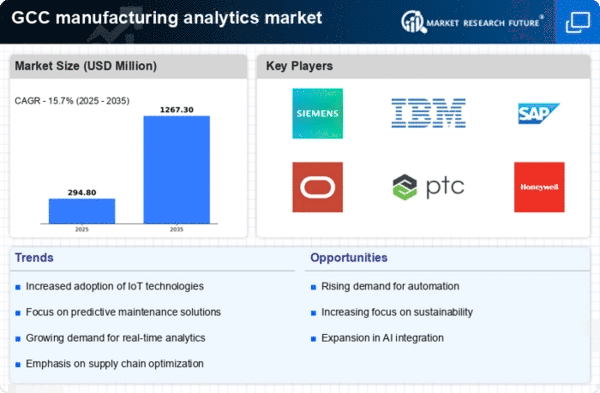
As per MRFR analysis, the GCC manufacturing analytics market size was estimated at 254.8 USD Million in 2024. The GCC manufacturing analytics market is projected to grow from 294.8 USD Million in 2025 to 1267.3 USD Million by 2035, exhibiting a compound annual growth rate (CAGR) of 15.7% during the forecast period 2025 - 2035.

Key Market Trends & Highlights

The GCC manufacturing analytics market is poised for substantial growth driven by technological advancements and evolving operational needs.

  • Integrating IoT technologies is transforming data collection and analysis in the manufacturing sector.
  • A strong focus on data security and privacy is becoming increasingly critical as manufacturers adopt advanced analytics solutions.
  • Cloud-based solutions are gaining traction, enabling manufacturers to enhance scalability and flexibility in their operations.
  • Rising demand for operational efficiency and increased investment in smart manufacturing are key drivers propelling market growth.

Market Size & Forecast

2024 Market Size 254.8 (USD Million)
2035 Market Size 1267.3 (USD Million)
CAGR (2025 - 2035) 15.7%

Major Players

Siemens (DE), IBM (US), SAP (DE), Oracle (US), PTC (US), Honeywell (US), Rockwell Automation (US), GE (US), Microsoft (US)

GCC Manufacturing Analytics Market Trends

The manufacturing analytics market is currently experiencing a transformative phase. This transformation is driven by the increasing adoption of advanced technologies and data-driven decision-making processes. In the GCC region, industries are increasingly recognizing the value of analytics in enhancing operational efficiency and optimizing production processes. This shift is largely influenced by the growing emphasis on digital transformation initiatives, which aim to integrate smart technologies into traditional manufacturing practices. As organizations seek to remain competitive, the demand for sophisticated analytics solutions is likely to rise, enabling manufacturers to harness real-time data for improved insights and strategic planning. Moreover, the focus on sustainability and resource optimization is shaping the landscape of the manufacturing analytics market. Companies are increasingly leveraging analytics to monitor energy consumption, reduce waste, and enhance supply chain management. This trend aligns with the broader goals of the GCC nations to promote sustainable industrial practices and reduce environmental impact. As a result, the manufacturing analytics market is poised for growth, with stakeholders investing in innovative solutions that facilitate data analysis and support informed decision-making. The future appears promising, as the integration of analytics into manufacturing processes continues to evolve, potentially leading to enhanced productivity and profitability for businesses in the region.

Integration of IoT Technologies

The incorporation of Internet of Things (IoT) technologies is becoming a pivotal trend within the manufacturing analytics market. By connecting machines and devices, manufacturers can collect vast amounts of data in real-time, enabling more accurate analysis and insights. This integration facilitates predictive maintenance, reduces downtime, and enhances overall operational efficiency.

Focus on Data Security and Privacy

As the reliance on data analytics increases, concerns regarding data security and privacy are also rising. Manufacturers are prioritizing the implementation of robust cybersecurity measures to protect sensitive information. This trend reflects a growing awareness of the need to safeguard data against potential breaches and ensure compliance with regulations.

Adoption of Cloud-Based Solutions

The shift towards cloud-based analytics solutions is gaining momentum in the manufacturing analytics market. These platforms offer scalability, flexibility, and cost-effectiveness, allowing manufacturers to access advanced analytics tools without significant upfront investments. This trend is particularly appealing to small and medium-sized enterprises looking to leverage data analytics for competitive advantage.

GCC Manufacturing Analytics Market Drivers

Rising Demand for Operational Efficiency

The manufacturing analytics market is experiencing a notable surge in demand for operational efficiency across various sectors in the GCC. Companies are increasingly recognizing the need to optimize their production processes to reduce waste and enhance productivity. This trend is driven by the competitive landscape, where organizations strive to maintain profitability amidst fluctuating market conditions. According to recent data, the manufacturing sector in the GCC is projected to grow at a CAGR of 5.2% from 2025 to 2030, indicating a robust appetite for analytics solutions that can streamline operations. By leveraging advanced analytics, manufacturers can identify bottlenecks, improve supply chain management, and ultimately achieve higher output levels. This focus on operational efficiency is likely to propel the growth of the manufacturing analytics market in the region.

Growing Need for Real-Time Decision Making

The manufacturing analytics market is experiencing a growing need for real-time decision-making capabilities among manufacturers in the GCC. In an era where market dynamics are constantly changing, organizations require timely insights to respond effectively to emerging challenges and opportunities. The ability to analyze data in real-time allows manufacturers to make informed decisions that can enhance operational agility and competitiveness. Recent surveys indicate that 70% of manufacturers in the GCC are prioritizing investments in analytics solutions that provide real-time data visibility. This trend underscores the importance of manufacturing analytics in enabling organizations to adapt swiftly to market demands. As the need for agility and responsiveness continues to rise, the manufacturing analytics market is likely to see sustained growth in the coming years.

Advancements in Data Analytics Technologies

The manufacturing analytics market is benefiting from rapid advancements in data analytics technologies, which are transforming how manufacturers operate in the GCC. Innovations in machine learning, artificial intelligence, and big data analytics are enabling organizations to extract actionable insights from vast amounts of data generated during production processes. These technologies facilitate predictive maintenance, quality control, and real-time monitoring, thereby enhancing overall operational performance. As manufacturers increasingly adopt these advanced analytics tools, the market is expected to expand significantly. Reports suggest that the adoption of AI-driven analytics in manufacturing could lead to a 30% reduction in downtime and a 25% increase in production efficiency. This technological evolution is likely to be a key driver for the growth of the manufacturing analytics market in the region.

Increased Investment in Smart Manufacturing

The manufacturing analytics market is witnessing a significant increase in investments in smart manufacturing initiatives within the GCC. Governments and private enterprises are allocating substantial resources to modernize their manufacturing capabilities through the adoption of advanced technologies. This shift is evident as the GCC countries aim to diversify their economies and reduce reliance on oil revenues. For instance, the UAE has committed to investing over $70 billion in smart manufacturing technologies by 2030. Such investments are expected to enhance data collection and analysis, thereby driving the demand for manufacturing analytics solutions. As manufacturers embrace automation and data-driven decision-making, the manufacturing analytics market is poised for substantial growth, reflecting the region's commitment to innovation and technological advancement.

Emphasis on Sustainability and Environmental Compliance

The manufacturing analytics market is influenced by the growing emphasis on sustainability and environmental compliance in the GCC. As regulatory frameworks become more stringent, manufacturers are compelled to adopt practices that minimize their environmental impact. This shift is prompting organizations to utilize analytics to monitor and optimize resource consumption, waste management, and emissions. Recent studies indicate that companies implementing sustainable practices can achieve cost savings of up to 20% through improved resource efficiency. Consequently, the demand for manufacturing analytics solutions that facilitate compliance with environmental regulations is likely to rise. By integrating sustainability metrics into their analytics frameworks, manufacturers can not only meet regulatory requirements but also enhance their brand reputation and appeal to environmentally conscious consumers.


Market Segment Insights

By Application: Sales Analytics (Largest) vs. Inventory Analytics (Fastest-Growing)

In the GCC manufacturing analytics market, Sales Analytics dominates the market with substantial market share due to its critical role in forecasting revenue and optimizing sales strategies. By leveraging data-driven insights, businesses can better understand customer behaviors and market dynamics, thereby enhancing their sales performance. On the other hand, Inventory Analytics is emerging swiftly, riding the wave of heightened demand for supply chain efficiency and cost reduction. This rapid growth is largely propelled by advancements in technology that facilitate real-time inventory tracking and predictive analysis. Growth trends in the application segment are being influenced by the increasing need for data integration and management solutions among manufacturers. As industries digitize, the reliance on analytics to drive decision-making becomes paramount. The growing adoption of IoT and artificial intelligence in manufacturing processes is further enhancing the capabilities of analytics applications, particularly in Inventory and Manufacturing Analytics, resulting in increased efficiencies and reduced operational costs. Moreover, the ongoing economic recovery in the region is encouraging investments in analytics solutions, positioning these applications for sustained growth.

Sales Analytics: Dominant vs. Inventory Analytics: Emerging

Sales Analytics stands as the dominant force in the GCC manufacturing analytics market, primarily due to its ability to provide actionable insights into customer preferences and sales performance. Companies utilize Sales Analytics to optimize their strategies, forecast future sales trends, and ultimately enhance profitability. Conversely, Inventory Analytics is marked as an emerging segment, rapidly gaining traction as businesses increasingly focus on reducing excess inventory and minimizing storage costs. This segment employs advanced technologies, such as machine learning, to enable real-time tracking and analysis of inventory levels. Both Sales and Inventory Analytics play critical roles in streamlining manufacturing processes and ensuring that firms remain competitive in a fast-evolving market landscape.

By Deployment Model: Cloud (Largest) vs. On-Premise (Fastest-Growing)

In the GCC manufacturing analytics market, the deployment model segment is primarily dominated by the cloud, which captures a significant share of the market due to its scalability and flexibility. Businesses are increasingly migrating to cloud-based solutions, benefiting from reduced infrastructure costs and enhanced collaboration capabilities. On-premise solutions still retain a competitive presence, particularly among industries with stringent data security requirements or legacy systems, yet they reflect a smaller portion of total market share compared to cloud services. The growth trends in this segment indicate a robust movement towards cloud solutions, driven by the proliferation of IoT devices and the need for real-time data analysis. The flexibility offered by cloud solutions is attracting manufacturers seeking to optimize their operations efficiently. Conversely, the on-premise segment is growing, albeit at a slower pace, as it is leveraged by organizations prioritizing data autonomy and control, setting a base for innovative hybrid models in the future.

Cloud (Dominant) vs. On-Premise (Emerging)

The cloud deployment model in the GCC manufacturing analytics market is characterized by its ability to provide scalable and flexible solutions that cater to various manufacturing processes. Companies are increasingly adopting cloud-based platforms to enhance operational efficiency, allowing them to access analytical tools and insights from anywhere at any time. This shift is bolstered by the rising adoption of IoT technologies, which necessitate robust, real-time data processing capabilities. In contrast, the on-premise model, while still relevant, is perceived as an emerging choice, appealing to organizations that require stringent data security and control over their infrastructure. This duality in deployment preferences highlights the evolving landscape of manufacturing analytics, where hybrid solutions might play a significant role in balancing agility and security.

By End-User Industry: Automotive (Largest) vs. Electronics (Fastest-Growing)

In the GCC manufacturing analytics market, the automotive industry holds the largest share, driven by the region's expanding car production and technological advancements in smart manufacturing solutions. The electronics sector, while smaller, is rapidly growing as digital transformation initiatives gain momentum in the region, appealing to firms looking for efficiency and innovation. The growth trends in this segment show a clear divergence, with automotive leading due to established manufacturers and increasing investments. Conversely, the electronics industry is benefiting from a surge in consumer electronics demand and automation, making it the fastest-growing segment. The focus on sustainable manufacturing practices and IoT integration are pivotal drivers for both sectors in the GCC.

Automotive: Dominant vs. Electronics: Emerging

The automotive sector is characterized by its dominance in the GCC manufacturing analytics market, supported by strong government policies to enhance local manufacturing capabilities and boost production efficiency. Key players in this domain are leveraging analytics for supply chain optimization and predictive maintenance, thus enhancing overall performance. In contrast, the electronics sector, although currently smaller, is emerging rapidly due to rising consumer demand for smart devices and the integration of IoT technologies. Analytics in electronics are focused on improving product quality and operational efficiency, making this sector a key growth area as companies seek to innovate and respond to changing market needs.

Get more detailed insights about GCC Manufacturing Analytics Market

Key Players and Competitive Insights

The manufacturing analytics market is currently characterized by a dynamic competitive landscape, driven by the increasing demand for data-driven decision-making and operational efficiency. Key players such as Siemens (DE), IBM (US), and Oracle (US) are strategically positioned to leverage their technological expertise and extensive portfolios. Siemens (DE) focuses on integrating IoT solutions with advanced analytics to enhance manufacturing processes, while IBM (US) emphasizes AI-driven insights to optimize supply chains. Oracle (US) is enhancing its cloud-based analytics capabilities, which collectively shapes a competitive environment that prioritizes innovation and digital transformation.

In terms of business tactics, companies are increasingly localizing manufacturing operations and optimizing supply chains to enhance responsiveness to market demands. The market appears moderately fragmented, with a mix of established players and emerging startups. The collective influence of these key players fosters a competitive structure that encourages continuous innovation and adaptation to evolving customer needs.

In October 2025, Siemens (DE) announced a partnership with a leading regional university to develop advanced manufacturing analytics programs. This collaboration aims to bridge the skills gap in the workforce and enhance the adoption of smart manufacturing technologies. Such initiatives are crucial as they not only bolster Siemens' market presence but also contribute to the overall growth of the manufacturing analytics ecosystem in the region.

In September 2025, IBM (US) launched a new suite of AI-powered analytics tools specifically designed for the manufacturing sector. This strategic move is significant as it positions IBM to capture a larger share of the market by addressing the growing need for predictive maintenance and operational efficiency. The integration of AI into manufacturing processes is likely to enhance productivity and reduce downtime, thereby providing a competitive edge.

In August 2025, Oracle (US) expanded its cloud infrastructure to support advanced analytics capabilities for manufacturers. This expansion is indicative of Oracle's commitment to providing scalable solutions that meet the demands of modern manufacturing environments. By enhancing its cloud offerings, Oracle is poised to attract more clients seeking to leverage data analytics for improved decision-making and operational performance.

As of November 2025, current trends in the manufacturing analytics market include a strong emphasis on digitalization, sustainability, and AI integration. Strategic alliances among key players are shaping the landscape, fostering innovation and collaboration. The competitive differentiation is likely to evolve from traditional price-based competition to a focus on technological advancements, innovation, and supply chain reliability. Companies that can effectively harness these trends will likely secure a competitive advantage in the rapidly changing market.

Key Companies in the GCC Manufacturing Analytics Market market include

Industry Developments

Siemens and Gulf Business Machines (GBM) announced a strategic partnership at COP28 in December 2023. The partnership is designed to provide Industrial IoT, automation, and OT cybersecurity solutions to the GCC countries, with a particular focus on manufacturing analytics, digital twins, and zero-trust frameworks.

Industrial 4.0 trends in the GCC during 2024 demonstrated a growing integration of AI/ML-driven predictive analytics, digital twins, and cloud-based automation platforms in manufacturing facilities. This integration enabled real-time process monitoring, anomaly detection, and adaptive control in production environments.


Future Outlook

GCC Manufacturing Analytics Market Future Outlook

The manufacturing analytics market is projected to grow at a 15.7% CAGR from 2024 to 2035, driven by advancements in IoT, AI integration, and data-driven decision-making.

New opportunities lie in:

  • Development of predictive maintenance solutions for machinery optimization.
  • Implementation of real-time analytics dashboards for operational efficiency.
  • Creation of customized analytics platforms for specific manufacturing sectors.

By 2035, the manufacturing analytics market is expected to achieve substantial growth and innovation.

Market Segmentation

GCC Manufacturing Analytics Market Application Outlook

  • Sales Analytics
  • Inventory Analytics
  • Manufacturing Analytics
  • Financial Analytics

GCC Manufacturing Analytics Market Deployment Model Outlook

  • On-Premise
  • Cloud

GCC Manufacturing Analytics Market End-User Industry Outlook

  • Automotive
  • Electronics
  • Chemicals
  • Aerospace

Report Scope

MARKET SIZE 2024254.8(USD Million)
MARKET SIZE 2025294.8(USD Million)
MARKET SIZE 20351267.3(USD Million)
COMPOUND ANNUAL GROWTH RATE (CAGR)15.7% (2024 - 2035)
REPORT COVERAGERevenue Forecast, Competitive Landscape, Growth Factors, and Trends
BASE YEAR2024
Market Forecast Period2025 - 2035
Historical Data2019 - 2024
Market Forecast UnitsUSD Million
Key Companies Profiled["Siemens (DE)", "IBM (US)", "SAP (DE)", "Oracle (US)", "PTC (US)", "Honeywell (US)", "Rockwell Automation (US)", "GE (US)", "Microsoft (US)"]
Segments CoveredApplication, Deployment Model, End-User Industry
Key Market OpportunitiesIntegration of artificial intelligence and machine learning enhances predictive maintenance in the manufacturing analytics market.
Key Market DynamicsRising demand for data-driven decision-making enhances competitive advantage in the manufacturing analytics market.
Countries CoveredGCC

Leave a Comment

FAQs

What is the expected market size of the GCC Manufacturing Analytics Market in 2024?

The GCC Manufacturing Analytics Market is expected to be valued at 91.3 USD Million in 2024.

What is the predicted market size for the GCC Manufacturing Analytics Market by 2035?

The market is anticipated to reach 219.0 USD Million by the year 2035.

What is the expected CAGR for the GCC Manufacturing Analytics Market from 2025 to 2035?

The market is projected to grow at a CAGR of 8.279 percent during the forecast period from 2025 to 2035.

Which segments of the market are expected to contribute significantly to its growth by 2035?

The software segment is expected to reach 104.3 USD Million while the services segment is projected to grow to 114.7 USD Million by 2035.

Who are the major players in the GCC Manufacturing Analytics Market?

Key competitors in this market include SAP, GE Digital, Honeywell, and IBM among others.

What market share do the leading companies hold within the GCC Manufacturing Analytics Market?

The leading companies collectively maintain a significant portion of the market, capitalizing on advanced technologies and innovative solutions.

What are the emerging trends in the GCC Manufacturing Analytics Market?

Notable trends include the increased adoption of AI-driven analytics and cloud-based solutions to enhance manufacturing processes.

What challenges might the GCC Manufacturing Analytics Market face in achieving its growth potential?

Challenges may include high integration costs and the need for skilled personnel to implement advanced analytics solutions.

How has the global scenario impacted the growth of the GCC Manufacturing Analytics Market?

Current global economic conditions and technological advancements are pushing manufacturers to adopt analytics for efficient operations.

What is the growth outlook for the GCC Manufacturing Analytics Market in the next decade?

The market is poised for robust growth, driven by increasing demand for data-driven decision-making in manufacturing sectors.

Download Free Sample

Kindly complete the form below to receive a free sample of this Report

Compare Licence

×
Features License Type
Single User Multiuser License Enterprise User
Price $4,950 $5,950 $7,250
Maximum User Access Limit 1 User Upto 10 Users Unrestricted Access Throughout the Organization
Free Customization
Direct Access to Analyst
Deliverable Format
Platform Access
Discount on Next Purchase 10% 15% 15%
Printable Versions