×
Request Free Sample ×

Kindly complete the form below to receive a free sample of this Report

Leading companies partner with us for data-driven Insights

clients tt-cursor
Hero Background

GCC Methanol Market

ID: MRFR/CnM/45600-HCR
111 Pages
Chitranshi Jaiswal
October 2025

GCC Methanol Market Research Report: By Feedstock (Natural Gas, Oil, Coal), By Derivatives (Formaldehyde, Acetic Acid, Dimethyl Ether, Others) and By End-Use Industry (Transportation, Building and Construction, Others)- Forecast to 2035

Share:
Download PDF ×

We do not share your information with anyone. However, we may send you emails based on your report interest from time to time. You may contact us at any time to opt-out.

GCC Methanol Market Infographic
Purchase Options

GCC Methanol Market Summary

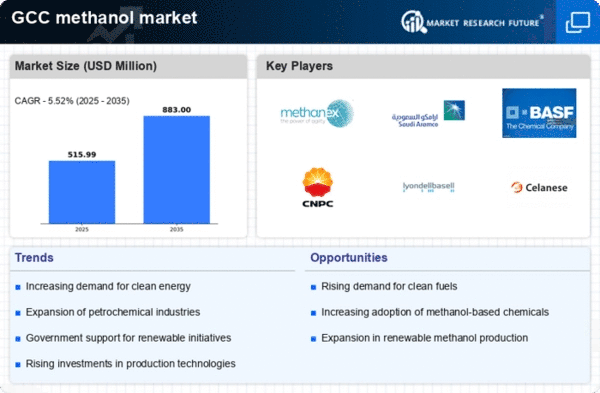
As per MRFR analysis, the GCC methanol market Size was estimated at 489.0 USD Million in 2024. The GCC methanol market is projected to grow from 515.99 USD Million in 2025 to 883.0 USD Million by 2035, exhibiting a compound annual growth rate (CAGR) of 5.52% during the forecast period 2025 - 2035.

Key Market Trends & Highlights

The GCC methanol market is experiencing a shift towards sustainable practices and increased production capacity.

  • Sustainable production practices are becoming increasingly prevalent in the GCC methanol market.
  • The largest segment in this market is the industrial applications, while the fastest-growing segment is the clean energy solutions.
  • Investment in production capacity is on the rise, driven by the need for diversification of applications.
  • Rising demand for clean energy solutions and government initiatives are key drivers propelling market growth.

Market Size & Forecast

2024 Market Size 489.0 (USD Million)
2035 Market Size 883.0 (USD Million)

Major Players

Methanex Corporation (CA), Saudi Methanol Company (SA), BASF SE (DE), China National Petroleum Corporation (CN), LyondellBasell Industries N.V. (US), Celanese Corporation (US), OCI N.V. (NL), Yara International ASA (NO), Mitsubishi Gas Chemical Company, Inc. (JP)

GCC Methanol Market Trends

The methanol market in the GCC region is currently experiencing notable developments driven by various factors. The region's strategic location and abundant natural gas resources provide a competitive advantage in methanol production. As a result, several countries within the GCC are investing in expanding their production capacities to meet both domestic and international demand. Furthermore, the increasing focus on sustainable practices and the transition towards cleaner energy sources are influencing the market dynamics. This shift is prompting manufacturers to explore innovative production methods and applications for methanol, which is being recognized for its potential as a clean fuel alternative. In addition, the methanol market is witnessing a growing interest in its use as a feedstock for the production of chemicals and plastics. The GCC's industrial landscape is evolving, with methanol being integrated into various sectors, including automotive and construction. This diversification of applications is likely to enhance the market's resilience against fluctuations in demand. Overall, the methanol market in the GCC appears poised for growth, driven by both traditional and emerging applications, as well as a commitment to sustainability and innovation in production processes.

Sustainable Production Practices

The methanol market is increasingly influenced by the adoption of sustainable production practices. Companies are exploring methods that reduce carbon emissions and enhance energy efficiency. This trend aligns with the GCC's broader environmental goals, as nations seek to diversify their economies and reduce reliance on fossil fuels. Innovations in production technology may lead to lower operational costs and improved market competitiveness.

Diversification of Applications

There is a noticeable trend towards the diversification of methanol applications within the GCC. Industries such as automotive, construction, and chemicals are increasingly utilizing methanol as a key feedstock. This expansion into various sectors not only supports market growth but also mitigates risks associated with demand fluctuations in traditional markets.

Investment in Production Capacity

Investment in production capacity remains a critical trend in the methanol market. GCC countries are actively enhancing their production facilities to meet rising demand. This strategic focus on capacity expansion is expected to strengthen the region's position as a leading methanol producer, catering to both local and international markets.

GCC Methanol Market Drivers

Growing Industrial Applications

The expansion of industrial applications for methanol is a crucial driver for the methanol market in the GCC. Methanol is increasingly utilized as a feedstock in the production of chemicals, plastics, and fuels, which are essential for various industries. The chemical sector, in particular, is projected to account for over 40% of methanol consumption by 2026. This growing demand from industrial sectors is likely to stimulate investments in methanol production facilities, thereby enhancing the overall market landscape. As industries continue to seek efficient and sustainable raw materials, the methanol market stands to benefit significantly.

Government Initiatives and Policies

Government initiatives aimed at promoting the use of alternative fuels are significantly impacting the methanol market in the GCC. Various policies are being implemented to encourage the production and consumption of methanol, which is seen as a strategic resource for energy security. For instance, subsidies and incentives for methanol production facilities are being introduced, which could lead to a 20% increase in production capacity by 2027. These supportive measures are likely to enhance the competitiveness of the methanol market, fostering innovation and attracting investments in the sector.

Increased Investment in Infrastructure

Investment in infrastructure related to methanol production and distribution is a pivotal factor influencing the methanol market in the GCC. The establishment of new production plants and distribution networks is expected to enhance supply chain efficiency. In 2025, investments in methanol infrastructure are anticipated to exceed $1 billion, reflecting the sector's growth potential. This influx of capital is likely to facilitate the development of advanced facilities capable of meeting rising demand. As infrastructure improves, the methanol market is positioned to expand its reach and enhance its competitiveness in the regional energy landscape.

Rising Demand for Clean Energy Solutions

The increasing emphasis on clean energy solutions is driving the methanol market in the GCC. As countries in the region seek to diversify their energy sources, methanol emerges as a viable alternative due to its lower emissions compared to traditional fossil fuels. The GCC's commitment to reducing carbon footprints aligns with the growing global trend towards sustainability. In 2025, the demand for methanol is projected to rise by approximately 15%, reflecting its potential as a clean energy carrier. This shift not only supports environmental goals but also positions the methanol market as a key player in the transition to greener energy systems.

Technological Advancements in Production

Technological advancements in methanol production processes are transforming the methanol market in the GCC. Innovations such as improved catalytic processes and carbon capture technologies are enhancing production efficiency and reducing costs. These advancements may lead to a reduction in production costs by up to 10%, making methanol more economically viable. Furthermore, the integration of renewable energy sources in methanol production is expected to bolster the market's growth. As these technologies continue to evolve, they are likely to create new opportunities within the methanol market, positioning it favorably in the energy landscape.


Market Segment Insights

By Application: Chemical Feedstock (Largest) vs. Fuel (Fastest-Growing)

In the GCC methanol market, the application segment showcases a diverse distribution among its values. Chemical Feedstock holds a substantial share and is recognized as the largest segment due to its critical role in producing various chemicals. Meanwhile, Fuel is rapidly gaining traction, expected to witness significant growth driven by rising energy demands and shifting preferences towards cleaner energy alternatives. The growth trends within this segment are largely influenced by the increasing industrial uses of methanol as it serves as a vital feedstock for the production of high-value chemicals. The transition towards sustainable fuels also positions Fuel as the fastest-growing application, appealing to both consumers and manufacturers as a cleaner energy source. As regulatory frameworks become more favorable, these two segments are poised for robust development in the foreseeable future.

Chemical Feedstock (Dominant) vs. Fuel (Emerging)

Chemical Feedstock is the dominant application in the GCC methanol market, primarily because it is extensively utilized in the manufacture of various chemicals, including formaldehyde and acetic acid. This segment benefits from established industrial partnerships and a steady demand from the downstream chemical production sectors. On the other hand, Fuel represents an emerging application with great potential, driven by the global push towards cleaner fuels and renewable energy sources. Methanol as a Fuel offers a lower carbon footprint and is gaining acceptance in blending applications for gasoline and as a substitute for diesel in transportation. The contrasting maturity of these segments indicates unique opportunities and challenges for stakeholders in the GCC methanol market.

By End Use Industry: Automotive (Largest) vs. Construction (Fastest-Growing)

The distribution of market share in the end use industry segment of the GCC methanol market highlights the automotive sector as the largest contributor, driven by the high demand for methanol in fuel production and as a feedstock in chemical processes. Following closely is the construction industry, which has been increasingly utilizing methanol for various applications including insulation and adhesives, showcasing substantial growth in recent years. Growth trends indicate that the automotive sector continues to dominate due to the rising adoption of methanol-blended fuels. On the other hand, the construction industry is emerging as the fastest-growing segment, propelled by various government initiatives to promote sustainable building materials. Factors such as innovations in methanol applications and increased infrastructure spending are further driving this growth, making it a pivotal area in the GCC methanol market.

Automotive (Dominant) vs. Agriculture (Emerging)

The automotive sector stands out as the dominant force in the GCC methanol market, recognizing methanol as a vital component in creating cleaner fuel alternatives and chemical intermediates. This sector benefits from robust investments in automotive technologies that promote the use of methanol fuel blends. Conversely, the agricultural segment is emerging, marking its presence through the incorporation of methanol in the production of fertilizers and pesticides. As agriculture increasingly transitions towards more efficient and environmentally friendly practices, the demand for methanol-derived products is expected to rise significantly, positioning it as an attractive growth opportunity in the region.

By Production Method: Natural Gas Reforming (Largest) vs. Biomass Gasification (Fastest-Growing)

In the GCC methanol market, the production method segment is led by Natural Gas Reforming, which holds the largest market share due to its established technology and efficiency. Other methods such as Coal Gasification and Recycling contribute to the market, but they do not match the dominance of Natural Gas Reforming. Biomass Gasification represents an emerging focus, appealing to sustainability-driven initiatives and gradually increasing its footprint in the market. Growth trends in the production method segment are significantly influenced by the shift towards sustainable practices and the increasing demand for cleaner energy sources. Biomass Gasification, in particular, has seen rapid advancements and investment due to its environmental benefits. Natural Gas Reforming continues to thrive thanks to technological improvements and cost-effectiveness, ensuring its ongoing relevance in the GCC methanol market, while other production methods adapt to meet evolving regulations and consumer preferences.

Natural Gas Reforming (Dominant) vs. Biomass Gasification (Emerging)

Natural Gas Reforming remains the dominant production method in the GCC methanol market, characterized by its high efficiency and ability to produce large volumes of methanol from natural gas sources. This method benefits from established infrastructure and technological advancements that augment its output and reduce costs. In contrast, Biomass Gasification is emerging as a competitive alternative, driven by the need for sustainable energy solutions. It converts organic materials into syngas, which can then be processed into methanol. This process appeals to environmentally conscious consumers and policymakers. However, while Biomass Gasification is gaining traction, it still represents a smaller share of the market compared to Natural Gas Reforming.

By Form: Liquid (Largest) vs. Gas (Fastest-Growing)

In the GCC methanol market, the liquid segment holds the largest share, primarily due to its extensive application in various industries such as automotive, construction, and pharmaceuticals. Meanwhile, the gas segment is rapidly gaining prominence, appealing to sectors looking for cleaner fuel alternatives. Both these forms contribute significantly to the overall dynamics of the market, capturing the interest of investors and manufacturers alike. The growth trends for these segments are shaped by increased demand for methanol in energy and chemical sectors. The liquid form benefits from established infrastructure for distribution and usage, while the gas form is driven by the rising need for sustainable and eco-friendly solutions. As regulations on emissions tighten, more industries are pivoting towards methanol in gas form, propelling its growth trajectories across the region.

Liquid (Dominant) vs. Gas (Emerging)

The liquid form of methanol stands out as the dominant segment in the GCC methanol market, characterized by its versatility and extensive utility in producing formaldehyde, acetic acid, and various chemicals. Its established infrastructure and widespread adoption in traditional applications make it a preferred choice for many industries. Conversely, the gas form is identified as an emerging segment, gaining traction primarily due to its potential as a cleaner energy source. As industries aim to reduce their carbon footprint, the gas form's role becomes increasingly vital, with innovations and investments geared towards enhancing efficiency and storage options. This duality highlights the dynamic nature of methanol consumption trends in the region.

Get more detailed insights about GCC Methanol Market

Key Players and Competitive Insights

The methanol market exhibits a dynamic competitive landscape characterized by a blend of established players and emerging entities. Key growth drivers include the increasing demand for methanol as a clean fuel alternative and its applications in the production of chemicals and plastics. Major companies such as Methanex Corporation (Canada), Saudi Methanol Company (Saudi Arabia), and BASF SE (Germany) are strategically positioned to leverage these trends. Methanex Corporation (Canada) focuses on innovation and sustainability, investing in low-carbon technologies to enhance its production processes. Meanwhile, Saudi Methanol Company (Saudi Arabia) emphasizes regional expansion and supply chain optimization, aiming to strengthen its market presence in the GCC. BASF SE (Germany) is actively pursuing partnerships to enhance its product offerings and improve operational efficiencies, thereby shaping a competitive environment that prioritizes sustainability and technological advancement.

The business tactics employed by these companies reflect a concerted effort to localize manufacturing and optimize supply chains. The market structure appears moderately fragmented, with a few dominant players exerting considerable influence. This fragmentation allows for competitive pricing strategies while fostering innovation among smaller entities. The collective actions of these key players contribute to a robust competitive framework, where agility and responsiveness to market demands are paramount.

In October 2025, Methanex Corporation (Canada) announced a strategic partnership with a leading renewable energy firm to develop a new methanol production facility powered by renewable energy sources. This initiative underscores Methanex's commitment to sustainability and positions the company to capitalize on the growing demand for green methanol, potentially enhancing its market share in the eco-conscious segment.

In September 2025, Saudi Methanol Company (Saudi Arabia) unveiled plans to expand its production capacity by 20% through the implementation of advanced manufacturing technologies. This expansion is expected to bolster the company's competitive edge by increasing output efficiency and meeting the rising demand for methanol in various industrial applications. Such strategic moves indicate a proactive approach to market dynamics and customer needs.

In August 2025, BASF SE (Germany) launched a new line of methanol-based products aimed at the automotive sector, focusing on reducing emissions and enhancing fuel efficiency. This product line not only aligns with The methanol market, potentially attracting new customers and partnerships.

As of November 2025, the competitive trends in the methanol market are increasingly defined by digitalization, sustainability, and the integration of artificial intelligence in production processes. Strategic alliances are becoming more prevalent, as companies seek to enhance their technological capabilities and market reach. The shift from price-based competition to a focus on innovation, technology, and supply chain reliability is evident, suggesting that future competitive differentiation will hinge on these factors. Companies that can effectively navigate these trends are likely to emerge as leaders in the evolving landscape.

Key Companies in the GCC Methanol Market market include

Industry Developments

Recent developments in the have showcased significant activities and growth trajectories among key players. Saudi Basic Industries Corporation reported an increase in production capacity due to enhanced operational efficiencies as of September 2023. Additionally, Qatar Methanol Company has been actively pursuing expansion initiatives aimed at boosting its market share and output levels. In notable merger and acquisition activity, National Methanol Company sought strategic partnerships to enhance its technological capabilities, with talks reported in August 2023. Furthermore, collaboration between Abu Dhabi National Oil Company and international firms has accelerated advancements in methanol production technologies.

As a result, the is witnessing a period of growth due to increased demand for methanol in fuel applications and as a feedstock for various chemical products. Over the past two years, a notable rise in methanol prices, attributed to strong demand from Asia and supply chain dynamics, has positively impacted the market valuation of several GCC companies, establishing a more competitive landscape in the region. These developments underline the ongoing transformation and potential in the GCC Methanol Market sector, reflecting its strategic importance in the energy and petrochemical industries.

GCC Methanol Market Segmentation Insights

Methanol Market Feedstock Outlook

    • Natural Gas
    • Oil
    • Coal

Methanol Market Derivatives Outlook

    • Formaldehyde
    • Acetic Acid
    • Dimethyl Ether
    • Others

Methanol Market End-Use Industry Outlook

    • Transportation
    • Building and Construction
    • Others

Future Outlook

GCC Methanol Market Future Outlook

The methanol market is projected to grow at a 5.52% CAGR from 2024 to 2035, driven by increasing demand in energy and chemical sectors.

New opportunities lie in:

  • Expansion of methanol-to-olefins (MTO) plants for enhanced production efficiency.
  • Development of renewable methanol production facilities to meet sustainability goals.
  • Investment in methanol fuel cell technology for transportation applications.

By 2035, the methanol market is expected to achieve robust growth, driven by innovation and strategic investments.

Market Segmentation

GCC Methanol Market Form Outlook

  • Liquid
  • Gas
  • Solid

GCC Methanol Market Application Outlook

  • Fuel
  • Chemical Feedstock
  • Solvent
  • Reducing Agent
  • Antifreeze

GCC Methanol Market End Use Industry Outlook

  • Automotive
  • Construction
  • Agriculture
  • Electronics
  • Pharmaceuticals

GCC Methanol Market Production Method Outlook

  • Natural Gas Reforming
  • Coal Gasification
  • Biomass Gasification
  • Recycling
  • Others

Report Scope

MARKET SIZE 2024489.0(USD Million)
MARKET SIZE 2025515.99(USD Million)
MARKET SIZE 2035883.0(USD Million)
COMPOUND ANNUAL GROWTH RATE (CAGR)5.52% (2024 - 2035)
REPORT COVERAGERevenue Forecast, Competitive Landscape, Growth Factors, and Trends
BASE YEAR2024
Market Forecast Period2025 - 2035
Historical Data2019 - 2024
Market Forecast UnitsUSD Million
Key Companies Profiled["Methanex Corporation (CA)", "Saudi Methanol Company (SA)", "BASF SE (DE)", "China National Petroleum Corporation (CN)", "LyondellBasell Industries N.V. (US)", "Celanese Corporation (US)", "OCI N.V. (NL)", "Yara International ASA (NO)", "Mitsubishi Gas Chemical Company, Inc. (JP)"]
Segments CoveredApplication, End Use Industry, Production Method, Form
Key Market OpportunitiesGrowing demand for sustainable fuels and chemicals presents opportunities in the methanol market.
Key Market DynamicsRising demand for methanol as a cleaner fuel alternative drives innovation and regulatory support in the GCC.
Countries CoveredGCC

Leave a Comment

FAQs

What is the expected market size of the GCC Methanol Market in 2024?

The GCC Methanol Market is expected to be valued at 458.32 million USD in 2024.

What is the anticipated market growth rate for the GCC Methanol Market from 2025 to 2035?

The expected compound annual growth rate, or CAGR, for the GCC Methanol Market during this period is 7.696%.

What will be the projected market size of the GCC Methanol Market by 2035?

By 2035, the overall market is projected to reach approximately 1036.0 million USD.

Which feedstock is anticipated to hold the largest market share in the GCC Methanol Market?

Natural gas is expected to dominate the feedstock segment, with a market value of 230.0 million USD in 2024.

What is the estimated market value for the oil feedstock segment in 2035?

The oil feedstock segment is expected to be valued at 322.0 million USD by 2035.

How much is the coal feedstock market expected to grow by 2035?

The coal feedstock market value is projected to reach 166.0 million USD by 2035.

Who are the key players in the GCC Methanol Market?

Major players include Saudi Methanol Company, National Methanol Company, and Abu Dhabi National Oil Company among others.

What role do emerging trends play in shaping the GCC Methanol Market?

Emerging trends such as increased demand for eco-friendly chemicals are expected to significantly shape the market landscape.

How does the regionality affect the GCC Methanol Market's growth?

The GCC region benefits from abundant natural gas resources, which positively influences the growth of the methanol market.

What opportunities and challenges does the GCC Methanol Market face?

Opportunities include rising demand for methanol derivatives, while challenges may arise from fluctuating raw material prices.

Download Free Sample

Kindly complete the form below to receive a free sample of this Report

Compare Licence

×
Features License Type
Single User Multiuser License Enterprise User
Price $4,950 $5,950 $7,250
Maximum User Access Limit 1 User Upto 10 Users Unrestricted Access Throughout the Organization
Free Customization
Direct Access to Analyst
Deliverable Format
Platform Access
Discount on Next Purchase 10% 15% 15%
Printable Versions