×
Request Free Sample ×

Kindly complete the form below to receive a free sample of this Report

* Please use a valid business email

Leading companies partner with us for data-driven Insights

clients tt-cursor
Hero Background

GCC Multimodal Ui Market

ID: MRFR/ICT/61755-HCR
200 Pages
Aarti Dhapte
October 2025

GCC Multimodal UI Market Research Report By Component (Hardware, Software, Services), By Technology (Voice Recognition, Text Input, Gesture Recognition, Visual, Others) and By End User Vertical (Automotive, Healthcare, Entertainment, IT & Telecommunication, Retail, Others) - Forecast to 2035

Share:
Download PDF ×

We do not share your information with anyone. However, we may send you emails based on your report interest from time to time. You may contact us at any time to opt-out.

GCC Multimodal Ui Market Infographic
Purchase Options

GCC Multimodal Ui Market Summary

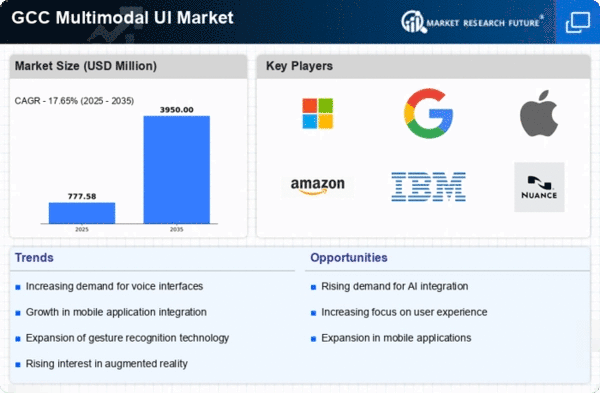
As per MRFR analysis, the GCC Multimodal UI Market Size was estimated at 660.93 USD Million in 2024. The GCC multimodal ui market is projected to grow from 777.58 USD Million in 2025 to 3950.0 USD Million by 2035, exhibiting a compound annual growth rate (CAGR) of 17.65% during the forecast period 2025 - 2035.

Key Market Trends & Highlights

The GCC multimodal UI market is experiencing robust growth driven by technological advancements and user-centric innovations.

  • The integration of AI technologies is reshaping user interactions across various platforms.
  • Voice-activated interfaces are gaining traction, particularly in the consumer electronics and automotive segments.
  • Accessibility and inclusivity are becoming focal points, enhancing user engagement and satisfaction.
  • The growing demand for enhanced user experience and advancements in natural language processing are key drivers of market expansion.

Market Size & Forecast

2024 Market Size 660.93 (USD Million)
2035 Market Size 3950.0 (USD Million)
CAGR (2025 - 2035) 17.65%

Major Players

Microsoft (US), Google (US), Apple (US), Amazon (US), IBM (US), Nuance Communications (US), Samsung Electronics (KR), Facebook (US), Alibaba Group (CN)

GCC Multimodal Ui Market Trends

The multimodal ui market is currently experiencing a notable evolution, driven by advancements in technology and changing user preferences. In the GCC region, there is a growing emphasis on integrating various input methods, such as voice, touch, and gesture, to create seamless user experiences. This shift appears to be influenced by the increasing adoption of smart devices and the demand for more intuitive interfaces. As organizations strive to enhance user engagement, the multimodal ui market is likely to expand, reflecting the diverse needs of consumers and businesses alike. Moreover, the rise of artificial intelligence and machine learning technologies is reshaping the landscape of user interfaces. These innovations enable systems to better understand user intent and context, thereby facilitating more personalized interactions. In the GCC, where digital transformation is a priority, the multimodal ui market is poised for growth as companies invest in solutions that enhance usability and accessibility. The focus on creating adaptive interfaces that cater to various user scenarios suggests a promising future for this market, as it aligns with broader trends in technology and consumer behavior.

Integration of AI Technologies

The incorporation of artificial intelligence into multimodal user interfaces is becoming increasingly prevalent. This trend allows systems to learn from user interactions, thereby improving responsiveness and personalization. In the GCC, businesses are likely to leverage AI to enhance user experiences, making interfaces more intuitive and efficient.

Rise of Voice-Activated Interfaces

Voice recognition technology is gaining traction within the multimodal ui market. Users are increasingly favoring voice commands for their convenience and efficiency. In the GCC, this trend is expected to grow as more applications and devices integrate voice capabilities, catering to a tech-savvy population.

Focus on Accessibility and Inclusivity

There is a growing emphasis on creating user interfaces that are accessible to all individuals, including those with disabilities. In the GCC, the multimodal ui market is likely to see innovations aimed at enhancing usability for diverse user groups, reflecting a commitment to inclusivity in technology.

GCC Multimodal Ui Market Drivers

Focus on Data Security and Privacy

As the multimodal ui market expands, concerns regarding data security and privacy are becoming more pronounced. Users in the GCC are increasingly aware of the risks associated with data breaches and are demanding interfaces that prioritize their security. This trend is prompting companies to invest in robust security measures and transparent data handling practices. The multimodal ui market is thus adapting to these demands by integrating advanced encryption technologies and user consent protocols. This focus on security not only builds trust among users but also positions companies favorably in a competitive landscape where privacy is paramount.

Increased Adoption of Smart Devices

The proliferation of smart devices in the GCC region is a significant driver for the multimodal ui market. As households and businesses increasingly adopt smart technologies, the demand for interfaces that can integrate multiple input methods rises. Reports indicate that the number of smart devices in the GCC is expected to exceed 100 million by 2027. This surge necessitates the development of multimodal interfaces that can seamlessly connect and interact with various devices, enhancing user convenience. Consequently, the multimodal ui market is likely to experience substantial growth as manufacturers strive to meet the evolving needs of tech-savvy consumers.

Advancements in Natural Language Processing

Natural Language Processing (NLP) technologies are rapidly evolving, significantly impacting the multimodal ui market. The ability to understand and process human language is crucial for creating interfaces that can respond to voice commands and text inputs effectively. In the GCC, investments in NLP are projected to grow by over 30% annually, indicating a robust interest in enhancing communication between users and devices. This advancement not only improves usability but also broadens the scope of applications for multimodal interfaces, making them more accessible to a wider audience. The multimodal ui market is thus positioned to benefit from these technological innovations.

Growing Demand for Enhanced User Experience

The increasing emphasis on user experience is a primary driver in the multimodal ui market. As consumers in the GCC region become more discerning, businesses are compelled to adopt interfaces that provide seamless interactions across various modalities. This demand is reflected in the projected growth of the market, which is expected to reach approximately $1.5 billion by 2026. Companies are investing in research and development to create intuitive designs that cater to diverse user preferences. The multimodal ui market is thus witnessing a shift towards more personalized and engaging user experiences, which could potentially enhance customer satisfaction and loyalty.

Government Initiatives Supporting Digital Transformation

Government initiatives aimed at fostering digital transformation in the GCC are significantly influencing the multimodal ui market. Various national strategies are being implemented to enhance technological infrastructure and promote innovation. For instance, the UAE's Vision 2021 emphasizes the importance of smart technologies and digital services. Such initiatives are likely to create a conducive environment for the growth of the multimodal ui market, as they encourage investments in cutting-edge technologies. The alignment of government policies with market needs could potentially accelerate the adoption of multimodal interfaces across various sectors, including healthcare, education, and retail.

Market Segment Insights

By Component: Hardware (Largest) vs. Software (Fastest-Growing)

In the GCC multimodal ui market, the component segment is primarily dominated by hardware, which holds a substantial share among the offerings. This category encapsulates a range of physical devices and systems essential for effective integration within multimodal interfaces. Software follows as a significant contributor, driven by the increasing reliance on advanced algorithms and applications that optimize user interaction in complex environments. Meanwhile, services play a supportive role, enhancing the overall system's usability and efficiency. Growth trends in this component segment are strongly influenced by the rapid advancements in hardware technologies and increasing software innovations. The hardware segment is seeing a surge as organizations seek robust and reliable devices to manage their multimodal operations. On the other hand, software is emerging as the fastest-growing part of the segment, propelled by developments in artificial intelligence and machine learning, enabling more intuitive interfaces and improved user experiences in the GCC multimodal ui landscape.

Hardware: Dominant vs. Software: Emerging

The hardware segment in the GCC multimodal ui market stands as the dominant force, characterized by its extensive adoption across various industries for seamless integration and performance. These tangible components, including terminals, sensors, and other devices, are crucial for supporting multimodal communication and operations. In parallel, the software segment is gaining ground as an emerging player, marked by its rapid evolution to incorporate advanced functionalities that enhance user interaction. Software solutions are increasingly tailored to meet specific industry needs, showcasing flexibility and adaptability, which further contribute to their growth. Both segments are vital, yet they serve distinct roles; hardware establishes the foundation while software drives innovation and responsiveness in the user experience.

By Technology: Voice Recognition (Largest) vs. Gesture Recognition (Fastest-Growing)

In the GCC multimodal ui market, the distribution of market share among the technology segment values indicates that Voice Recognition holds the largest share, driven by its widespread adoption in various applications including customer service and personal assistant technologies. Other segments, such as Text Input and Visual, contribute to the market dynamics but maintain a smaller share compared to Voice Recognition. Gesture Recognition, while currently smaller, is gaining traction due to increasing interest in hands-free interfaces and enhanced user experience. Growth trends in the GCC multimodal ui market are primarily influenced by advancements in AI and machine learning technologies. The demand for more intuitive and efficient user interfaces is pushing innovation in Gesture Recognition, positioning it as the fastest-growing segment. Meanwhile, the robust presence of Voice Recognition is anticipated to continue, as it becomes more integrated into smart homes and mobile devices. The focus on improving user engagement and accessibility across devices will further propel these segments forward.

Technology: Voice Recognition (Dominant) vs. Gesture Recognition (Emerging)

Voice Recognition is characterized by its capability to process and interpret human speech, making it essential for applications like virtual assistants and customer interaction tools. Its dominance in the market is bolstered by the growing preference among users for voice-controlled devices. Gesture Recognition, on the other hand, represents an emerging technology that allows users to interact with devices through physical movements. This segment is gaining importance as developers seek innovative ways to enhance user engagement and accessibility. The growing implementation of gesture-based controls in gaming, telecommunications, and healthcare showcases its potential to reshape user interfaces. As technology evolves, both segments are expected to complement each other, with Voice Recognition maintaining its lead while Gesture Recognition rapidly expands its presence.

By End Use Vertical: Automotive (Largest) vs. Healthcare (Fastest-Growing)

The market share distribution among various segments in the GCC multimodal ui market reveals a strong preference for the automotive sector, which holds the largest share due to the increasing demand for innovative transportation solutions. Following closely, the healthcare sector is gaining traction, motivated by advancements in medical technology and increased investments in health services, allowing it to emerge as a prominent contender in the market scene. Growth trends highlight the automotive segment's dominance, supported by rising consumer expectations for connected vehicles and advanced features. Conversely, the healthcare sector is experiencing rapid growth driven by the rise of telemedicine, electronic health records, and the need for efficient healthcare delivery solutions, indicating a shift in focus towards technology integration in healthcare practices and expanding the customer base significantly.

Automotive: Dominant vs. Healthcare: Emerging

The automotive segment is characterized by its substantial footprint in the GCC multimodal ui market, leveraging innovation and consumer demand for smart vehicles. This segment is focused on enhancing user experience through integrated interfaces that improve safety and convenience, establishing itself as the dominant force in the market. Meanwhile, healthcare is deemed an emerging vertical, fueled by digital transformation and a growing emphasis on telehealth services. This sector aims to optimize patient care through advancements in multimodal user interfaces, thus attracting significant investments and partnerships, eager to introduce automated solutions and improve accessibility. The interplay between traditional automotive solutions and burgeoning healthcare applications demonstrates the dynamic evolution of the GCC multimodal ui market.

Get more detailed insights about GCC Multimodal Ui Market

Key Players and Competitive Insights

The multimodal UI market is currently characterized by a dynamic competitive landscape, driven by rapid technological advancements and increasing consumer demand for integrated user experiences. Key players such as Microsoft (US), Google (US), and Amazon (US) are at the forefront, each adopting distinct strategies to enhance their market positioning. Microsoft (US) focuses on innovation through its Azure cloud services, which facilitate seamless integration of multimodal interfaces across various devices. Google (US), on the other hand, emphasizes partnerships, particularly in the realm of AI, to enhance its Google Assistant capabilities, thereby improving user interaction. Amazon (US) leverages its extensive ecosystem, integrating multimodal functionalities into its Alexa platform, which is pivotal for maintaining its competitive edge in smart home technology.

The business tactics employed by these companies reflect a concerted effort to optimize supply chains and localize manufacturing, which are essential in a moderately fragmented market. This competitive structure allows for a diverse range of offerings, yet the influence of major players remains substantial. The collective strategies of these companies not only shape market dynamics but also set benchmarks for emerging players, fostering an environment where innovation is paramount.

In September 2025, Microsoft (US) announced a strategic partnership with a leading automotive manufacturer to integrate its multimodal UI technology into next-generation vehicles. This move is significant as it positions Microsoft (US) at the intersection of automotive innovation and user experience, potentially transforming how consumers interact with their vehicles. The collaboration is expected to enhance in-car experiences, making them more intuitive and responsive to user needs.

In October 2025, Google (US) unveiled an upgraded version of its Google Assistant, which now incorporates advanced multimodal capabilities, allowing users to interact through voice, touch, and visual cues. This enhancement is crucial as it reflects Google's commitment to staying ahead in the AI-driven market, catering to the evolving preferences of consumers who seek more interactive and engaging interfaces. The integration of these features is likely to bolster user retention and attract new customers.

In August 2025, Amazon (US) expanded its Alexa platform by introducing a multimodal interface that allows users to control smart home devices through a combination of voice commands and visual displays. This strategic enhancement is indicative of Amazon's focus on creating a cohesive ecosystem that enhances user convenience and satisfaction. By integrating these functionalities, Amazon (US) aims to solidify its position as a leader in the smart home market, where user experience is increasingly becoming a differentiating factor.

As of November 2025, the competitive trends in the multimodal UI market are heavily influenced by digitalization, sustainability, and AI integration. Strategic alliances among key players are shaping the landscape, fostering innovation and enhancing product offerings. The shift from price-based competition to a focus on technological advancement and supply chain reliability is evident. Companies are likely to continue differentiating themselves through innovative solutions that prioritize user experience, suggesting a future where competitive advantage hinges on the ability to adapt and innovate in response to consumer demands.


Key Companies in the GCC Multimodal Ui Market market include

Industry Developments

The GCC Multimodal User Interface Market has been experiencing significant growth and transformation. Recent developments indicate increasing investments by major companies such as Oracle, Google, and Microsoft in advanced technologies to enhance user experience. In particular, major partnerships have been formed to leverage Artificial Intelligence and machine learning in their solutions. Notably, in June 2023, Accenture announced a strategic acquisition to strengthen its digital transformation capabilities within the region, further establishing its presence in the GCC. Additionally, in September 2023, SAP and Cisco collaborated to provide integrated solutions that streamline operations and improve efficiency for clients. 

The ongoing digitalization strategies being implemented by GCC governments in response to global trends are significantly contributing to market expansion, with initiatives targeting smart city projects and enhanced connectivity. The demand for next-generation interfaces is intensifying as firms strive to enhance customer engagement and operational efficiency. Moreover, the rise in remote work and digital services is further propelling investments in technology, indicating a robust growth trajectory for the Multimodal User Interface Market across the GCC region.

Future Outlook

GCC Multimodal Ui Market Future Outlook

The multimodal UI market is projected to grow at a 17.65% CAGR from 2024 to 2035, driven by advancements in AI, increased user demand, and integration of diverse interfaces.

New opportunities lie in:

  • Development of AI-driven voice recognition systems for enhanced user interaction.
  • Integration of augmented reality features in multimodal applications.
  • Expansion of multimodal platforms for smart home automation solutions.

By 2035, the multimodal UI market is expected to achieve substantial growth and innovation.

Market Segmentation

GCC Multimodal Ui Market Component Outlook

  • Hardware
  • Software
  • Services

GCC Multimodal Ui Market Technology Outlook

  • Voice Recognition
  • Text Input
  • Gesture Recognition
  • Visual
  • Others

GCC Multimodal Ui Market End Use Vertical Outlook

  • Automotive
  • Healthcare
  • Entertainment
  • IT & Telecommunication
  • Retail
  • Others

Report Scope

MARKET SIZE 2024 660.93(USD Million)
MARKET SIZE 2025 777.58(USD Million)
MARKET SIZE 2035 3950.0(USD Million)
COMPOUND ANNUAL GROWTH RATE (CAGR) 17.65% (2024 - 2035)
REPORT COVERAGE Revenue Forecast, Competitive Landscape, Growth Factors, and Trends
BASE YEAR 2024
Market Forecast Period 2025 - 2035
Historical Data 2019 - 2024
Market Forecast Units USD Million
Key Companies Profiled Microsoft (US), Google (US), Apple (US), Amazon (US), IBM (US), Nuance Communications (US), Samsung Electronics (KR), Facebook (US), Alibaba Group (CN)
Segments Covered Component, Technology, End Use Vertical
Key Market Opportunities Integration of artificial intelligence enhances user experience in the multimodal ui market.
Key Market Dynamics Rising demand for seamless user experiences drives innovation in multimodal user interface technologies across various sectors.
Countries Covered GCC

Leave a Comment

FAQs

What is the expected market size of the GCC Multimodal UI Market in 2024?

The GCC Multimodal UI Market is expected to be valued at 650.48 million USD in 2024.

What is the projected market size for the GCC Multimodal UI Market by 2035?

By 2035, the GCC Multimodal UI Market is anticipated to reach a value of 2171.95 million USD.

What is the expected CAGR for the GCC Multimodal UI Market from 2025 to 2035?

The GCC Multimodal UI Market is expected to experience a CAGR of 11.584% from 2025 to 2035.

What are the key components of the GCC Multimodal UI Market?

The market is segmented into hardware, software, and services.

What is the projected value of the hardware segment in 2035?

The hardware segment of the GCC Multimodal UI Market is projected to be valued at 518.25 million USD in 2035.

What revenue does the software segment of the market expect in 2024?

In 2024, the software segment of the GCC Multimodal UI Market is estimated to be valued at 250 million USD.

Who are the major players in the GCC Multimodal UI Market?

Key players in the market include Oracle, Google, Accenture, Atos, Cisco, SAP, Capgemini, Salesforce, IBM, Infosys, Wipro, Microsoft, TCS, and Hewlett Packard Enterprise.

What is the expected value of the services segment in 2035?

The services segment of the GCC Multimodal UI Market is forecasted to reach a value of 718.23 million USD by 2035.

What opportunities are present in the GCC Multimodal UI Market?

The market presents opportunities in the growing demand for innovative user interfaces across various sectors.

What challenges may the GCC Multimodal UI Market face in the coming years?

The market may face challenges related to rapid technological changes and the need for continuous adaptation to evolving user preferences.

Download Free Sample

Kindly complete the form below to receive a free sample of this Report

Compare Licence

×
Features License Type
Single User Multiuser License Enterprise User
Price $4,950 $5,950 $7,250
Maximum User Access Limit 1 User Upto 10 Users Unrestricted Access Throughout the Organization
Free Customization
Direct Access to Analyst
Deliverable Format
Platform Access
Discount on Next Purchase 10% 15% 15%
Printable Versions