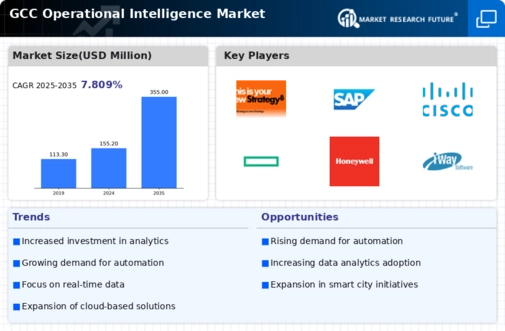
The operational intelligence market is currently characterized by a dynamic competitive landscape, driven by the increasing demand for real-time data analytics and decision-making capabilities. Key players such as IBM (AE), SAP (AE), and Microsoft (AE) are strategically positioning themselves through innovation and partnerships. IBM (AE) focuses on integrating AI and machine learning into its operational intelligence solutions, enhancing predictive analytics capabilities. Meanwhile, SAP (AE) emphasizes regional expansion and digital transformation, aiming to provide tailored solutions that meet the specific needs of GCC businesses. Microsoft (AE) leverages its cloud infrastructure to offer scalable operational intelligence solutions, thereby enhancing its competitive edge in the market. Collectively, these strategies contribute to a robust competitive environment, fostering innovation and collaboration among market participants.
In terms of business tactics, companies are increasingly localizing their operations to better serve the GCC market. This includes optimizing supply chains and establishing regional data centers to ensure compliance with local regulations. The market structure appears moderately fragmented, with several key players exerting influence while also facing competition from emerging startups. The collective actions of these established companies shape the market dynamics, as they strive to maintain their market share while adapting to evolving customer demands.
In November 2025, IBM (AE) announced a strategic partnership with a leading regional telecommunications provider to enhance its operational intelligence offerings. This collaboration aims to integrate advanced analytics into telecommunications infrastructure, enabling real-time insights for network optimization. The strategic importance of this partnership lies in its potential to drive innovation in the telecommunications sector, positioning IBM (AE) as a leader in operational intelligence solutions tailored for this industry.
In October 2025, SAP (AE) launched a new suite of operational intelligence tools specifically designed for the manufacturing sector in the GCC. This initiative reflects SAP's commitment to digital transformation and its focus on providing industry-specific solutions. The launch is significant as it addresses the unique challenges faced by manufacturers in the region, thereby enhancing operational efficiency and productivity.
In September 2025, Microsoft (AE) expanded its Azure cloud services in the GCC, introducing new features aimed at improving data analytics capabilities for businesses. This expansion is crucial as it allows organizations to leverage advanced analytics tools, fostering a data-driven culture. The move underscores Microsoft's strategy to enhance its cloud offerings, thereby solidifying its position in the operational intelligence market.
As of December 2025, current trends in the operational intelligence market include a strong emphasis on digitalization, sustainability, and AI integration. Strategic alliances are increasingly shaping the competitive landscape, as companies seek to combine their strengths to deliver comprehensive solutions. Looking ahead, competitive differentiation is likely to evolve, with a shift from price-based competition to a focus on innovation, technology, and supply chain reliability. This transition suggests that companies that prioritize these aspects will be better positioned to thrive in the rapidly changing market.






























Leave a Comment