×
Request Free Sample ×

Kindly complete the form below to receive a free sample of this Report

Leading companies partner with us for data-driven Insights

clients tt-cursor
Hero Background

GCC Telecom Analytics Market

ID: MRFR/ICT/62044-HCR
200 Pages
Aarti Dhapte
October 2025

GCC Telecom Analytics Market Research Report By Analytics Type (Customer Analytics, Network Analytics, Subscriber Analytics, Location Analytics, Price Analytics, Service Analytic), By Solution (Customer Management, Network Management, Marketing Management, Sales & Distribution, Others), By Services (Professional Services, Managed Services) and By Deployment Models (On-Premise, Cloud-Based)-Forecast to 2035

Share:
Download PDF ×

We do not share your information with anyone. However, we may send you emails based on your report interest from time to time. You may contact us at any time to opt-out.

GCC Telecom Analytics Market Infographic
Purchase Options

GCC Telecom Analytics Market Summary

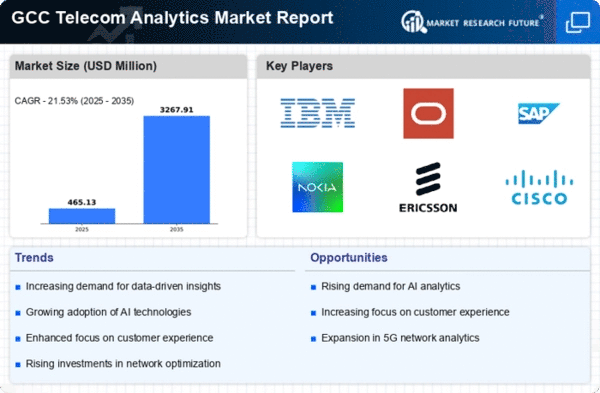
As per MRFR analysis, the GCC telecom analytics market Size was estimated at 382.72 USD Million in 2024. The telecom analytics market is projected to grow from 465.13 USD Million in 2025 to 3267.91 USD Million by 2035, exhibiting a compound annual growth rate (CAGR) of 21.53% during the forecast period 2025 - 2035.

Key Market Trends & Highlights

The GCC telecom analytics market is poised for substantial growth driven by technological advancements and evolving consumer demands.

  • The market is witnessing increased adoption of AI and machine learning technologies to enhance data analytics capabilities.
  • Customer experience enhancement remains a focal point, with telecom operators striving to deliver personalized services.
  • The integration of IoT technologies is emerging as a key trend, particularly in the largest segment of network analytics.
  • Rising demand for data-driven insights and the emergence of 5G technology are significant drivers propelling market growth.

Market Size & Forecast

2024 Market Size 382.72 (USD Million)
2035 Market Size 3267.91 (USD Million)

Major Players

IBM (US), Oracle (US), SAP (DE), Nokia (FI), Ericsson (SE), Cisco (US), Amdocs (IL), TIBCO Software (US), ZTE (CN)

GCC Telecom Analytics Market Trends

The telecom analytics market is currently experiencing a transformative phase. This phase is driven by the increasing demand for data-driven decision-making among telecom operators. As the region's telecommunications infrastructure continues to evolve, operators are increasingly leveraging analytics to enhance operational efficiency, improve customer experience, and optimize network performance. The integration of advanced technologies such as artificial intelligence and machine learning into analytics solutions appears to be a key factor in this evolution. Moreover, the growing emphasis on customer-centric strategies is prompting telecom companies to invest in analytics tools that provide deeper insights into consumer behavior and preferences. In addition, regulatory frameworks in the GCC are evolving to support the adoption of innovative technologies within the telecom sector. This regulatory support, combined with a competitive landscape, is likely to foster an environment conducive to the growth of the telecom analytics market. As operators seek to differentiate themselves, the ability to harness data effectively will be paramount. The ongoing digital transformation initiatives across the region further indicate a robust future for analytics solutions, as telecom companies strive to remain agile and responsive to market dynamics. Overall, the telecom analytics market is poised for substantial growth, driven by technological advancements and a focus on enhancing customer engagement.

Increased Adoption of AI and Machine Learning

Telecom operators are increasingly integrating artificial intelligence and machine learning into their analytics frameworks. This trend enables more sophisticated data analysis, allowing for predictive insights that can enhance operational efficiency and customer satisfaction.

Focus on Customer Experience Enhancement

There is a growing emphasis on utilizing analytics to improve customer experience. Telecom companies are leveraging data to understand customer preferences and behaviors, which helps in tailoring services and improving retention rates.

Regulatory Support for Innovation

The evolving regulatory landscape in the GCC is fostering innovation within the telecom sector. Supportive policies are encouraging telecom operators to adopt advanced analytics solutions, thereby driving market growth.

GCC Telecom Analytics Market Drivers

Emergence of 5G Technology

The rollout of 5G technology is poised to transform the telecom analytics market in the GCC. With its promise of ultra-fast connectivity and low latency, 5G is expected to generate unprecedented volumes of data. Telecom operators are increasingly investing in analytics solutions to harness this data effectively. By 2025, the telecom analytics market is anticipated to expand by approximately 25%, driven by the need for real-time analytics to manage 5G networks. This technology enables operators to gain insights into network performance, user behavior, and service quality, thereby enhancing customer experiences. The ability to analyze data in real-time is becoming essential for telecom companies to remain competitive in the evolving landscape of the telecom analytics market.

Enhanced Regulatory Frameworks

The establishment of enhanced regulatory frameworks is positively impacting the telecom analytics market. In the GCC, regulatory bodies are increasingly supporting innovation and the adoption of advanced analytics solutions. This supportive environment encourages telecom operators to invest in analytics capabilities, fostering competition and improving service quality. The telecom analytics market is expected to benefit from these regulatory advancements, with a projected growth rate of 12% as companies align their strategies with regulatory requirements. By adhering to these frameworks, telecom operators can ensure compliance while leveraging analytics to enhance customer experiences and operational performance. Thus, regulatory support is emerging as a crucial driver in the telecom analytics market.

Focus on Operational Efficiency

A growing emphasis on operational efficiency is shaping the telecom analytics market. Telecom operators in the GCC are increasingly adopting analytics solutions to streamline their operations and reduce costs. By leveraging data analytics, companies can identify inefficiencies, optimize resource allocation, and enhance service delivery. The telecom analytics market is projected to grow at a rate of 18% as operators seek to improve their bottom line through data-driven strategies. This focus on efficiency not only helps in cost reduction but also enables telecom companies to respond swiftly to market changes and customer demands. As a result, operational efficiency is becoming a key driver of growth in the telecom analytics market.

Integration of IoT Technologies

The integration of Internet of Things (IoT) technologies is significantly influencing the telecom analytics market. As IoT devices proliferate across the GCC, telecom operators are compelled to adopt advanced analytics solutions to manage the influx of data generated by these devices. The telecom analytics market is expected to witness a growth rate of around 20% in the coming years, as operators utilize analytics to monitor device performance, optimize resource allocation, and enhance service offerings. This integration not only improves operational efficiency but also enables telecom companies to create new revenue streams through innovative IoT-based services. Consequently, the ability to analyze and interpret data from IoT devices is becoming a critical component of success in the telecom analytics market.

Rising Demand for Data-Driven Insights

The telecom analytics market is experiencing a surge in demand for data-driven insights, particularly within the GCC region. As telecom operators seek to optimize their operations and enhance service delivery, the reliance on analytics tools has become paramount. In 2025, the market is projected to grow at a CAGR of approximately 15%, driven by the need for actionable intelligence derived from vast data sets. This trend is indicative of a broader shift towards data-centric decision-making, where telecom companies leverage analytics to improve network performance and customer satisfaction. The increasing complexity of telecom networks necessitates sophisticated analytics solutions, which are essential for identifying trends, predicting customer behavior, and ultimately driving revenue growth in the telecom analytics market.


Market Segment Insights

By Type: Customer Analytics (Largest) vs. Network Analytics (Fastest-Growing)

In the segment of the GCC telecom analytics market, Customer Analytics holds the largest market share, reflecting the growing importance of understanding consumer behavior and preferences. This segment is critical as telecom companies leverage data analytics to enhance customer experiences, streamline services, and tailor offerings. Conversely, Network Analytics is emerging as the fastest-growing segment, driven by the increasing demand for optimizing network performance and ensuring service reliability. The growth trends in these segments are influenced by the rising digitalization and the need for telecom operators to innovate continuously. Customer Analytics is primarily driven by the need for personalized customer engagement and retention strategies. On the other hand, Network Analytics is benefiting from advancements in AI and machine learning, allowing for predictive insights that enhance operational efficiencies and reduce costs.

Subscriber Analytics (Dominant) vs. Price Analytics (Emerging)

Subscriber Analytics is a dominant force within the GCC telecom analytics market, focusing on the in-depth analysis of subscriber behavior, usage patterns, and churn prediction. This segment is essential for operators aiming to maximize customer lifetime value and optimize their service offerings. Meanwhile, Price Analytics is emerging as a vital component as telecom companies explore innovative pricing strategies to remain competitive in a saturated market. It enables operators to analyze pricing models and consumer response, supporting effective revenue management and enhancing profitability. The interplay between these two segments highlights the importance of subscriber insights while also addressing the financial dynamics of service delivery.

By Solution: Customer Management (Largest) vs. Network Management (Fastest-Growing)

The GCC telecom analytics market exhibits a diverse solution segment, with Customer Management commanding the largest market share. This segment encompasses tools that enhance customer interaction and service delivery, thereby leading in adoption. Following closely is Network Management, which focuses on optimizing and managing telecom networks, rapidly gaining traction due to growing demand for efficient network performance. Growth trends indicate a significant shift towards advanced analytics in Network Management as telecom operators seek to improve operational efficiency and customer satisfaction. The emergence of AI-driven insights is driving this trend, making Network Management a priority. As competition intensifies, telecom companies are investing in solutions that provide predictive capabilities and enhance user experiences, marking it as the fastest-growing segment in the current market landscape.

Customer Management (Dominant) vs. Sales & Distribution (Emerging)

In the GCC telecom analytics market, Customer Management remains a dominant force, ensuring operators deliver superior customer experiences through targeted analytics and engagement strategies. This solution leverages data analytics to understand customer behavior and optimize service offerings. Conversely, Sales & Distribution is identified as an emerging segment, focusing on streamlining sales processes and enhancing distribution strategies through analytics. As companies increasingly recognize the importance of aligning sales initiatives with analytics-driven insights, this segment is swiftly evolving. With advancements in technology, the integration of analytics in Sales & Distribution is expected to drive market adaptation, enhancing efficiency and competitiveness within the industry.

By Services: Professional Services (Largest) vs. Managed Services (Fastest-Growing)

In the GCC telecom analytics market, Professional Services dominate the market share due to their established presence and comprehensive offerings. This segment includes consulting, system integration, and training services, making it critical for telecom companies striving for operational efficiency and enhanced customer experience. Managed Services, while smaller in share, are quickly gaining traction as telecom operators seek to outsource non-core functionalities, allowing them to focus on strategic initiatives to enhance competitiveness. The growth of the Managed Services segment is being driven by an increasing need for telecom operators to adopt advanced technologies and manage complex infrastructures. Factors like the rise of cloud-based solutions, the need for agile operations, and a heightened focus on cybersecurity are propelling this segment forward. Additionally, a shift in consumer expectations for seamless connectivity and enhanced service quality is leading telecom companies to invest more in managed solutions, positioning this segment as the fastest-growing area within the market.

Professional Services: Dominant vs. Managed Services: Emerging

Professional Services in the GCC telecom analytics market have proven to be indispensable for companies looking to streamline their operations and implement new technologies. Known for their expertise in various domains, these services encompass strategy formulation, operational management, and customer engagement techniques, aligning closely with the evolving demands of the market. On the other hand, Managed Services are emerging rapidly, with telecom operators increasingly opting for outsourced solutions that offer flexibility and cost savings. While initially perceived as supplementary, Managed Services are becoming vital for maintaining competitive edge as they facilitate access to innovative technologies and specialized skills without the burden of significant initial investments.

By Deployment Models: Cloud-Based (Largest) vs. On-Premise (Fastest-Growing)

In the GCC telecom analytics market, the distribution of market share between deployment models showcases that cloud-based solutions command the largest presence, appealing to telecom providers seeking flexibility and scalable solutions. Conversely, on-premise deployment is gaining momentum, especially among enterprises with strict data sovereignty and privacy policies, reflecting a significant shift in preferences within the industry. Growth trends indicate that while cloud-based solutions leverage the growing demand for remote accessibility and cost reduction, on-premise models are emerging robustly due to enhanced security requirements. The uptick in digital transformation initiatives among telecom companies is further contributing to the heightened interest in on-premise solutions, marking a pivotal point in the strategic deployment choices of the sector.

Deployment Models: Cloud-Based (Dominant) vs. On-Premise (Emerging)

Cloud-based deployment models are currently the dominant force in the GCC telecom analytics market, characterized by their ability to provide scalable, cost-effective solutions that meet the dynamic needs of telecom operators. This model is particularly favored for its ease of integration with existing platforms and the ongoing trend towards digital transformation. In contrast, the emerging on-premise segment is gaining traction, with organizations prioritizing data security and compliance. This model provides a robust framework for managing sensitive customer data and offers greater control over operational infrastructure, making it attractive for enterprises with stringent regulatory requirements.

Get more detailed insights about GCC Telecom Analytics Market

Key Players and Competitive Insights

The telecom analytics market is currently characterized by a dynamic competitive landscape, driven by rapid technological advancements and increasing demand for data-driven decision-making. Key players such as IBM (US), Oracle (US), and Nokia (FI) are strategically positioning themselves through innovation and partnerships. IBM (US) focuses on integrating AI and machine learning into its analytics solutions, enhancing predictive capabilities for telecom operators. Oracle (US) emphasizes cloud-based analytics, enabling scalability and flexibility for its clients. Meanwhile, Nokia (FI) is investing in 5G analytics, which is crucial for optimizing network performance and customer experience. Collectively, these strategies foster a competitive environment that prioritizes technological innovation and customer-centric solutions.

In terms of business tactics, companies are increasingly localizing their operations to better serve regional markets, which appears to enhance responsiveness to local demands. The market structure is moderately fragmented, with several players vying for market share, yet the influence of major companies remains substantial. This competitive structure allows for a diverse range of offerings, catering to various segments within the telecom analytics market.

In October 2025, IBM (US) announced a partnership with a leading telecom operator to deploy its AI-driven analytics platform, aimed at improving customer engagement and operational efficiency. This strategic move underscores IBM's commitment to leveraging advanced technologies to meet the evolving needs of telecom providers. The partnership is expected to enhance the operator's ability to analyze customer data in real-time, thereby facilitating more personalized service offerings.

In September 2025, Oracle (US) launched a new suite of cloud-based analytics tools specifically designed for telecom companies. This initiative reflects Oracle's strategy to capitalize on the growing trend of digital transformation within the industry. By providing scalable solutions, Oracle aims to empower telecom operators to harness their data more effectively, potentially leading to improved decision-making and operational efficiencies.

In August 2025, Nokia (FI) unveiled its latest 5G analytics solution, which integrates advanced data analytics capabilities to optimize network performance. This development is particularly significant as it aligns with the increasing demand for high-speed connectivity and enhanced user experiences. Nokia's focus on 5G analytics positions it as a leader in the market, likely enabling telecom operators to better manage their networks and improve service delivery.

As of November 2025, current trends in the telecom analytics market include a strong emphasis on digitalization, sustainability, and the integration of AI technologies. Strategic alliances are increasingly shaping the competitive landscape, as companies recognize the value of collaboration in driving innovation. Looking ahead, it appears that competitive differentiation will evolve, shifting from traditional price-based competition to a focus on technological innovation, supply chain reliability, and the ability to deliver tailored solutions. This transition may redefine how companies compete, emphasizing the importance of agility and responsiveness in a rapidly changing market.

Key Companies in the GCC Telecom Analytics Market market include

Future Outlook

GCC Telecom Analytics Market Future Outlook

The Telecom Analytics Market is projected to grow at 21.53% CAGR from 2024 to 2035, driven by increasing data consumption, IoT integration, and demand for enhanced customer insights.

New opportunities lie in:

  • Development of AI-driven predictive maintenance tools for network optimization.
  • Implementation of real-time analytics platforms for customer experience enhancement.
  • Creation of tailored analytics solutions for emerging 5G applications.

By 2035, The telecom analytics market is expected to achieve significant innovation.

Market Segmentation

GCC Telecom Analytics Market Type Outlook

  • Customer Analytics
  • Network Analytics
  • Subscriber Analytics
  • Location Analytics
  • Price Analytics
  • Service Analytics

GCC Telecom Analytics Market Services Outlook

  • Professional Services
  • Managed Services

GCC Telecom Analytics Market Solution Outlook

  • Customer Management
  • Network Management
  • Marketing Management
  • Sales & Distribution
  • Others

GCC Telecom Analytics Market Deployment Models Outlook

  • On-Premise
  • Cloud-Based

Report Scope

MARKET SIZE 2024 382.72(USD Million)
MARKET SIZE 2025 465.13(USD Million)
MARKET SIZE 2035 3267.91(USD Million)
COMPOUND ANNUAL GROWTH RATE (CAGR) 21.53% (2024 - 2035)
REPORT COVERAGE Revenue Forecast, Competitive Landscape, Growth Factors, and Trends
BASE YEAR 2024
Market Forecast Period 2025 - 2035
Historical Data 2019 - 2024
Market Forecast Units USD Million
Key Companies Profiled IBM (US), Oracle (US), SAP (DE), Nokia (FI), Ericsson (SE), Cisco (US), Amdocs (IL), TIBCO Software (US), ZTE (CN)
Segments Covered Type, Solution, Services, Deployment Models
Key Market Opportunities Integration of artificial intelligence enhances predictive analytics capabilities in the telecom analytics market.

Key Market Dynamics Growing demand for data-driven insights drives innovation and competition in the telecom analytics market.
Countries Covered GCC

Leave a Comment

FAQs

What is the expected market size of the GCC Telecom Analytics Market in 2024?

The GCC Telecom Analytics Market is expected to be valued at 97.35 million USD in 2024.

What will be the market size of the GCC Telecom Analytics Market by 2035?

By 2035, the GCC Telecom Analytics Market is anticipated to reach a valuation of 685.76 million USD.

What is the expected CAGR for the GCC Telecom Analytics Market from 2025 to 2035?

The anticipated CAGR for the GCC Telecom Analytics Market from 2025 to 2035 is 19.419 percent.

What are some of the major players in the GCC Telecom Analytics Market?

Key players in the GCC Telecom Analytics Market include Bahrain Telecommunications Company, Ooredoo, Etisalat, DU, Vodafone Qatar, and Mobily.

What was the market value for Customer Analytics in 2024?

In 2024, the market value for Customer Analytics in the GCC Telecom Analytics Market was 22.0 million USD.

What is the projected market value for Subscriber Analytics in 2035?

The projected market value for Subscriber Analytics in the GCC Telecom Analytics Market by 2035 is 158.7 million USD.

How much is the Network Analytics segment expected to grow by 2035?

The Network Analytics segment is expected to grow to 129.99 million USD by 2035.

What was the market value for Location Analytics in 2024?

In 2024, Location Analytics was valued at 18.0 million USD in the GCC Telecom Analytics Market.

What are the growth drivers for the GCC Telecom Analytics Market?

Key growth drivers for the GCC Telecom Analytics Market include increasing demand for data-driven insights and advancements in telecommunications technology.

What challenges does the GCC Telecom Analytics Market face?

Challenges for the GCC Telecom Analytics Market include data privacy concerns and the need for ongoing technological advancements.

Download Free Sample

Kindly complete the form below to receive a free sample of this Report

Compare Licence

×
Features License Type
Single User Multiuser License Enterprise User
Price $4,950 $5,950 $7,250
Maximum User Access Limit 1 User Upto 10 Users Unrestricted Access Throughout the Organization
Free Customization
Direct Access to Analyst
Deliverable Format
Platform Access
Discount on Next Purchase 10% 15% 15%
Printable Versions