Expansion of Data Centers
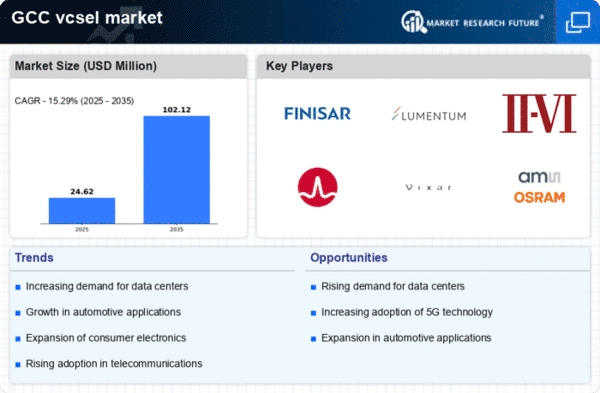
The rapid expansion of data centers in the GCC region is a pivotal driver for the vcsel market. As organizations increasingly rely on cloud computing and big data analytics, the demand for high-speed data transmission has surged. Vcsel technology, known for its efficiency in optical communication, is becoming essential in these facilities. The market for data centers in the GCC is projected to grow at a CAGR of approximately 15% from 2025 to 2030, indicating a robust demand for advanced optical components. This growth is likely to stimulate investments in vcsel technology, as companies seek to enhance their data transmission capabilities. Consequently, the expansion of data centers is expected to significantly influence the vcsel market, driving innovation and adoption of these devices across various applications.
Rise of Smart Cities Initiatives
The GCC region is actively pursuing smart city initiatives, aiming to enhance urban living through technology integration. Vcsel technology is poised to play a vital role in smart city applications, particularly in communication networks and sensor systems. As cities become more interconnected, the demand for efficient data transmission and real-time monitoring is expected to rise. The smart city market in the GCC is projected to reach $20 billion by 2025, indicating a robust investment in technological infrastructure. This trend suggests that the vcsel market will benefit from the increasing need for reliable and high-speed communication solutions within smart city frameworks, potentially leading to innovative applications and enhanced urban management.
Growth in Healthcare Technologies
The healthcare sector in the GCC is witnessing a surge in the adoption of advanced technologies, including telemedicine and diagnostic imaging. Vcsel technology is emerging as a vital component in these applications, particularly in optical coherence tomography and other imaging systems. The healthcare market in the GCC is projected to grow at a CAGR of around 10% through 2027, driven by increasing investments in healthcare infrastructure and technology. This growth is likely to create a substantial demand for vcsel devices, as they offer high precision and efficiency in medical applications. Consequently, the expansion of healthcare technologies is expected to significantly impact the vcsel market, leading to increased collaboration between healthcare providers and technology developers.
Advancements in Automotive Applications
The automotive sector in the GCC is undergoing a transformation, with a growing emphasis on advanced driver-assistance systems (ADAS) and autonomous vehicles. Vcsel technology plays a crucial role in these applications, particularly in LiDAR systems for distance measurement and obstacle detection. The automotive market in the GCC is anticipated to reach a valuation of $30 billion by 2026, with a substantial portion allocated to innovative technologies. As manufacturers increasingly integrate vcsel-based solutions into their vehicles, the vcsel market is likely to experience significant growth. This trend suggests that the automotive industry's shift towards automation and enhanced safety features will be a key driver for the vcsel market, fostering further research and development in this domain.
Increased Focus on Renewable Energy Solutions
The GCC region is increasingly focusing on renewable energy solutions, particularly solar energy, to diversify its energy sources. Vcsel technology is becoming integral in various renewable energy applications, including solar panel monitoring and energy management systems. The renewable energy market in the GCC is expected to grow significantly, with investments projected to exceed $50 billion by 2030. This growth is likely to drive demand for advanced optical components, such as vcsels, which can enhance the efficiency of energy systems. As the region transitions towards sustainable energy solutions, the vcsel market is expected to experience substantial growth, reflecting the broader trend of integrating technology into renewable energy initiatives.























Leave a Comment