×
Request Free Sample ×

Kindly complete the form below to receive a free sample of this Report

* Please use a valid business email

Leading companies partner with us for data-driven Insights

clients tt-cursor
Hero Background

Germany Advanced Distribution Management Systems Market

ID: MRFR/ICT/59844-HCR
200 Pages
Aarti Dhapte
October 2025

Germany Advanced Distribution Management Systems Market Research Report By Application (Distribution Network Management, Load Management, Power Quality Management, Grid Automation), By Deployment Type (On-Premise, Cloud-Based, Hybrid), By Component (Software, Services, Support and Maintenance) and By End Use (Utilities, Renewable Energy Providers, Industrial)- Forecast to 2035

Share:
Download PDF ×

We do not share your information with anyone. However, we may send you emails based on your report interest from time to time. You may contact us at any time to opt-out.

Germany Advanced Distribution Management Systems Market Infographic
Purchase Options

Germany Advanced Distribution Management Systems Market Summary

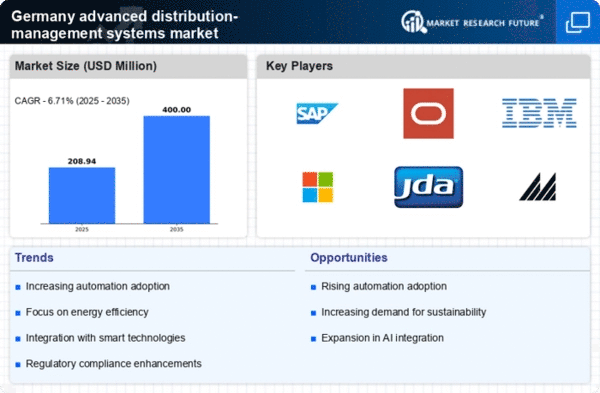
As per MRFR analysis, the advanced distribution-management-systems market Size was estimated at 195.8 USD Million in 2024. The advanced distribution-management-systems market is projected to grow from 208.94 USD Million in 2025 to 400.0 USD Million by 2035, exhibiting a compound annual growth rate (CAGR) of 6.71% during the forecast period 2025 - 2035.

Key Market Trends & Highlights

The Germany advanced distribution-management-systems market is experiencing a transformative shift towards automation and cloud solutions.

  • The integration of automation technologies is reshaping operational efficiencies across the market.
  • Cloud-based solutions are gaining traction, driven by the need for scalable and flexible distribution management.
  • Sustainability practices are increasingly prioritized, reflecting a broader commitment to environmental responsibility.
  • The rising demand for real-time data analytics and the growth of e-commerce are key drivers propelling market expansion.

Market Size & Forecast

2024 Market Size 195.8 (USD Million)
2035 Market Size 400.0 (USD Million)
CAGR (2025 - 2035) 6.71%

Major Players

SAP (DE), Oracle (US), IBM (US), Microsoft (US), JDA Software (US), Manhattan Associates (US), Infor (US), Blue Yonder (US), Softeon (US)

Germany Advanced Distribution Management Systems Market Trends

The The market is currently experiencing notable growth, driven by the increasing demand for efficient supply chain operations. Companies are increasingly adopting advanced technologies to streamline their distribution processes, which enhances overall productivity. The integration of automation and data analytics into distribution systems appears to be a key factor in improving operational efficiency. Furthermore, the emphasis on sustainability and reducing carbon footprints is influencing the adoption of innovative distribution solutions. As organizations strive to meet regulatory requirements and consumer expectations, the market is likely to see a rise in eco-friendly distribution practices. In addition, the advanced distribution-management-systems market is witnessing a shift towards cloud-based solutions. This transition allows for greater flexibility and scalability, enabling businesses to adapt to changing market conditions. The ability to access real-time data and analytics from anywhere enhances decision-making processes. Moreover, the growing trend of e-commerce is pushing companies to invest in advanced distribution systems that can handle increased order volumes and complex logistics. Overall, the market is poised for continued expansion as businesses recognize the importance of advanced distribution management in achieving competitive advantages.

Integration of Automation Technologies

The advanced distribution-management-systems market is increasingly incorporating automation technologies. This trend is driven by the need for efficiency and accuracy in distribution processes. Automated systems reduce human error and enhance speed, allowing companies to respond swiftly to market demands.

Shift Towards Cloud-Based Solutions

There is a noticeable shift towards cloud-based solutions within the advanced distribution-management-systems market. These solutions offer flexibility and scalability, enabling businesses to manage their distribution networks more effectively. Access to real-time data enhances operational decision-making.

Focus on Sustainability Practices

Sustainability is becoming a central theme in the advanced distribution-management-systems market. Companies are adopting eco-friendly practices to meet regulatory standards and consumer expectations. This focus on sustainability is likely to drive innovation in distribution technologies.

Germany Advanced Distribution Management Systems Market Drivers

Regulatory Compliance and Standards

In Germany, stringent regulatory requirements are shaping the advanced distribution-management-systems market. Companies are compelled to adopt systems that ensure compliance with local and EU regulations, particularly concerning data protection and environmental standards. The implementation of advanced distribution-management-systems not only aids in meeting these regulations but also enhances transparency and accountability within supply chains. As businesses strive to avoid penalties and maintain their reputations, the demand for compliant systems is expected to rise. This focus on regulatory adherence is likely to propel the advanced distribution-management-systems market, as organizations invest in technologies that facilitate compliance and improve operational integrity.

Focus on Cost Reduction and Efficiency

Cost reduction remains a primary objective for businesses in Germany, significantly impacting the advanced distribution-management-systems market. Companies are under constant pressure to minimize expenses while maintaining high service levels. Advanced distribution-management-systems facilitate this by optimizing logistics, reducing waste, and improving resource allocation. By implementing these systems, organizations can achieve substantial cost savings, with studies suggesting potential reductions of up to 15% in operational costs. This focus on efficiency and cost-effectiveness is likely to drive the adoption of advanced distribution-management-systems, as businesses seek to enhance their profitability in a competitive landscape.

Growth of E-commerce and Online Retail

The rapid expansion of e-commerce in Germany is significantly influencing the advanced distribution-management-systems market. As online retail continues to grow, businesses are increasingly challenged to manage complex logistics and distribution networks efficiently. Advanced distribution-management-systems provide the necessary tools to streamline operations, manage inventory effectively, and enhance customer service. Reports indicate that e-commerce sales in Germany are projected to reach €100 billion by 2025, necessitating robust distribution solutions. This growth in online retail is likely to drive investments in advanced distribution-management-systems, as companies seek to adapt to changing consumer behaviors and expectations.

Rising Demand for Real-Time Data Analytics

The advanced distribution-management-systems market in Germany is experiencing a notable surge in demand for real-time data analytics. Companies are increasingly recognizing the value of data-driven decision-making, which enhances operational efficiency and customer satisfaction. The integration of advanced analytics tools allows businesses to monitor supply chain performance in real-time, leading to improved inventory management and reduced operational costs. According to recent studies, organizations utilizing real-time analytics can achieve up to a 20% increase in efficiency. This trend is likely to continue as more companies seek to leverage data insights to optimize their distribution processes, thereby driving growth in the advanced distribution-management-systems market.

Technological Advancements in Supply Chain Management

Technological innovations are playing a crucial role in shaping the advanced distribution-management-systems market in Germany. The adoption of technologies such as artificial intelligence, machine learning, and the Internet of Things (IoT) is transforming supply chain management practices. These advancements enable companies to automate processes, enhance visibility, and improve decision-making capabilities. As organizations increasingly recognize the benefits of these technologies, investments in advanced distribution-management-systems are expected to rise. The market is likely to witness a shift towards more sophisticated systems that leverage these technologies to optimize distribution operations and drive competitive advantage.


Market Segment Insights

By Application: Distribution Network Management (Largest) vs. Load Management (Fastest-Growing)

In the Germany advanced distribution-management-systems market, Distribution Network Management holds the largest market share, driven by its crucial role in maintaining efficient and reliable distribution operations. Following closely is Load Management, which has been gaining traction as industries increasingly focus on optimizing energy consumption and managing peak loads effectively. Power Quality Management and Grid Automation, while important, represent smaller segments within the overall market, yet they complement the primary applications by enhancing operational efficiency and reliability. Growth trends in this segment are primarily influenced by rapid technological advancements and the push for smarter energy systems. The continuous development of IoT and AI technologies is enhancing the capabilities of Load Management systems, making them more appealing to users. Additionally, increasing regulatory pressures and sustainability goals are driving investments towards Grid Automation and Power Quality Management, which are expected to see significant growth in the coming years, as they are integral to the transition to renewable energy sources and smart grids.

Distribution Network Management (Dominant) vs. Load Management (Emerging)

Distribution Network Management is currently the dominant force in the Germany advanced distribution-management-systems market, characterized by its comprehensive approach to overseeing the flow and distribution of electricity across various networks. This segment focuses on optimizing efficiency, ensuring reliability, and minimizing disruptions. In contrast, Load Management is an emerging segment that is rapidly gaining popularity due to its ability to enhance energy efficiency by controlling and balancing load demands. This involves sophisticated technologies that allow businesses to adapt to real-time energy needs, ensuring they can meet demand without excess costs. Both segments are vital to the evolving landscape of energy distribution, where efficiency and sustainability are paramount.

By Deployment Type: Cloud-Based (Largest) vs. Hybrid (Fastest-Growing)

In the Germany advanced distribution-management-systems market, the deployment type segment is becoming increasingly diverse. Currently, the Cloud-Based deployment is at the forefront, commanding a significant share due to its scalability and flexibility that meet the contemporary demands of businesses. Conversely, the Up-and-coming Hybrid deployment model demonstrates a growing acceptance among companies seeking to combine the benefits of both on-premise and cloud solutions. This shift in preference reveals an emerging trend towards mixed deployments that cater to specific operational needs. Growth in this segment is primarily attributed to advancements in technology and increased demand for efficient resource management. As organizations in Germany seek to optimize their distribution processes, the benefits of cloud-based solutions such as lower initial costs and reduced maintenance responsibilities are becoming more appealing. Meanwhile, the Hybrid model attracts businesses looking for tailored solutions that offer both flexibility and control, fueling its rapid growth in the market.

Cloud-Based (Dominant) vs. Hybrid (Emerging)

Cloud-Based deployment is characterized by its versatility and accessibility, which allows organizations to efficiently scale their operations without investing heavily in physical infrastructure. Its dominance in the Germany advanced distribution-management-systems market is supported by a rising trend towards digital transformation. In contrast, the Hybrid deployment model is seen as an emerging solution that addresses specific business needs by leveraging both cloud and on-premise resources. This model allows companies to utilize existing infrastructure while transitioning to cloud-based solutions gradually. As the market evolves, the blend of these two models illustrates the dynamic landscape of deployment types, with organizations evaluating their operational requirements and embracing solutions that provide both agility and control.

By Component: Software (Largest) vs. Services (Fastest-Growing)

The Germany advanced distribution-management-systems market showcases a diverse range of components contributing to the overall landscape. Software remains the largest segment, commanding significant market share due to its essential role in optimizing distribution processes. Meanwhile, services are emerging as a strong contender, experiencing rapid growth as companies seek more integrated and efficient solutions. The growth trends in this segment are driven by increasing digitalization and the need for real-time data analytics. Businesses are more inclined to adopt advanced distribution-management systems that offer comprehensive software solutions combined with strong service support. The rising demand for efficiency and cost-effectiveness in supply chain management continues to push the services sector forward, positioning it as the fastest-growing component alongside the robust software segment.

Software (Dominant) vs. Services (Emerging)

In the Germany advanced distribution-management-systems market, software plays a dominant role due to its capability to streamline operations and enhance productivity. This segment benefits from continuous innovation, with a focus on features that support data integration and analytics. On the other hand, the services segment is emerging as a crucial part of the ecosystem, focusing on consulting, implementation, and managed services that cater to customer-specific needs. As organizations increasingly prioritize customized solutions, the services offered are gaining traction, making them vital for sustaining competitive advantage within the market.

By End Use: Utilities (Largest) vs. Renewable Energy Providers (Fastest-Growing)

In the Germany advanced distribution-management-systems market, the utilities segment holds the largest market share due to its essential role in managing energy distribution. The reliance on efficient distribution management systems is crucial for utilities as they strive to enhance operational efficiency and reduce downtime. Renewable energy providers, while currently smaller in market share, are witnessing significant adoption of advanced distribution management systems as they strive to incorporate more sustainable energy solutions into the grid. Growth trends in this segment are being driven by an increased focus on sustainability and the integration of renewable energy sources into existing infrastructures. Regulatory policies are compelling utilities and renewable energy providers to invest in advanced systems that facilitate better load management and grid reliability. As a result, the sector is evolving rapidly, with renewable energy providers expected to become the fastest-growing segment in the coming years, reflecting a shift in energy paradigms and technological advancements.

Utilities (Dominant) vs. Renewable Energy Providers (Emerging)

The utilities segment remains dominant within the Germany advanced distribution-management-systems market, characterized by established infrastructure and a stable demand for energy management solutions. Utilities focus extensively on optimizing their distribution networks through advanced technologies, ensuring reliable energy service for consumers. In contrast, renewable energy providers represent the emerging facet of the market, prioritizing innovation and efficiency as they implement advanced management systems. These providers are adapting to new energy trends, leading to enhanced integration of solar and wind power. The emerging segment faces challenges such as regulatory compliance and the need for real-time data analytics, but they are well-positioned for growth as market dynamics shift towards greener energy solutions.

Get more detailed insights about Germany Advanced Distribution Management Systems Market

Key Players and Competitive Insights

The advanced distribution-management-systems market in Germany is characterized by a dynamic competitive landscape, driven by the increasing demand for efficiency and optimization in supply chain operations. Key players such as SAP (DE), Oracle (US), and IBM (US) are at the forefront, leveraging their technological prowess to enhance operational capabilities. SAP (DE) focuses on integrating advanced analytics and machine learning into its solutions, thereby enabling clients to achieve greater visibility and control over their distribution processes. Oracle (US) emphasizes cloud-based solutions, which facilitate scalability and flexibility, appealing to a diverse range of industries. Meanwhile, IBM (US) is investing heavily in AI-driven insights, which are crucial for predictive analytics in distribution management. Collectively, these strategies foster a competitive environment that prioritizes innovation and technological advancement.

In terms of business tactics, companies are increasingly localizing their operations to better serve regional markets, which is particularly relevant in Germany's diverse economic landscape. Supply chain optimization remains a critical focus, as firms seek to enhance efficiency and reduce costs. The market structure appears moderately fragmented, with several key players holding substantial market shares while also facing competition from emerging firms. This fragmentation allows for a variety of solutions tailored to specific industry needs, thereby enriching the overall market offering.

In October 2025, SAP (DE) announced a strategic partnership with a leading logistics provider to enhance its distribution management capabilities. This collaboration aims to integrate real-time data analytics into supply chain operations, which is expected to significantly improve decision-making processes for clients. The strategic importance of this partnership lies in its potential to provide clients with a more agile and responsive distribution framework, aligning with current market demands for speed and efficiency.

In September 2025, Oracle (US) launched a new suite of cloud-based distribution management tools designed to streamline operations for mid-sized enterprises. This initiative reflects Oracle's commitment to expanding its market reach and catering to the needs of smaller businesses that require robust yet flexible solutions. The launch is strategically significant as it positions Oracle to capture a growing segment of the market that is increasingly seeking digital transformation.

In August 2025, IBM (US) unveiled an AI-driven platform aimed at enhancing supply chain visibility and resilience. This platform utilizes advanced machine learning algorithms to predict disruptions and optimize inventory levels. The introduction of this technology is crucial, as it addresses the pressing need for businesses to adapt to rapidly changing market conditions, thereby reinforcing IBM's position as a leader in innovative distribution solutions.

As of November 2025, the competitive trends in the advanced distribution-management-systems market are heavily influenced by digitalization, sustainability, and AI integration. Strategic alliances are becoming increasingly prevalent, as companies recognize the value of collaboration in enhancing their technological capabilities. Looking ahead, competitive differentiation is likely to evolve from traditional price-based strategies to a focus on innovation, technology integration, and supply chain reliability. This shift underscores the importance of adaptability and forward-thinking in maintaining a competitive edge in a rapidly changing market.

Key Companies in the Germany Advanced Distribution Management Systems Market market include

Industry Developments

The Germany Advanced Distribution Management Systems Market has seen significant developments recently, particularly in July 2023 when Siemens launched its latest grid management software, aiming to enhance operational efficiency amid the energy transformation. Oracle has also been making strides, unveiling advanced analytics capabilities in its distribution management systems, designed to improve decision-making processes for utilities. Additionally, in August 2023, GE Digital expanded its partnership with various German utilities, focusing on integrating AI and IoT technologies into their grid operations. 

Major growth in market valuation is evident, driven by rising investments in renewable energy infrastructure and smart grid technology, reflecting Germany’s commitment to its energy transition goals as part of its national strategy. Over the past few years, significant advancements have occurred, to develop innovative software solutions aimed at improving grid reliability and efficiency, showcasing the robust adaptation of technology in the German market.

Future Outlook

Germany Advanced Distribution Management Systems Market Future Outlook

The Advanced Distribution Management Systems Market in Germany is projected to grow at a 6.71% CAGR from 2024 to 2035, driven by technological advancements and increasing demand for efficiency.

New opportunities lie in:

  • Integration of AI-driven analytics for real-time inventory management.
  • Development of cloud-based distribution platforms for enhanced scalability.
  • Implementation of IoT solutions for predictive maintenance and operational efficiency.

By 2035, the market is expected to achieve substantial growth, driven by innovation and strategic investments.

Market Segmentation

Germany Advanced Distribution Management Systems Market End Use Outlook

  • Utilities
  • Renewable Energy Providers
  • Industrial

Germany Advanced Distribution Management Systems Market Component Outlook

  • Software
  • Services
  • Support and Maintenance

Germany Advanced Distribution Management Systems Market Application Outlook

  • Distribution Network Management
  • Load Management
  • Power Quality Management
  • Grid Automation

Germany Advanced Distribution Management Systems Market Deployment Type Outlook

  • On-Premise
  • Cloud-Based
  • Hybrid

Report Scope

MARKET SIZE 2024 195.8(USD Million)
MARKET SIZE 2025 208.94(USD Million)
MARKET SIZE 2035 400.0(USD Million)
COMPOUND ANNUAL GROWTH RATE (CAGR) 6.71% (2024 - 2035)
REPORT COVERAGE Revenue Forecast, Competitive Landscape, Growth Factors, and Trends
BASE YEAR 2024
Market Forecast Period 2025 - 2035
Historical Data 2019 - 2024
Market Forecast Units USD Million
Key Companies Profiled SAP (DE), Oracle (US), IBM (US), Microsoft (US), JDA Software (US), Manhattan Associates (US), Infor (US), Blue Yonder (US), Softeon (US)
Segments Covered Application, Deployment Type, Component, End Use
Key Market Opportunities Integration of artificial intelligence enhances efficiency in the advanced distribution-management-systems market.
Key Market Dynamics Technological advancements and regulatory changes drive innovation in the advanced distribution-management-systems market.
Countries Covered Germany

Leave a Comment

FAQs

What is the expected market size of the Germany Advanced Distribution Management Systems Market in 2024?

The expected market size of the Germany Advanced Distribution Management Systems Market in 2024 is valued at 139.44 million USD.

What is the projected market value for the Germany Advanced Distribution Management Systems Market by 2035?

By 2035, the projected market value for the Germany Advanced Distribution Management Systems Market is anticipated to reach 271.0 million USD.

What is the expected compound annual growth rate (CAGR) for the Germany Advanced Distribution Management Systems Market from 2025 to 2035?

The expected compound annual growth rate (CAGR) for the Germany Advanced Distribution Management Systems Market from 2025 to 2035 is 6.227%.

Which application is estimated to dominate the Germany Advanced Distribution Management Systems Market by 2035?

By 2035, the Distribution Network Management application is estimated to dominate the market, with a value of 100.0 million USD.

What is the market value for Load Management in 2024 within the Germany Advanced Distribution Management Systems Market?

The market value for Load Management in 2024 within the Germany Advanced Distribution Management Systems Market is projected to be 35.0 million USD.

How much is the Grid Automation segment expected to be valued at in 2035?

The Grid Automation segment is expected to be valued at 51.0 million USD in 2035.

Who are the key players in the Germany Advanced Distribution Management Systems Market?

Key players in the Germany Advanced Distribution Management Systems Market include Oracle, Honeywell, Siemens, and GE Digital among others.

What is the expected market size for Power Quality Management in 2024?

The expected market size for Power Quality Management in 2024 is 30.0 million USD.

What opportunities exist in the Germany Advanced Distribution Management Systems Market?

Opportunities in the market include advancements in grid automation and integration of renewable energy sources.

What challenges does the Germany Advanced Distribution Management Systems Market face?

The market faces challenges such as evolving regulations and the need for substantial investments in technology.

Download Free Sample

Kindly complete the form below to receive a free sample of this Report

Compare Licence

×
Features License Type
Single User Multiuser License Enterprise User
Price $4,950 $5,950 $7,250
Maximum User Access Limit 1 User Upto 10 Users Unrestricted Access Throughout the Organization
Free Customization
Direct Access to Analyst
Deliverable Format
Platform Access
Discount on Next Purchase 10% 15% 15%
Printable Versions