×
Hero Background
English
Chinese
French
Japanese
Korean
German
Spanish

Germany Bio-lubricants Market Size

ID: MRFR/CnM/16266-HCR
128 Pages
Priya Nagrale
October 2025

Germany Bio-lubricants Market Research Report Information By Base Oil (Vegetable Oil, Animal Fat), By Application (Hydraulic Oil, Metalworking Fluids, Chainsaw Oil, Mold Release Agents, Two-Cycle Engine Oils, Gear Oils, Greases)–Market Forecast Till 2035

Share:
Download PDF ×

We do not share your information with anyone. However, we may send you emails based on your report interest from time to time. You may contact us at any time to opt-out.

Germany Bio-lubricants Market Infographic
Purchase Options

Germany Bio Lubricants Size

Germany Bio-lubricants Market Growth Projections and Opportunities

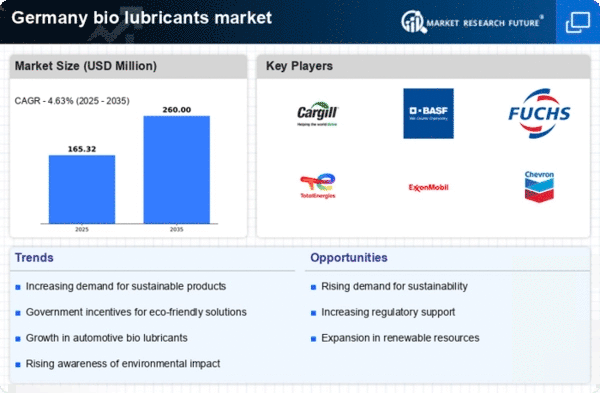
Germany Bio-lubricants Market is influenced by several market variables which are responsible for its growth and prominence in sustainable lubrication. Enhanced ecological awareness and dedication to the environment conservation in Germany are some of the main forces that drive this market. The country has been one of the leading pioneers of sustainability, thus more accentuation is being placed on reducing the environmental impact of lubricants. Eco-friendly bio-lubricants made from renewable sources, offering biodegradability have become popular due to their greenness. This raised consciousness is driving the demand for bio-lubricants across various sectors including automotive manufacturing and agriculture. Government policies and regulations greatly shape the Germany Bio-lubricants Market. In a bid to protect its environment systematically there are set rules, regulations and standards that encourage use of bio based/ environmentally friendly products. Government incentives, subsidies, and statutory requirements underpinning use of bio-lubricants provide a favorable regulatory climate for both manufacturers and consumers alike. Besides driving market growth, this alignment with government policies promotes industrial sector’s goal. The trend towards sustainable eco-friendly products is shaping consumer preferences in Germany Bio-Lubricants Market currently as shown in figure 1 below: Growing consumer environmental awareness leads to increased demand for green oriented goods as well as services.For those customers who want an alternative from traditional lubricating oils they will choose bio-based oil as it comes with such features like biodegradable property.Bio-Lubes Innovations Ltd., Green Earth Technologies Inc., Renewable Lubricants Inc., NeoBio Oil GmbH, Biosynthetic Technologies LLC., Polnox Corporation, BP PLC (Castrol), Klüber Lubrication München SE & Co. KG, Fuchs Petrolub AG, Exxon Mobil Corporation. Technological innovations involving formulation of biolubricants, significantly contribute to market development. On-going research and development effort target improvement of performance attributes of bio-lubricants such as lubricity, stability and temperature resistance. Advanced manufacturing techniques and exploration of new feedstocks improve the overall efficiency and competitiveness of bio-lubricants compared with traditional lubricants. To meet the changing demands from different industries, it is vital for manufacturers of bio-lubricants to keep up with these technological advances. The success of Germany Bio-lubricants Market depends on supply chain considerations such as availability of feedstock and logistical efficiency. Sustainable sourcing of renewable feedstocks like vegetable oils for producing bio-lubricant requires proper planning to ensure sustainability. Further, a well-managed supply chain guarantees that end-users in various sectors receive timely delivery of bio-lubricant thereby further contributing towards the growth in the market. Market collaborations and partnerships are crucial in shaping Germany Bio-Lubricants Market. Bio-lube manufacturers partnering with researchers at universities or other private research facilities can get help doing this by sharing information on how they can go about replacing petroleum based raw materials with the most efficient ones. This paper examines several key factors affecting German biolubes industry: changes in consumer demand, government regulations, pricing trends, technological advancements and sources of feed stocks.These partnerships increase competition within the market and promote innovation through exchange of ideas among partners leading to new technologies being used in production.
Germany Bio-lubricants Market Size Graph
Author
Priya Nagrale
Senior Research Analyst

With an experience of over five years in market research industry (Chemicals & Materials domain), I gather and analyze market data from diverse sources to produce results, which are then presented back to a client. Also, provide recommendations based on the findings. As a Senior Research Analyst, I perform quality checks (QC) for market estimations, QC for reports, and handle queries and work extensively on client customizations. Also, handle the responsibilities of client proposals, report planning, report finalization, and execution

Leave a Comment

FAQs

What is the current valuation of the Germany Bio-lubricants Market?

The market valuation was 2.34 USD Billion in 2024.

What is the projected market size for the Germany Bio-lubricants Market by 2035?

The projected valuation for 2035 is 4.443 USD Billion.

What is the expected CAGR for the Germany Bio-lubricants Market during the forecast period 2025 - 2035?

The expected CAGR is 6.0% during the forecast period.

Which companies are considered key players in the Germany Bio-lubricants Market?

Key players include Fuchs Petrolub SE, TotalEnergies SE, Castrol Limited, and BASF SE.

What are the main segments of the Germany Bio-lubricants Market?

The main segments include Base Oil and Application.

Market Summary

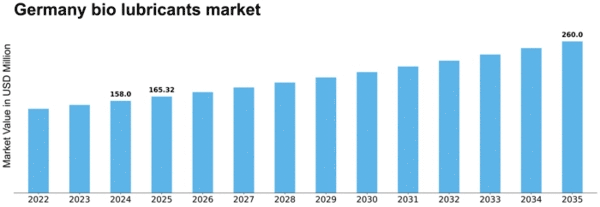
As per analysis, the Germany bio lubricants market is projected to grow from USD 158.0 Million in 2024 to USD 164.99 Million in 2025, exhibiting a compound annual growth rate (CAGR) of 4.42% during the forecast period (2025 - 2035).

Key Market Trends & Highlights

The Germany bio lubricants market is poised for growth driven by regulatory support and increasing consumer awareness.

  • The automotive segment remains the largest contributor to the bio lubricants market in Germany.
  • The industrial segment is currently the fastest-growing sector, reflecting a shift towards sustainable practices.
  • Vegetable oil-based bio lubricants dominate the market, while synthetic esters are emerging as the fastest-growing formulation.
  • Key market drivers include regulatory support for bio-based products and rising consumer awareness regarding sustainability.

Market Size & Forecast

2024 Market Size 158.0 (USD Million)
2035 Market Size 254.31 (USD Million)
CAGR (2025 - 2035) 4.42%

Major Players

<p>Fuchs Petrolub SE (DE), TotalEnergies SE (FR), Castrol Limited (GB), Shell Deutschland Oil GmbH (DE), BP p.l.c. (GB), ExxonMobil Chemical Europe Inc. (US), Klüber Lubrication München SE & Co. KG (DE), Rhenus Lub GmbH & Co. KG (DE), Biolubricants GmbH (DE)</p>

Market Trends

The Germany bio lubricants market is currently experiencing a notable shift towards sustainable and environmentally friendly alternatives to traditional lubricants. This transition is largely driven by increasing regulatory pressures and a growing awareness of environmental issues among consumers and industries alike. The German government has been proactive in promoting bio-based products, which aligns with the European Union's broader sustainability goals. As a result, manufacturers are increasingly investing in research and development to create innovative bio lubricant formulations that meet stringent performance standards while minimizing ecological impact. Furthermore, the automotive and manufacturing sectors in Germany are progressively adopting bio lubricants, recognizing their potential to enhance operational efficiency and reduce carbon footprints. In addition to regulatory influences, consumer preferences are evolving, with a marked inclination towards products that are perceived as safer and more sustainable. This trend is reflected in the rising demand for bio lubricants across various applications, including automotive, industrial, and marine sectors. The Germany bio lubricants market appears poised for growth, as stakeholders from different sectors collaborate to promote the benefits of bio-based lubricants. The ongoing advancements in technology and formulation are likely to further enhance the appeal of these products, making them a viable alternative to conventional lubricants in the near future.

Regulatory Support for Bio-based Products

The German government actively supports the development and adoption of bio-based lubricants through various initiatives and regulations. This regulatory framework encourages manufacturers to innovate and produce environmentally friendly alternatives, aligning with national sustainability objectives.

Rising Consumer Awareness

There is a growing awareness among consumers regarding the environmental impact of lubricants. This shift in perception is driving demand for bio lubricants, as consumers increasingly prefer products that are perceived as safer and more sustainable.

Technological Advancements in Formulations

Ongoing research and development efforts are leading to significant advancements in bio lubricant formulations. These innovations aim to enhance performance characteristics, making bio lubricants more competitive with traditional options in various applications.

Germany Bio-lubricants Market Market Drivers

Regulatory Framework

The regulatory landscape significantly influences the Germany Bio-lubricants Market. Stringent environmental regulations and policies aimed at reducing pollution and promoting sustainable practices are driving the adoption of bio-lubricants. The European Union's directives on hazardous substances and waste management have prompted industries to seek compliant alternatives, thereby boosting the demand for bio-lubricants. In Germany, the government has implemented various initiatives to support the transition towards greener products, including financial incentives for companies adopting bio-lubricants. This regulatory support is likely to enhance market growth, as businesses align their operations with environmental standards and consumer expectations.

Technological Innovations

Technological advancements play a crucial role in shaping the Germany Bio-lubricants Market. Innovations in formulation and production processes have led to the development of high-performance bio-lubricants that meet stringent industry standards. For instance, advancements in esterification and refining techniques have improved the efficiency and performance of bio-lubricants, making them viable alternatives to conventional lubricants. The market is witnessing a surge in research and development activities, with investments aimed at enhancing product quality and expanding application areas. This focus on technology is expected to drive market growth, as manufacturers strive to meet the evolving demands of various sectors, including automotive and manufacturing.

Sustainability Initiatives

The increasing emphasis on sustainability within the Germany Bio-lubricants Market is a pivotal driver. As environmental concerns escalate, businesses and consumers alike are gravitating towards eco-friendly alternatives. This shift is evidenced by a growing demand for bio-lubricants, which are derived from renewable resources and are biodegradable. In 2025, the market for bio-lubricants in Germany is projected to reach approximately 300 million euros, reflecting a compound annual growth rate of around 5%. This trend is likely to continue as companies seek to enhance their sustainability profiles and reduce their carbon footprints, thereby fostering a more sustainable industrial ecosystem.

Rising Awareness Among Consumers

Consumer awareness regarding the environmental impact of traditional lubricants is on the rise, which is a significant driver for the Germany Bio-lubricants Market. As individuals become more informed about the benefits of bio-lubricants, including their reduced toxicity and biodegradability, the demand for these products is expected to increase. Educational campaigns and marketing efforts by manufacturers are contributing to this heightened awareness, leading to a shift in consumer preferences. In 2025, it is anticipated that a substantial portion of consumers will actively seek out bio-lubricants, thereby propelling market growth and encouraging manufacturers to expand their product offerings.

Industrial Demand for Eco-Friendly Solutions

The industrial sector's growing demand for eco-friendly solutions is a key driver in the Germany Bio-lubricants Market. Industries such as automotive, manufacturing, and agriculture are increasingly adopting bio-lubricants to comply with environmental regulations and enhance their sustainability initiatives. The shift towards greener practices is not only driven by regulatory compliance but also by the potential for cost savings and improved operational efficiency. In 2025, it is projected that the industrial segment will account for a significant share of the bio-lubricants market, as companies recognize the long-term benefits of integrating sustainable products into their operations.

Market Segment Insights

By Application: Automotive (Largest) vs. Industrial (Fastest-Growing)

<p>In the Germany bio lubricants market, the application segment displays a diverse distribution of shares among automotive, industrial, marine, aerospace, and agricultural sectors. The automotive sector holds the largest share, significantly driven by the increasing demand for sustainable and environmentally friendly lubricants in vehicles. Meanwhile, the industrial application is emerging as the fastest-growing segment, owing to rising industrial needs for bio-based lubricants that minimize environmental impact while enhancing performance.</p>

<p>Automotive (Dominant) vs. Industrial (Emerging)</p>

<p>The automotive application of bio lubricants is characterized by its established presence, benefiting from a strong demand for eco-friendly alternatives to traditional lubricants. This segment aims to improve engine performance and reduce emissions, aligning with stricter environmental regulations. Conversely, the industrial sector, while currently smaller, is rapidly expanding as industries adopt bio lubricants to meet sustainability targets. The industrial applications are often tailored for specific machinery, focusing on efficiency and minimizing ecological footprints, thus positioning themselves as key players in the evolving lubrication market.</p>

By Base Oil Type: Vegetable Oil (Largest) vs. Synthetic Ester (Fastest-Growing)

<p>In the Germany bio lubricants market, the base oil type segment is largely dominated by vegetable oils, which hold the largest market share due to their renewability and compatibility with various applications. The widespread acceptance of vegetable oils stems from their established performance standards and growing preference among manufacturers for eco-friendly materials. Following this, synthetic esters are gaining momentum as they offer superior performance characteristics, especially in high-temperature applications, contributing to their rapid rise in market share.</p>

<p>Vegetable Oil (Dominant) vs. Synthetic Ester (Emerging)</p>

<p>Vegetable oils remain the dominant player in the Germany bio lubricants market, thanks to their natural origin and excellent lubrication properties. Common sources include rapeseed and sunflower oils, which are favored for their biodegradability and low toxicity. On the other hand, synthetic esters, while still emerging, are recognized for their high-performance capabilities, making them suitable for demanding industrial applications. The diversification of applications for synthetic esters, coupled with technological advancements, positions them as a strong, environmentally-friendly alternative that is rapidly gaining traction amongst manufacturers seeking performance with sustainability.</p>

By End Use: Engine Oil (Largest) vs. Hydraulic Fluid (Fastest-Growing)

<p>In the Germany bio lubricants market, the end use segment is characterized by distinct applications that cater to various industrial needs. Engine oil holds the largest market share, primarily due to its widespread use in automotive applications. Following closely, hydraulic fluid exemplifies a growing interest, attributed to increased demands for environmentally friendly alternatives in machinery and equipment operations. Other applications like gear oil, grease, and metalworking fluids collectively contribute to the market dynamics, albeit at a slower pace than engine oil and hydraulic fluid. As the market adapts to sustainable practices, products within the hydraulic fluid segment are witnessing rapid growth, driven by regulatory changes and consumer preferences emphasizing eco-friendliness. This shift is pivotal as more industries prioritize bio-based lubricants. Engine oil remains essential, but the burgeoning hydraulic fluid segment indicates evolving trends towards sustainability and innovation in product formulations, vital for addressing future market demands.</p>

<p>Engine Oil (Dominant) vs. Hydraulic Fluid (Emerging)</p>

<p>Engine oil continues to dominate the Germany bio lubricants market due to its critical role in vehicle performance and maintenance. Its formulation emphasizes high lubrication efficiency and protection against wear, oxidation, and thermal degradation, appealing to automotive manufacturers and consumers alike. Conversely, hydraulic fluid is emerging rapidly, driven by industrial applications demanding reliable performance while adhering to environmental standards. This burgeoning segment showcases innovation in bio-based formulations that enhance sustainability without compromising efficacy. The transition towards hydraulic fluid reflects broader trends in manufacturing and industrial practices, where eco-friendly options are increasingly favored. Both segments illustrate the dynamic nature of bio lubricants in Germany, with engine oil holding a strong position while hydraulic fluid gains momentum in various sectors.</p>

By Formulation Type: Additive-based (Largest) vs. Biodegradable Oil (Fastest-Growing)

<p>In the Germany bio lubricants market, the segment distribution reveals that additive-based formulations hold the largest market share, predominantly due to their versatility and effectiveness in various industrial applications. Following this, straight oil and emulsifiable oil formulations are notable for their specific use in machinery and metalworking processes, while multi-purpose oil is gaining traction for its convenience. Biodegradable oil is emerging as a competitive segment given the growing environmental awareness among consumers and companies alike, which influences purchasing decisions heavily. The growth trends in the formulation type segment are driven by stringent regulations on conventional lubricants and a strong push towards sustainable alternatives. Factors such as increasing demand from the automotive and industrial sectors for eco-friendly options are propelling the adoption of biodegradable and multi-purpose oils. Additionally, innovations in additive technologies enhance the performance and applicability of these products, further supporting their growth in the market.</p>

<p>Additive-based (Dominant) vs. Multi-purpose Oil (Emerging)</p>

<p>The additive-based segment is characterized by its ability to enhance the performance and longevity of lubricants, making it a dominant force in the Germany bio lubricants market. These formulations are widely preferred across various industries due to their customized solutions that address specific lubrication challenges. In contrast, multi-purpose oil is emerging as a popular choice among consumers seeking versatility and cost-effectiveness. Its appeal lies in its suitability for a range of applications, simplifying procurement and usage for both consumers and businesses. The growth of multi-purpose oils is further supported by a rising preference for products that offer convenience without compromising on performance.</p>

By Viscosity Grade: Low Viscosity (Largest) vs. High Viscosity (Fastest-Growing)

<p>In the Germany bio lubricants market, the distribution of viscosity grades reveals that low viscosity lubricants hold the largest market share, favored for their efficiency and performance in various applications. This segment has become increasingly popular in sectors like automotive and industrial machinery, where lower friction and enhanced fluidity are crucial. In contrast, high viscosity lubricants, while smaller in share, are recognized for their vital role in applications requiring thicker lubricants, such as in heavy machinery and equipment.</p>

<p>Low Viscosity (Dominant) vs. High Viscosity (Emerging)</p>

<p>Low viscosity bio lubricants in Germany dominate the market due to their versatility and efficiency, making them ideal for various applications, including automotive and machinery. Their ability to reduce fuel consumption and emissions aligns with the growing demand for eco-friendly solutions. Conversely, high viscosity lubricants, considered an emerging segment, are gaining traction for their specific applications in heavy-duty and industrial environments. This growth is driven by the rising need for lubricants that can withstand extreme conditions while offering excellent protection against wear and tear.</p>

Get more detailed insights about Germany Bio-lubricants Market Research Report—Forecast till 2035

Regional Insights

North America : Sustainable Innovation Leader

The North American bio-lubricants market is driven by increasing environmental regulations and a shift towards sustainable products. The U.S. holds the largest market share at approximately 70%, followed by Canada at 20%. The demand for bio-lubricants is further fueled by the automotive and industrial sectors, which are increasingly adopting eco-friendly alternatives. Regulatory catalysts, such as the EPA's initiatives, are enhancing market growth. Leading players in this region include ExxonMobil, TotalEnergies, and Castrol, which are investing in R&D to innovate bio-lubricant formulations. The competitive landscape is characterized by a mix of established companies and emerging startups focusing on sustainable solutions. The presence of key players ensures a robust supply chain and distribution network, facilitating market penetration and consumer awareness.

Europe : Regulatory-Driven Market Growth

Europe is witnessing significant growth in the bio-lubricants market, primarily driven by stringent environmental regulations and a strong push for sustainability. Germany, as the largest market, holds approximately 35% of the European share, followed by France at 25%. The EU's Green Deal and REACH regulations are pivotal in promoting bio-lubricants, encouraging manufacturers to innovate and comply with eco-friendly standards. Germany, France, and the UK are leading countries in this sector, with key players like Fuchs Petrolub and BASF spearheading advancements. The competitive landscape is marked by collaborations and partnerships aimed at enhancing product offerings. The presence of established companies alongside innovative startups fosters a dynamic market environment, ensuring a steady supply of bio-lubricants to meet growing demand.

Asia-Pacific : Emerging Market Potential

The Asia-Pacific region is emerging as a significant player in the bio-lubricants market, driven by rapid industrialization and increasing awareness of environmental sustainability. Countries like China and India are leading the charge, with China holding approximately 30% of the market share, followed by India at 20%. The growing automotive and manufacturing sectors are key demand drivers, supported by government initiatives promoting green technologies. The competitive landscape features both local and international players, with companies like Klüber Lubrication and BioBlend Renewable Resources making strides in product development. The region's market is characterized by a mix of established brands and new entrants, fostering innovation and competitive pricing. As regulations become more stringent, the demand for bio-lubricants is expected to rise significantly in the coming years.

Middle East and Africa : Resource-Rich Opportunities

The Middle East and Africa (MEA) region presents unique opportunities for the bio-lubricants market, driven by increasing industrial activities and a growing focus on sustainability. The UAE and South Africa are the largest markets, holding approximately 40% and 25% of the regional share, respectively. The demand for bio-lubricants is being propelled by the oil and gas sector, which is increasingly adopting eco-friendly alternatives to traditional lubricants. Key players in the MEA market include local manufacturers and international companies looking to expand their footprint. The competitive landscape is evolving, with a focus on innovation and sustainability. As awareness of environmental issues grows, the bio-lubricants market is expected to gain traction, supported by government initiatives promoting green technologies and sustainable practices.

Key Players and Competitive Insights

The bio lubricants market in Germany is characterized by a dynamic competitive landscape, driven by increasing environmental regulations and a growing demand for sustainable alternatives to conventional lubricants. Key players such as Fuchs Petrolub SE (DE), TotalEnergies SE (FR), and Klüber Lubrication München SE & Co. KG (DE) are at the forefront, each adopting distinct strategies to enhance their market presence. Fuchs Petrolub SE (DE) focuses on innovation and product development, emphasizing the creation of high-performance bio-based lubricants tailored for various industrial applications. Meanwhile, TotalEnergies SE (FR) is leveraging its extensive research capabilities to expand its portfolio of bio lubricants, aiming to meet the rising consumer demand for eco-friendly products. Klüber Lubrication München SE & Co. KG (DE) is also investing in sustainable practices, positioning itself as a leader in specialty lubricants with a strong emphasis on environmental responsibility.

The competitive structure of the bio lubricants market appears moderately fragmented, with several players vying for market share. Companies are increasingly localizing manufacturing and optimizing supply chains to enhance efficiency and reduce costs. This trend is indicative of a broader strategy among key players to strengthen their operational capabilities while responding to regional market demands. The collective influence of these companies shapes a competitive environment where innovation and sustainability are paramount.

In November 2025, Fuchs Petrolub SE (DE) announced the launch of a new line of biodegradable lubricants designed specifically for the automotive sector. This strategic move is significant as it not only reinforces the company's commitment to sustainability but also positions it to capture a growing segment of environmentally conscious consumers. The introduction of these products is likely to enhance Fuchs's competitive edge in a market increasingly focused on eco-friendly solutions.

In October 2025, TotalEnergies SE (FR) entered into a partnership with a leading agricultural equipment manufacturer to develop bio lubricants tailored for agricultural machinery. This collaboration is noteworthy as it aligns with the company's strategy to penetrate niche markets while promoting sustainable practices within the agricultural sector. By leveraging its expertise in bio-based products, TotalEnergies is poised to strengthen its market position and drive growth in this specialized area.

In September 2025, Klüber Lubrication München SE & Co. KG (DE) expanded its distribution network in Germany by partnering with local distributors to enhance product accessibility. This strategic action is crucial as it not only increases the company's market reach but also facilitates better customer service and support. By ensuring that its products are readily available, Klüber Lubrication is likely to improve its competitive standing in the bio lubricants market.

As of December 2025, current trends in the bio lubricants market indicate a strong emphasis on digitalization, sustainability, and the integration of advanced technologies such as AI. Strategic alliances among key players are shaping the competitive landscape, fostering innovation and collaboration. The shift from price-based competition to a focus on technological advancement and supply chain reliability is evident, suggesting that future differentiation will hinge on the ability to innovate and deliver sustainable solutions.

Key Companies in the Germany Bio-lubricants Market market include

Industry Developments

Future Outlook

Germany Bio-lubricants Market Future Outlook

<p>The Germany bio lubricants market is projected to grow at a 4.42% CAGR from 2024 to 2035, driven by sustainability initiatives, regulatory support, and increasing demand for eco-friendly products.</p>

New opportunities lie in:

  • <p>Development of bio-based hydraulic fluids for industrial applications.</p>
  • <p>Expansion of bio lubricant product lines for automotive sectors.</p>
  • <p>Investment in R&D for innovative bio lubricant formulations.</p>

<p>By 2035, the market is expected to solidify its position as a leader in sustainable lubrication solutions.</p>

Market Segmentation

Germany Bio-lubricants Market End Use Outlook

  • Engine Oil
  • Hydraulic Fluid
  • Gear Oil
  • Grease
  • Metalworking Fluid

Germany Bio-lubricants Market Application Outlook

  • Automotive
  • Industrial
  • Marine
  • Aerospace
  • Agricultural

Germany Bio-lubricants Market Base Oil Type Outlook

  • Vegetable Oil
  • Animal Fat
  • Synthetic Ester
  • Bio-based Oil
  • Recycled Oil

Germany Bio-lubricants Market Viscosity Grade Outlook

  • Low Viscosity
  • Medium Viscosity
  • High Viscosity
  • Multi-grade
  • Specialty Viscosity

Germany Bio-lubricants Market Formulation Type Outlook

  • Additive-based
  • Straight Oil
  • Emulsifiable Oil
  • Biodegradable Oil
  • Multi-purpose Oil

Report Scope

MARKET SIZE 2024158.0(USD Million)
MARKET SIZE 2025164.99(USD Million)
MARKET SIZE 2035254.31(USD Million)
COMPOUND ANNUAL GROWTH RATE (CAGR)4.42% (2024 - 2035)
REPORT COVERAGERevenue Forecast, Competitive Landscape, Growth Factors, and Trends
BASE YEAR2024
Market Forecast Period2025 - 2035
Historical Data2019 - 2024
Market Forecast UnitsUSD Million
Key Companies ProfiledFuchs Petrolub SE (DE), TotalEnergies SE (FR), Castrol Limited (GB), Shell Deutschland Oil GmbH (DE), BP p.l.c. (GB), ExxonMobil Chemical Europe Inc. (US), Klüber Lubrication München SE & Co. KG (DE), Rhenus Lub GmbH & Co. KG (DE), Biolubricants GmbH (DE)
Segments CoveredApplication, Base Oil Type, End Use, Formulation Type, Viscosity Grade
Key Market OpportunitiesGrowing demand for sustainable products drives innovation in the Germany bio lubricants market.
Key Market DynamicsRising demand for sustainable alternatives drives innovation and competition in Germany's bio lubricants market.
Countries CoveredGermany

FAQs

What is the current valuation of the Germany Bio-lubricants Market?

The market valuation was 2.34 USD Billion in 2024.

What is the projected market size for the Germany Bio-lubricants Market by 2035?

The projected valuation for 2035 is 4.443 USD Billion.

What is the expected CAGR for the Germany Bio-lubricants Market during the forecast period 2025 - 2035?

The expected CAGR is 6.0% during the forecast period.

Which companies are considered key players in the Germany Bio-lubricants Market?

Key players include Fuchs Petrolub SE, TotalEnergies SE, Castrol Limited, and BASF SE.

What are the main segments of the Germany Bio-lubricants Market?

The main segments include Base Oil and Application.

  1. SECTION I: EXECUTIVE SUMMARY AND KEY HIGHLIGHTS
    1. EXECUTIVE SUMMARY
      1. Market Overview
      2. Key Findings
      3. Market Segmentation
      4. Competitive Landscape
      5. Challenges and Opportunities
      6. Future Outlook
  2. SECTION II: SCOPING, METHODOLOGY AND MARKET STRUCTURE
    1. MARKET INTRODUCTION
      1. Definition
      2. Scope of the study
    2. RESEARCH METHODOLOGY
      1. Overview
      2. Data Mining
      3. Secondary Research
      4. Primary Research
      5. Forecasting Model
      6. Market Size Estimation
      7. Data Triangulation
      8. Validation
  3. SECTION III: QUALITATIVE ANALYSIS
    1. MARKET DYNAMICS
      1. Overview
      2. Drivers
      3. Restraints
      4. Opportunities
    2. MARKET FACTOR ANALYSIS
      1. Value chain Analysis
      2. Porter's Five Forces Analysis
      3. COVID-19 Impact Analysis
  4. SECTION IV: QUANTITATIVE ANALYSIS
    1. Chemicals and Materials, BY Base Oil (USD Billion)
      1. Vegetable oil
      2. Animal fat
    2. Chemicals and Materials, BY Application (USD Billion)
      1. Hydraulic oil
      2. Metalworking fluids
      3. Chainsaw oil
      4. Mold release agents
      5. Two-cycle engine oils
      6. Gear oils
      7. Greases
    3. Chemicals and Materials, BY Region (USD Billion)
      1. North America
      2. Europe
      3. APAC
      4. South America
      5. MEA
  5. SECTION V: COMPETITIVE ANALYSIS
    1. Competitive Landscape
      1. Overview
      2. Competitive Analysis
      3. Market share Analysis
      4. Major Growth Strategy in the Chemicals and Materials
      5. Competitive Benchmarking
      6. Leading Players in Terms of Number of Developments in the Chemicals and Materials
      7. Key developments and growth strategies
      8. Major Players Financial Matrix
    2. Company Profiles
      1. Fuchs Petrolub SE (DE)
      2. TotalEnergies SE (FR)
      3. Castrol Limited (GB)
      4. Shell Lubricants (NL)
      5. BASF SE (DE)
      6. ExxonMobil Corporation (US)
      7. Klüber Lubrication (DE)
      8. BioBlend Renewable Resources (US)
      9. Ravensdown (NZ)
    3. Appendix
      1. References
      2. Related Reports
  6. LIST OF FIGURES
    1. MARKET SYNOPSIS
    2. NORTH AMERICA MARKET ANALYSIS
    3. US MARKET ANALYSIS BY BASE OIL
    4. US MARKET ANALYSIS BY APPLICATION
    5. CANADA MARKET ANALYSIS BY BASE OIL
    6. CANADA MARKET ANALYSIS BY APPLICATION
    7. EUROPE MARKET ANALYSIS
    8. GERMANY MARKET ANALYSIS BY BASE OIL
    9. GERMANY MARKET ANALYSIS BY APPLICATION
    10. UK MARKET ANALYSIS BY BASE OIL
    11. UK MARKET ANALYSIS BY APPLICATION
    12. FRANCE MARKET ANALYSIS BY BASE OIL
    13. FRANCE MARKET ANALYSIS BY APPLICATION
    14. RUSSIA MARKET ANALYSIS BY BASE OIL
    15. RUSSIA MARKET ANALYSIS BY APPLICATION
    16. ITALY MARKET ANALYSIS BY BASE OIL
    17. ITALY MARKET ANALYSIS BY APPLICATION
    18. SPAIN MARKET ANALYSIS BY BASE OIL
    19. SPAIN MARKET ANALYSIS BY APPLICATION
    20. REST OF EUROPE MARKET ANALYSIS BY BASE OIL
    21. REST OF EUROPE MARKET ANALYSIS BY APPLICATION
    22. APAC MARKET ANALYSIS
    23. CHINA MARKET ANALYSIS BY BASE OIL
    24. CHINA MARKET ANALYSIS BY APPLICATION
    25. INDIA MARKET ANALYSIS BY BASE OIL
    26. INDIA MARKET ANALYSIS BY APPLICATION
    27. JAPAN MARKET ANALYSIS BY BASE OIL
    28. JAPAN MARKET ANALYSIS BY APPLICATION
    29. SOUTH KOREA MARKET ANALYSIS BY BASE OIL
    30. SOUTH KOREA MARKET ANALYSIS BY APPLICATION
    31. MALAYSIA MARKET ANALYSIS BY BASE OIL
    32. MALAYSIA MARKET ANALYSIS BY APPLICATION
    33. THAILAND MARKET ANALYSIS BY BASE OIL
    34. THAILAND MARKET ANALYSIS BY APPLICATION
    35. INDONESIA MARKET ANALYSIS BY BASE OIL
    36. INDONESIA MARKET ANALYSIS BY APPLICATION
    37. REST OF APAC MARKET ANALYSIS BY BASE OIL
    38. REST OF APAC MARKET ANALYSIS BY APPLICATION
    39. SOUTH AMERICA MARKET ANALYSIS
    40. BRAZIL MARKET ANALYSIS BY BASE OIL
    41. BRAZIL MARKET ANALYSIS BY APPLICATION
    42. MEXICO MARKET ANALYSIS BY BASE OIL
    43. MEXICO MARKET ANALYSIS BY APPLICATION
    44. ARGENTINA MARKET ANALYSIS BY BASE OIL
    45. ARGENTINA MARKET ANALYSIS BY APPLICATION
    46. REST OF SOUTH AMERICA MARKET ANALYSIS BY BASE OIL
    47. REST OF SOUTH AMERICA MARKET ANALYSIS BY APPLICATION
    48. MEA MARKET ANALYSIS
    49. GCC COUNTRIES MARKET ANALYSIS BY BASE OIL
    50. GCC COUNTRIES MARKET ANALYSIS BY APPLICATION
    51. SOUTH AFRICA MARKET ANALYSIS BY BASE OIL
    52. SOUTH AFRICA MARKET ANALYSIS BY APPLICATION
    53. REST OF MEA MARKET ANALYSIS BY BASE OIL
    54. REST OF MEA MARKET ANALYSIS BY APPLICATION
    55. KEY BUYING CRITERIA OF CHEMICALS AND MATERIALS
    56. RESEARCH PROCESS OF MRFR
    57. DRO ANALYSIS OF CHEMICALS AND MATERIALS
    58. DRIVERS IMPACT ANALYSIS: CHEMICALS AND MATERIALS
    59. RESTRAINTS IMPACT ANALYSIS: CHEMICALS AND MATERIALS
    60. SUPPLY / VALUE CHAIN: CHEMICALS AND MATERIALS
    61. CHEMICALS AND MATERIALS, BY BASE OIL, 2024 (% SHARE)
    62. CHEMICALS AND MATERIALS, BY BASE OIL, 2024 TO 2035 (USD Billion)
    63. CHEMICALS AND MATERIALS, BY APPLICATION, 2024 (% SHARE)
    64. CHEMICALS AND MATERIALS, BY APPLICATION, 2024 TO 2035 (USD Billion)
    65. BENCHMARKING OF MAJOR COMPETITORS
  7. LIST OF TABLES
    1. LIST OF ASSUMPTIONS
    2. North America MARKET SIZE ESTIMATES; FORECAST
      1. BY BASE OIL, 2025-2035 (USD Billion)
      2. BY APPLICATION, 2025-2035 (USD Billion)
    3. US MARKET SIZE ESTIMATES; FORECAST
      1. BY BASE OIL, 2025-2035 (USD Billion)
      2. BY APPLICATION, 2025-2035 (USD Billion)
    4. Canada MARKET SIZE ESTIMATES; FORECAST
      1. BY BASE OIL, 2025-2035 (USD Billion)
      2. BY APPLICATION, 2025-2035 (USD Billion)
    5. Europe MARKET SIZE ESTIMATES; FORECAST
      1. BY BASE OIL, 2025-2035 (USD Billion)
      2. BY APPLICATION, 2025-2035 (USD Billion)
    6. Germany MARKET SIZE ESTIMATES; FORECAST
      1. BY BASE OIL, 2025-2035 (USD Billion)
      2. BY APPLICATION, 2025-2035 (USD Billion)
    7. UK MARKET SIZE ESTIMATES; FORECAST
      1. BY BASE OIL, 2025-2035 (USD Billion)
      2. BY APPLICATION, 2025-2035 (USD Billion)
    8. France MARKET SIZE ESTIMATES; FORECAST
      1. BY BASE OIL, 2025-2035 (USD Billion)
      2. BY APPLICATION, 2025-2035 (USD Billion)
    9. Russia MARKET SIZE ESTIMATES; FORECAST
      1. BY BASE OIL, 2025-2035 (USD Billion)
      2. BY APPLICATION, 2025-2035 (USD Billion)
    10. Italy MARKET SIZE ESTIMATES; FORECAST
      1. BY BASE OIL, 2025-2035 (USD Billion)
      2. BY APPLICATION, 2025-2035 (USD Billion)
    11. Spain MARKET SIZE ESTIMATES; FORECAST
      1. BY BASE OIL, 2025-2035 (USD Billion)
      2. BY APPLICATION, 2025-2035 (USD Billion)
    12. Rest of Europe MARKET SIZE ESTIMATES; FORECAST
      1. BY BASE OIL, 2025-2035 (USD Billion)
      2. BY APPLICATION, 2025-2035 (USD Billion)
    13. APAC MARKET SIZE ESTIMATES; FORECAST
      1. BY BASE OIL, 2025-2035 (USD Billion)
      2. BY APPLICATION, 2025-2035 (USD Billion)
    14. China MARKET SIZE ESTIMATES; FORECAST
      1. BY BASE OIL, 2025-2035 (USD Billion)
      2. BY APPLICATION, 2025-2035 (USD Billion)
    15. India MARKET SIZE ESTIMATES; FORECAST
      1. BY BASE OIL, 2025-2035 (USD Billion)
      2. BY APPLICATION, 2025-2035 (USD Billion)
    16. Japan MARKET SIZE ESTIMATES; FORECAST
      1. BY BASE OIL, 2025-2035 (USD Billion)
      2. BY APPLICATION, 2025-2035 (USD Billion)
    17. South Korea MARKET SIZE ESTIMATES; FORECAST
      1. BY BASE OIL, 2025-2035 (USD Billion)
      2. BY APPLICATION, 2025-2035 (USD Billion)
    18. Malaysia MARKET SIZE ESTIMATES; FORECAST
      1. BY BASE OIL, 2025-2035 (USD Billion)
      2. BY APPLICATION, 2025-2035 (USD Billion)
    19. Thailand MARKET SIZE ESTIMATES; FORECAST
      1. BY BASE OIL, 2025-2035 (USD Billion)
      2. BY APPLICATION, 2025-2035 (USD Billion)
    20. Indonesia MARKET SIZE ESTIMATES; FORECAST
      1. BY BASE OIL, 2025-2035 (USD Billion)
      2. BY APPLICATION, 2025-2035 (USD Billion)
    21. Rest of APAC MARKET SIZE ESTIMATES; FORECAST
      1. BY BASE OIL, 2025-2035 (USD Billion)
      2. BY APPLICATION, 2025-2035 (USD Billion)
    22. South America MARKET SIZE ESTIMATES; FORECAST
      1. BY BASE OIL, 2025-2035 (USD Billion)
      2. BY APPLICATION, 2025-2035 (USD Billion)
    23. Brazil MARKET SIZE ESTIMATES; FORECAST
      1. BY BASE OIL, 2025-2035 (USD Billion)
      2. BY APPLICATION, 2025-2035 (USD Billion)
    24. Mexico MARKET SIZE ESTIMATES; FORECAST
      1. BY BASE OIL, 2025-2035 (USD Billion)
      2. BY APPLICATION, 2025-2035 (USD Billion)
    25. Argentina MARKET SIZE ESTIMATES; FORECAST
      1. BY BASE OIL, 2025-2035 (USD Billion)
      2. BY APPLICATION, 2025-2035 (USD Billion)
    26. Rest of South America MARKET SIZE ESTIMATES; FORECAST
      1. BY BASE OIL, 2025-2035 (USD Billion)
      2. BY APPLICATION, 2025-2035 (USD Billion)
    27. MEA MARKET SIZE ESTIMATES; FORECAST
      1. BY BASE OIL, 2025-2035 (USD Billion)
      2. BY APPLICATION, 2025-2035 (USD Billion)
    28. GCC Countries MARKET SIZE ESTIMATES; FORECAST
      1. BY BASE OIL, 2025-2035 (USD Billion)
      2. BY APPLICATION, 2025-2035 (USD Billion)
    29. South Africa MARKET SIZE ESTIMATES; FORECAST
      1. BY BASE OIL, 2025-2035 (USD Billion)
      2. BY APPLICATION, 2025-2035 (USD Billion)
    30. Rest of MEA MARKET SIZE ESTIMATES; FORECAST
      1. BY BASE OIL, 2025-2035 (USD Billion)
      2. BY APPLICATION, 2025-2035 (USD Billion)
    31. PRODUCT LAUNCH/PRODUCT DEVELOPMENT/APPROVAL
    32. ACQUISITION/PARTNERSHIP

Germany Bio-lubricants Market Segmentation

Market Segmentation Overview

  • Detailed segmentation data will be available in the full report
  • Comprehensive analysis by multiple parameters
  • Regional and country-level breakdowns
  • Market size forecasts by segment
Infographic

Free Sample Request

Kindly complete the form below to receive a free sample of this Report

Get Free Sample

Customer Strories

Compare Licence

×
Features License Type
Single User Multiuser License Enterprise User
Price $4,950 $5,950 $7,250
Maximum User Access Limit 1 User Upto 10 Users Unrestricted Access Throughout the Organization
Free Customization
Direct Access to Analyst
Deliverable Format
Platform Access
Discount on Next Purchase 10% 15% 15%
Printable Versions