Download Free Sample
Kindly complete the form below to receive a free sample of this Report
Germany Gene Editing Market Research Report: Size, Share, Trend Analysis By Technology (CRISPR, TALEN, ZFN, Antisense, others), By Applications (Genetic Engineering, Gene Therapy, Cell Line Engineering, Others), By Method (Ex-vivo, In-vivo) and By End Users (Biotechnology and Pharmaceutical Companies, Contract Research Organizations (CROs), Academic and amp; Government Research Institutes) - Growth Outlook & Industry Forecast 2025 To 2035
As per Market Research Future analysis, the Germany gene editing market Size was estimated at 543.12 USD Million in 2024. The Germany gene editing market is projected to grow from 654.85 USD Million in 2025 to 4252.87 USD Million by 2035, exhibiting a compound annual growth rate (CAGR) of 20.5% during the forecast period 2025 - 2035
The Germany gene editing market is poised for substantial growth driven by technological advancements and increasing public acceptance.
| 2024 Market Size | 543.12 (USD Million) |
| 2035 Market Size | 4252.87 (USD Million) |
| CAGR (2025 - 2035) | 20.57% |
CRISPR Therapeutics (CH), Editas Medicine (US), Intellia Therapeutics (US), Regeneron Pharmaceuticals (US), Sangamo Therapeutics (US), Vertex Pharmaceuticals (US), Amgen (US), Bayer (DE), Novartis (CH)
Our Impact
Enabled $4.3B Revenue Impact for Fortune 500 and Leading Multinationals
Partnering with 2000+ Global Organizations Each Year
30K+ Citations by Top-Tier Firms in the Industry
The gene editing market in Germany is currently experiencing a transformative phase, driven by advancements in biotechnology and increasing investment in research and development. The regulatory environment appears to be evolving, with authorities working to establish frameworks that facilitate innovation while ensuring safety and ethical considerations. This shift may encourage more companies to engage in gene editing technologies, potentially leading to a surge in applications across various sectors, including agriculture, healthcare, and industrial biotechnology. Furthermore, collaborations between academic institutions and private enterprises seem to be fostering a vibrant ecosystem that supports the growth of this market. In addition, public awareness and acceptance of gene editing technologies are gradually increasing, which could influence market dynamics positively. As stakeholders recognize the potential benefits of these innovations, there may be a growing demand for products and solutions derived from gene editing. The focus on sustainable practices and food security is likely to drive interest in agricultural applications, while healthcare advancements may lead to breakthroughs in personalized medicine. Overall, the gene editing market in Germany appears poised for significant growth, with various factors converging to create a favorable environment for development and commercialization.
The regulatory landscape for gene editing technologies in Germany is undergoing significant changes. Authorities are actively working to create guidelines that balance innovation with safety and ethical considerations. This evolving framework may encourage more research and development activities, fostering a conducive environment for market growth.
Collaborations between academic institutions and private companies are becoming increasingly common in the gene editing market. These partnerships are likely to enhance innovation and accelerate the development of new applications. By pooling resources and expertise, stakeholders can drive advancements in various sectors, including healthcare and agriculture.
There is a noticeable increase in public awareness regarding gene editing technologies in Germany. As the benefits of these innovations become more recognized, acceptance may grow, leading to higher demand for gene-edited products. This trend could significantly influence market dynamics, particularly in agriculture and healthcare.
Regulatory frameworks in Germany are evolving to support the growth of the gene editing market. The government is actively working to create guidelines that facilitate research while ensuring safety and ethical considerations are met. In 2025, the German Federal Ministry of Education and Research announced new initiatives aimed at streamlining the approval process for gene editing projects. This regulatory support is likely to encourage more research and development activities within the gene editing market, fostering innovation and attracting international collaborations. As regulations become more favorable, the market is expected to see increased participation from various stakeholders.
The gene editing market in Germany is significantly influenced by the rising demand for precision medicine. As healthcare shifts towards personalized treatment approaches, gene editing technologies are becoming essential for developing targeted therapies. In 2025, the precision medicine market in Germany is estimated to be valued at €3 billion, with gene editing playing a crucial role in this growth. The ability to tailor treatments based on individual genetic profiles is likely to drive the adoption of gene editing solutions in clinical settings. Consequently, the gene editing market is expected to expand as healthcare providers increasingly integrate these technologies into their practices.
Germany's gene editing market is witnessing a surge in investment from both public and private sectors. The German government has allocated substantial funding to biotechnology research, with an emphasis on gene editing technologies. In 2025, the total investment in biotechnology reached approximately €1.5 billion, with a significant portion directed towards gene editing initiatives. This influx of capital is expected to accelerate the development of innovative therapies and agricultural solutions, thereby enhancing the competitiveness of the gene editing market. Additionally, venture capital firms are increasingly interested in funding startups focused on gene editing, further stimulating market growth.
Collaboration between public institutions and private companies is a driving force in the gene editing market in Germany. Partnerships between universities, research centers, and biotech firms are fostering innovation and accelerating the development of gene editing technologies. In 2025, several collaborative projects were launched, focusing on agricultural applications and therapeutic developments. These partnerships not only enhance research capabilities but also facilitate knowledge transfer and resource sharing. As a result, the gene editing market is likely to benefit from a more robust ecosystem, leading to faster advancements and commercialization of gene editing solutions.
The gene editing market in Germany is experiencing rapid technological advancements, particularly in CRISPR and other genome editing techniques. These innovations enhance precision and efficiency, making gene editing more accessible for various applications, including agriculture and medicine. The market is projected to grow at a CAGR of approximately 15% from 2025 to 2030, driven by these advancements. Furthermore, the integration of artificial intelligence in gene editing processes is likely to streamline research and development, reducing costs and timeframes. As a result, the gene editing market is poised for significant growth, attracting investments and fostering collaborations among research institutions and biotech companies.
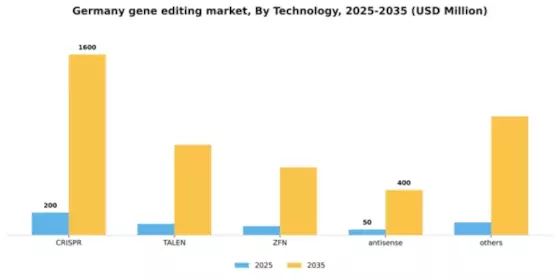
In the Germany gene editing market, the distribution of market share among various technologies reflects a competitive landscape. CRISPR dominates significantly, favored for its precision and efficiency, commanding a substantial share of the market. TALEN, while not as prevalent as CRISPR, shows impressive growth, quickly gaining traction among researchers and biotech companies looking for alternative gene-editing methods. The growth trends in this segment indicate a shift towards more precise gene-editing techniques. Factors driving this growth include increased investment in research and development, heightened demand for personalized medicine, and improvements in gene-editing technologies that enhance reliability and efficacy. As applications expand across health and agriculture, both CRISPR and TALEN are set to play critical roles in advanced genetic modifications.
Technology: CRISPR (Dominant) vs. TALEN (Emerging)
CRISPR is the dominant technology in the gene editing segment, renowned for its ability to deliver precise genomic modifications quickly and efficiently, making it a favorite among researchers and institutions. Its widespread adoption is reflected in numerous studies and commercial applications across various fields, including pharmaceuticals and agriculture. On the other hand, TALEN represents an emerging technology that, while currently smaller in market share compared to CRISPR, is gaining popularity due to its capability to target specific genes with high precision. TALEN's growing recognition is driven by ongoing advancements and successful applications, particularly in therapeutic settings, which position it as a compelling alternative to CRISPR.
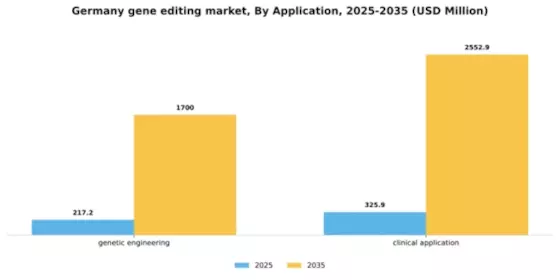
In the Germany gene editing market, genetic engineering holds the largest share, playing a pivotal role in advancements and applications across various sectors such as medicine and agriculture. It is well-established, backed by substantial investments in research and development. On the other hand, clinical applications, while smaller in share, are rapidly gaining traction, driven by innovative therapies and increasing regulatory approvals that enhance their attractiveness in the healthcare sector. Growth trends for the application segment are significantly influenced by technological advancements, particularly in precision medicine. The demand for customized treatments and the integration of gene editing techniques in clinical research have catalyzed the increase of clinical applications. Moreover, public and private funding initiatives are bolstering research in genetic engineering, ensuring its dominant market presence while promoting the rapid evolution of clinical applications aiming for effective disease management and patient care.
Genetic Engineering (Dominant) vs. Clinical Application (Emerging)
Genetic engineering is characterized by its extensive applications in modifying organisms to enhance traits or produce beneficial outcomes, making it indispensable for both agriculture and health sectors. Its dominance is supported by established protocols and a significant body of research. In contrast, clinical applications represent an emerging trend within the gene editing landscape, focusing on therapeutic uses such as correcting genetic disorders. These applications are gaining momentum due to breakthroughs in clinical trials and an increasing number of companies entering the space. The synergy between genetic engineering's solid foundation and the potential for growth in clinical applications creates a dynamic and evolving market environment.
In the Germany gene editing market, the Ex-vivo segment currently holds the largest market share, attributed to its established methodologies and applications within clinical settings. This segment has been predominant due to its effectiveness in cell therapies and therapeutic applications, making it a preferred choice among researchers and medical professionals. On the other hand, the In-Vivo segment, while smaller, is gaining traction as advancements in delivery mechanisms and techniques are making it increasingly viable for applications in genetically modifying organisms directly within a living system. The growth trends of these segments show that In-Vivo is the fastest-growing category within the market, driven by technological innovations that enhance the precision and efficiency of gene editing techniques. Factors such as rising investments in biotechnology, increasing adoption of gene therapies, and regulatory advancements are propelling the demand for In-Vivo methods. In contrast, the Ex-vivo segment continues to thrive, leveraging its established base while adapting to emerging technologies and evolving market needs.
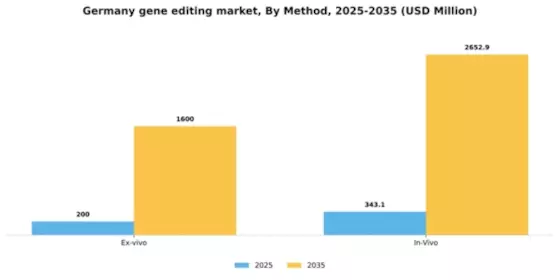
Method: Ex-vivo (Dominant) vs. In-Vivo (Emerging)
The Ex-vivo method is recognized as the dominant approach in the Germany gene editing market, showcasing a solid foothold in therapeutic applications. This method involves the alteration of cells outside the body before reintroduction, allowing for controlled manipulation of genetic material. Its applications are vast, ranging from cancer treatment to hereditary disease corrections. Conversely, the In-Vivo method is emerging rapidly, characterized by its direct manipulation of genes within a living organism. This approach is becoming increasingly important due to the potential for real-time edits and the reduction of complexities associated with cell extraction and re-implantation. The advancements in delivery techniques for In-Vivo applications are driving its market share growth, indicating a shifting focus towards more integrated gene editing solutions.
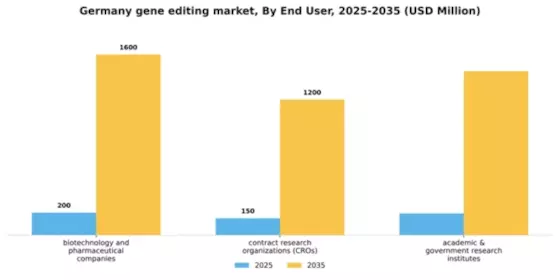
In the Germany gene editing market, the distribution of market share among end users shows a significant dominance of biotechnology and pharmaceutical companies, which leverage gene editing technologies for drug development and therapeutic innovations. These companies benefit from substantial investments in research and development, resulting in a strong foothold in the market. Conversely, academic and government research institutes are gaining traction, driven by grants and funding aimed at advancing scientific knowledge and innovative applications of gene editing technologies. The growth trends in the end user segment are particularly favorable for academic and government research institutes, which are emerging as the fastest-growing segment due to increased collaboration with industry partners and rising government investments in genetic research. This growth is fueled by the ongoing need for innovative solutions in healthcare and agriculture, alongside public interest in gene therapy and genomic research. Biotechnology and pharmaceutical companies continue to expand their capabilities, enhancing their market presence through mergers and acquisitions, thus sustaining their dominant position in the market.
Biotechnology & Pharmaceutical Companies (Dominant) vs. Contract Research Organizations (Emerging)
Biotechnology and pharmaceutical companies represent the dominant force in the end user segment of the Germany gene editing market, characterized by their capacity for large-scale application of gene editing technologies in developing novel therapies and drugs. Their strong investment in R&D not only propels innovation but also positions them as leaders, often setting industry standards and guidelines. In contrast, contract research organizations (CROs) are emerging as vital partners, providing specialized services that support the drug discovery process, including preclinical and clinical trial services. As the demand for external expertise grows, CROs are adapting to provide tailored solutions, amplifying their role within the market. Their agility and focus on niche areas of gene editing research enable them to capture a share of the market, particularly for projects requiring specific technical capabilities.
Get more detailed insights about Germany Gene Editing Market Request Free Sample
The gene editing market in Germany is characterized by a dynamic competitive landscape, driven by rapid technological advancements and increasing investments in research and development. Key players such as Bayer (DE), CRISPR Therapeutics (CH), and Intellia Therapeutics (US) are at the forefront, each adopting distinct strategies to enhance their market positioning. Bayer (DE) focuses on leveraging its extensive agricultural expertise to develop gene editing solutions that address crop resilience and yield improvement, while CRISPR Therapeutics (CH) emphasizes innovation in therapeutic applications, particularly in genetic disorders. Intellia Therapeutics (US) is strategically positioned towards advancing in vivo gene editing technologies, which could potentially revolutionize treatment paradigms for various diseases. Collectively, these strategies contribute to a competitive environment that is increasingly innovation-driven and collaborative.In terms of business tactics, companies are increasingly localizing manufacturing and optimizing supply chains to enhance operational efficiency. The market structure appears moderately fragmented, with a mix of established pharmaceutical giants and emerging biotech firms. This fragmentation allows for diverse approaches to gene editing, fostering a competitive atmosphere where collaboration and partnerships are essential for success. The influence of key players is significant, as they not only drive technological advancements but also shape regulatory frameworks and market access strategies.
In October Bayer (DE) announced a strategic partnership with a leading agricultural technology firm to co-develop gene editing solutions aimed at enhancing crop resilience against climate change. This collaboration is pivotal, as it aligns with global sustainability goals and positions Bayer as a leader in the agricultural gene editing sector. The partnership is expected to accelerate the development of innovative solutions that could significantly impact food security and agricultural productivity.
In September CRISPR Therapeutics (CH) reported the initiation of a pivotal clinical trial for its CRISPR-based therapy targeting sickle cell disease. This move underscores the company's commitment to advancing its therapeutic pipeline and highlights the potential of gene editing in treating genetic disorders. The trial's success could not only validate CRISPR's technology but also enhance its competitive edge in the therapeutic market.
In August Intellia Therapeutics (US) revealed promising preclinical data for its in vivo gene editing platform, showcasing its potential to treat a range of genetic diseases. This announcement is significant as it reinforces Intellia's position as a frontrunner in the gene editing space, potentially attracting further investment and partnerships. The advancements in their technology could lead to breakthroughs that redefine treatment options for patients.
As of November current competitive trends in the gene editing market include a strong emphasis on digitalization, sustainability, and the integration of artificial intelligence in research and development processes. Strategic alliances are increasingly shaping the landscape, enabling companies to pool resources and expertise to accelerate innovation. Looking ahead, competitive differentiation is likely to evolve, with a shift from price-based competition towards a focus on technological innovation, reliability in supply chains, and sustainable practices. This evolution suggests that companies that prioritize these aspects will be better positioned to thrive in the increasingly complex and competitive gene editing market.

Recent developments in the Germany Gene Editing Market highlight significant growth and innovation. Evotec has been expanding its capabilities in gene editing, focusing on partnerships that enhance its Research and Development efforts.
Alnylam Pharmaceuticals is gaining traction with advancements in RNA interference, while Merck KGaA continues to invest in gene editing technologies to strengthen its position in the pharmaceutical sector. In July 2023, Bayer announced a collaboration with CRISPR Therapeutics aimed at developing gene-editing therapies, signifying a strategic move within the industry.
Moreover, Thermo Fisher Scientific has seen growth due to increased demand for gene editing tools and reagents, showcasing the rising interest in genetic technologies. The German government has recently fostered a supportive regulatory environment for biotech innovations, aiming to bolster the sector's contribution to the economy.
Current affairs indicate that mergers and acquisitions are shaping the market landscape; for instance, Corteva and QIAGEN have explored potential collaboration opportunities to leverage complementary technologies. Overall, the Germany Gene Editing Market is experiencing robust advancements, driven by both collaboration and investment, which is positively impacting its growth trajectory.
The Gene Editing Market in Germany is projected to grow at a 20.57% CAGR from 2025 to 2035, driven by advancements in biotechnology, regulatory support, and increasing applications in agriculture and medicine.
New opportunities lie in:
By 2035, the gene editing market is expected to be robust, driven by innovation and strategic investments.
| MARKET SIZE 2024 | 543.12(USD Million) |
| MARKET SIZE 2025 | 654.85(USD Million) |
| MARKET SIZE 2035 | 4252.87(USD Million) |
| COMPOUND ANNUAL GROWTH RATE (CAGR) | 20.57% (2025 - 2035) |
| REPORT COVERAGE | Revenue Forecast, Competitive Landscape, Growth Factors, and Trends |
| BASE YEAR | 2024 |
| Market Forecast Period | 2025 - 2035 |
| Historical Data | 2019 - 2024 |
| Market Forecast Units | USD Million |
| Key Companies Profiled | CRISPR Therapeutics (CH), Editas Medicine (US), Intellia Therapeutics (US), Regeneron Pharmaceuticals (US), Sangamo Therapeutics (US), Vertex Pharmaceuticals (US), Amgen (US), Bayer (DE), Novartis (CH) |
| Segments Covered | Technology, Application, Method, End User |
| Key Market Opportunities | Advancements in gene editing technologies drive innovation in therapeutic applications and agricultural enhancements. |
| Key Market Dynamics | Regulatory advancements and technological innovations drive growth in the gene editing market, enhancing competitive dynamics. |
| Countries Covered | Germany |
The market valuation of the gene editing market in Germany was $543.12 Million in 2024.
The projected market valuation for the gene editing market in Germany is $4252.87 Million by 2035.
The expected CAGR for the gene editing market in Germany during the forecast period 2025 - 2035 is 20.57%.
The CRISPR technology segment had the highest valuation at $200 Million in 2024.
The projected valuation for the genetic engineering application segment is $1700 Million by 2035.
The biotechnology and pharmaceutical companies end user segment is expected to grow significantly, with a valuation of $200 Million in 2024.
The In-Vivo method segment had a valuation of $343.12 Million in 2024.
In 2024, the TALEN technology segment was valued at $100 Million, whereas the ZFN segment was valued at $80 Million.
The clinical application segment is expected to reach a valuation of $2552.87 Million by 2035.
Key players leading the gene editing market in Germany include Bayer (DE), CRISPR Therapeutics (CH), and Novartis (CH).


Kindly complete the form below to receive a free sample of this Report

“This is really good guys. Excellent work on a tight deadline. I will continue to use you going forward and recommend you to others. Nice job”


“Thanks. It’s been a pleasure working with you, please use me as reference with any other Intel employees.”


“Thanks for sending the report it gives us a good global view of the Betaïne market.”


“Thank you, this will be very helpful for OQS.”


“We found the report very insightful! we found your research firm very helpful. I'm sending this email to secure our future business.”


“I am very pleased with how market segments have been defined in a relevant way for my purposes (such as "Portable Freezers & refrigerators" and "last-mile"). In general the report is well structured. Thanks very much for your efforts.”


“I have been reading the first document or the study, ,the Global HVAC and FP market report 2021 till 2026. Must say, good info! I have not gone in depth at all parts, but got a good indication of the data inside!”


“We got the report in time, we really thank you for your support in this process. I also thank to all of your team as they did a great job.”


“The Automotive 48V ECU Components Procurement Intelligence Study” was a complex project, but the Market Research Future (MRFR) team handled it with quality, agility, and customer-centricity. They delivered all requested data on time and within the agreed scope. The team, including Shubhendra Anand and Rahul Gotadki, was always readily available to clarify questions and swiftly implement necessary adjustments, driving the project to a successful conclusion within a very demanding timeframe.
I would also like to specifically commend Akshay Agarwal for his responsiveness and support at every stage—from our initial inquiry on May 6th through to final delivery on June 18th. His dedication made the entire process seamless.”



