Download Free Sample
Kindly complete the form below to receive a free sample of this Report
Germany Pathological Microscopes Market Research Report By Type (Electron Microscope, Optical Microscope, Compound Microscope, Digital Microscope, Fluorescence Microscope, others), By Application (Bodily Fluids, Tissue Scanning, others) and By End User (Pathology and Diagnostic Laboratories, Hospitals & Clinics, Forensic Laboratories, others) -Forecast to 2035
As per Market Research Future analysis, the Germany pathological microscopes market size was estimated at 8.53 USD Million in 2024. The Germany pathological microscopes market is projected to grow from 8.96 USD Million in 2025 to 14.65 USD Million by 2035, exhibiting a compound annual growth rate (CAGR) of 5.0% during the forecast period 2025 - 2035
The Germany pathological microscopes market is experiencing a dynamic shift driven by technological advancements and increasing healthcare demands.
| 2024 Market Size | 8.53 (USD Million) |
| 2035 Market Size | 14.65 (USD Million) |
| CAGR (2025 - 2035) | 5.04% |
Leica Microsystems (DE), Olympus Corporation (JP), Zeiss (DE), Thermo Fisher Scientific (US), Nikon Corporation (JP), Bruker Corporation (US), Motic (CN), Xenon (US)
Our Impact
Enabled $4.3B Revenue Impact for Fortune 500 and Leading Multinationals
Partnering with 2000+ Global Organizations Each Year
30K+ Citations by Top-Tier Firms in the Industry
The pathological microscopes market is currently experiencing notable advancements. These advancements are driven by technological innovations and an increasing demand for precise diagnostic tools. The integration of digital imaging and automation in microscopy enhances the efficiency and accuracy of pathological examinations. Furthermore, the growing emphasis on early disease detection and personalized medicine is propelling the need for sophisticated microscopy solutions. As healthcare providers seek to improve patient outcomes, the adoption of advanced pathological microscopes is likely to rise, reflecting a shift towards more reliable diagnostic practices. In addition, the regulatory landscape in Germany appears to be evolving, with stricter guidelines aimed at ensuring the quality and safety of medical devices. This regulatory focus may influence manufacturers to invest in research and development, fostering innovation within the pathological microscopes market. Moreover, collaborations between academic institutions and industry players are expected to facilitate the development of cutting-edge technologies, further enhancing the capabilities of pathological microscopes. Overall, the market seems poised for growth, driven by technological advancements and a commitment to improving healthcare standards.
The ongoing integration of digital imaging technologies is transforming the pathological microscopes market. Enhanced imaging capabilities allow for more detailed analysis, which is crucial for accurate diagnoses. This trend indicates a shift towards automation and improved user interfaces, making microscopy more accessible to healthcare professionals.
Recent updates in regulatory frameworks are shaping the landscape of the pathological microscopes market. Stricter compliance requirements are prompting manufacturers to prioritize quality and safety in their products. This trend may lead to increased investment in research and development, fostering innovation and enhancing product offerings.
The growing focus on precision medicine is influencing the pathological microscopes market significantly. As healthcare providers aim for tailored treatment approaches, the need for advanced diagnostic tools becomes more pronounced. This trend suggests a potential increase in the adoption of sophisticated microscopy solutions. These solutions will support personalized healthcare initiatives.
Advancements in digital pathology are transforming the landscape of the pathological microscopes market. Digital pathology enables the digitization of glass slides, allowing for remote access and analysis, which is particularly beneficial in a country like Germany with a robust telemedicine framework. The integration of artificial intelligence (AI) in pathology is also gaining traction, enhancing diagnostic accuracy and efficiency. As of 2025, it is estimated that the digital pathology segment could account for over 25% of the total market share. This shift towards digital solutions is likely to attract investments and drive innovation within the pathological microscopes market, as laboratories seek to modernize their operations and improve patient outcomes.
Rising healthcare expenditure in Germany is a pivotal driver for the pathological microscopes market. As the government and private sectors allocate more funds towards healthcare, the demand for advanced diagnostic tools, including pathological microscopes, is likely to increase. In 2024, healthcare spending in Germany reached approximately €450 billion, reflecting a growth of around 4% from the previous year. This trend suggests that hospitals and laboratories are investing in state-of-the-art equipment to enhance diagnostic accuracy and efficiency. Consequently, the pathological microscopes market is expected to benefit from this increased financial commitment, as healthcare facilities seek to upgrade their diagnostic capabilities to meet the growing patient needs.
Emphasis on training and education in pathology significantly impacts the pathological microscopes market. As the field of pathology evolves, there is a growing need for skilled professionals who can effectively utilize advanced microscopy technologies. Educational institutions in Germany are increasingly incorporating modern microscopy techniques into their curricula, ensuring that future pathologists are well-equipped to handle contemporary diagnostic challenges. This focus on education is likely to enhance the demand for high-quality pathological microscopes, as training programs require access to state-of-the-art equipment. Consequently, the market may see a surge in sales as educational institutions and healthcare facilities invest in the latest microscopy technologies to support their training initiatives.
The escalating prevalence of chronic diseases in Germany significantly influences the pathological microscopes market. Conditions such as cancer, diabetes, and cardiovascular diseases necessitate precise diagnostic tools for effective management and treatment. According to recent statistics, nearly 30% of the German population is affected by chronic diseases, which underscores the urgent need for advanced diagnostic solutions. This growing patient demographic is likely to drive the demand for pathological microscopes, as healthcare providers require reliable instruments to conduct thorough examinations and provide accurate diagnoses. The market is poised for growth as the healthcare sector adapts to these challenges by investing in innovative microscopy technologies.
Increasing focus on research and development (R&D) in Germany is a crucial driver for the pathological microscopes market. With numerous research institutions and universities dedicated to advancing medical science, there is a heightened demand for sophisticated microscopy tools. The German government has been actively promoting R&D initiatives, allocating approximately €20 billion annually to support scientific research. This investment fosters innovation in microscopy technologies, leading to the development of more advanced pathological microscopes. As researchers seek to explore new frontiers in medical science, the pathological microscopes market is likely to experience growth driven by the need for cutting-edge equipment that can facilitate groundbreaking discoveries.
The Germany pathological microscopes market displays a diverse segmentation by application, with Digital Microscopes commanding the largest market share due to their advanced imaging capabilities and user-friendly interfaces. Fluorescence Microscopes are emerging as the fastest-growing segment, driven by increasing demand in research and clinical applications that require precise and sensitive detection of biological materials. Growth trends in this segment are predominantly influenced by technological advancements and rising applications across various fields, such as pathology, biotechnology, and clinical diagnostics. Digital Microscopes continue to dominate due to their integration with imaging software and ease of use, while Fluorescence Microscopes are rapidly gaining traction owing to innovations in labeling techniques and their ability to provide real-time imaging of live cells, enhancing research capabilities.
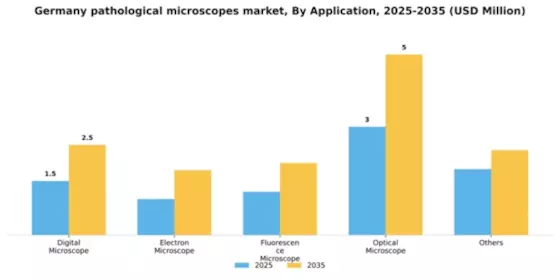
Digital Microscope (Dominant) vs. Fluorescence Microscope (Emerging)
Digital Microscopes are characterized by their high-resolution imaging and versatility, making them widely utilized in educational and clinical settings. This dominant segment offers advanced features such as live imaging and digital capture, crucial for accurate diagnostics. In contrast, Fluorescence Microscopes, classified as an emerging segment, are at the forefront of scientific research, providing unique capabilities to visualize cellular processes with high specificity through fluorophore labeling. Their ability to detect multiple targets simultaneously positions them as essential tools in molecular biology and pathology, driving their rapid adoption in laboratories focused on innovative research.
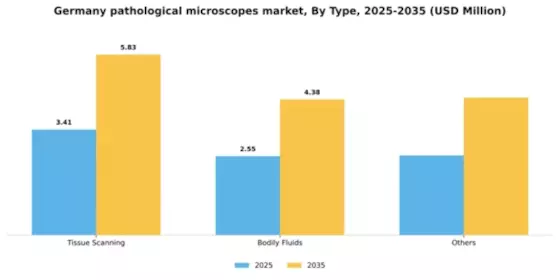
The Germany pathological microscopes market displays a dynamic segmentation in the Type category, with Tissue Scanning leading in market share. This segment captures significant interest due to its essential role in histopathology, driving a robust demand among healthcare facilities. Bodily Fluids, although smaller in market share, showcases rapid growth owing to advancements in diagnostic technologies, elevating its importance in clinical settings. Growth trends indicate an increasing reliance on Tissue Scanning in the diagnostics process, spurred by its accuracy and efficacy. Meanwhile, the Bodily Fluids segment is experiencing a surge in popularity due to the adoption of minimally invasive techniques, aligning with current healthcare trends. Both segments are poised to grow, reflecting advancements and increased applications in pathology.
Tissue Scanning (Dominant) vs. Bodily Fluids (Emerging)
Tissue Scanning holds the dominant position in the Type segment, favored for its precision in detecting cellular anomalies and facilitating accurate diagnoses. Its technological robustness and established protocols make it a staple in laboratories. Conversely, the Bodily Fluids segment is emerging rapidly, driven by innovations in techniques such as liquid biopsies and point-of-care testing. These advancements allow for efficient analysis with lower sample volumes, catering to a growing demand for rapid and accurate diagnostics. The juxtaposition of these segments underscores the evolving landscape of pathological analysis, highlighting how traditional methods are complemented by new, innovative approaches.
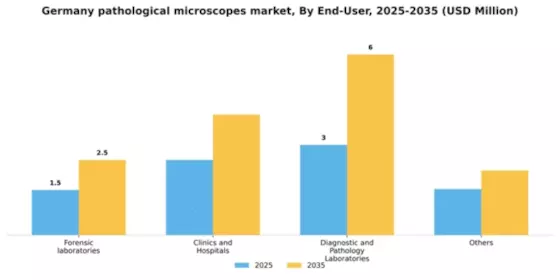
In the Germany pathological microscopes market, Diagnostic and Pathology Laboratories hold the largest share, driven by a high demand for accurate diagnostics and disease identification. Forensic Laboratories and Clinics and Hospitals also contribute significantly but to a lesser extent. Others segment, while present, encapsulates niche requirements that do not compete with the primary segments dominating the market. The growth trends indicate a robust increase in demand for pathological microscopes, particularly in Clinics and Hospitals, which are adopting advanced technologies to enhance diagnostic capabilities. Factors like an increasing prevalence of chronic diseases and a greater focus on early detection are driving growth in this sector. Forensic Laboratories, while stable, are witnessing slower growth compared to emerging segments, indicating a shift in market dynamics.
Diagnostic and Pathology Laboratories (Dominant) vs. Clinics and Hospitals (Emerging)
Diagnostic and Pathology Laboratories serve as the backbone of the Germany pathological microscopes market, characterized by their extensive use of advanced microscopy for detailed analysis and diagnostics. These facilities invest in high-quality microscopes to ensure accurate results, making them the dominant segment. Conversely, Clinics and Hospitals represent an emerging segment that is rapidly adopting innovative microscopy solutions. Their focus on improving patient outcomes drives demand, leading to a trend where they integrate advanced technologies at an accelerated pace. This segment's growth is propelled by the emphasis on timely and accurate diagnostics, thus reshaping their role in the overall healthcare framework.
Get more detailed insights about Germany Pathological Microscopes Market Request Free Sample
The pathological microscopes market in Germany is characterized by a competitive landscape that is increasingly shaped by technological advancements and strategic collaborations. Key players such as Leica Microsystems (DE), Zeiss (DE), and Thermo Fisher Scientific (US) are at the forefront, leveraging innovation and regional expansion to enhance their market presence. These companies appear to focus on integrating advanced imaging technologies and automation into their product offerings, which not only improves diagnostic accuracy but also streamlines laboratory workflows. The collective strategies of these firms suggest a trend towards a more interconnected and technologically sophisticated market environment.In terms of business tactics, companies are increasingly localizing manufacturing to reduce lead times and optimize supply chains. The market structure is moderately fragmented, with several players vying for market share, yet the influence of major companies remains substantial. This competitive dynamic fosters an environment where innovation is paramount, as firms strive to differentiate themselves through unique product features and enhanced customer service.In October Leica Microsystems (DE) announced the launch of a new line of digital pathology solutions aimed at improving remote diagnostics. This strategic move is significant as it aligns with the growing demand for telepathology, particularly in light of the increasing need for efficient diagnostic processes. By enhancing their digital offerings, Leica Microsystems positions itself to capture a larger share of the market, catering to the evolving needs of healthcare providers.In September Zeiss (DE) expanded its partnership with a leading biotechnology firm to co-develop advanced imaging systems that integrate artificial intelligence (AI) capabilities. This collaboration is noteworthy as it underscores Zeiss's commitment to innovation and its strategic focus on AI integration, which is likely to enhance the precision and efficiency of pathological analysis. Such partnerships may also facilitate the development of next-generation microscopy solutions that could redefine diagnostic standards.In August Thermo Fisher Scientific (US) completed the acquisition of a smaller competitor specializing in high-resolution imaging technologies. This acquisition is indicative of a broader trend where larger firms seek to bolster their technological capabilities through strategic mergers. By integrating these advanced technologies, Thermo Fisher aims to enhance its product portfolio and maintain a competitive edge in the market.As of November the competitive trends in the pathological microscopes market are increasingly defined by digitalization, sustainability, and the integration of AI. Strategic alliances are playing a crucial role in shaping the landscape, enabling companies to pool resources and expertise to drive innovation. Looking ahead, it is anticipated that competitive differentiation will evolve, with a shift from price-based competition to a focus on technological innovation and supply chain reliability. This transition may ultimately lead to a more resilient and adaptive market, where companies that prioritize innovation and customer-centric solutions are likely to thrive.




The Germany Pathological Microscopes Market has been witnessing significant developments with an increasing emphasis on digital pathology and automation. Companies such as Leica Microsystems, Olympus, and Zeiss are investing heavily in Research and Development, focusing on advanced imaging technologies to improve diagnostic accuracy.
In terms of mergers and acquisitions, notable activity was observed in March 2023, when Thermo Fisher Scientific acquired a microscopy solutions provider to enhance its portfolio in life sciences. Growth in the market valuation is evident, driven by rising demand for high-resolution imaging solutions in hospitals and laboratories.
Additionally, Motic and Vision Engineering announced strategic partnerships in June 2023 to facilitate better distribution channels in Germany, thereby expanding their market reach. The German government continues to promote innovation in the healthcare sector with funding initiatives that support research projects related to microscopic technologies.
Over the last two years, advancements in artificial intelligence and machine learning have significantly impacted operational efficiencies, marking a transition in how microscopic analysis is performed and interpreted in clinical settings across Germany. The increased focus on digital health technology is reshaping the industry, making it pivotal to stay ahead in the rapidly evolving market landscape.
The Pathological Microscopes Market is projected to grow at a 5.04% CAGR from 2025 to 2035, driven by technological advancements, increasing healthcare investments, and rising demand for diagnostic tools.
New opportunities lie in:
By 2035, the market is expected to achieve robust growth, driven by innovation and strategic partnerships.
| MARKET SIZE 2024 | 8.53(USD Million) |
| MARKET SIZE 2025 | 8.96(USD Million) |
| MARKET SIZE 2035 | 14.65(USD Million) |
| COMPOUND ANNUAL GROWTH RATE (CAGR) | 5.04% (2025 - 2035) |
| REPORT COVERAGE | Revenue Forecast, Competitive Landscape, Growth Factors, and Trends |
| BASE YEAR | 2024 |
| Market Forecast Period | 2025 - 2035 |
| Historical Data | 2019 - 2024 |
| Market Forecast Units | USD Million |
| Key Companies Profiled | Leica Microsystems (DE), Olympus Corporation (JP), Zeiss (DE), Thermo Fisher Scientific (US), Nikon Corporation (JP), Bruker Corporation (US), Motic (CN), Xenon (US) |
| Segments Covered | Application, Type, End-User |
| Key Market Opportunities | Advancements in digital pathology enhance diagnostic accuracy in the pathological microscopes market. |
| Key Market Dynamics | Technological advancements drive innovation in the pathological microscopes market, enhancing diagnostic accuracy and efficiency. |
| Countries Covered | Germany |
The overall market valuation for pathological microscopes was $8.53 Million in 2024.
The projected market valuation for pathological microscopes is $14.65 Million by 2035.
The expected CAGR for the Germany pathological microscopes market during 2025 - 2035 is 5.04%.
Key players in the market include Leica Microsystems (DE), Olympus Corporation (JP), Zeiss (DE), and Thermo Fisher Scientific (US), among others.
In 2024, the Optical Microscope segment had the highest valuation at $5.0 Million.
The projected valuation for the Tissue Scanning segment is $5.83 Million by 2035.
The Clinics and Hospitals segment generated $2.5 Million in 2024.
The Electron Microscope segment is expected to grow from $1.0 Million in 2024 to $1.8 Million by 2035.
The Diagnostic and Pathology Laboratories segment is projected to have the highest valuation at $6.0 Million by 2035.
The Others segment in the application category had a valuation range of $1.83 Million to $2.35 Million in 2024.


Kindly complete the form below to receive a free sample of this Report

“This is really good guys. Excellent work on a tight deadline. I will continue to use you going forward and recommend you to others. Nice job”


“Thanks. It’s been a pleasure working with you, please use me as reference with any other Intel employees.”


“Thanks for sending the report it gives us a good global view of the Betaïne market.”


“Thank you, this will be very helpful for OQS.”


“We found the report very insightful! we found your research firm very helpful. I'm sending this email to secure our future business.”


“I am very pleased with how market segments have been defined in a relevant way for my purposes (such as "Portable Freezers & refrigerators" and "last-mile"). In general the report is well structured. Thanks very much for your efforts.”


“I have been reading the first document or the study, ,the Global HVAC and FP market report 2021 till 2026. Must say, good info! I have not gone in depth at all parts, but got a good indication of the data inside!”


“We got the report in time, we really thank you for your support in this process. I also thank to all of your team as they did a great job.”


“The Automotive 48V ECU Components Procurement Intelligence Study” was a complex project, but the Market Research Future (MRFR) team handled it with quality, agility, and customer-centricity. They delivered all requested data on time and within the agreed scope. The team, including Shubhendra Anand and Rahul Gotadki, was always readily available to clarify questions and swiftly implement necessary adjustments, driving the project to a successful conclusion within a very demanding timeframe.
I would also like to specifically commend Akshay Agarwal for his responsiveness and support at every stage—from our initial inquiry on May 6th through to final delivery on June 18th. His dedication made the entire process seamless.”



