×
Request Free Sample ×

Kindly complete the form below to receive a free sample of this Report

* Please use a valid business email

Leading companies partner with us for data-driven Insights

clients tt-cursor
Hero Background

Germany Video Processing Platform Market

ID: MRFR/ICT/61097-HCR
200 Pages
Aarti Dhapte
October 2025

Germany Video Processing Platform Market Research Report By Component (Hardware, Platform, Services), By Application (Video Upload and Ingestion, Dynamic Ad Insertion, Video Transcoding and Processing, Video Hosting, Content Rendering), By Content Type (Real-Time/Live, On-Demand), By End User (TV Broadcasters, Network Operators, Content Providers) and By Verticals (BFSI, Manufacturing, IT and Telecommunications, Retail and Consumer Goods, Media and Entertainment)- Forecast to 2035

Share:
Download PDF ×

We do not share your information with anyone. However, we may send you emails based on your report interest from time to time. You may contact us at any time to opt-out.

Germany Video Processing Platform Market Infographic
Purchase Options

Germany Video Processing Platform Market Summary

As per analysis, the Germany video processing platform market is projected to grow from USD 628 Million in 2024 to USD 724 Million in 2025, ultimately reaching USD 3.54 Billion by 2035, exhibiting a compound annual growth rate (CAGR) of 17.02% during the forecast period (2025 - 2035).

Key Market Trends & Highlights

The Germany video processing platform market is experiencing a transformative shift towards cloud-based solutions and AI integration.

  • The video editing segment remains the largest contributor to the market, driven by increasing content creation demands.
  • Live streaming is emerging as the fastest-growing segment, reflecting a surge in real-time content consumption.
  • The media and entertainment sector continues to dominate, while the education sector is rapidly expanding its video processing needs.
  • Key market drivers include the growing demand for streaming services and advancements in video compression technologies.

Market Size & Forecast

2024 Market Size 0.628 (USD Million)
2035 Market Size 3.54 (USD Million)
CAGR (2025 - 2035) 17.02%

Major Players

Adobe (DE), Avid Technology (DE), Blackmagic Design (DE), Telestream (DE), Haivision (DE), Wowza Media Systems (DE), Vimeo (DE), Zencoder (DE), Kaltura (DE)

Germany Video Processing Platform Market Trends

The Germany video processing platform market is currently experiencing a dynamic evolution, driven by advancements in technology and increasing demand for high-quality video content. The proliferation of digital media consumption has led to a surge in the need for efficient video processing solutions. As organizations across various sectors, including entertainment, education, and corporate communications, seek to enhance their video capabilities, the market is adapting to meet these diverse requirements. Furthermore, the integration of artificial intelligence and machine learning into video processing platforms is reshaping the landscape, enabling more sophisticated editing, real-time analytics, and improved user experiences. In addition, the regulatory environment in Germany plays a crucial role in shaping the video processing platform market. Compliance with data protection laws, such as the General Data Protection Regulation (GDPR), influences how companies develop and implement their video solutions. This regulatory framework encourages innovation while ensuring that user privacy is maintained. As the market continues to grow, stakeholders must navigate these complexities to leverage opportunities effectively. Overall, the Germany video processing platform market appears poised for continued expansion, driven by technological advancements and a strong focus on compliance and user experience.

Rise of Cloud-Based Solutions

The trend towards cloud-based video processing platforms is gaining traction in Germany. Organizations are increasingly adopting these solutions due to their scalability, flexibility, and cost-effectiveness. Cloud technology allows for seamless collaboration and access to resources, enabling users to process and edit videos from anywhere. This shift is particularly beneficial for businesses that require remote work capabilities and efficient resource management.

Integration of AI and Automation

The incorporation of artificial intelligence and automation into video processing platforms is transforming the industry in Germany. These technologies enhance video editing, improve content personalization, and streamline workflows. By automating repetitive tasks, companies can focus on creative aspects, thereby increasing productivity and efficiency. This trend indicates a move towards more intelligent and user-friendly video solutions.

Focus on Compliance and Security

As data protection regulations become more stringent, the Germany video processing platform market is placing a heightened emphasis on compliance and security. Companies are investing in solutions that ensure adherence to GDPR and other relevant laws. This focus not only protects user data but also builds trust with consumers, which is essential for long-term success in the market.

Market Segment Insights

By Application: Video Editing (Largest) vs. Live Streaming (Fastest-Growing)

In the Germany video processing platform market, the application segment displays a diverse distribution of usage. Video Editing commands a significant portion of the market, driven by its integration into both professional and amateur content creation. Meanwhile, Live Streaming is not only garnering attention for its growth but is also rapidly evolving due to rising demand for real-time content delivery. Other applications, such as Video Conferencing and Content Delivery, play crucial supportive roles, ensuring a well-rounded market landscape. The growth trends for these segments are largely influenced by changing consumer behaviors and technological advancements. The recent surge in remote work and online platforms has propelled the Live Streaming segment to the forefront, while Video Editing remains a staple due to its established presence in filmmaking and social media. Technological innovations, such as improved editing software and better streaming capabilities, continue to drive the market forward, fostering a competitive environment among various application segments.

Video Editing (Dominant) vs. Video Surveillance (Emerging)

Video Editing stands out as the dominant application within the Germany video processing platform market, characterized by its widespread adoption across various sectors, including entertainment, marketing, and education. The high demand for quality content has established this segment as a formidable player, enabling users to produce professional-grade materials easily. In contrast, Video Surveillance is an emerging segment, gaining traction due to increasing security concerns and advancements in monitoring technology. The growth of AI-driven analytics in Video Surveillance enhances its appeal, especially among businesses looking to ensure safety and protect assets. While Video Editing serves established markets, Video Surveillance is poised for growth, driven by innovation and increasing reliance on security solutions.

By End Use: Media and Entertainment (Largest) vs. Education (Fastest-Growing)

In the Germany video processing platform market, the distribution of market share among various end-use segments reveals that Media and Entertainment constitutes the largest share. This segment is the primary consumer of video processing technologies, driven by increased demand for streaming services, content creation, and digital media consumption. Meanwhile, Education, while comparatively smaller, showcases significant potential for growth as digital learning platforms gain traction in German institutions. The growth trends in these segments indicate a clear shift towards digitization. Media and Entertainment continues to thrive as companies invest in high-quality content delivery and viewer engagement solutions. On the other hand, the Education sector is experiencing an explosive rise in demand for video-based learning tools, spurred by the adoption of hybrid learning models and the necessity for online education resources. This shift presents substantial opportunities for video processing solutions tailored specifically for educational purposes.

Media and Entertainment: Dominant vs. Education: Emerging

In the context of the Germany video processing platform market, Media and Entertainment remains the dominant force, largely due to its extensive integration of video processing technologies for streaming, broadcasting, and content production. This traditional segment has seen continuous innovation, leveraging advanced video codecs and real-time processing capabilities to enhance viewer experiences. Conversely, the Education segment is emerging rapidly, adopting video processing for lessons, webinars, and interactive content at an unprecedented rate. Educational institutions are increasingly utilizing video tools to facilitate remote learning, thus creating a burgeoning demand for tailored solutions that cater to this segment's unique requirements. The contrast between these segments highlights a classic case of established versus emerging markets, each with distinctive demands and growth trajectories.

By Deployment Type: Cloud-Based (Largest) vs. On-Premises (Fastest-Growing)

In the Germany video processing platform market, deployment types are diversely utilized, with Cloud-Based solutions holding the largest share. This large share is attributed to the rising demand for scalable, flexible, and cost-efficient platforms among media firms. On-Premises deployment follows closely, catering to organizations that prioritize security and control over their data. Hybrid deployment is also present, balancing the need for both cloud and on-premises solutions but remains smaller in share compared to the other two types. Growth trends indicate that while Cloud-Based platforms continue to dominate the market due to increased adoption of remote working and streaming services, On-Premises solutions are rapidly gaining traction. This growth is driven by security concerns and the need for organizations to maintain greater control over their data amidst rising cyber threats. Moreover, the advent of hybrid deployment strategies is enabling a new wave of flexibility as companies seek to adapt to changing market needs.

Cloud-Based (Dominant) vs. On-Premises (Emerging)

Cloud-Based video processing platforms are at the forefront of the Germany market, emphasizing operational flexibility, lower upfront costs, and ease of integration with other cloud services. These solutions allow content creators and distributors to scale their operations efficiently while utilizing advanced technologies like AI and machine learning for processing and analytics. Conversely, On-Premises solutions have emerged as a strong contender, particularly among industries with stringent security regulations, such as healthcare and finance. These platforms offer complete data control and mitigate risks associated with data breaches. However, as businesses increasingly shift towards digital transformation, the requirement for hybrid models that combine the strengths of both deployment types is likely to rise, fostering competition and innovation.

By Technology: Artificial Intelligence (Largest) vs. Machine Learning (Fastest-Growing)

In the Germany video processing platform market, Artificial Intelligence (AI) holds the largest market share among the technology segments, primarily due to its extensive application in various video enhancement techniques and content analysis. It dominates the market as businesses increasingly adopt AI-driven solutions to improve user engagement and operational efficiency, thereby leading to a substantial share position in the segment. On the other hand, Machine Learning (ML) is identified as the fastest-growing segment within this market, as it enables continuous learning and adaptation of video processing algorithms. The dynamic nature of ML technologies allows platforms to deliver more personalized content and improve processing capabilities, significantly contributing to the development of innovative solutions. The acceleration in ML adoption is expected to continue as organizations seek to leverage data for competitive advantage.

Technology: Artificial Intelligence (Dominant) vs. Machine Learning (Emerging)

Artificial Intelligence stands as the dominant technology in the Germany video processing platform market, showcasing substantial robustness in applications such as video content recognition, automated editing, and real-time enhancement. The strategic deployment of AI technologies offers companies the ability to analyze and interpret vast amounts of video data, thereby enhancing user experiences and operational processes. In contrast, Machine Learning emerges as a progressive force, rapidly gaining traction in the sector. Its capability to enable real-time data analysis and adapt to user preferences makes it pivotal for content providers aiming to stay ahead. While AI ensures reliability, ML’s innovative applications position it as an essential tool for future growth, facilitating more intelligent and responsive video processing solutions.

By User Type: Small and Medium Enterprises (Largest) vs. Individual Users (Fastest-Growing)

In the German video processing platform market, Small and Medium Enterprises (SMEs) account for the largest share, leveraging video processing solutions to enhance their marketing efforts and client engagement. Individual Users, though a smaller segment, are witnessing a robust increase, driven by the growing demand for personalized content creation and streaming services. The competitive landscape is characterized by a diverse array of service providers catering to the unique needs of both segments, resulting in dynamic growth patterns. The increasing adoption of digital platforms has propelled growth in the Individual Users segment, as consumers seek to create and share video content more easily. In contrast, SMEs are focusing on integrating advanced video processing technologies into their operational frameworks, aiming to improve customer interaction. This dual trend signifies a shift in how the market is evolving, highlighting the importance of scalable solutions that support both individual creativity and business productivity.

Small and Medium Enterprises (Dominant) vs. Individual Users (Emerging)

Small and Medium Enterprises (SMEs) form the cornerstone of the video processing platform landscape in Germany, benefiting from tailored solutions that enhance their operational capabilities and marketing effectiveness. These businesses prioritize employing robust video editing and processing platforms to deliver high-quality content and engage audiences across multiple channels. Conversely, the Individual Users segment is emerging as a significant force, characterized by a growing appetite for user-friendly tools that enable easy content creation and sharing. This rise among individual creators highlights a cultural shift toward more democratized access to content tools, fostering a creative ecosystem where everyone can participate.

Get more detailed insights about Germany Video Processing Platform Market

Key Players and Competitive Insights

The video processing platform market in Germany is characterized by a dynamic competitive landscape, driven by rapid technological advancements and increasing demand for high-quality content delivery. Key players such as Adobe (DE), Avid Technology (DE), and Blackmagic Design (DE) are at the forefront, each adopting distinct strategies to enhance their market positioning. Adobe (DE) focuses on innovation through continuous software updates and integration of AI capabilities, while Avid Technology (DE) emphasizes partnerships with media companies to expand its reach. Blackmagic Design (DE) leverages cost-effective solutions to attract a diverse customer base, thereby shaping a competitive environment that is both innovative and price-sensitive.

The market structure appears moderately fragmented, with several players vying for market share. Key business tactics include localizing manufacturing to reduce costs and optimizing supply chains to enhance efficiency. This fragmentation allows for a variety of offerings, catering to different segments of the market, from professional filmmakers to amateur content creators. The collective influence of these companies fosters a competitive atmosphere where innovation and customer-centric solutions are paramount.

In November 2025, Adobe (DE) announced the launch of its latest video editing software, which integrates advanced AI features for automated editing and content suggestions. This strategic move is likely to enhance user experience and streamline workflows, positioning Adobe (DE) as a leader in the creative software space. The incorporation of AI not only reflects current technological trends but also addresses the growing demand for efficiency in content production.

In October 2025, Avid Technology (DE) expanded its partnership with a major broadcasting network, enabling the integration of its video processing solutions into the network's existing infrastructure. This collaboration is significant as it underscores Avid's commitment to enhancing its service offerings and solidifying its presence in the broadcast sector. Such strategic alliances may facilitate access to new markets and bolster Avid's competitive edge.

In September 2025, Blackmagic Design (DE) unveiled a new line of affordable video processing hardware aimed at independent filmmakers. This initiative is indicative of Blackmagic's strategy to democratize access to high-quality video production tools. By targeting this niche market, Blackmagic (DE) not only expands its customer base but also reinforces its reputation as a cost-effective solution provider in a competitive landscape.

As of December 2025, current trends in the video processing platform market include a pronounced shift towards digitalization, sustainability, and AI integration. Strategic alliances among key players are increasingly shaping the competitive landscape, fostering innovation and collaboration. Looking ahead, competitive differentiation is likely to evolve, with a greater emphasis on technological advancements and supply chain reliability rather than solely on price. This shift suggests that companies will need to invest in innovative solutions to maintain their competitive advantage in an ever-evolving market.


Key Companies in the Germany Video Processing Platform Market market include

Industry Developments

Blackmagic Design announced a partnership with prominent German broadcasters in September 2023 to provide advanced live streaming and video production solutions that meet the increasing demand for high-quality, real-time content in Germany.Adobe strengthened its competitive position in the German market by introducing new Creative Cloud features in August 2023, such as AI-assisted workflows and enhanced video editing tools.In 2023, Hewlett Packard Enterprise reported an increase in demand for hybrid cloud video processing solutions, which is consistent with the digital transformation initiatives and the production of video content in German industries.

NVIDIA leveraged its advanced GPU technology to enhance the efficacy of video encoding and the quality of content for enterprises and creators in Germany in 2023, thereby expanding its video processing platform offerings.Telestream acquired a video analytics company in July 2023, which improved its real-time video processing and analytics capabilities to better meet the changing requirements of streaming platforms and broadcasters.

Future Outlook

Germany Video Processing Platform Market Future Outlook

The Germany video processing platform market is poised for growth at 17.02% CAGR from 2024 to 2035, driven by increasing demand for high-quality video content and advancements in AI technology.

New opportunities lie in:

  • Development of AI-driven video editing tools for content creators.
  • Expansion of cloud-based video processing services for enterprises.
  • Integration of real-time analytics in video streaming platforms.

By 2035, the market is expected to be robust, reflecting substantial advancements and increased adoption.

Market Segmentation

Germany Video Processing Platform Market End Use Outlook

  • Media and Entertainment
  • Education
  • Corporate
  • Healthcare
  • Government

Germany Video Processing Platform Market User Type Outlook

  • Individual Users
  • Small and Medium Enterprises
  • Large Enterprises

Germany Video Processing Platform Market Technology Outlook

  • Artificial Intelligence
  • Machine Learning
  • Real-Time Processing
  • 4K and 8K Processing

Germany Video Processing Platform Market Application Outlook

  • Video Editing
  • Live Streaming
  • Video Conferencing
  • Content Delivery
  • Video Surveillance

Germany Video Processing Platform Market Deployment Type Outlook

  • Cloud-Based
  • On-Premises
  • Hybrid

Report Scope

MARKET SIZE 20240.628(USD Million)
MARKET SIZE 20250.724(USD Million)
MARKET SIZE 20353.54(USD Million)
COMPOUND ANNUAL GROWTH RATE (CAGR)17.02% (2024 - 2035)
REPORT COVERAGERevenue Forecast, Competitive Landscape, Growth Factors, and Trends
BASE YEAR2024
Market Forecast Period2025 - 2035
Historical Data2019 - 2024
Market Forecast UnitsUSD Million
Key Companies ProfiledAdobe (DE), Avid Technology (DE), Blackmagic Design (DE), Telestream (DE), Haivision (DE), Wowza Media Systems (DE), Vimeo (DE), Zencoder (DE), Kaltura (DE)
Segments CoveredApplication, End Use, Deployment Type, Technology, User Type
Key Market OpportunitiesGrowing demand for real-time video processing solutions in Germany's expanding digital media landscape.
Key Market DynamicsGrowing demand for high-definition content drives innovation in Germany's video processing platform market.
Countries CoveredGermany

Leave a Comment

FAQs

What is the projected market size of the Germany Video Processing Platform Market in 2024?

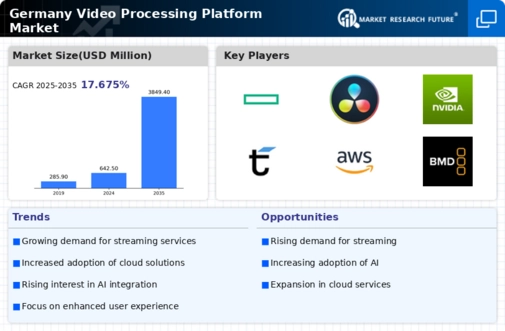
The Germany Video Processing Platform Market is expected to be valued at 642.49 million USD in 2024.

What is the expected market size for the Germany Video Processing Platform Market by 2035?

By 2035, the market is projected to reach a valuation of 3849.36 million USD.

What is the expected compound annual growth rate (CAGR) of the Germany Video Processing Platform Market from 2025 to 2035?

The expected CAGR for the market is 17.675% for the period from 2025 to 2035.

Which component segment of the Germany Video Processing Platform Market is valued the highest in 2024?

In 2024, the Hardware component segment is valued at 180.0 million USD.

What will the valuation of the Platform segment in the Germany Video Processing Platform Market be in 2035?

The Platform segment is expected to be valued at 1500.0 million USD by 2035.

Who are the major players in the Germany Video Processing Platform Market?

Key players in the market include Hewlett Packard Enterprise, Nvidia, Adobe, and Amazon, among others.

What is the market value of the Services segment in 2024?

The Services segment is projected to be valued at 212.49 million USD in 2024.

How is the growth rate of the Germany Video Processing Platform Market expected to affect the industry?

The market's strong growth rate is anticipated to enhance competition and innovation within the industry.

What opportunities are present in the Germany Video Processing Platform Market?

The rise in video content consumption presents significant opportunities for growth in this market.

Which segment shows the highest growth potential from 2025 to 2035 within the Germany Video Processing Platform Market?

The Platform segment exhibits high growth potential, expected to increase significantly by 2035.

Download Free Sample

Kindly complete the form below to receive a free sample of this Report

Compare Licence

×
Features License Type
Single User Multiuser License Enterprise User
Price $4,950 $5,950 $7,250
Maximum User Access Limit 1 User Upto 10 Users Unrestricted Access Throughout the Organization
Free Customization
Direct Access to Analyst
Deliverable Format
Platform Access
Discount on Next Purchase 10% 15% 15%
Printable Versions