Distributed Control System Market (2025 - 2035)

Distributed Control System Market Size, Share & Growth Analysis Report By Component (Hardware, Software, Services), By Architecture (Hybrid / Distributed-Hybrid Systems, Centralized Controller Systems, Other Architectures), By Deployment Model (On-Premise, Cloud / Edge-Hosted), By Industry Vertical (Oil & Gas, Pharmaceuticals & Life Sciences, Power & Utilities, Chemicals, Others), By Plant Size (Large, Medium, Small) and By Regional (North America, Europe, South America, Asia Pacific, Middle East and Africa) – Industry Growth & Forecast to 2035
ID: MRFR/EnP/1166-CR
188 Pages
Chitranshi Jaiswal
Last Updated: July 10, 2026
Distributed Control System Market
Market Size
Forecast Period2025-2035
CAGR (2025-2035)5.74%
2025 Market SizeUSD 24.10 Billion
2035 Market SizeUSD 42.11 Billion
Key Players
Emerson Electric Co.
ABB Ltd.
Honeywell International Inc.
Siemens AG
Yokogawa Electric Corporation
Schneider Electric SE
Opportunities
  • Subscription-Based DCS-as-a-Service Models
  • Carbon-Capture-Ready Controller Platforms
  • Emerging-Market Small-Plant Digitization

Global Distributed Control System Market Summary

The Distributed Control System Market was valued at USD 24.10 billion in 2025 and is projected to grow from USD 25.48 billion in 2026 to USD 42.11 billion by 2035, expanding at a 5.74% CAGR during the forecast period. Two capital-intensive trends anchor this trajectory: a global wave of refinery brownfield retrofits — driven by tightening IEC 61511 functional-safety mandates [1] — and the rapid build-out of green-hydrogen electrolyzer trains that require tight closed-loop control across hundreds of I/O points [2]. Both catalysts channel sustained investment into controller hardware, engineering services, and increasingly, cloud-connected analytics software.

Many asset owners were not prepared for the rapid end-of-support of legacy proprietary control platforms installed in the 1990s and early 2000s. According to a 2024 ARC Advisory Group poll [3], hyperscale cloud providers currently collaborate with controller OEMs to provide consumption-based supervisory workloads, which can reduce commissioning timeframes by up to 35%. In the Distributed Control System Market, operators' allocation of capital versus operating budgets is changing as a result of the transition from periodic control-room upgrades to subscription-based predictive-maintenance modules.

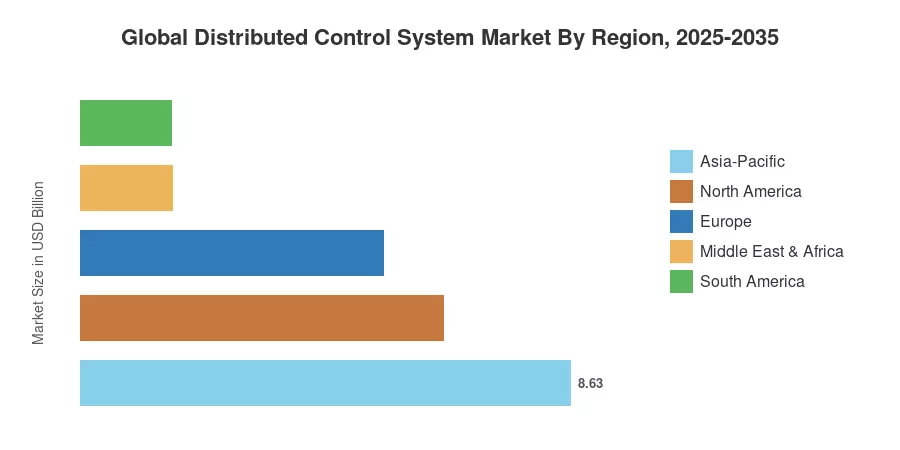
With 35.8% of the 2025 Distributed Control System Market, Asia-Pacific holds the biggest revenue share, driven by India's refinery capacity increases under the Hydrocarbon Vision 2030 program and China's coal-to-gas conversion regulations [4]. With a CAGR of 6.72%, the Middle East and Africa area is expected to grow at the fastest rate due to Saudi Arabia's efforts to diversify downstream. Due to carbon-capture retrofit spending along the U.S. Gulf Coast, North America has the second-largest share at 26.5%. The distributed control system market is set for ten years of consistent, policy-backed growth as decarbonization regulations tighten globally.


Key Report Takeaways

• By Component & Architecture

  • Hardware accounted for 52.2% of the Distributed Control System Market in 2025, reflecting the capital-intensive nature of controller and I/O replacements.
  • Software revenue is set to register a 6.38% CAGR through 2035 as containerized analytics and digital-twin subscriptions gain traction.
  • Hybrid and distributed-hybrid architectures captured 43.5% of 2025 revenue, outpacing centralized designs.

• By Deployment

  • On-premises installations held 79.3% of the Distributed Control System Market share in 2025.
  • Cloud- and edge-hosted deployment configurations are forecast to grow at a 6.11% CAGR through 2035


• By End user

  • Pharmaceuticals and life sciences verticals are expected to register a 7.62% CAGR, the fastest among end-use sectors.

• By Geography

  • Asia-Pacific led the Distributed Control System Market with 35.8% of 2025 revenue.
  • The Middle East & Africa region is projected to record the fastest regional CAGR of 6.72% through 2035.


Market Size and Forecast (2021–2035)

Market sizing relies on a bottom-up methodology combining controller-vendor shipment data, engineering-services revenue disclosures, and plant-level I/O-count databases. Historical figures (2021–2024) draw on audited annual reports, while forecast values (2026–2035) apply the calibrated 5.74% CAGR with adjustments for identified capex cycles.
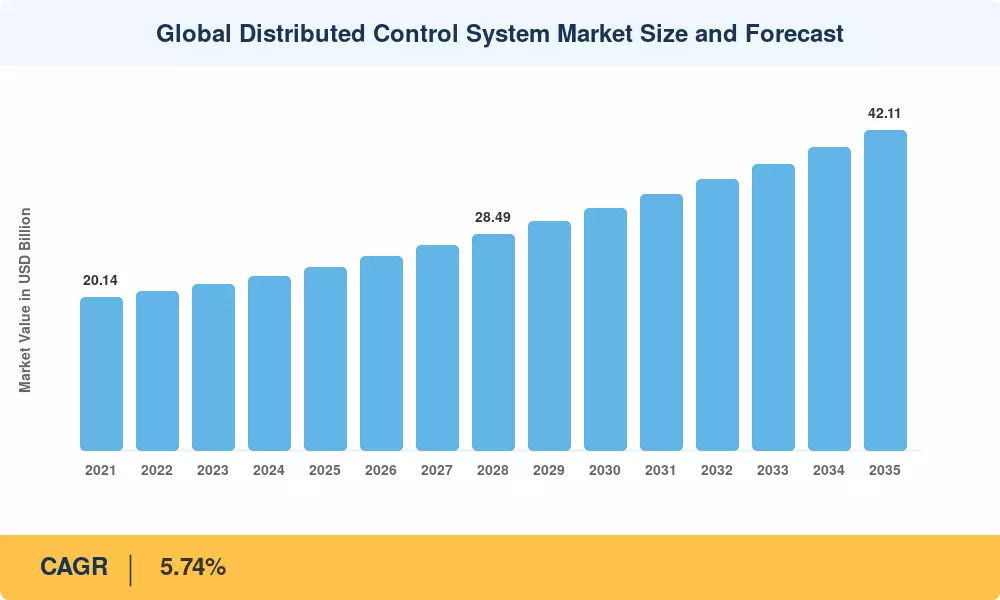
Global Distributed Control System Market Size and Forecast
Our Impact
Enabled $4.3B Revenue Impact for Fortune 500 and Leading Multinationals
Partnering with 2000+ Global Organizations Each Year
30K+ Citations by Top-Tier Firms in the Industry

Driver Impact Analysis

Driver ~% Impact on CAGR Geographic Relevance Impact Timeline
Aging-refinery retrofit mandates ~18% North America, Europe Short-term (≤2 yr)
Green-hydrogen electrolyzer build-out ~15% Asia-Pacific, Europe Medium-term (2–4 yr)
Cloud-DCS supervisory convergence ~14% Global Medium-term (2–4 yr)
Pharma continuous-manufacturing shift ~12% Europe, North America Long-term (≥4 yr)
Carbon-capture integration requirements ~11% North America, MEA Long-term (≥4 yr)
Cybersecurity compliance upgrades ~10% Global Short-term (≤2 yr)
Small-plant digitization in emerging markets ~9% South America, ASEAN Medium-term (2–4 yr)


Aging-Refinery Retrofit Mandates

Over 40% of the world's refining capacity runs on control platforms older than 20 years, according to AFPM data [1]. Functional-safety regulations such as IEC 61511 require lifecycle assessments that often conclude with full controller replacements rather than patch upgrades. The U.S. EPA's Risk Management Program Rule amendments, finalized in early 2024, tighten process-hazard analysis timelines, compelling Gulf Coast operators to accelerate DCS migration projects worth an estimated USD 2.8 billion collectively through 2028 [1].

Green-Hydrogen Electrolyzer Build-Out

The IEA's Global Hydrogen Review 2024 counts over 45 GW of electrolyzer capacity under construction worldwide, each facility demanding hundreds of analog-input channels for stack-temperature and pressure monitoring [2]. Proton-exchange-membrane and alkaline electrolyzer trains rely on sub-second control loops that favor dedicated DCS architectures over PLC-based alternatives. Europe's REPowerEU hydrogen corridor alone could generate USD 1.4 billion in DCS hardware and engineering orders by 2030 [2].

Cloud-DCS Supervisory Convergence

Hyperscale providers, including Microsoft Azure and AWS, have launched dedicated OT-cloud integration services that allow smaller facilities to shift historian and advanced-process-control workloads to consumption-based platforms [3]. It is estimated that cloud-connected DCS deployments shorten commissioning schedules by 30–35% and reduce up-front software licensing costs by up to 40%. The trend is particularly impactful for the Distributed Control System Market in the sub-5,000 I/O segment, where capital constraints historically delayed modernization.

Pharmaceutical Continuous-Manufacturing Shift

The FDA's Emerging Technology Program has approved continuous-manufacturing processes for more than a dozen drug products since 2021 [8]. Continuous trains require tighter cascade-control strategies and real-time quality-attribute monitoring that legacy batch-DCS platforms struggle to deliver. European Medicines Agency guidance on real-time release testing further accelerates demand, with pharma DCS spending projected to grow at 7.62% CAGR through 2035.


Restraints Impact Analysis

Restraint ~% Negative Impact on CAGR Geographic Relevance Impact Timeline
High switching costs and vendor lock-in ~−20% Global Long-term (≥4 yr)
Skilled workforce shortage in OT engineering ~−18% North America, Europe Short-term (≤2 yr)
Cybersecurity threat escalation ~−15% Global Medium-term (2–4 yr)
Macroeconomic capex uncertainty ~−12% Global Short-term (≤2 yr)
Slow OPC-UA adoption in legacy brownfields ~−10% Asia-Pacific, South America Medium-term (2–4 yr)


High Switching Costs and Vendor Lock-In

Proprietary controller-bus protocols and application-layer software lock operators into single-vendor ecosystems for 15–25-year asset lifecycles [16]. A 2024 Automation World end-user survey found that 58% of respondents cited migration cost — averaging USD 1,200–1,800 per I/O point — as the primary barrier to competitive re-tendering. This friction suppresses addressable-market turnover and slows the Distributed Control System Market growth that open-architecture initiatives aim to unlock.

Skilled-Workforce Shortage in OT Engineering

The U.S. Bureau of Labor Statistics projects a 7% gap between demand and supply for instrumentation and control engineers through 2032 [17]. European automation integrators report average project-start delays of 14 weeks due to staffing constraints. The shortage raises commissioning costs and pushes some asset owners toward simpler PLC-SCADA solutions, limiting Distributed Control System Market penetration in mid-size facilities.

Cybersecurity Threat Escalation

High-profile incidents such as the 2023 MOVEit and 2024 Unitronics PLC breaches have heightened regulatory scrutiny of industrial-control-system security [7]. Mandatory vulnerability assessments and network-segmentation retrofits add 8–12% to total project costs, dampening the pace of new DCS deployments, particularly among budget-constrained operators in emerging economies.


Global Distributed Control System Market Opportunities

Subscription-Based DCS-as-a-Service Models

Controller vendors are piloting opex-friendly DCS-as-a-Service packages that bundle hardware leasing, cloud-hosted historian licenses, and remote support into monthly fees. Plants below 5,000 I/O — historically underserved — stand to benefit most, expanding the addressable Distributed Control System Market by an estimated USD 3.2 billion through 2035 [14].

Carbon-Capture-Ready Controller Platforms

North American carbon-capture mandates under the U.S. Inflation Reduction Act's 45Q tax credit are generating demand for DCS modules pre-configured for amine-scrubbing and compression loops. Vendors offering plug-and-play carbon-capture control libraries can capture first-mover advantage in a segment expected to exceed USD 1.8 billion by 2032 [11].

Emerging-Market Small-Plant Digitization

ASEAN and sub-Saharan Africa host thousands of small chemical, food-processing, and water-treatment plants that still rely on single-loop controllers or manual operations [15]. Government-backed Industry 4.0 programs in Indonesia, Vietnam, and Nigeria are providing low-interest financing for control-system modernization, opening a greenfield runway for compact DCS platforms.

Data Monetization Through Predictive-Maintenance Analytics

Operators increasingly justify DCS upgrades on the basis of predictive-maintenance payback rather than regulatory compliance alone. Digital-twin vendors report that embedded analytics modules deliver 15–22% reductions in unplanned downtime, creating recurring software revenue streams that improve vendor margins and expand the Distributed Control System Market beyond traditional hardware sales [12].

Pharmaceutical Continuous-Manufacturing Expansion

Regulatory tailwinds from the FDA and EMA are accelerating the shift from batch to continuous pharmaceutical production lines, each requiring advanced cascade-control and PAT-integration capabilities. This vertical represents the fastest-growing end-use segment in the Distributed Control System Market, offering automation vendors premium-margin project opportunities.


Global Distributed Control System Market Future Outlook

Autonomous Operations and AI-Driven Control

Level-3 and Level-4 autonomous operations — where the DCS executes setpoint changes without operator confirmation — are expected to reach commercial readiness by 2030 for select unit operations such as distillation and heat exchange [12]. The IEA estimates that AI-augmented process optimization could save the global refining sector USD 8 billion annually in energy costs, creating strong demand-side pull for advanced Distributed Control System Market offerings [2].

Platform Economics and Vendor Ecosystems

The Distributed Control System Market is shifting from project-based revenue models to platform-centric ecosystems where controller OEMs monetize app-store-style analytics marketplaces. Emerson's Plantweb, Honeywell's Forge, and ABB's Ability platforms exemplify this trend, generating recurring SaaS revenue that now represents 12–18% of these vendors' industrial-automation earnings [14].

Electrification Supercycle and Grid-Connected Plants

The global electrification push — BloombergNEF projects USD 21.4 trillion in clean-energy investment through 2035 — will drive demand for DCS in battery-materials processing, green-ammonia synthesis, and e-methanol production [2]. Each of these next-generation facilities requires tight cascade control over temperature-sensitive reactions, favoring dedicated DCS over PLC-SCADA hybrid architectures.

ESG Reporting and Emissions-Integrated Control

Scope 1 and Scope 2 emissions reporting mandates, such as the EU's Corporate Sustainability Reporting Directive (CSRD), are compelling plant operators to embed emissions-measurement logic directly into DCS control strategies [11]. Real-time CO₂-intensity dashboards linked to controller outputs allow facilities to optimize yield and emissions simultaneously — a capability that will become table-stakes for the Distributed Control System Market by the early 2030s.


Global Distributed Control System Market Segmentation

By Component

Segment Metric Primary Demand Driver
Hardware 52.2% share (2025) Controller and I/O module replacement cycles
Software 6.38% CAGR (2026–2035) Digital-twin and predictive-maintenance subscriptions
Services USD 4.68 Billion (2025) Engineering, commissioning, and lifecycle support


Hardware — encompassing controllers, I/O cards, engineering workstations, and field-termination assemblies — remains the revenue backbone of the Distributed Control System Market. Replacement cycles driven by end-of-support announcements from vendors such as Honeywell (TPS/TDC 3000) and ABB (Bailey INFI 90) are sustaining double-digit order backlogs across North America and Europe. Software, although a smaller share today, is growing faster as operators adopt containerized analytics modules that run on-premise or in the cloud, unlocking value from existing sensor data without requiring new field instruments.

By Architecture

Segment Metric Primary Demand Driver
Hybrid / Distributed-Hybrid Systems 43.5% share (2025) Scalability across modular process units
Centralized Controller Systems USD 5.34 Billion (2025) Legacy installed base in large refineries
Other Architectures 5.96% CAGR (2026–2035) Edge-native and micro-DCS designs


Hybrid architectures allow asset owners to distribute control logic across multiple redundant processor pairs while maintaining a centralized engineering environment — a balance that suits both grassroots mega-projects and phased brownfield expansions. The Distributed Control System Market is also seeing early adoption of micro-DCS platforms in modular skid-based plants, where compact form factors and Ethernet-APL connectivity reduce footprint and wiring costs.

By Deployment Model

Segment Metric Primary Demand Driver
On-Premise 79.3% share (2025) Regulatory and latency requirements
Cloud / Edge-Hosted 6.11% CAGR (2026–2035) Opex-friendly historian and APC workloads


On-premise deployments dominate because real-time control loops require sub-10-millisecond determinism that current cloud architectures cannot guarantee. Cloud and edge-hosted configurations gain ground for supervisory-layer functions — historian data storage, advanced process control model execution, and remote asset monitoring — where latency tolerance is broader.

By Industry Vertical

Segment Metric Primary Demand Driver
Oil & Gas 28.6% share (2025) Refinery and upstream control modernization
Pharmaceuticals & Life Sciences 7.62% CAGR (2026–2035) Continuous-manufacturing regulatory push
Power & Utilities USD 3.83 Billion (2025) Gas-turbine and renewable-integration controls
Chemicals 5.94% CAGR (2026–2035) Specialty-chemical batch-to-continuous conversion
Others (Metals, Mining, Water) USD 2.91 Billion (2025) Mineral-processing and water-treatment automation


Oil and gas remains the single largest vertical for the Distributed Control System Market, with upstream production platforms, midstream gas-processing plants, and downstream refineries each demanding distinct controller configurations. Pharmaceuticals are the fastest-growing vertical, propelled by FDA and EMA endorsement of continuous manufacturing, which requires real-time quality-attribute monitoring tightly integrated with the control layer.

By Plant Size

Segment Metric Primary Demand Driver
Large (Above 15,000 I/O) 42.9% share (2025) Mega-refinery and petrochemical complexes
Medium (5,000–15,000 I/O) USD 6.82 Billion (2025) Mid-scale chemical and power plants
Small (Below 5,000 I/O) 6.33% CAGR (2026–2035) Modular plants, water treatment, food processing


Large-plant installations dominate today's revenue mix because their high I/O counts translate into extensive hardware and engineering-service scopes. Small plants represent the fastest-growing segment of the Distributed Control System Market as DCS-as-a-Service models and compact controller platforms make enterprise-grade control accessible to facilities that previously relied on standalone PLCs.


Regional Market Share Analysis

Region Metric Primary Investment Themes
Asia-Pacific 35.8% share (2025) Coal-to-gas conversion, refinery expansion
North America USD 6.39 Billion (2025) Carbon-capture retrofits, refinery modernization
Europe 22.1% share (2025) Pharma continuous manufacturing, hydrogen corridors
South America USD 1.61 Billion (2025) Pre-salt offshore, mining automation
Middle East & Africa 6.72% CAGR (2026–2035) Downstream diversification, LNG processing
Total USD 24.10 Billion (2025)

The Distributed Control System Market exhibits a concentrated regional hierarchy, with Asia-Pacific, North America, and Europe collectively accounting for over 84% of 2025 revenue. Growth dynamics vary sharply: mature regions prioritize retrofit and cybersecurity spending, while the Middle East & Africa and South America lean toward greenfield capacity additions. The Distributed Control System Market's regional landscape is evolving as decarbonization policies redirect capital flows.


North America

Country Metric Key Driver
United States ~68% of regional revenue Refinery SIS upgrades, 45Q carbon-capture projects
Canada 5.91% CAGR (2026–2035) Oil-sands DCS modernization
Mexico USD 0.42 Billion (2025) Pemex Dos Bocas refinery commissioning


U.S. Gulf Coast refiners committed over USD 2.8 billion to control-system retrofits following the EPA's updated Risk Management Program Rule, while Canada's oil-sands operators are replacing 20-year-old Bailey and Provox systems with modern redundant-controller architectures [1]. Mexico's Dos Bocas refinery, once fully operational, will add roughly 1,600 heavy I/O loops to the country's installed DCS base [9].

Europe

Country Metric Key Driver
Germany ~24% of regional revenue Chemical-park DCS consolidation
United Kingdom 5.82% CAGR (2026–2035) Offshore wind balance-of-plant control
France USD 0.72 Billion (2025) Nuclear-fleet life-extension programs
Italy ~9% of regional revenue Petrochemical complex modernization
Spain 5.68% CAGR (2026–2035) Renewable-hydrogen pilot plants
Nordic Countries USD 0.48 Billion (2025) Pulp, paper, and biorefinery automation
Russia ~8% of regional revenue Upstream oil and gas operations
Rest of Europe 5.51% CAGR (2026–2035) General industrial modernization


Europe's DCS spending is driven by the EU's Continuous Manufacturing Initiative in pharmaceuticals and the REPowerEU hydrogen backbone [8]. Germany's BASF Ludwigshafen complex alone is undertaking a multi-phase controller migration worth an estimated EUR 180 million through 2029 [6].

Asia-Pacific

Country Metric Key Driver
China ~38% of regional revenue Coal-to-gas mandates, chemical self-sufficiency push
India 6.84% CAGR (2026–2035) Refinery-capacity additions under Hydrocarbon Vision 2030
Japan USD 1.12 Billion (2025) Chemical-plant lifecycle replacements
South Korea ~11% of regional revenue Semiconductor-grade chemical processing
ASEAN 6.21% CAGR (2026–2035) LNG terminal and palm oil refinery construction
Rest of Asia-Pacific USD 0.54 Billion (2025) Mining and mineral-processing automation


China's "dual-carbon" targets are accelerating the retirement of coal-fired boiler controls in favor of gas-turbine DCS, creating a replacement cycle across more than 300 power plants [4]. India's state-owned refiners — Indian Oil, Bharat Petroleum, and Hindustan Petroleum — have collectively tendered over USD 1.1 billion in DCS contracts since 2023 for grassroots and brownfield projects [4].

South America

Country Metric Key Driver
Brazil ~54% of regional revenue Pre-salt deepwater FPSO control systems
Argentina 6.05% CAGR (2026–2035) Vaca Muerta shale-gas processing
Rest of South America USD 0.29 Billion (2025) Copper and lithium mining automation


Petrobras's ongoing pre-salt FPSO program drives the bulk of Brazil's DCS procurement, with each floating production unit requiring 4,000–6,000 I/O points of dedicated control [9]. Argentina's Vaca Muerta development has attracted Tecpetrol and YPF investment that includes new gas-processing facilities equipped with modern hybrid-architecture DCS [9].

Middle East & Africa

Country Metric Key Driver
Saudi Arabia ~34% of regional revenue Vision 2030 petrochemical downstream projects
UAE 6.48% CAGR (2026–2035) Gas-processing and LNG expansion
South Africa USD 0.18 Billion (2025) Sasol CTL facility control upgrades
Egypt ~8% of regional revenue Mediterranean gas-field processing
Rest of MEA 5.92% CAGR (2026–2035) East African LNG development


Saudi Arabia's SATORP and Jazan refinery-petrochemical integrations represent multi-billion-dollar complexes where DCS scope spans crude-distillation through polymer-finishing units [9]. The UAE's ADNOC is investing over USD 15 billion in sour-gas processing capacity through 2030, each train demanding redundant fault-tolerant controllers [9].


Global Distributed Control System Market By Region, 2025-2035

Competitive Benchmarking

The Distributed Control System Market exhibits medium concentration, with an estimated top-five share of 48–55% and a Herfindahl–Hirschman Index (HHI) below 1,200. Six global automation majors compete head-to-head across all regions, while a tier of focused specialists captures niche verticals and geographies. Strategic activity centers on cloud-platform partnerships, cybersecurity acquisitions, and the bundling of digital-twin subscriptions with controller hardware.

Company Est. Revenue Share Range Key Offerings Strategic Positioning
Emerson Electric Co. ~9–12% DeltaV, Ovation, Plantweb Full-lifecycle process automation leader
ABB Ltd. ~8–11% Ability Symphony Plus, 800xA Power and process convergence
Honeywell International Inc. ~8–11% Experion PKS, Forge platform Integrated OT-IT ecosystem
Siemens AG ~7–10% SIMATIC PCS neo, XHQ Digital-enterprise portfolio synergy
Yokogawa Electric Corporation ~6–9% CENTUM VP, OpreX Strong Asia-Pacific and MEA presence
Schneider Electric SE ~5–8% EcoStruxure Foxboro DCS Sustainability-centric automation
Rockwell Automation ~4–6% PlantPAx PLC-to-DCS convergence strategy
General Electric ~3–5% Mark VIe Turbine and power-plant controls
Mitsubishi Electric Corp. ~3–5% MELSEC iQ-R, DIASYS Netmation Japanese heavy-industry base
Azbil Corporation ~2–4% Harmonas-DEO Mid-scale chemical and pharma niche


Recent News & Developments

  • ABB(February, 2026) -- Launched its Automation Extended program, a strategic evolution allowing operators to progressively modernize distributed control systems without interrupting critical plant production.
  • Emerson (May, 2025) -- Unveiled Project Beyond, a software-defined enterprise operations platform built on DeltaV distributed control systems to integrate industrial artificial intelligence seamlessly.
  • Schneider Electric (2025) -- Expanded its distributed control system capabilities by launching advanced predictive analytics modules, embedding machine learning for real-time smart factory optimization.

Global Distributed Control System Market Report Scope

Parameter Detail
Market Scope Global Distributed Control System Market across five components: architecture, deployment, vertical, and plant-size dimensions
Study Period 2021–2035
CAGR (2026–2035) 5.74%
Base Year Market Size USD 24.10 Billion (2025)
Forecast Endpoint USD 42.11 Billion (2035)
Fastest Growing Segment Pharmaceuticals & Life Sciences (7.62% CAGR)
Companies Profiled 10 (Emerson, ABB, Honeywell, Siemens, Yokogawa, Schneider Electric, Rockwell, GE, Mitsubishi Electric, Azbil)
Valuation Currency USD Billion


FAQs

What migration path do brownfield plants typically follow when upgrading legacy DCS platforms?
Most operators adopt a phased controller-swap strategy, replacing one process unit at a time while maintaining gateways to legacy I/O. This limits downtime to planned turnaround windows and preserves existing field-wiring investments [Ref 18].
How does total cost of ownership for cloud-hosted DCS compare to on-premises deployments?
Cloud-hosted configurations reduce up-front capital by 30–40% but carry higher recurring subscription fees. Break-even typically occurs within three to four years for plants below 5,000 I/O [Ref 19].
Which cybersecurity frameworks matter most for Distributed Control System Market procurement?
IEC 62443 remains the primary standard governing industrial-control security zones and conduits. Buyers should verify that vendor products carry ISASecure certification before shortlisting [Ref 20].
What role does digital-twin integration play in the Distributed Control System Market?
Digital twins let operators simulate setpoint changes before executing them on live equipment, cutting commissioning time by up to 25%. Leading vendors now bundle twin licenses with controller hardware purchases [Ref 21].
How are edge-computing modules reshaping the Distributed Control System Market?
Edge nodes handle real-time analytics at the controller level, reducing cloud-bandwidth costs and data round-trip latency. Smaller vendors use edge-native designs to compete against incumbents in greenfield builds [Ref 22].
What are the primary integration challenges when connecting DCS to enterprise MES/ERP layers?
Data-model mismatches between OT and IT layers remain the biggest hurdle, often requiring middleware or OPC-UA gateways. NAMUR Open Architecture guidelines are shortening integration timelines [Ref 23].
How should end users evaluate vendor lock-in risk in the Distributed Control System Market?
Buyers should assess controller interoperability, open-protocol support, and data-portability clauses in service contracts. Requesting benchmark tests on third-party I/O modules reduces long-term switching costs [Ref 24].    
Author
Author
Author Profile
Chitranshi Jaiswal LinkedIn
Team Lead - Research
Chitranshi is a Team Leader in the Chemicals & Materials (CnM) and Energy & Power (EnP) domains, with 6+ years of experience in market research. She leads and mentors teams to deliver cross-domain projects that equip clients with actionable insights and growth strategies. She is skilled in market estimation, forecasting, competitive benchmarking, and both primary & secondary research, enabling her to turn complex data into decision-ready insights. An engineer and MBA professional, she combines technical expertise with strategic acumen to solve dynamic market challenges. Chitranshi has successfully managed projects that support market entry, investment planning, and competitive positioning, while building strong client relationships. Certified in Advanced Excel & Power BI she leverages data-driven approaches to ensure accuracy, clarity, and impactful outcomes.
Download Free Sample

Kindly complete the form below to receive a free sample of this Report

Download PDF ×

We do not share your information with anyone. However, we may send you emails based on your report interest from time to time. You may contact us at any time to opt-out.