Download Free Sample
Kindly complete the form below to receive a free sample of this Report
Global Mobility and Expatriate Services Market Size, Share and Trends Analysis Research Report Information By Client Type (Corporations, Government, NGOs, Educational Institutions, Individuals), By Service Type (Relocation, Assignment Management, Immigration, Tax, Consulting), By Mobility Type (Short-Term, Long-Term, Permanent, Commuter, Virtual Assignments), And By Region – Market Forecast Till 2035.
As per MRFR analysis, the Global Mobility and Expatriate Services was estimated at 35.0 USD Billion in 2024. The Global Mobility and Expatriate Services industry is projected to grow from 36.47 USD Billion in 2025 to 55.0 USD Billion by 2035, exhibiting a compound annual growth rate (CAGR) of 4.19% during the forecast period 2025 - 2035.
The Global Mobility and Expatriate Services is experiencing a transformative shift towards enhanced employee well-being and technological integration.
| 2024 Market Size | 35.0 (USD Billion) |
| 2035 Market Size | 55.0 (USD Billion) |
| CAGR (2025 - 2035) | 4.19% |
Cartus (US), Crown Relocations (SG), SIRVA (US), BGRS (US), Fragomen (US), Move Guides (GB), Altair Global (US), Global Mobility Solutions (US), InterNations (DE)
Our Impact
Enabled $4.3B Revenue Impact for Fortune 500 and Leading Multinationals
Partnering with 2000+ Global Organizations Each Year
30K+ Citations by Top-Tier Firms in the Industry
The Global Mobility and Expatriate Services is currently experiencing a transformation driven by various factors. Organizations are increasingly recognizing the value of a diverse workforce, which has led to a rise in international assignments. This trend appears to be fueled by globalization, as companies seek to expand their operations across borders. Furthermore, advancements in technology are facilitating smoother transitions for expatriates, enabling them to adapt more quickly to new environments. As a result, the demand for comprehensive mobility services is likely to grow, encompassing relocation assistance, cultural training, and ongoing support for expatriates and their families. In addition, the market seems to be influenced by changing employee expectations. Professionals today often seek opportunities that allow for personal and professional growth, which may include international experiences. This shift in mindset suggests that organizations must adapt their mobility strategies to attract and retain top talent. Moreover, the emphasis on sustainability and corporate responsibility is becoming more pronounced, prompting companies to consider the environmental impact of their mobility practices. Overall, The Global Mobility and Expatriate Services is poised for continued evolution as it responds to these emerging trends and challenges.
Organizations are placing greater emphasis on the well-being of expatriates and their families. This trend indicates a shift towards providing holistic support, including mental health resources and family integration services, to ensure a smoother transition and overall satisfaction.
The integration of technology into mobility services is becoming more prevalent. This development suggests that companies are leveraging digital tools to streamline processes, enhance communication, and provide real-time support to expatriates during their assignments.
There is a growing awareness of sustainability within The Global Mobility and Expatriate Services. Companies are increasingly considering the environmental impact of their mobility strategies, which may lead to the adoption of greener practices and policies.
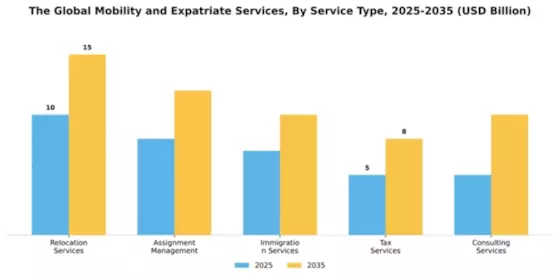
In The Global Mobility and Expatriate Services, Relocation Services dominate the service type segment, accounting for a significant share of the overall market. This service encompasses a range of offerings aimed at facilitating employee relocations, making it fundamental to the industry's operations. Following closely, Assignment Management emerges as a vital service, handling the logistical and administrative aspects of international assignments, which are integral for companies looking to enhance their global workforce. As organizations increasingly prioritize the mobility of their talent, growth trends highlight the importance of Assignment Management as the fastest-growing segment. Factors such as globalization, the rise of remote work, and the need for organizations to attract top talent across borders drive this growth. Companies are increasingly looking for comprehensive solutions that streamline their international mobility processes, ensuring compliance and enhancing employee experience during assignments.
Relocation Services: Dominant vs. Assignment Management: Emerging
Relocation Services stands as the dominant force in The Global Mobility and Expatriate Services, primarily due to its comprehensive nature, which includes planning, logistics, and support for relocating employees. Its effectiveness in ensuring a smooth transition contributes to higher employee satisfaction and retention. Meanwhile, Assignment Management is gaining momentum as an emerging service, driven by the need for structured policies and efficient management of international assignments. This segment focuses on creating customized strategies for expatriates, addressing their unique challenges, and ensuring compliance with host country regulations. The combination of these services caters to the growing demand for streamlined and efficient mobility solutions in an increasingly interconnected world.
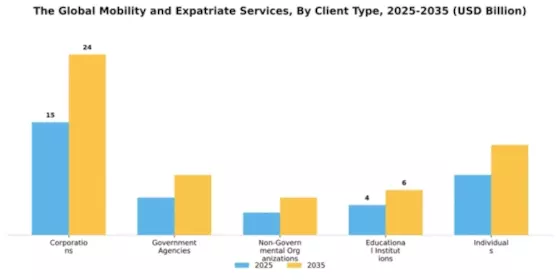
In The Global Mobility and Expatriate Services, corporations represent the largest client type, claiming a substantial share due to their ongoing need for talent mobility and globalization strategies. Corporations invest heavily in relocation services, temporary assignments, and expatriate management. Government agencies follow as significant clients, facilitating the movement of personnel for diplomatic missions and international projects. Although they currently hold a smaller market share, they are increasingly recognized for their potential impact on mobility services.
Corporations: Dominant vs. Government Agencies: Emerging
Corporations dominate The Global Mobility and Expatriate Services with their extensive mobility programs tailored for talent acquisition and retention. They leverage these services to enhance their competitive advantage in a globalized economy. In contrast, government agencies, while representing an emerging segment, are adapting rapidly to meet the growing demands for international mobility. They facilitate personnel transfers for various missions, including development aid and foreign relations, thus necessitating a more robust support framework. Both segments showcase distinct characteristics, with corporations focusing on efficiency and cost-effectiveness, while government agencies emphasize compliance and effectiveness in international relations.
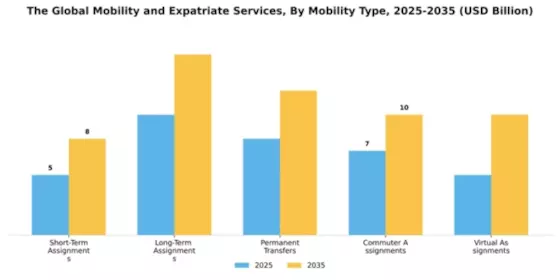
In The Global Mobility and Expatriate Services, the segment of Short-Term Assignments holds significant market share, driven by increasing globalization and the need for businesses to adapt quickly to changing environments. As companies expand their operations and tap into new markets, they often rely on short-term international assignments to meet immediate business needs and skill gaps. Conversely, Long-Term Assignments are rapidly gaining traction, supported by a growing emphasis on permanent relocations and long-term integration of talent across borders, indicating a strong shift in talent mobility preferences.
Short-Term Assignments (Dominant) vs. Long-Term Assignments (Emerging)
Short-Term Assignments are characterized by their flexible nature, typically ranging from a few weeks to a year, allowing organizations to rapidly deploy talent without extensive relocation processes. This segment's dominance is attributed to the immediate project-based needs of businesses, catering to workforce agility. In contrast, Long-Term Assignments, which often span multiple years, are emerging as organizations recognize the importance of long-term talent integration. This shift is fueled by the desire for comprehensive knowledge transfer and cultural adaptation, ensuring that expatriates can effectively contribute to the host location's objectives. Both segments reflect distinct strategies in workforce mobility, addressing varying corporate demands.
Get more detailed insights about Global Mobility and Expatriate Services Market Request Free Sample
North America continues to lead The Global Mobility and Expatriate Services, holding a significant market share of 17.5 in 2024. The region's growth is driven by a robust economy, increasing globalization, and a rising number of expatriates seeking relocation services. Regulatory support and favorable immigration policies further enhance demand, making it a prime destination for businesses and expatriates alike. The competitive landscape is characterized by key players such as Cartus, SIRVA, and Fragomen, which dominate the market with comprehensive service offerings. The U.S. remains the leading country, supported by a strong infrastructure for expatriate services. Companies are increasingly focusing on technology-driven solutions to streamline processes and enhance customer experience, ensuring they remain competitive in this dynamic market.
Europe's The Global Mobility and Expatriate Services is valued at 10.5, reflecting a growing demand for relocation services across the continent. Factors such as increased cross-border employment, regulatory harmonization, and a diverse workforce contribute to this growth. The region is witnessing a trend towards more flexible work arrangements, which is further driving the need for mobility services. Leading countries in this market include Germany, the UK, and France, where companies like InterNations and Crown Relocations are prominent. The competitive landscape is marked by a mix of local and international players, all vying for market share. As businesses adapt to changing workforce dynamics, the focus on tailored mobility solutions is becoming increasingly important, ensuring that expatriates receive the support they need during transitions.
The Asia-Pacific region, with a market size of 5.5, is rapidly emerging as a key player in The Global Mobility and Expatriate Services. The growth is fueled by increasing foreign investments, urbanization, and a rising number of skilled professionals seeking opportunities abroad. Countries are implementing policies to attract talent, which is further driving demand for mobility services in the region. Leading countries such as Australia, Japan, and Singapore are at the forefront of this market, with companies like Move Guides and Altair Global providing essential services. The competitive landscape is evolving, with both established players and new entrants focusing on innovative solutions to meet the diverse needs of expatriates. As the region continues to develop, the demand for comprehensive mobility services is expected to rise significantly.
The Middle East and Africa region, with a market size of 1.5, presents untapped potential in The Global Mobility and Expatriate Services. The growth is driven by increasing expatriate populations, economic diversification efforts, and a focus on attracting foreign talent. Countries in the region are enhancing their regulatory frameworks to support mobility, which is expected to catalyze market growth. Leading countries such as the UAE and South Africa are emerging as key players, with a growing number of service providers entering the market. The competitive landscape is characterized by a mix of local and international firms, all aiming to capture the growing demand for mobility services. As the region continues to evolve, the focus on tailored solutions for expatriates will be crucial for success.
The Global Mobility and Expatriate Services is currently characterized by a dynamic competitive landscape, driven by increasing globalization and the need for companies to manage their workforce across borders effectively. Key players such as Cartus (US), SIRVA (US), and Fragomen (US) are strategically positioned to leverage their extensive networks and expertise in relocation services. Cartus (US) focuses on enhancing its digital platforms to streamline the relocation process, while SIRVA (US) emphasizes operational efficiency through technology integration. Fragomen (US), on the other hand, is concentrating on compliance and legal services, ensuring that expatriates navigate the complexities of immigration laws seamlessly. Collectively, these strategies contribute to a competitive environment that prioritizes innovation and customer-centric solutions.In terms of business tactics, companies are increasingly localizing their services to cater to specific regional needs, which appears to enhance customer satisfaction and operational efficiency. The market structure is moderately fragmented, with several players vying for market share, yet the influence of major companies remains substantial. This competitive structure allows for a diverse range of services, fostering innovation and adaptability among the players.In November Cartus (US) announced a partnership with a leading technology firm to develop an AI-driven platform aimed at optimizing relocation logistics. This strategic move is likely to enhance their service offerings by providing real-time data analytics, thereby improving decision-making for clients. Such advancements may position Cartus (US) as a frontrunner in the digital transformation of the industry.In October SIRVA (US) expanded its global footprint by acquiring a regional relocation service provider in Asia. This acquisition is expected to bolster SIRVA's capabilities in the Asia-Pacific region, allowing for a more localized approach to service delivery. The strategic importance of this move lies in SIRVA's ability to tap into emerging markets, thereby enhancing its competitive edge.In September Fragomen (US) launched a new compliance management tool designed to assist companies in navigating the complexities of international labor laws. This initiative underscores Fragomen's commitment to providing comprehensive legal support to expatriates, which is increasingly vital in a landscape marked by regulatory changes. The introduction of such tools may solidify Fragomen's position as a leader in compliance services within the market.As of December the competitive trends in The Global Mobility and Expatriate Services are heavily influenced by digitalization, sustainability, and the integration of AI technologies. Strategic alliances among key players are shaping the landscape, fostering innovation and enhancing service delivery. Looking ahead, it appears that competitive differentiation will increasingly pivot from price-based strategies to a focus on technological innovation and supply chain reliability, suggesting a transformative shift in how companies approach global mobility.
The Global Mobility and Expatriate Services is projected to grow at a 4.19% CAGR from 2025 to 2035, driven by globalization, technological advancements, and evolving workforce dynamics.
New opportunities lie in:
By 2035, the market is expected to be robust, reflecting sustained growth and innovation.
| MARKET SIZE 2024 | 35.0(USD Billion) |
| MARKET SIZE 2025 | 36.47(USD Billion) |
| MARKET SIZE 2035 | 55.0(USD Billion) |
| COMPOUND ANNUAL GROWTH RATE (CAGR) | 4.19% (2025 - 2035) |
| REPORT COVERAGE | Revenue Forecast, Competitive Landscape, Growth Factors, and Trends |
| BASE YEAR | 2024 |
| Market Forecast Period | 2025 - 2035 |
| Historical Data | 2019 - 2024 |
| Market Forecast Units | USD Billion |
| Key Companies Profiled | Cartus (US), Crown Relocations (SG), SIRVA (US), BGRS (US), Fragomen (US), Move Guides (GB), Altair Global (US), Global Mobility Solutions (US), InterNations (DE) |
| Segments Covered | Service Type, Client Type, Mobility Type |
| Key Market Opportunities | Integration of digital platforms enhances efficiency in The Global Mobility and Expatriate Services operations. |
| Key Market Dynamics | Rising demand for flexible relocation solutions drives innovation in expatriate services and competitive market dynamics. |
| Countries Covered | North America, Europe, APAC, South America, MEA |


Kindly complete the form below to receive a free sample of this Report

“This is really good guys. Excellent work on a tight deadline. I will continue to use you going forward and recommend you to others. Nice job”


“Thanks. It’s been a pleasure working with you, please use me as reference with any other Intel employees.”


“Thanks for sending the report it gives us a good global view of the Betaïne market.”


“Thank you, this will be very helpful for OQS.”


“We found the report very insightful! we found your research firm very helpful. I'm sending this email to secure our future business.”


“I am very pleased with how market segments have been defined in a relevant way for my purposes (such as "Portable Freezers & refrigerators" and "last-mile"). In general the report is well structured. Thanks very much for your efforts.”


“I have been reading the first document or the study, ,the Global HVAC and FP market report 2021 till 2026. Must say, good info! I have not gone in depth at all parts, but got a good indication of the data inside!”


“We got the report in time, we really thank you for your support in this process. I also thank to all of your team as they did a great job.”


“The Automotive 48V ECU Components Procurement Intelligence Study” was a complex project, but the Market Research Future (MRFR) team handled it with quality, agility, and customer-centricity. They delivered all requested data on time and within the agreed scope. The team, including Shubhendra Anand and Rahul Gotadki, was always readily available to clarify questions and swiftly implement necessary adjustments, driving the project to a successful conclusion within a very demanding timeframe.
I would also like to specifically commend Akshay Agarwal for his responsiveness and support at every stage—from our initial inquiry on May 6th through to final delivery on June 18th. His dedication made the entire process seamless.”



