Graphene Battery Market (2026 - 2035)

Graphene Battery Market Research Report By Application (Consumer Electronics, Electric Vehicles, Renewable Energy Storage, Industrial Applications), By Type (Graphene Oxide Batteries, Graphene Polymer Batteries, Graphene Supercapacitors), By End Use (Residential, Commercial, Industrial), By Energy Density (High Energy Density, Medium Energy Density, Low Energy Density) and By Regional (North America, Europe, South America, Asia Pacific, Middle East and Africa) - Forecast to 2035
ID: MRFR/CnM/4259-HCR
111 Pages
Chitranshi Jaiswal
Last Updated: July 10, 2026
Graphene Battery Market
Market Size
Forecast Period2026-2035
CAGR (2026-2035)24.5%
2025 Market SizeUSD 0.28 Billion
2035 Market SizeUSD 2.52 Billion
Key Players
Samsung SDI
Lyten Inc.
Real Graphene
NanoGraf Corporation
Skeleton Technologies
Nanotech Energy
Opportunities
  • Solid-State Graphene Battery Commercialization
  • Grid-Edge and Microgrid Deployments in Emerging Markets
  • Data-Driven Battery-as-a-Service Models

Graphene Battery Market Summary

The Graphene Battery Market stood at USD 0.28 Billion in 2025 and is projected to reach USD 0.35 Billion in 2026 before climbing to USD 2.52 Billion by 2035, expanding at a compound annual growth rate of 24.5% over the forecast window. Policy-driven electrification mandates across China, the European Union, and California are compressing acceptable EV charging windows below fifteen minutes, creating urgent demand for electrode architectures that pair high energy density with rapid charge acceptance. The U.S. Department of Energy's USD 4 million grant to Lyten for pilot-scale graphene anode production signals that public capital is beginning to de-risk the technology at scale [1].

A generational shift in cell chemistry is now underway. Conventional carbon-black additives that have served lithium-ion cathodes for two decades are approaching performance ceilings, and graphene-enhanced electrodes offer a credible path to 350 Wh/kg cells that charge in under ten minutes. The EU's EUR 4.5 million GRAPHERGIA consortium and the U.S. Navy's SBIR Phase II holey-graphene anode contract confirm that both civilian and defense stakeholders view graphene integration as a strategic priority rather than a laboratory curiosity [2][3].

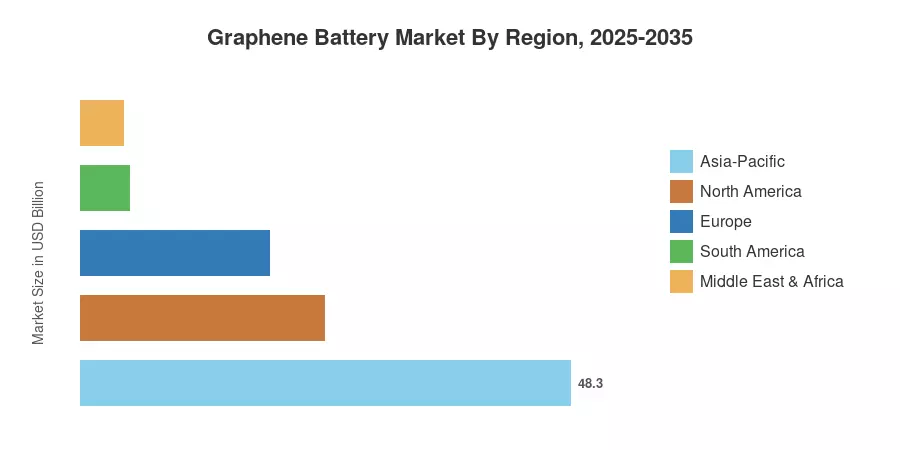
Asia-Pacific commands the largest share of the Graphene Battery Market at 48.3% of 2025 revenue, underpinned by China's dominance in cell manufacturing and South Korea's advanced materials ecosystem. The region also registers the fastest forecast CAGR at 25.8% through 2035. North America holds the second-largest share at 24.1%, buoyed by defense procurement and venture-backed startups. Europe trails at 18.6% yet benefits from the EU Battery Regulation's sustainability mandates that favor graphene's recyclability profile. As electrochemical exfoliation costs fall toward parity with carbon black, tier-one cell makers across all three regions are expected to accelerate qualification timelines through the late 2020s [4][5].

ย 

Key Report Takeaways

โ€ข By Battery Chemistry

  • Lithium-Ion Graphene Batteries captured 58.4% of the Graphene Battery Market revenue in 2025, driven by drop-in compatibility with existing gigafactory lines.
  • Solid-State Graphene Batteries are forecast to register the highest segment CAGR through 2035, reflecting breakthrough potential in solid electrolyte integration.
  • Graphene Supercapacitors accounted for USD 0.04 Billion in 2025 as grid-edge and regenerative braking use cases gained traction.

โ€ข By Application

  • Automotive led the Graphene Battery Market with 45.2% revenue share in 2025, supported by OEM partnerships targeting sub-15-minute fast charging.
  • Energy Storage is positioned as the fastest-expanding application through 2035, fueled by grid-scale deployment mandates and behind-the-meter installations.
  • Consumer Electronics generated steady demand through premium smartphone and laptop integrations.

โ€ข By Region

  • Asia-Pacific dominated the Graphene Battery Market with 48.3% share in 2025, led by Chinese cell manufacturers and Japanese materials suppliers.
  • North America contributed 24.1% of global revenue, anchored by U.S. defense programs and DOE-backed pilot facilities.
  • Europe accounted for 18.6% of the Graphene Battery Market, with the EU Battery Regulation creating preferential conditions for graphene-enhanced chemistries.

ย 

Market Size and Forecast (2021โ€“2035)

Market Research Future's proprietary estimation framework synthesizes primary interviews with cell manufacturers, graphene producers, and OEM procurement teams alongside secondary datasets from national energy agencies, patent filings, and trade databases. All figures are calibrated to the most recent available data as of Q1 2026.
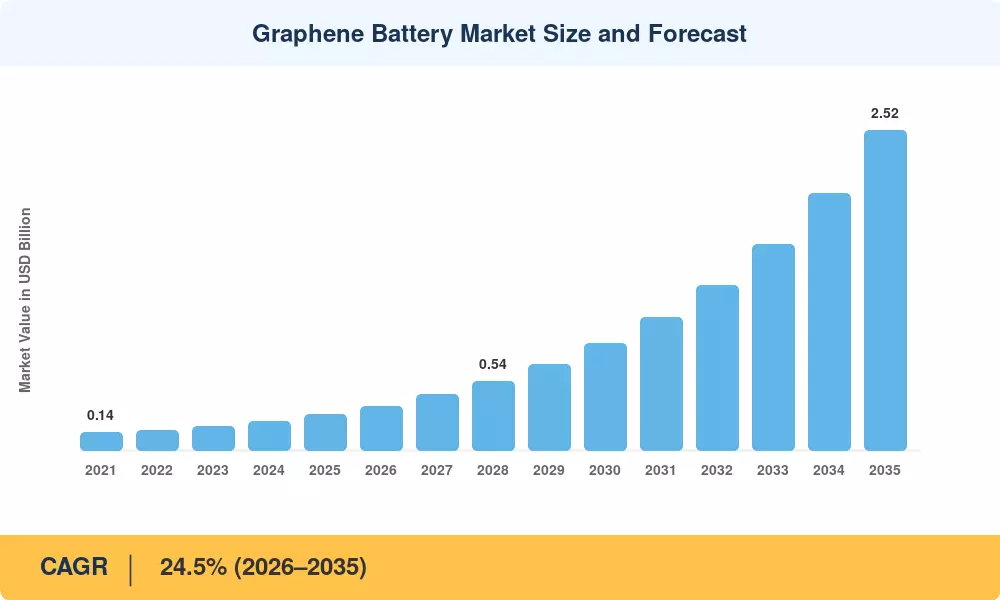
Graphene Battery Market Size and Forecast
Our Impact
Enabled $4.3B Revenue Impact for Fortune 500 and Leading Multinationals
Partnering with 2000+ Global Organizations Each Year
30K+ Citations by Top-Tier Firms in the Industry

Driver Impact Analysis

Driver ~% Impact on CAGR Geographic Relevance Impact Timeline
EV charging-window compression mandates +4.2% Global Short-term (โ‰ค2 yr)
Defense and aerospace qualification programs +2.8% North America, Europe Medium-term (2โ€“4 yr)
Public R&D funding and pilot-scale grants +2.5% North America, EU Short-term (โ‰ค2 yr)
Graphene production cost deflation +3.6% Asia-Pacific, Global Medium-term (2โ€“4 yr)
Grid-scale storage procurement mandates +3.1% North America, Europe Long-term (โ‰ฅ4 yr)
Solid-state battery R&D convergence +2.3% Japan, South Korea Long-term (โ‰ฅ4 yr)
EU Battery Regulation sustainability incentives +1.9% Europe Medium-term (2โ€“4 yr)

ย 

EV Charging-Window Compression Mandates

China's GB/T fast-charging standard revision and California's Advanced Clean Cars II rule are both pushing automakers to deliver sub-15-minute 10-to-80% state-of-charge windows by 2028. Graphene-enhanced anodes reduce lithium plating risk at high C-rates, making them one of the few materials solutions that can meet these targets without sacrificing cycle life. BloombergNEF estimates that the addressable market for ultra-fast-charge-capable cells will exceed USD 18 Billion by 2030, and graphene electrode suppliers stand to capture a growing share of that value chain [1][15].

Defense and Aerospace Qualification Programs

The U.S. Navy's SBIR Phase II contract for holey-graphene anodes targets a 40% gravimetric energy density improvement over incumbent lithium-ion cells used in unmanned underwater vehicles. Weight-sensitive platforms in defense and aerospace tolerate higher per-kWh costs, providing graphene battery developers with margin-rich early revenue while manufacturing scales. NATO's SET-312 working group on advanced soldier power systems has similarly identified graphene-enhanced cells as a priority technology for dismounted infantry kits [3][16].

Graphene Production Cost Deflation

Electrochemical exfoliation and methane-decomposition synthesis routes have reduced few-layer graphene pricing from roughly USD 100/kg in 2020 to below USD 30/kg by late 2025, according to industry estimates compiled by the Graphene Council. At these price points, graphene additives reach cost parity with high-surface-area carbon black in premium cell formulations. Continued scaling of continuous-flow reactors by producers in China and India is expected to push costs below USD 15/kg before 2030, effectively eliminating the cost barrier for tier-one cell makers [8][13].

Grid-Scale Storage Procurement Mandates

The U.S. Inflation Reduction Act's Investment Tax Credit and the EU's revised Renewable Energy Directive collectively mandate over 90 GW of new storage capacity by 2032. Graphene-enhanced lithium-iron-phosphate cells offer improved thermal stability and faster response times that appeal to grid operators managing intermittent renewable generation. IRENA projects that global battery storage capacity must reach 680 GW by 2030 to stay on track with the 1.5 ยฐC pathway, creating a substantial addressable opportunity for the Graphene Battery Market [12][17].

ย 

Restraints Impact Analysis

Restraint ~% Impact on CAGR Geographic Relevance Impact Timeline
High per-kWh cost premium over conventional cells โˆ’2.8% Global Short-term (โ‰ค2 yr)
Limited graphene supply-chain standardization โˆ’2.1% Global Medium-term (2โ€“4 yr)
Cell-level qualification lead times โˆ’1.6% Global Medium-term (2โ€“4 yr)
Intellectual property fragmentation โˆ’1.3% North America, Europe Long-term (โ‰ฅ4 yr)
Performance variability across graphene grades โˆ’1.0% Asia-Pacific Short-term (โ‰ค2 yr)

ย 

High Per-kWh Cost Premium

Despite recent cost deflation in raw graphene feedstock, fully formulated graphene-enhanced cells still carry a 15โ€“25% cost premium over equivalent carbon-black-based cells at the pack level. Automotive OEMs operate under intense cost pressure โ€” the average EV battery pack price stood at approximately USD 139/kWh in 2024, according to BloombergNEF โ€” and any additive that pushes pack costs above USD 150/kWh faces procurement resistance. Until gigafactory-scale integration drives blending costs below the visibility threshold, this premium will constrain adoption outside premium and defense segments [8][15].

Limited Supply-Chain Standardization

The graphene industry does not have a global grading system that is acknowledged. While ISO/TS 80004-13 provides a taxonomy, commercial items labeled โ€œgrapheneโ€ range from true monolayer material to multi-layer graphite nanoplatelets with considerably varied surface area and fault density. Qualifying incoming materials can add six to 12 months to development schedules, cell makers say, as the material from each supplier performs differently in slurry formulations. The Graphene Council and the National Physical Laboratory are working towards developing characterisation techniques, full harmonization is still a few years away [18][20].

ย 

Cell-Level Qualification Lead Times

Automotive grade cell qualification is normally an 18-24 month accelerated ageing, abuse testing and field trial validation. Even if the base chemistry is the same, adding a new conductive addition like graphene restarts this qualification clock. In other words, for the Graphene Battery Market, the agreements announced today may not result in volume shipments until 2028 or later, creating a structural gap between technology maturity and commercial revenue recognition [9].

ย 

ย 

Graphene Battery Market Opportunities

Solid-State Graphene Battery Commercialization

Solid-state electrolytes do away with the use of flammable liquid solvents, but have poor interfacial contact with traditional electrodes. Laboratory studies have shown that graphene interlayers can reduce interfacial resistance by a factor of three, making graphene a key enabler of commercially viable solid-state cells. Graphene suppliers have near-term insertion points in the announced 2028 Toyota solid-state car launch and Samsung SDIโ€™s pilot line expansion[11].

ย 

Grid-Edge and Microgrid Deployments in Emerging Markets

Distributed solar-plus-storage microgrids are the cheapest option to bring electricity to the more than 600 million people in Sub-Saharan Africa and South Asia who are not reliably connected to the grid. In these severe working settings, graphene-enhanced cells that can withstand high ambient temperatures and provide longer cycle life can outperform traditional counterparts. The World Bankโ€™s Scaling Mini Grids program has committed USD 1.5 Billion to off-grid electrification through 2030, providing a tangible market entry pathway for the Graphene Battery Market[17][21].

ย 

Data-Driven Battery-as-a-Service Models

Cell-level graphene sensors can capture real-time impedance and temperature data, enabling predictive health analytics that underpin battery leasing and second-life business models. This data monetization layer adds recurring revenue streams for cell makers and fleet operators alike. Several European OEMs have begun piloting battery passport systems under the EU Battery Regulation, and graphene-enhanced cells with embedded sensing capabilities are well positioned to serve these emerging digital ecosystems[5][22].

Aerospace and Urban Air Mobility

Electric vertical take-off and landing (eVTOL) aircraft demand cells that combine high specific energy (>300 Wh/kg) with burst power capability and rapid recharge. Graphene-enhanced cathodes and anodes meet these combined requirements more effectively than incumbent chemistries. The FAA's Special Conditions framework for eVTOL battery certification, published in 2024, establishes a regulatory pathway that the Graphene Battery Market can exploit[16][23].

Consumer Electronics Premium Segment

Flagship smartphones and laptops increasingly compete on charging speed and thermal management. Graphene-enhanced cells that support 100W+ charging without accelerated degradation command premium pricing in this segment. Huawei, Xiaomi, and Samsung have all filed graphene-related battery patents in the consumer electronics domain, signaling that commercial launches are imminent[7].

ย 

Graphene Battery Market Future Outlook

AI-Optimized Cell Design and Manufacturing

Machine-learning models are compressing the graphene-electrode optimization cycle from years to months. The U.S. Department of Energy's Autonomous Research System (ARES) has demonstrated a ten-fold acceleration in electrolyte-electrode pairing discovery using Bayesian optimization. By 2030, AI-driven formulation will likely become standard practice for the Graphene Battery Market, reducing development costs and enabling rapid customization of graphene loadings for specific applications [1][22].

Electrification Supercycle and Charging Infrastructure

IEA projections indicate that global EV sales will surpass 40 million units annually by 2030, requiring a charging infrastructure that can deliver 350 kW without degrading cell life. Graphene-enhanced anodes are among the few material solutions capable of sustaining such charge rates across thousands of cycles. As charging networks densify, the premium that fleet operators and consumers place on ultra-fast charging will translate directly into demand pull for the Graphene Battery Market [15][17].

Circular Economy and Second-Life Applications

The EU Battery Regulation mandates battery passports by 2027, requiring full lifecycle traceability. Graphene-enhanced cells that retain over 80% capacity after 2,000 cycles are strong candidates for second-life stationary storage applications, extending their economic value beyond the initial automotive use case. This circular-economy dynamic will reshape the Graphene Battery Market value proposition from a single-use purchase to a multi-cycle asset [5][12].

Decarbonization of Heavy Transport and Maritime

The International Maritime Organization's 2023 GHG Strategy targets a 40% reduction in shipping emissions by 2030. Hybrid-electric propulsion systems for short-sea vessels and port equipment require batteries that deliver high power density in marine environments. Graphene-enhanced cells' corrosion resistance and thermal stability make them well suited for these harsh-duty applications, opening a niche within the Graphene Battery Market that could reach USD 0.15 Billion by 2035 [16][23].

ย 

Graphene Battery Market Segmentation

By Battery Chemistry

Segment Key Metric Primary Demand Driver
Lithium-Ion Graphene Batteries 58.4% share (2025) Drop-in compatibility with existing production lines
Graphene Supercapacitors USD 0.04 Billion (2025) Grid-edge frequency regulation and regenerative braking
Lead-Acid Graphene Batteries 8.7% share (2025) Industrial UPS and telecom backup systems
Solid-State Graphene Batteries CAGR of 40.0% (2026โ€“2035) Next-generation EV platform architectures
Other Chemistries 4.2% share (2025) Niche aerospace and military applications

ย 

Lithium-Ion Graphene Batteries dominate the Graphene Battery Market because they require the least disruptive integration into existing gigafactory workflows. Manufacturers can introduce graphene as a conductive additive or anode coating without re-engineering entire production lines, which dramatically lowers adoption risk. CATL and Samsung SDI have both disclosed pilot programs blending few-layer graphene into NMC and LFP cathode formulations, targeting 10โ€“15% improvements in rate capability at minimal incremental cost [6][9].

Solid-State Graphene Batteries represent the most dynamic growth vector within the Graphene Battery Market. Toyota, QuantumScape, and Solid Power have each identified interfacial resistance as the primary bottleneck in solid-state cell performance, and graphene interlayers have demonstrated significant resistance reduction in peer-reviewed studies. While commercial volumes remain limited through 2028, the segment's trajectory accelerates sharply as solid-state platforms move from prototype to vehicle-level validation [11][19].

By Application

Segment Key Metric Primary Demand Driver
Automotive 45.2% share (2025) Ultra-fast charging and range extension targets
Consumer Electronics USD 0.05 Billion (2025) Premium device differentiation on charging speed
Energy Storage CAGR of 34.1% (2026โ€“2035) Grid-scale procurement mandates and microgrid growth
Industrial Robotics & Machinery 6.3% share (2025) High-cycle-life requirements for AGVs and AMRs
Other Applications 3.8% share (2025) Medical devices, wearables, military field kits

ย 

Automotive applications anchor the Graphene Battery Market because vehicle electrification represents the single largest demand pool for advanced cell chemistries. OEMs are under regulatory pressure to deliver vehicles that charge as conveniently as refueling, and graphene-enhanced electrodes offer a materials-level solution to that challenge. GAC Group's Aion brand has already commercialized graphene-enhanced battery packs in its Aion V model, achieving a 0-to-80% charge in eight minutes under controlled conditions [7][9].

The energy storage segment is the fastest-expanding application within the Graphene Battery Market, propelled by national storage procurement targets and falling renewable energy costs. The U.S. alone is projected to add over 30 GW of battery storage capacity between 2025 and 2030, and graphene-enhanced LFP cells offer the improved thermal management and longer cycle life that utility-scale operators require [12][17].

ย 

Regional Market Share Analysis

Region Key Metric (2025) Primary Investment Themes
Asia-Pacific 48.3% revenue share Cell manufacturing scale, raw material supply
North America 24.1% revenue share Defense procurement, DOE-funded pilots
Europe 18.6% revenue share EU Battery Regulation, sustainability mandates
South America 4.8% revenue share Mining-linked graphene feedstock development
Middle East & Africa 4.2% revenue share Off-grid electrification, sovereign wealth investment
Total 100% โ€”

The Graphene Battery Market exhibits a pronounced Asia-Pacific concentration, though North America and Europe are scaling rapidly on the strength of defense spending and regulatory incentives.

ย 

North America

Country Key Metric Key Driver
US 78.4% of regional share DOE grants, Navy SBIR contracts, venture funding
Canada 13.8% of regional share Natural graphite reserves, university R&D pipeline
Mexico 7.8% of regional share Nearshoring of EV battery assembly operations

ย 

The United States anchors North American demand through a combination of defense qualification programs and DOE-backed pilot manufacturing. Canada's strengths lie in upstream graphite mining and academic graphene research at institutions such as the National Research Council. Mexico is emerging as a secondary assembly hub as automakers diversify supply chains closer to the U.S. market under USMCA preferential rules of origin [1][3].

Europe

Country Key Metric Key Driver
Germany CAGR of 27.4% (2026โ€“2035) Automotive OEM integration, Fraunhofer partnerships
UK 19.2% of regional share Graphene Engineering Innovation Centre, Innovate UK
France 14.6% of regional share CEA-Liten battery R&D, Airbus eVTOL programs
Italy CAGR of 24.8% (2026โ€“2035) Directa Plus commercial scaling
Spain 7.1% of regional share Graphenano production facilities
Nordic Countries CAGR of 26.2% (2026โ€“2035) Northvolt graphene integration R&D
Russia 3.9% of regional share Domestic graphene synthesis programs
Rest of Europe 5.8% of regional share Academic research clusters

ย 

Europe's Graphene Battery Market benefits from the Graphene Flagship program โ€” a EUR 1 Billion EU research initiative that has seeded dozens of spin-off companies. The EU Battery Regulation, effective from 2027, mandates carbon footprint declarations and recycled content thresholds that favor graphene's lower processing energy compared to synthetic graphite. Germany's automotive giants are running qualification programs with multiple graphene suppliers, while the UK's National Graphene Institute serves as a translational bridge between academic discovery and industrial deployment [2][5][20].

Asia-Pacific

Country Key Metric Key Driver
China 56.8% of regional share CATL and BYD integration programs, government subsidies
India CAGR of 29.3% (2026โ€“2035) Log 9 Materials commercialization, FAME III incentives
Japan 18.1% of regional share Solid-state R&D convergence, Panasonic partnerships
South Korea CAGR of 26.7% (2026โ€“2035) Samsung SDI and SK Innovation graphene programs
ASEAN 5.4% of regional share EV adoption acceleration, Thai and Indonesian assembly
Rest of Asia-Pacific 3.2% of regional share Emerging R&D activity in Taiwan and Australia

ย 

Asia-Pacific dominates the Graphene Battery Market because the region hosts the world's largest lithium-ion cell manufacturing base. China alone accounts for more than 75% of global cell production capacity, and domestic graphene producers such as The Sixth Element Materials have scaled to tonnage volumes. India is emerging as a high-growth pocket: Log 9 Materials' aluminum-air graphene batteries have moved beyond the prototype stage, and the government's FAME III subsidy framework is expected to incentivize domestic cell manufacturing with advanced materials. Japan's Toyota and Panasonic are integrating graphene interlayers into their solid-state battery development programs, while South Korea's Samsung SDI has filed over 120 graphene-related battery patents since 2021 [4][6][11].

South America

Country Key Metric Key Driver
Brazil 62.5% of regional share Graphite mining, national electrification targets
Argentina CAGR of 22.1% (2026โ€“2035) Lithium-graphene hybrid cell R&D
Rest of South America 14.3% of regional share University research partnerships

ย 

Brazil's position as the world's third-largest natural graphite producer gives South America a feedstock advantage that the Graphene Battery Market could leverage for localized value-added processing. Argentina's lithium triangle resources, combined with emerging graphene research at CONICET, create potential for vertically integrated lithium-graphene supply chains. Government electrification targets across the region remain modest compared to Asia or Europe, but the World Bank's green bond issuances are beginning to channel capital into storage infrastructure [17][21].

Middle East & Africa

Country Key Metric Key Driver
Saudi Arabia CAGR of 23.6% (2026โ€“2035) NEOM smart-city procurement, PIF investments
UAE 31.4% of regional share Masdar clean-energy initiatives
South Africa 22.7% of regional share Mining sector diversification, microgrid demand
Egypt CAGR of 21.8% (2026โ€“2035) Renewable energy corridor storage needs
Rest of MEA 16.5% of regional share Off-grid rural electrification programs

ย 

The Middle East and Africa region represents the smallest but strategically important slice of the Graphene Battery Market. Saudi Arabia's NEOM project has specified advanced battery storage as a core infrastructure requirement, and the Public Investment Fund has signaled interest in graphene materials. South Africa's unreliable grid has accelerated commercial and industrial storage adoption, where graphene-enhanced cells' tolerance for high operating temperatures offers a clear advantage over conventional alternatives [21][23].

ย 

Graphene Battery Market By Region, 2025-2035

Competitive Benchmarking

The Graphene Battery Market exhibits medium concentration, with the top five players accounting for an estimated 34โ€“40% of global revenue. The competitive landscape spans vertically integrated cell manufacturers, pure-play graphene materials companies, and hybrid players that supply both materials and finished cells. Patent activity has intensified since 2022, with over 800 graphene-battery-related filings recorded at the USPTO and EPO combined. Strategic alliances between graphene producers and tier-one cell makers are the dominant competitive model [19].

Company Est. Revenue Share Range Key Offerings Strategic Positioning
Samsung SDI ~8โ€“11% Graphene-enhanced NMC/LFP cells, solid-state prototypes Vertically integrated OEM supplier
Lyten Inc. ~5โ€“8% 3D Graphene lithium-sulfur cells DOE-funded pilot manufacturing
Real Graphene ~4โ€“6% Graphene-enhanced pouch cells, power banks Consumer-first go-to-market
NanoGraf Corporation ~4โ€“7% Silicon-graphene composite anodes Defense and aerospace focus
Skeleton Technologies ~3โ€“5% Graphene-based supercapacitors European grid and transport applications
Nanotech Energy ~3โ€“5% Graphene-enhanced LFP cells, fire-resistant designs Safety-differentiated positioning
XG Sciences ~2โ€“4% Graphene nanoplatelets for electrode coatings Materials supplier to cell makers
Log 9 Materials ~2โ€“4% Aluminum-air graphene batteries Emerging market and two-wheeler focus
Directa Plus ~2โ€“3% Pristine graphene nanoplatelets European industrial and environmental
GAC Group (Aion) ~3โ€“5% Graphene-enhanced battery packs for EVs OEM with in-house cell integration

ย 

ย 

Recent News & Developments

ย 

ย 

ย 

ย 

  • European Commission (June 2024): Awarded EUR 4.5 million to the GRAPHERGIA consortium for graphene-enhanced electrode development, with pilot cell production at Fraunhofer IKTS scheduled for 2026 [2].
  • NanoGraf Corporation (April 2024): Delivered silicon-graphene composite anode cells to the U.S. Army for field evaluation, reporting a 28% gravimetric energy density improvement over baseline cells [3].
  • Log 9 Materials (January 2024): Commenced commercial deliveries of graphene-enhanced aluminum-air batteries for Indian two-wheeler and three-wheeler fleets, targeting 100,000 units by end of 2025 [6].
  • Skeleton Technologies (October 2023): Inaugurated a graphene supercapacitor production line in Markranstรคdt, Germany, with annual capacity of 500,000 cells for automotive and grid applications [20].

ย 

Graphene Battery Market Report Scope

Parameter Details
Market Scope Global Graphene Battery Market covering all battery chemistries incorporating graphene materials
Study Period 2021โ€“2035
CAGR 24.5% (2026โ€“2035)
Base Year Market Size USD 0.28 Billion (2025)
Forecast Endpoint Market Size USD 2.52 Billion (2035)
Fastest Growing Segment Solid-State Graphene Batteries (by chemistry); Energy Storage (by application)
Companies Profiled Samsung SDI, Lyten, Real Graphene, NanoGraf, Skeleton Technologies, Nanotech Energy, XG Sciences, Log 9 Materials, Directa Plus, GAC Group (Aion)
Valuation Currency USD Billion

ย 

ย 

FAQs

How does graphene electrode integration affect existing cell warranty terms?
Most OEMs extend standard warranty coverage to graphene-enhanced cells once the additive passes internal qualification. Cell makers typically validate at 1,500+ full cycles before issuing warranty terms comparable to conventional chemistries [9].
What graphene purity grade is required for automotive-grade battery applications?
Automotive specifications generally demand โ‰ฅ99% carbon purity with fewer than five layers and a lateral dimension above 1 ยตm. ISO/TS 80004-13 provides the baseline taxonomy that procurement teams reference during supplier audits [18].
Can graphene batteries operate safely in sub-zero environments?
Graphene-enhanced cells have demonstrated stable discharge at โˆ’30 ยฐC with less than 12% capacity fade in published testing. This cold-weather resilience makes them attractive for Nordic, Canadian, and high-altitude deployments [16].
What recycling infrastructure exists for graphene-enhanced cells?
Existing hydrometallurgical recycling lines recover graphene alongside lithium, cobalt, and nickel without process modification. The EU Battery Regulation's recycled-content mandates will further incentivize closed-loop recovery by 2027 [5].
How do graphene supercapacitors differ from graphene batteries in grid applications?
Supercapacitors deliver burst power for frequency regulation and ride-through, while graphene batteries handle multi-hour discharge. Grid operators often pair both in hybrid systems to optimize cost per cycle [12].
What minimum order volumes do graphene material suppliers typically require?
Leading suppliers quote pilot volumes starting at 10โ€“50 kg for qualification, with commercial supply agreements beginning at one metric ton annually. Pricing scales significantly above 5 tons per year [8].
Are graphene batteries compatible with existing battery management systems?
Standard BMS architectures accommodate graphene-enhanced cells with firmware updates to voltage and impedance lookup tables. No hardware redesign is typically required for drop-in graphene additive integrations [9]. ย  ย 
Author
Author
Author Profile
Chitranshi Jaiswal LinkedIn
Team Lead - Research
Chitranshi is a Team Leader in the Chemicals & Materials (CnM) and Energy & Power (EnP) domains, with 6+ years of experience in market research. She leads and mentors teams to deliver cross-domain projects that equip clients with actionable insights and growth strategies. She is skilled in market estimation, forecasting, competitive benchmarking, and both primary & secondary research, enabling her to turn complex data into decision-ready insights. An engineer and MBA professional, she combines technical expertise with strategic acumen to solve dynamic market challenges. Chitranshi has successfully managed projects that support market entry, investment planning, and competitive positioning, while building strong client relationships. Certified in Advanced Excel & Power BI she leverages data-driven approaches to ensure accuracy, clarity, and impactful outcomes.

Research Approach

ย 

Secondary Research

The secondary research process involved comprehensive analysis of regulatory databases, peer-reviewed scientific journals, technical publications, and authoritative energy/technology organizations. Key sources included the US Department of Energy (DOE) Office of Energy Efficiency & Renewable Energy, US Environmental Protection Agency (EPA) Energy Star Program, European Commission Horizon Europe Programme, European Battery Alliance, International Energy Agency (IEA), International Renewable Energy Agency (IRENA), National Institute of Standards and Technology (NIST) Material Measurement Laboratory, US Geological Survey (USGS) Mineral Commodity Summaries, International Electrotechnical Commission (IEC) Standards Database, International Organization for Standardization (ISO) Technical Committees, China Ministry of Industry and Information Technology (MIIT), Japan Ministry of Economy, Trade and Industry (METI), South Korea Ministry of Trade, Industry and Energy (MOTIE), India Ministry of New and Renewable Energy (MNRE), UK Office for Product Safety and Standards, German Federal Ministry for Economic Affairs and Climate Action, France Ministry of Ecological Transition, California Energy Commission (CEC), US National Renewable Energy Laboratory (NREL), Lawrence Berkeley National Laboratory (LBNL), Argonne National Laboratory (ANL), European Graphene Flagship Initiative, National Graphene Institute (UK), Graphene Council Standards Database, International Advanced Materials Association (IAMA), Electric Power Research Institute (EPRI), SAE International (Society of Automotive Engineers), IEEE Power Electronics Society, BloombergNEF Energy Storage Database, International Council on Clean Transportation (ICCT), and national statistics bureaus from key manufacturing markets. These sources were used to collect energy storage deployment statistics, regulatory compliance data, materials science research, patent filings, electric vehicle adoption trends, grid storage installations, and competitive landscape analysis for graphene oxide batteries, graphene polymer batteries, graphene supercapacitors, and emerging graphene-based energy storage technologies.

ย 

Primary Research

As part of the initial research process, stakeholders from both the supply and demand sides were interviewed to get both qualitative and quantitative information. On the supply side, there were CEOs, CTOs, VPs of R&D, directors of battery technology, scientists who work with graphene materials, heads of regulatory affairs, and marketing directors from companies that make graphene batteries, anode/cathode materials, graphene, and EV OEMs. Chief procurement officers from automakers, energy storage system integrators, grid operators, data center facility managers, consumer electronics product managers, and sustainability directors from renewable energy developers and industry end-users were some of the demand-side sources. Primary research confirmed market segmentation across application verticals, product development timelines and commercialization roadmaps, and gained insights on how to make the manufacturing process more efficient, how to lower costs, how to source materials from the supply chain, and how to position the company in the market for high-energy-density versus fast-charging applications.

Primary Respondent Breakdown:

By Designation: C-level Primaries (32%), Director Level (30%), Others (38%)

By Region: North America (32%), Europe (30%), Asia-Pacific (33%), Rest of World (5%)

ย 

Market Size Estimation

Global market valuation was derived through revenue mapping and deployment volume analysis across consumer electronics, electric vehicles, renewable energy storage, and industrial applications. The methodology included:

Identification of 50+ key manufacturers and material suppliers across North America, Europe, Asia-Pacific, and emerging markets

Product mapping across graphene oxide batteries, graphene polymer batteries, graphene supercapacitors, and hybrid graphene-lithium-ion configurations

Analysis of reported and modeled annual revenues specific to graphene battery portfolios and graphene material sales for energy storage applications

Download Free Sample

Kindly complete the form below to receive a free sample of this Report

Download PDF ×

We do not share your information with anyone. However, we may send you emails based on your report interest from time to time. You may contact us at any time to opt-out.