Download Free Sample
Kindly complete the form below to receive a free sample of this Report
Greenhouse Irrigation System Market Size, Share, Industry Trend & Analysis Research Report By Irrigation Type (Drip Irrigation, Sprinkler Irrigation, Surface Irrigation, Subsurface Irrigation), By Automation Level (Fully Automated, Semi-Automated, Manual), By Crop Type (Vegetables, Fruits, Flowers, Herbs), By Components (Pipes and Tubes, Valves, Pumps, Filtration Systems, Controllers) and By Regional (North America, Europe, South America, Asia Pacific, Middle East and Africa) - Forecast to 2035
As per Market Research Future analysis, the Greenhouse Irrigation System Market Size was estimated at 6.764 USD Billion in 2024. The Greenhouse Irrigation System industry is projected to grow from 7.384 USD Billion in 2025 to 17.74 USD Billion by 2035, exhibiting a compound annual growth rate (CAGR) of 9.16% during the forecast period 2025 - 2035
The Greenhouse Irrigation System Market is poised for substantial growth driven by technological advancements and sustainability initiatives.
| 2024 Market Size | 6.764 (USD Billion) |
| 2035 Market Size | 17.74 (USD Billion) |
| CAGR (2025 - 2035) | 9.16% |
Netafim (IL), Rain Bird Corporation (US), Hunter Industries (US), Toro Company (US), Jain Irrigation Systems Limited (IN), Valmont Industries (US), AquaSpy (US), Irritec (IT), Lindsay Corporation (US)
Our Impact
Enabled $4.3B Revenue Impact for Fortune 500 and Leading Multinationals
Partnering with 2000+ Global Organizations Each Year
30K+ Citations by Top-Tier Firms in the Industry
The Greenhouse Irrigation System Market is currently experiencing a notable transformation, driven by advancements in technology and a growing emphasis on sustainable agricultural practices. As the global population continues to rise, the demand for efficient food production methods intensifies. This market appears to be adapting by integrating innovative irrigation technologies that enhance water efficiency and crop yield. Furthermore, the increasing awareness of environmental concerns is prompting growers to adopt systems that minimize water waste and optimize resource utilization. Consequently, the market is likely to witness a shift towards automated and precision irrigation solutions, which could potentially revolutionize traditional farming methods. In addition to technological advancements, the Greenhouse Irrigation System Market is influenced by changing consumer preferences and regulatory frameworks. There seems to be a growing inclination towards organic and locally sourced produce, which may drive the adoption of greenhouse systems that facilitate year-round cultivation. Moreover, government initiatives aimed at promoting sustainable farming practices could further bolster market growth. As stakeholders navigate these evolving dynamics, the focus on enhancing productivity while ensuring environmental sustainability remains paramount. The future of the Greenhouse Irrigation System Market appears promising, with opportunities for innovation and expansion on the horizon.
The Greenhouse Irrigation System Market is increasingly incorporating advanced technologies such as IoT and automation. These innovations facilitate real-time monitoring and control of irrigation processes, leading to improved efficiency and reduced water consumption.
There is a growing emphasis on sustainable practices within the Greenhouse Irrigation System Market. This trend reflects a broader commitment to environmental stewardship, as growers seek to minimize their ecological footprint while maximizing crop productivity.
Government policies and incentives are playing a crucial role in shaping the Greenhouse Irrigation System Market. Supportive regulations aimed at promoting efficient water use and sustainable agriculture are likely to encourage further investment and development in this sector.
The increasing global population has led to a heightened demand for food security, which significantly influences the greenhouse irrigation system Market. As urbanization continues to rise, the need for efficient agricultural practices becomes paramount. Greenhouses, equipped with advanced irrigation systems, offer a solution to maximize crop yield in limited spaces. According to recent data, the market for greenhouse irrigation systems is projected to grow at a compound annual growth rate of approximately 10% over the next five years. This growth is driven by the necessity to produce more food with fewer resources, thereby enhancing the appeal of greenhouse cultivation.
Government incentives and support for sustainable agriculture are increasingly influencing the Greenhouse Irrigation System Market. Various countries are implementing policies that promote the use of efficient irrigation systems in greenhouses. These initiatives may include financial subsidies, tax breaks, and grants aimed at encouraging farmers to adopt modern irrigation technologies. Such support is crucial, as it lowers the financial barriers associated with upgrading irrigation systems. As a result, the market is likely to witness a surge in investments in greenhouse irrigation solutions, driven by favorable government policies that aim to enhance agricultural productivity.
Technological advancements play a crucial role in shaping the Greenhouse Irrigation System Market. Innovations such as automated irrigation systems, precision agriculture, and smart sensors are transforming traditional farming practices. These technologies enable farmers to monitor soil moisture levels and adjust irrigation schedules accordingly, leading to improved water efficiency. The integration of IoT devices in irrigation systems is expected to enhance operational efficiency, potentially reducing water usage by up to 30%. As these technologies become more accessible, the adoption of advanced irrigation solutions in greenhouses is likely to increase, further propelling market growth.
The rising interest in urban agriculture is significantly impacting the Greenhouse Irrigation System Market. As cities expand, the need for local food production becomes increasingly important. Greenhouses, often situated in urban areas, provide an efficient means of cultivating crops close to consumers. This trend is supported by the increasing awareness of food miles and the desire for fresh produce. The market for greenhouse irrigation systems is expected to benefit from this urban agriculture movement, as more urban dwellers seek to establish their own greenhouses. This shift not only promotes local food production but also encourages the adoption of innovative irrigation technologies.
The growing emphasis on environmental sustainability is a key driver for the Greenhouse Irrigation System Market. As concerns about climate change and resource depletion intensify, agricultural practices are evolving to become more sustainable. Greenhouse irrigation systems, which often utilize recycled water and efficient water management techniques, align with these sustainability goals. Reports indicate that the adoption of sustainable irrigation practices can lead to a reduction in water consumption by 20-50%. This shift towards eco-friendly practices not only meets regulatory requirements but also appeals to environmentally conscious consumers, thereby fostering market expansion.
In the Greenhouse Irrigation System Market, the type segment is primarily dominated by Drip Irrigation, which holds the largest market share due to its efficiency in delivering water directly to the plant roots. Sprinkler Irrigation follows as a notable segment, appreciated for its versatility in various crop types and settings. Surface and Subsurface Irrigation are also prevalent but remain comparatively smaller contributors to the market's overall distribution. Consequently, Drip and Sprinkler Irrigation are increasingly recognized by growers prioritizing water conservation and improved crop yields. The growth trends of the type segment are largely influenced by advancements in technology and increasing adoption rates. Drip Irrigation continues to be favored for its water-saving capabilities, making it essential for sustainable agricultural practices. Meanwhile, Sprinkler Irrigation is gaining traction as a fast-growing option, driven by its ease of installation and efficiency over larger areas. As greenhouse operations aim for higher productivity and efficiency, the demand for sophisticated irrigation types is expected to rise, further propelling these segments' growth in the market.
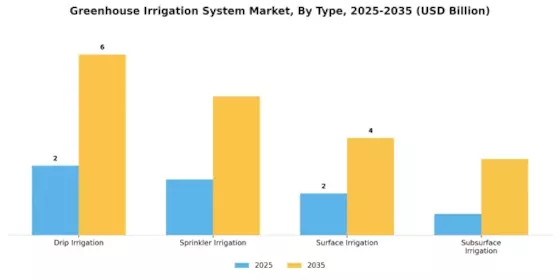
Drip Irrigation (Dominant) vs. Surface Irrigation (Emerging)
Drip Irrigation remains the dominant force within the Greenhouse Irrigation System Market, characterized by its ability to minimize water wastage while ensuring optimal nourishment for crops. This method provides precise control over water and nutrient delivery, making it ideal for greenhouses where resource efficiency is critical. In contrast, Surface Irrigation, while recognized as an emerging method, offers accessibility and simplicity, often used in less complicated greenhouse setups. Although it may not match the efficiency of Drip Irrigation, it provides a viable option for growers looking for cost-effective solutions. As environmental concerns and water scarcity intensify, Surface Irrigation is expected to evolve and integrate more efficient practices, making it an interesting area to watch in the coming years.
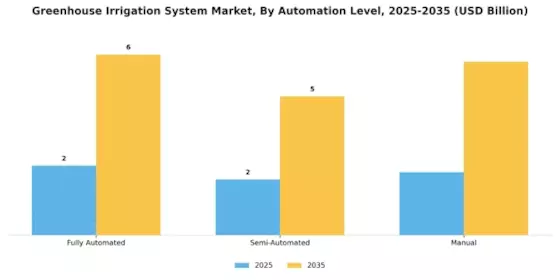
The Greenhouse Irrigation System Market is segmented by automation levels, predominantly featuring Fully Automated systems, which hold the largest market share due to their efficiency and advanced technological integration. Semi-Automated systems also capture a significant portion, appealing to growers seeking a balance between manual control and automation. Manual systems represent a smaller share but cater to niche markets focused on traditional farming methods.
Automation Level: Fully Automated (Dominant) vs. Manual (Emerging)
Fully Automated greenhouse irrigation systems are recognized for their operational efficiency and minimal labor requirements, allowing growers to maximize yields while optimizing water usage. As technology advances, these systems incorporate smart sensors and IoT capabilities, enhancing their appeal. On the other hand, Manual irrigation systems are emerging as a choice for those who prefer hands-on control and operate on smaller scales; they are particularly favored in organic farming sectors where labor-intensive processes are viewed as beneficial for crop quality. The growth of eco-conscious consumerism is also shaping the dynamics in favor of more traditional, Manual systems, allowing for diverse market participation.
In the Greenhouse Irrigation System Market, Vegetables dominate the crop type segment, capturing a significant proportion of the overall market share. This category's robustness is primarily attributed to growing consumer demand for fresh produce and advancements in irrigation technologies that specifically cater to vegetable cultivation. Fruits, while currently holding a smaller share compared to vegetables, are seeing rapid adoption of greenhouse irrigation systems. Increased interest in organic fruits and year-round cultivation practices are driving this upward trend.
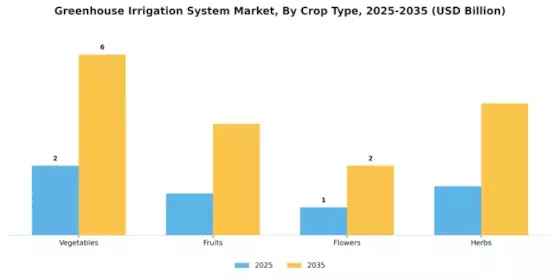
Vegetables (Dominant) vs. Fruits (Emerging)
The vegetable segment stands as the dominant force in the greenhouse irrigation market, characterized by its extensive variety and consistent consumer demand. Key factors contributing to its strong position include advancements in irrigation efficiency and tailored agronomic practices that enhance yield. Conversely, the fruits segment is emerging rapidly, influenced by the rise in consumer preferences for fresh, high-quality fruits and the potential for higher profit margins compared to vegetables. Innovations in controlled environment agriculture and hydroponics are making fruit cultivation more viable and attractive for growers, thereby bolstering its growth and future market potential.
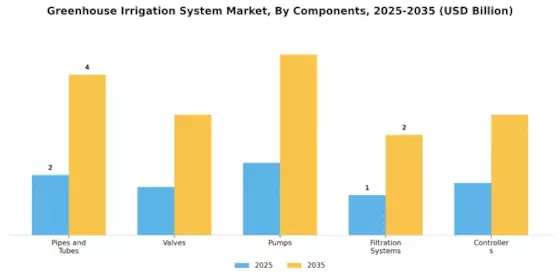
In the Greenhouse Irrigation System Market, the components segment is crucial, with Pipes and Tubes holding the largest market share due to their essential role in water distribution. Valves and Filtration Systems follow, playing significant roles in regulating flow and maintaining water quality. Controllers and Pumps are also vital, ensuring optimal operation and pressure management across the irrigation systems, although they contribute comparatively smaller market shares.
Pipes and Tubes (Dominant) vs. Pumps (Emerging)
Pipes and Tubes represent the dominant force within the Greenhouse Irrigation System Market, providing the essential infrastructure for water delivery. Their widespread usage and efficiency in directing water to plants make them irreplaceable. Meanwhile, Pumps are emerging as a critical component, driven by advancements in technology that enhance their performance and reliability. The growing demand for automated irrigation systems is propelling the pump segment forward, as they offer increased precision and efficiency in water usage, catering to modern agricultural practices.
Get more detailed insights about Greenhouse Irrigation System Market Request Free Sample
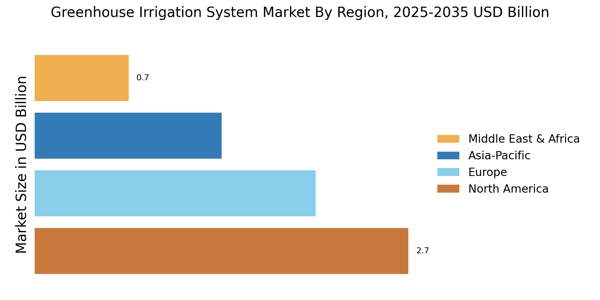
North America is the largest market for greenhouse irrigation systems, holding approximately 40% of the global market share. The region's growth is driven by increasing demand for sustainable agricultural practices, technological advancements, and supportive government policies. The U.S. and Canada are the primary contributors, with a strong emphasis on water conservation and efficiency in irrigation systems. Regulatory frameworks promoting sustainable farming practices further catalyze market growth. The competitive landscape in North America is robust, featuring key players such as Netafim, Rain Bird Corporation, and Toro Company. These companies are at the forefront of innovation, offering advanced irrigation solutions tailored to the needs of greenhouse operators. The presence of established agricultural practices and a focus on high-tech solutions position North America as a leader in the greenhouse irrigation market.
Europe is the second-largest market for greenhouse irrigation systems, accounting for approximately 30% of the global market share. The region's growth is fueled by stringent regulations aimed at promoting sustainable agriculture and efficient water use. Countries like Germany and the Netherlands are leading the charge, implementing policies that encourage the adoption of advanced irrigation technologies. The EU's Green Deal further supports the transition to sustainable farming practices, enhancing market demand. Leading countries in Europe include Germany, the Netherlands, and France, where the competitive landscape is characterized by a mix of established players and innovative startups. Companies like Irritec and Valmont Industries are key contributors, focusing on developing eco-friendly irrigation solutions. The presence of strong agricultural sectors and a commitment to sustainability make Europe a dynamic market for greenhouse irrigation systems.
Asia-Pacific is witnessing rapid growth in the greenhouse irrigation system market, holding approximately 20% of the global market share. The region's expansion is driven by increasing agricultural productivity demands, urbanization, and government initiatives promoting modern farming techniques. Countries like China and India are at the forefront, implementing policies to enhance water efficiency and support greenhouse farming, which is crucial for food security in densely populated areas. The competitive landscape in Asia-Pacific is evolving, with a mix of local and international players. Key companies such as Jain Irrigation Systems and AquaSpy are making significant strides in the market, offering innovative solutions tailored to regional needs. The growing focus on sustainable agriculture and the adoption of advanced irrigation technologies position Asia-Pacific as a promising market for greenhouse irrigation systems.
The Middle East and Africa region is emerging in the greenhouse irrigation system market, accounting for approximately 10% of the global market share. The growth is primarily driven by the need for efficient water management in arid climates and increasing agricultural investments. Countries like South Africa and the UAE are leading the way, implementing innovative irrigation solutions to combat water scarcity and enhance food production in challenging environments. The competitive landscape in this region is characterized by a mix of local and international players, with companies like Lindsay Corporation and Hunter Industries making significant contributions. The focus on sustainable practices and the adoption of advanced technologies are crucial for addressing the unique challenges faced by the agricultural sector in the Middle East and Africa, making it a key area for growth in greenhouse irrigation systems.
The Greenhouse Irrigation System Market is currently characterized by a dynamic competitive landscape, driven by increasing agricultural productivity demands and the need for efficient water management solutions. Key players such as Netafim (IL), Rain Bird Corporation (US), and Jain Irrigation Systems Limited (IN) are strategically positioned to leverage innovation and sustainability in their operations. Netafim (IL) focuses on precision irrigation technologies, while Rain Bird Corporation (US) emphasizes smart irrigation solutions that integrate with digital platforms. Jain Irrigation Systems Limited (IN) is expanding its product portfolio to include advanced drip irrigation systems, thereby enhancing its market presence. Collectively, these strategies foster a competitive environment that prioritizes technological advancement and sustainable practices. In terms of business tactics, companies are increasingly localizing manufacturing to reduce costs and enhance supply chain efficiency. The market structure appears moderately fragmented, with several players vying for market share. This fragmentation allows for diverse offerings, yet the influence of major companies remains significant, as they set trends and standards that smaller firms often follow. The collective actions of these key players shape the market dynamics, pushing for innovation and improved service delivery. In August 2025, Netafim (IL) announced a partnership with a leading agricultural technology firm to develop an AI-driven irrigation management system. This strategic move is likely to enhance their product offerings, allowing farmers to optimize water usage based on real-time data analytics. Such advancements not only position Netafim as a leader in smart irrigation but also reflect a broader trend towards integrating technology in agricultural practices. In September 2025, Rain Bird Corporation (US) launched a new line of solar-powered irrigation controllers aimed at reducing energy consumption for greenhouse operations. This initiative underscores the company's commitment to sustainability and energy efficiency, aligning with global trends towards greener agricultural practices. By focusing on renewable energy solutions, Rain Bird is likely to attract environmentally conscious consumers and enhance its competitive edge. In July 2025, Jain Irrigation Systems Limited (IN) expanded its operations into Southeast Asia, establishing a manufacturing facility in Vietnam. This strategic expansion not only allows Jain to tap into emerging markets but also positions the company to better serve local agricultural needs. Such geographical diversification may enhance their resilience against market fluctuations and strengthen their global footprint. As of October 2025, the competitive trends in the Greenhouse Irrigation System Market are increasingly defined by digitalization, sustainability, and the integration of artificial intelligence. Strategic alliances among key players are shaping the landscape, fostering innovation and collaborative solutions. The shift from price-based competition to a focus on technological differentiation and supply chain reliability is evident, suggesting that future competitive advantages will hinge on the ability to innovate and adapt to evolving market demands.
The Greenhouse Irrigation System Market is projected to grow at a 9.16% CAGR from 2025 to 2035, driven by technological advancements, increasing agricultural efficiency, and sustainability initiatives.
New opportunities lie in:
By 2035, the market is expected to be robust, reflecting substantial growth and innovation.
| MARKET SIZE 2024 | 6.764(USD Billion) |
| MARKET SIZE 2025 | 7.384(USD Billion) |
| MARKET SIZE 2035 | 17.74(USD Billion) |
| COMPOUND ANNUAL GROWTH RATE (CAGR) | 9.16% (2025 - 2035) |
| REPORT COVERAGE | Revenue Forecast, Competitive Landscape, Growth Factors, and Trends |
| BASE YEAR | 2024 |
| Market Forecast Period | 2025 - 2035 |
| Historical Data | 2019 - 2024 |
| Market Forecast Units | USD Billion |
| Key Companies Profiled | Netafim (IL), Rain Bird Corporation (US), Hunter Industries (US), Toro Company (US), Jain Irrigation Systems Limited (IN), Valmont Industries (US), AquaSpy (US), Irritec (IT), Lindsay Corporation (US) |
| Segments Covered | Irrigation Type, Automation Level, Crop Type, Components, Regional |
| Key Market Opportunities | Integration of smart technology enhances efficiency in the Greenhouse Irrigation System Market. |
| Key Market Dynamics | Technological advancements in irrigation efficiency drive competitive dynamics in the greenhouse irrigation system market. |
| Countries Covered | North America, Europe, APAC, South America, MEA |
The projected market valuation for the Greenhouse Irrigation System Market in 2035 is 17.74 USD Billion.
The market valuation for the Greenhouse Irrigation System Market in 2024 was 6.764 USD Billion.
The expected CAGR for the Greenhouse Irrigation System Market during the forecast period 2025 - 2035 is 9.16%.
Key players in the Greenhouse Irrigation System Market include Netafim, Rain Bird Corporation, Hunter Industries, and Toro Company.
The main types of irrigation systems include Drip Irrigation, Sprinkler Irrigation, Surface Irrigation, and Subsurface Irrigation.
The Drip Irrigation segment is projected to be worth 6.5 USD Billion by 2035.
The market size for Fully Automated irrigation systems in 2024 was 2.5 USD Billion.
Vegetables are expected to dominate the Greenhouse Irrigation System Market, with a projected value of 6.5 USD Billion by 2035.
Components in the Greenhouse Irrigation System Market include Pipes and Tubes, Valves, Pumps, Filtration Systems, and Controllers.
The Pumps segment is projected to reach a value of 4.5 USD Billion by 2035.





Kindly complete the form below to receive a free sample of this Report

“This is really good guys. Excellent work on a tight deadline. I will continue to use you going forward and recommend you to others. Nice job”


“Thanks. It’s been a pleasure working with you, please use me as reference with any other Intel employees.”


“Thanks for sending the report it gives us a good global view of the Betaïne market.”


“Thank you, this will be very helpful for OQS.”


“We found the report very insightful! we found your research firm very helpful. I'm sending this email to secure our future business.”


“I am very pleased with how market segments have been defined in a relevant way for my purposes (such as "Portable Freezers & refrigerators" and "last-mile"). In general the report is well structured. Thanks very much for your efforts.”


“I have been reading the first document or the study, ,the Global HVAC and FP market report 2021 till 2026. Must say, good info! I have not gone in depth at all parts, but got a good indication of the data inside!”


“We got the report in time, we really thank you for your support in this process. I also thank to all of your team as they did a great job.”


“The Automotive 48V ECU Components Procurement Intelligence Study” was a complex project, but the Market Research Future (MRFR) team handled it with quality, agility, and customer-centricity. They delivered all requested data on time and within the agreed scope. The team, including Shubhendra Anand and Rahul Gotadki, was always readily available to clarify questions and swiftly implement necessary adjustments, driving the project to a successful conclusion within a very demanding timeframe.
I would also like to specifically commend Akshay Agarwal for his responsiveness and support at every stage—from our initial inquiry on May 6th through to final delivery on June 18th. His dedication made the entire process seamless.”



