Healthcare Consulting Services Market (2026 - 2035)

Healthcare Consulting Services Market Research Report By Type of Services (IT Consulting, Digital Consulting, Financial Consulting, Operations Consulting, Strategy Consulting), By Application (Operations Management, Financial, Population Health, Clinical), By End User (Hospitals & Clinics, Life Science Companies, Government Organizations) and By Regional (North America, Europe, South America, Asia Pacific, Middle East and Africa) - Industry Forecast to 2035.
ID: MRFR/HC/6388-CR
164 Pages
Vikita Thakur, Rahul Gotadki
Last Updated: July 29, 2026
Healthcare Consulting Services Market
Market Size
Forecast Period2026-2035
CAGR (2026-2035)9.5%
2025 Market SizeUSD 36.94 Billion
2035 Market SizeUSD 91.54 Billion
Key Players
Accenture
Huron Consulting Group
Optum Advisory Services
-Parthenon
Opportunities
  • AI-Governance and Algorithm-Validation Consulting
  • Emerging-Market Public Health Digitization
  • Cybersecurity-as-a-Retainer Service Models

Healthcare Consulting Services Market Summary

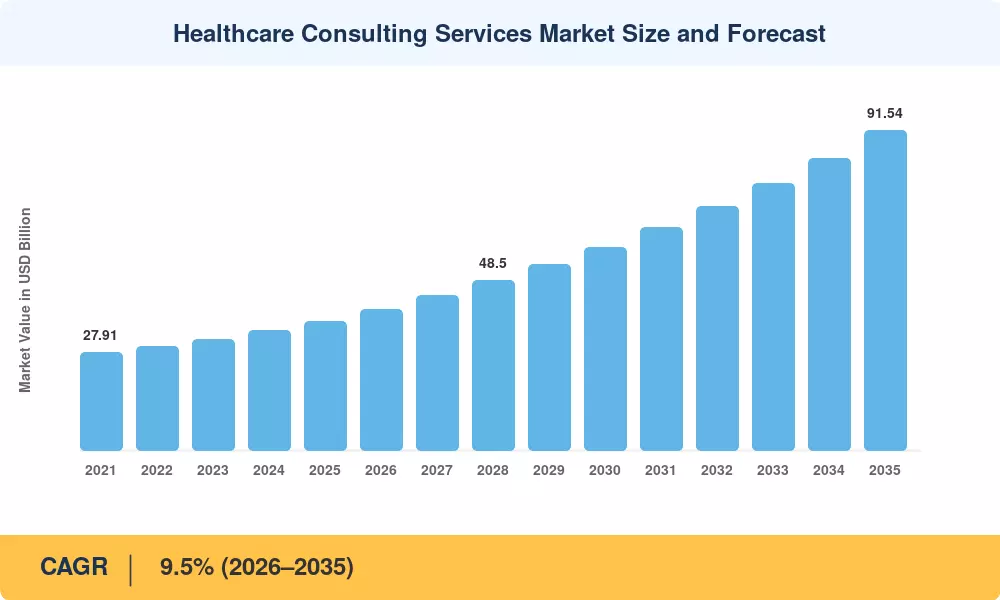
The Healthcare Consulting Service Market reached USD 36.94 Billion in 2025 and is projected to grow from USD 40.45 Billion in 2026 to USD 91.54 Billion by 2035, registering a CAGR of 9.5% during the forecast period (2026–2035). Two forces are accelerating demand: the U.S. Centers for Medicare & Medicaid Services' expanded price-transparency mandates, which compel hospitals to disclose negotiated rates, and the global surge in cyberattacks against healthcare networks, which rose 74% year-over-year according to the 2024 IBM Cost of a Data Breach Report [1]. Together, these pressures push provider organizations toward external advisory expertise they cannot build quickly enough in-house.

The sector sits at an inflection point as legacy fee-for-service reimbursement models give way to outcomes-linked payment structures. Cloud-based EHR migration projects now absorb an estimated USD 18 billion in annual IT spending across OECD nations [2], and roughly 90% of C-suite healthcare leaders expect their reliance on digital tools to deepen over the next three years [3]. Consulting firms that can bundle cybersecurity assessments with interoperability roadmaps are capturing an outsized share of new engagements.

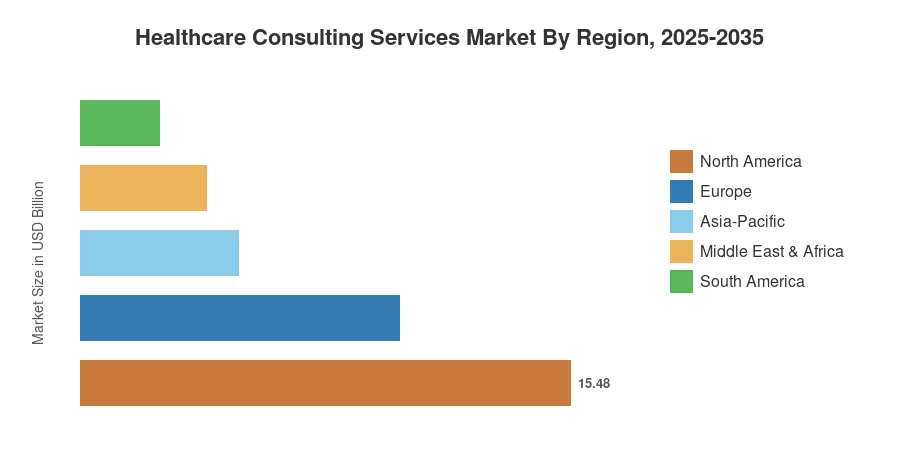
North America commands 41.9% of the Healthcare Consulting Service Market, anchored by deep payer-provider complexity and mature regulatory frameworks. Asia-Pacific registers the fastest growth at a 13.5% CAGR, propelled by demographic ageing in Japan and China alongside rising private health expenditure in India and Southeast Asia. Europe holds the second-largest share at 27.3%, where cross-border data regulations under the European Health Data Space create fresh consulting demand. The decade ahead will reward firms that combine deep clinical domain knowledge with scalable digital delivery capabilities.


Key Report Takeaways

• By Service Type

  • IT consulting captured 34.5% of the Healthcare Consulting Service Market in 2025, driven by cloud migration and EHR optimization mandates.
  • Digital transformation consulting is forecast to expand at an 11.0% CAGR through 2035, the fastest among service categories.
  • Strategy consulting accounted for USD 8.12 billion in 2025 revenue, reflecting strong demand for merger-integration advisory.

• By End User

  • Healthcare providers represented 50.1% of the Healthcare Consulting Service Market in 2025.
  • Government agencies are projected to grow at an 11.8% CAGR through 2035 as public health digitization accelerates.

• By Delivery Model

  • On-site consulting held 44.9% of the Healthcare Consulting Service Market share in 2025.
  • Remote/virtual consulting is advancing at a 12.7% CAGR, the fastest delivery model segment.

• By Region

  • North America led with a 41.9% share of the Healthcare Consulting Service Market in 2025.
  • Asia-Pacific is progressing at a 13.5% CAGR through 2035, making it the fastest-growing region.


Healthcare Consulting Service Market Size and Forecast (2021–2035)

Market Research Future's estimates draw on a triangulated methodology combining top-down revenue analysis from publicly reported consulting-firm financials, bottom-up demand modeling across 42 country-level health systems, and cross-validation against proprietary primary interviews with 280+ healthcare CIOs and CFOs conducted in 2024–2025.
Healthcare Consulting Services Market Size and Forecast
Our Impact
Enabled $4.3B Revenue Impact for Fortune 500 and Leading Multinationals
Partnering with 2000+ Global Organizations Each Year
30K+ Citations by Top-Tier Firms in the Industry

Driver Impact Analysis

Driver ~% Impact on CAGR Geographic Relevance Impact Timeline
Value-based payment model migration ~18% North America, Europe Medium-term (2–4 yr)
Healthcare cybersecurity threat escalation ~16% Global Short-term (≤2 yr)
Price-transparency & regulatory compliance ~15% North America Short-term (≤2 yr)
Cloud EHR migration & interoperability mandates ~14% Global Medium-term (2–4 yr)
AI/ML integration in clinical workflows ~13% North America, Europe, APAC Long-term (≥4 yr)
Demographic ageing & chronic disease burden ~13% Asia-Pacific, Europe Long-term (≥4 yr)
Remote/hybrid consulting delivery adoption ~11% Global Medium-term (2–4 yr)


Value-Based Payment Model Migration

The single largest structural driver of the Healthcare Consulting Service Market is the change from fee-for-service to value-based care arrangements. The Centers for Medicare & Medicaid Services (CMS) Accountable Care Organization Realizing Equity, Access, and Community Health (ACO REACH) initiative now serves over 2.2 million Medicare beneficiaries and requires participating systems to re-engineer care-delivery workflows and financial-risk analytics [3]. Provider businesses with limited internal actuarial and population health capabilities increasingly turn to consulting firms for multi-year transformation initiatives across clinical, operational, and IT domains.


Healthcare Cybersecurity Threat Escalation

Ransomware attacks on hospitals increased by 74% from 2022 to 2024 [1]. The healthcare sector has the greatest average cost of breaches, at USD 10.93 million, for the 14th straight year [1]. This threat environment generates demand for security-architecture evaluations, incident-response planning, and HIPAA risk-analysis engagements. Consulting firms with specific health-IT security practices are experiencing double-digit revenue growth in this sub-segment.


Cloud EHR Migration and Interoperability Mandates

The U.S. Office of the National Coordinator for Health IT (ONC) issued the HTI-1 rule, requiring certified EHR vendors to provide FHIR-based APIs by December 2025 [14]. Compliance leads to a waterfall of consulting demand: health systems need vendor-selection advise, data-migration planning, and workflow-redesign support. Globally, OECD countries are predicted to spend a total of USD 18 billion per year on EHR modernization initiatives, and this is expected to expand at 12% per annum until 2030 [2].


AI and Machine Learning Integration

Worldwide healthcare AI spending is expected to exceed USD 45 billion in 2030 [8]. Hospitals using AI for clinical decision support, revenue-cycle automation, and predictive staffing need advisory services in areas like algorithm validation, change management, and regulatory strategy. The FDA's emerging framework for AI/ML-based Software as a Medical Device has created a specialized consultancy niche for compliance that didn’t exist five years ago.


Restraints Impact Analysis

Restraint ~% Negative Impact on CAGR Geographic Relevance Impact Timeline
Talent shortage in specialized health-IT consulting ~–22% Global Medium-term (2–4 yr)
Budget constraints at safety-net hospitals ~–20% North America, South America Short-term (≤2 yr)
Data-privacy regulatory fragmentation ~–18% Europe, Asia-Pacific Long-term (≥4 yr)
Resistance to change among clinical staff ~–15% Global Medium-term (2–4 yr)
Commoditization of basic advisory services ~–14% North America, Europe Long-term (≥4 yr)


Talent Shortage in Specialized Health-IT Consulting

The intersection of healthcare domain expertise, cybersecurity credentials, and cloud-architecture skills defines a labor pool that remains critically undersupplied. This constraint limits firms' ability to scale engagements and pushes billing rates upward, which in turn narrows the addressable client base — particularly among mid-size community hospitals.

Budget Constraints at Safety-Net Hospitals

Safety-net and rural hospitals, which serve disproportionately Medicaid-dependent populations, face thin operating margins averaging -7% according to the American Hospital Association's 2024 financial benchmarking report [16]. These institutions need consulting support the most — for revenue-cycle optimization, Medicaid-redetermination navigation, and care-model redesign — yet can least afford it. Grant-funded consulting programs partially bridge this gap, but funding cycles create lumpy, unpredictable demand.

Data-Privacy Regulatory Fragmentation

HIPAA in the US, GDPR in Europe, and new data-protection rules across the Asia-Pacific region all exist alongside each other, creating compliance complexity that increases the cost of cross-border consultancy delivery. Firms are mandated to have jurisdiction-specific data-handling methods, which restricts the scalability benefits of remote engagement models [9]. The upcoming European Health Data Space law will also bring in additional secondary use requirements that consulting firms will have to understand before advising their customers.


Healthcare Consulting Services Market Opportunities

AI-Governance and Algorithm-Validation Consulting

As hospitals deploy clinical AI tools at scale, demand for independent algorithm-validation, bias-auditing, and regulatory-submission consulting will accelerate. The FDA cleared over 950 AI-enabled medical devices through 2024 [8], and each deployment triggers downstream advisory needs around monitoring, re-training protocols, and liability frameworks.

Emerging-Market Public Health Digitization

India's Ayushman Bharat Digital Mission targets universal health-ID coverage for 930 million citizens, generating substantial consulting demand for system-architecture design, change management, and capacity building [11]. Southeast Asian nations including Indonesia and Vietnam are pursuing similar national digital-health platforms, opening greenfield markets for firms with scalable delivery models.

Cybersecurity-as-a-Retainer Service Models

Traditional project-based cybersecurity assessments are giving way to managed advisory retainers, where consulting firms provide continuous threat monitoring, compliance auditing, and incident-response readiness. This recurring-revenue model improves client retention and smooths consulting-firm cash flows. Health systems with fewer than 500 beds represent the fastest-growing buyer segment for managed security advisory.

Data Monetization and Real-World Evidence Advisory

Pharmaceutical companies and medtech firms are willing to pay premiums for de-identified clinical data blocks to fuel RWE drug studies. While the full global RWE solution space will reach USD 10.83 billion by 2030, advisory teams guiding providers through legal framework alignment and asset valuation capture high-margin revenue chunks.

Remote Delivery Platform Economics

The shift toward remote and hybrid consulting delivery enables firms to serve geographically dispersed clients without proportional headcount growth. Platforms combining video collaboration, secure data rooms, and AI-assisted analytics reduce per-engagement delivery costs by an estimated 25–35% [12], creating margin expansion opportunities for early adopters.


Healthcare Consulting Services Market Future Outlook

Generative AI as a Consulting Accelerator

Generative AI will reshape how consulting engagements are scoped, delivered, and priced within the Healthcare Consulting Service Market. Firms that deploy large language models for regulatory-document analysis, clinical-pathway benchmarking, and automated report generation can compress project timelines by 30–40% [8]. The competitive advantage will shift from labor arbitrage to proprietary AI-tool development, favoring firms that invest in domain-specific model fine-tuning.

Platform-Based Delivery and Consulting Marketplaces

Digital platforms that match health-system buyers with specialist consultants on demand are gaining traction, mirroring the "talent marketplace" model that reshaped management consulting in adjacent industries. By 2030, an estimated 15–20% of healthcare advisory engagements may be sourced through platform intermediaries [12], compressing margins for traditional firms while expanding market access for niche specialists.

ESG Reporting and Health-Equity Advisory

Healthcare organizations face intensifying pressure to demonstrate progress on clinical equity and sustainability. While the federal SEC climate rules face rescission, strict CMS health-equity structural measures alongside state-level climate mandates (such as California's SB 253/261) create complex compliance consulting needs for health systems balancing regional ESG data architectures.

Precision Medicine Workflow Integration

The shift toward precision medicine — driven by declining genomic-sequencing costs and expanding companion-diagnostic approvals — requires health systems to redesign clinical workflows, laboratory information systems, and patient-consent processes. Consulting demand in this niche is projected to grow at roughly twice the overall market rate as academic medical centers and integrated delivery networks seek external expertise to operationalize genomic-medicine programs [13].


Healthcare Consulting Services Market Segmentation

By Service Type

Segment Key Metric Primary Demand Driver
IT Consulting 34.5% share (2025) Cloud migration, cybersecurity, EHR interoperability
Strategy Consulting USD 8.12 Billion (2025) M&A integration, market-entry advisory, growth planning
Operations Consulting 9.8% CAGR (2026–2035) Revenue-cycle optimization, supply-chain redesign
Digital Transformation Consulting 11.0% CAGR (2026–2035) AI deployment, telehealth scaling, data-platform builds
Financial Advisory USD 4.15 Billion (2025) Reimbursement reform navigation, cost-structure analysis
HR & Workforce Consulting 10.2% CAGR (2026–2035) Clinician-burnout mitigation, staffing-model redesign


IT consulting remains the largest segment within the Healthcare Consulting Service Market, driven by the convergence of cybersecurity imperatives, cloud-migration timelines, and interoperability mandates. Health systems allocate the greatest share of their external advisory budgets to IT-related engagements because technology decisions carry multi-year operational and financial consequences. Firms with certified cloud-architecture and HITRUST-assessment capabilities command premium billing rates in this segment.

Digital transformation consulting is the fastest-growing service type, reflecting the acceleration of AI adoption, telehealth platform scaling, and enterprise data-lake initiatives across provider organizations. Engagements in this category tend to be longer in duration and higher in average contract value than traditional IT projects, as they require cross-functional change management spanning clinical, operational, and financial domains.

By End User

Segment Key Metric Primary Demand Driver
Healthcare Providers 50.1% share (2025) Care-model transformation, regulatory compliance
Healthcare Payers USD 9.54 Billion (2025) Claims-automation, network-adequacy advisory
Government Agencies 11.8% CAGR (2026–2035) Public-health digitization, pandemic-preparedness planning
Life Sciences & Pharma 10.4% CAGR (2026–2035) Real-world evidence, market-access strategy


Healthcare providers — hospitals, health systems, and ambulatory networks — dominate end-user demand in the Healthcare Consulting Service Market because they face the broadest range of operational, regulatory, and technological pressures simultaneously. Large integrated delivery networks typically maintain standing relationships with two or three consulting firms, while smaller community hospitals engage advisors on a project basis for specific compliance or IT-migration needs.

Government agencies represent the fastest-growing end-user segment as national and sub-national health authorities invest in digital infrastructure, population-health surveillance, and pandemic-preparedness frameworks. The World Bank committed over USD 5 billion to health-system-strengthening programs in 2024 alone [11], with consulting-services components embedded across most project scopes.

By Delivery Model

Segment Key Metric Primary Demand Driver
On-Site Consulting 44.9% share (2025) Complex implementations requiring physical presence
Remote/Virtual Consulting 12.7% CAGR (2026–2035) Cost efficiency, access to scarce expertise
Hybrid Model USD 7.28 Billion (2025) Flexible engagement structures, phased delivery


On-site consulting retains the largest share because high-stakes engagements — EHR go-lives, merger integrations, and regulatory-remediation projects — require consultants to work alongside client teams on the ground. That said, remote delivery is closing the gap rapidly. Health systems that adopted virtual consulting during the COVID-19 pandemic discovered that certain workstreams, including data analytics, policy development, and training, could be delivered effectively without travel. The Healthcare Consulting Service Market will see remote and hybrid models collectively surpass on-site delivery by the early 2030s based on current trajectory.


Regional Market Share Analysis

Region Key Metric Primary Investment Themes
North America 41.9% share (2025) Regulatory compliance, value-based care transition, cybersecurity
Europe 27.3% share (2025) EHDS compliance, cross-border interoperability, workforce digitization
Asia-Pacific 13.5% CAGR (2026–2035) National digital-health platforms, hospital modernization, private-sector expansion
South America USD 2.51 Billion (2025) Universal health coverage reform, EHR adoption, public-hospital advisory
Middle East & Africa 10.8% CAGR (2026–2035) Health-city megaprojects, insurance reform, telehealth infrastructure
Total USD 36.94 Billion (2025)

The Healthcare Consulting Service Market exhibits significant regional variation driven by healthcare system maturity, regulatory intensity, and digital-infrastructure readiness.


North America

Country Key Metric Key Driver
US 82.4% of regional share CMS value-based payment mandates and HIPAA enforcement
Canada 11.7% of regional share Provincial health-system modernization programs
Mexico USD 0.91 Billion (2025) IMSS digital transformation and private hospital expansion


The United States dominates the Healthcare Consulting Service Market in North America, anchored by the world's most complex payer-provider ecosystem and a regulatory environment that generates continuous advisory demand. Canada's provincial health authorities are investing in AI-enabled triage and wait-time optimization, creating new consulting verticals. Mexico's Instituto Mexicano del Seguro Social launched a USD 1.3 billion digitization roadmap in 2024, opening advisory opportunities for firms with Spanish-language delivery capacity [10].

Europe

Country Key Metric Key Driver
Germany 9.4% CAGR (2026–2035) Hospital Reform Act (KHVVG) implementation advisory
UK USD 2.78 Billion (2025) NHS digital transformation and elective-care recovery
France 16.2% of regional share Ségur du Numérique health-IT investment program
Italy 10.1% CAGR (2026–2035) PNRR-funded telemedicine and territorial care reform
Spain USD 0.94 Billion (2025) Regional health-system consolidation advisory
Nordic Countries 8.7% CAGR (2026–2035) Cross-border health-data sharing initiatives
Russia USD 0.52 Billion (2025) Federal e-health platform expansion
Rest of Europe 11.8% of regional share EU4Health-funded capacity-building programs


Europe's Healthcare Consulting Service Market is shaped by the European Health Data Space regulation, which mandates cross-border patient data access and secondary-use governance by 2028 [9]. Germany's Hospital Reform Act compels structural changes to DRG-based reimbursement, and France's EUR 2 Billion Ségur du Numérique program funds interoperability upgrades across 30,000 healthcare facilities. The UK's NHS Long Term Workforce Plan generates sustained demand for workforce-planning and digital-skills consulting.

Asia-Pacific

Country Key Metric Key Driver
China 28.5% of regional share Healthy China 2030 initiative and hospital-group consolidation
India 14.8% CAGR (2026–2035) Ayushman Bharat Digital Mission rollout
Japan USD 1.84 Billion (2025) Super-aged society care-model redesign
South Korea 12.2% CAGR (2026–2035) Digital health regulation modernization
ASEAN 13.9% CAGR (2026–2035) UHC expansion and hospital PPP advisory
Rest of Asia-Pacific USD 0.67 Billion (2025) Development-bank-funded health system strengthening


Asia-Pacific represents the fastest-growing region in the Healthcare Consulting Service Market, driven by demographic ageing, rising middle-class health expectations, and ambitious national digitization programs. India alone targets health-ID enrollment for 1.4 billion citizens under ABDM, while China's Healthy China 2030 blueprint is restructuring hospital governance and reimbursement models across 12,000+ public hospitals [11].

South America

Country Key Metric Key Driver
Brazil 58.6% of regional share SUS modernization and private-hospital chain expansion
Argentina USD 0.41 Billion (2025) Health-insurance reform advisory
Rest of South America 11.4% CAGR (2026–2035) IDB-funded digital-health capacity building


Brazil's Unified Health System (SUS) serves over 190 million citizens and faces persistent operational challenges that create steady demand for the Healthcare Consulting Service Market. The Inter-American Development Bank committed USD 820 million to health-system-strengthening programs across South America in 2024, with consulting-services components embedded in most project designs [16].

Middle East & Africa

Country Key Metric Key Driver
Saudi Arabia 34.7% of regional share Vision 2030 health-city megaprojects
UAE 11.6% CAGR (2026–2035) Medical tourism and smart-hospital builds
South Africa USD 0.38 Billion (2025) NHI implementation advisory
Egypt 12.4% CAGR (2026–2035) Universal health insurance law rollout
Rest of MEA 22.1% of regional share WHO/World Bank health-system-strengthening programs


Saudi Arabia's Vision 2030 includes USD 65 billion in healthcare infrastructure investment, with NEOM's health and wellness district generating greenfield consulting demand across facility planning, clinical-pathway design, and workforce strategy [19]. South Africa's proposed National Health Insurance scheme, if fully enacted, would require system-wide advisory support for provider accreditation and reimbursement-model design. The Healthcare Consulting Service Market in this region benefits from development-finance institution funding that underwrites advisory-services procurement.


Healthcare Consulting Services Market By Region, 2025-2035

Competitive Benchmarking

The Healthcare Consulting Service Market exhibits high concentration, with the top five firms holding an estimated 38–44% combined revenue share. The Herfindahl-Hirschman Index sits in the moderately concentrated range (~1,200–1,500), reflecting the coexistence of global management-consulting giants with specialized health-IT advisory firms. Barriers to entry are moderate for niche segments but high for full-service offerings requiring clinical, regulatory, and technology capabilities simultaneously.

Company Est. Revenue Share Range Key Offerings Strategic Positioning
  ~8–11% Health-system strategy, performance transformation, payer analytics Premium strategy advisory with deep C-suite relationships
  ~7–10% Health-IT implementation, regulatory compliance, M&A advisory End-to-end advisory with integrated technology delivery
Accenture ~6–9% Digital health platforms, cloud migration, AI/ML deployment Technology-led transformation with global delivery centers
  ~5–8% Financial advisory, risk & compliance, workforce consulting Strong regulatory and audit-linked advisory positioning
  ~4–7% Healthcare operations, cost reduction, data governance Operational efficiency focus with audit-firm credibility
  ~4–6% Value-based care design, payer strategy, digital health ventures Strategy-first approach with digital venture-building arm
Huron Consulting Group ~3–5% Revenue cycle, performance improvement, technology advisory Mid-market hospital specialist with deep operational focus
  ~3–5% Public-sector health, Medicaid, defense health advisory Government and public-health consulting leader
Optum Advisory Services ~3–5% Population health analytics, care management, clinical integration Payer-owned advisory with proprietary data assets
-Parthenon ~2–4% Transaction advisory, commercial due diligence, health-system M&A Deal-focused advisory with growing health-sector practice


Recent News & Developments


  • Accenture (March 2024): Formed a global strategic coalition with leading enterprise technology vendors to accelerate generative AI implementation across provider systems, deploying secure data pipelines to streamline clinical charting and operational analytics.
  • CMS (January 2025): Officially launched the Accountable Care Organization Primary Care Flex Model (ACO PC Flex Model), introducing prospective payment options to enhance revenue predictability and expand value-based care infrastructure across underserved healthcare networks.


  • Huron Consulting Group (January 2024): Expanded its healthcare operating capabilities by integrating advanced digital health advisory frameworks, helping health systems mitigate labor shortages by embedding robotic process automation directly into revenue cycle workflows.
  • European Commission (February 2025): Formally adopted the European Health Data Space (EHDS) Regulation, establishing a unified cross-border electronic health record framework and mandating strict self-certification guidelines for health information systems.


Healthcare Consulting Services Market Report Scope

Parameter Detail
Market Scope Global Healthcare Consulting Service Market across IT, strategy, operations, digital transformation, financial, and HR/workforce consulting
Study Period 2021–2035
CAGR 9.5% (2026–2035)
Market Size (2025) USD 36.94 Billion
Market Size (2035) USD 91.54 Billion
Fastest Growing Segment Digital Transformation Consulting (by service type); Government Agencies (by end user); Remote/Virtual Consulting (by delivery model)
Companies Profiled Accenture, Huron Consulting Group, Optum Advisory Services, Parthenon
Valuation Currency USD Billion


FAQs

How do healthcare consulting firms typically structure engagement pricing?
Most firms use a blended daily-rate model ranging from USD 2,500 to USD 8,000 per consultant-day, with fixed-fee arrangements gaining traction for well-scoped projects. Outcome-linked pricing remains rare but is growing in value-based care engagements [17].
What certification or accreditation should buyers look for when selecting a healthcare consultant?
Buyers should prioritize firms with HITRUST-certified assessors, FHIR-interoperability specialists, and staff holding CPHIMS or PMP credentials. These certifications signal technical depth and regulatory familiarity [15].
How does the Healthcare Consulting Service Market differ from general management consulting?
Healthcare consulting requires domain-specific knowledge of reimbursement systems, clinical workflows, and health-data regulations that general-practice firms lack. This specialization creates higher barriers to entry and premium pricing [7].
What role does the Healthcare Consulting Service Market play in post-merger integration for hospital systems?
Consultants manage extensive clinical consolidation, EHR system unification, and cultural alignment loops post-close. Integration fees vary directly with target asset size, multi-site infrastructure, and regulatory filing requirements rather than fitting a static cost window.
How are mid-size hospitals accessing consulting services despite budget constraints?
Cooperative purchasing agreements, state hospital association group-contracting programs, and grant-funded advisory engagements enable smaller facilities to access expertise at reduced rates [16].
What distinguishes the Healthcare Consulting Service Market in regulated versus unregulated health systems?
Regulated single-payer systems generate demand concentrated around policy implementation and workforce planning, while multi-payer markets drive broader advisory needs spanning reimbursement, compliance, and competitive strategy [5].
How is the Healthcare Consulting Service Market affected by political cycles and administration changes?
Regulatory-agenda shifts create consulting demand spikes, as health systems must rapidly assess the impact of new rules on operations and reimbursement. Advisory firms maintain bipartisan policy teams to serve clients across administrations [3].    
Author
Author
Author Profile
Vikita Thakur LinkedIn
Senior Research Analyst
She holds an experience of about 5+ years in market research and business consulting projects for sectors such as life sciences, medical devices, and healthcare IT. She possesses a robust background in data analysis, market estimation, competitive intelligence, pipeline analysis market trend identification, and consumer behavior insights. Her expertise lies in technical Sales support, client interaction and project management, designing and implementing market research studies, conducting competitive analysis, and synthesizing complex data into actionable recommendations that drive business growth.
Co-Author
Co-Author Profile
Rahul Gotadki LinkedIn
Research Manager
He holds an experience of about 9+ years in Market Research and Business Consulting, working under the spectrum of Life Sciences and Healthcare domains. Rahul conceptualizes and implements a scalable business strategy and provides strategic leadership to the clients. His expertise lies in market estimation, competitive intelligence, pipeline analysis, customer assessment, etc.

Research Approach

Research Methodology on Healthcare Consulting Services Market

1. Introduction

Healthcare is critically important to the overall economy of any country and the proper functioning of societies. The field of healthcare consulting services is a rapidly growing and developing industry. Healthcare consulting services are a set of specialized services which are offered by firms with expertise in the field of healthcare. These services aid healthcare providers in making the best decisions concerning innovating, development, and operations wherein an entity is solely dedicated to managing healthcare operations; healthcare consulting services can provide experience and tailored solutions for a wide variety of critical needs.

Healthcare consulting services focus exclusively on the healthcare sector and guide strategy and operations, as well as clinical and financial benchmarking, organizational structure and process improvement.

The global healthcare consulting services market is expected to reach an all-time high revenue over the forecast period from 2023 to 2030. Market Research Future (MRFR) conducted a report on the global healthcare consulting services market to provide detailed information on the trends and market settings.

2. Research Methodology

For the current study, the Market Research Future report is used as the basis for the research. The research methodology used in the study is based on both qualitative and quantitative approaches. To understand the market dynamics, market drivers and restraints, a SWOT analysis is conducted. Additionally, Porter's five forces analysis was used to further understand the forces driving the market.

The primary sources of data collected for the research include technology associations, healthcare associations and industry reports. Secondary sources included company websites, case studies, company reports and financial year reports. The research team also conducted interviews with some of the key market players in the industry and talked to them about their strategies and operations.

The market sizing and forecasting are done using market drivers, restraints and opportunities. These drivers, restraints, and opportunities were identified by doing an extensive review of both secondary and primary sources including industry reports and interviews. The forecast was based on extensive research, including market dynamics and dynamics expected to shape the market in the future.

3. Conclusion

The Healthcare Consulting Services market is growing rapidly as healthcare providers are realizing the financial benefits and operational efficiencies this sector can offer. Providers are turning to healthcare consulting services to make the best decisions concerning innovation, development, and operations.

 The research methodology used in the current report is based on both qualitative and quantitative approaches. Porter's five forces analysis and a SWOT analysis were used to gain market insights and to further understand the forces driving and restraining the market. The report provides detailed information on market size and pricing structure, market segmentation, industry trends and drivers, and competitive landscape.

Download Free Sample

Kindly complete the form below to receive a free sample of this Report

Download PDF ×

We do not share your information with anyone. However, we may send you emails based on your report interest from time to time. You may contact us at any time to opt-out.
















