Download Free Sample
Kindly complete the form below to receive a free sample of this Report
Healthcare Technology Consulting Services Market Research Report: Size, Share, Trend Analysis By End User Outlook (Healthcare Providers, Pharmaceutical Companies, Medical Device Manufacturers, Health Insurance Companies) By Technology Outlook (Electronic Health Records, Telemedicine Solutions, Health Information Exchange, Patient Engagement Solutions) By Application Outlook (Clinical Consulting, Operational Consulting, Technology Implementation, Regulatory Compliance, Data Analytics) By Service Type Outlook (Strategy Consulting, IT Consulting, Management Consulting, Operational Consulting) By Consulting Model Outlook (On-site Consulting, Remote Consulting, Hybrid Consulting) By Region (North America, Europe, APAC, South America, MEA) - Growth Outlook & Industry Forecast To 2035
As per MRFR analysis, the Healthcare Technology Consulting Services Market was estimated at 15.0 USD Billion in 2024. The Healthcare Technology Consulting Services industry is projected to grow from 16.2 USD Billion in 2025 to 35.0 USD Billion by 2035, exhibiting a compound annual growth rate (CAGR) of 8.01% during the forecast period 2025 - 2035.
The Healthcare Technology Consulting Services Market is experiencing robust growth driven by digital transformation and evolving patient care models.
| 2024 Market Size | 15.0 (USD Billion) |
| 2035 Market Size | 35.0 (USD Billion) |
| CAGR (2025 - 2035) | 8.01% |
Accenture (US), Deloitte (US), Cognizant (US), McKinsey & Company (US), PwC (US), KPMG (GB), Optum (US), Cerner Corporation (US), IBM (US), Huron Consulting Group (US)
Our Impact
Enabled $4.3B Revenue Impact for Fortune 500 and Leading Multinationals
Partnering with 2000+ Global Organizations Each Year
30K+ Citations by Top-Tier Firms in the Industry
The Healthcare Technology Consulting Services Market is currently experiencing a transformative phase, driven by the increasing complexity of healthcare systems and the growing demand for innovative solutions. As healthcare organizations strive to enhance operational efficiency and improve patient outcomes, consulting services are becoming essential. These services encompass a wide range of offerings, including strategic planning, technology implementation, and regulatory compliance. The integration of advanced technologies, such as artificial intelligence and data analytics, is reshaping the landscape, enabling providers to make informed decisions and streamline processes. Furthermore, the emphasis on patient-centered care is prompting organizations to seek expert guidance in navigating the evolving regulatory environment and adopting best practices. In December 2025, the Healthcare Technology Consulting Services Market appears poised for continued growth, as stakeholders recognize the value of specialized expertise in addressing emerging challenges. The increasing focus on digital transformation and the need for interoperability among various healthcare systems suggest that consulting services will play a pivotal role in facilitating these transitions. Additionally, the rise of telehealth and remote patient monitoring solutions indicates a shift in service delivery models, further underscoring the necessity for consulting support. As the market evolves, it is likely that firms will need to adapt their strategies to remain competitive and meet the diverse needs of their clients.
Organizations are increasingly prioritizing digital transformation to enhance service delivery and operational efficiency. This trend involves the adoption of advanced technologies, such as cloud computing and artificial intelligence, to streamline processes and improve patient engagement.
With the healthcare landscape becoming more complex, there is a growing emphasis on regulatory compliance and risk management. Consulting services are essential for organizations to navigate the intricate regulatory environment and ensure adherence to industry standards.
The shift towards patient-centric care models is reshaping the Healthcare Technology Consulting Services Market. Organizations are seeking expert guidance to implement strategies that prioritize patient needs and improve overall care quality.
The shift towards value-based care is reshaping the Healthcare Technology Consulting Services Market. This model emphasizes patient outcomes and cost-effectiveness rather than the volume of services provided. As healthcare organizations transition to value-based care, they require consulting services to redesign care delivery models, implement performance measurement systems, and align incentives with patient outcomes. The value-based care market is expected to grow significantly, driven by the need for improved patient satisfaction and reduced healthcare costs. Consulting firms are instrumental in helping organizations navigate this transition, providing expertise in data analytics, care coordination, and stakeholder engagement. As the healthcare landscape evolves, the demand for consulting services that support value-based care initiatives is likely to increase.
Regulatory changes continue to be a significant driver for the Healthcare Technology Consulting Services Market. As governments and regulatory bodies introduce new healthcare policies and standards, organizations must adapt to remain compliant. This includes navigating complex regulations related to data privacy, reimbursement models, and quality reporting. The healthcare compliance market is projected to grow, reflecting the increasing need for expert guidance in understanding and implementing these regulations. Consulting services are essential in helping healthcare providers develop compliance strategies, conduct risk assessments, and ensure adherence to evolving standards. As regulatory landscapes become more intricate, the reliance on consulting expertise to navigate these challenges is expected to intensify, further driving the demand for healthcare technology consulting services.
The integration of advanced analytics and artificial intelligence (AI) is transforming the Healthcare Technology Consulting Services Market. Organizations are increasingly leveraging data analytics to enhance decision-making, improve patient outcomes, and streamline operations. The Healthcare Technology Consulting Services is expected to grow from USD 19.5 billion in 2021 to USD 50.5 billion by 2026, reflecting a compound annual growth rate of 20.5%. Consulting services are vital in guiding healthcare providers through the complexities of data integration, ensuring that they can harness the full potential of AI and analytics. This includes developing strategies for data governance, predictive modeling, and machine learning applications. As healthcare organizations seek to become more data-driven, the demand for consulting expertise in analytics and AI is anticipated to rise significantly.
The rise in telehealth solutions is a pivotal driver for the Healthcare Technology Consulting Services Market. As healthcare providers increasingly adopt telemedicine to enhance patient access and reduce costs, consulting services are essential for implementing these technologies effectively. According to recent data, the telehealth market is projected to reach USD 459.8 billion by 2030, indicating a substantial growth trajectory. This surge necessitates expert guidance in technology selection, integration, and compliance with healthcare regulations. Consulting firms play a crucial role in helping organizations navigate the complexities of telehealth implementation, ensuring that they meet both patient needs and regulatory standards. Consequently, the demand for specialized consulting services is likely to escalate as healthcare entities strive to optimize their telehealth offerings.
The increasing prevalence of cyber threats in the healthcare sector is a critical driver for the Healthcare Technology Consulting Services Market. With the rise in data breaches and ransomware attacks, healthcare organizations are prioritizing cybersecurity measures to protect sensitive patient information. The healthcare cybersecurity market is projected to reach USD 125.2 billion by 2028, underscoring the urgency for robust security frameworks. Consulting services are essential in assessing vulnerabilities, developing comprehensive security strategies, and ensuring compliance with regulations such as HIPAA. As healthcare providers invest in advanced cybersecurity solutions, the role of consulting firms in guiding these initiatives becomes increasingly vital. This focus on data protection not only safeguards patient trust but also enhances the overall resilience of healthcare systems.
The Healthcare Technology Consulting Services Market is characterized by a diverse range of applications, including Clinical Consulting, Operational Consulting, Technology Implementation, Regulatory Compliance, and Data Analytics. Among these, Clinical Consulting holds the largest market share, largely due to its vital role in improving patient care and outcomes within healthcare organizations. Operational Consulting also maintains a significant presence, focusing on streamlining healthcare operations to enhance service delivery and efficiency. Meanwhile, Data Analytics is emerging as a crucial component in decision-making processes, providing actionable insights for healthcare improvement.
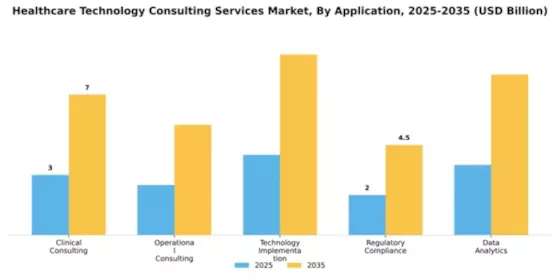
Operational Consulting (Dominant) vs. Regulatory Compliance (Emerging)
Operational Consulting remains a dominant segment within the Healthcare Technology Consulting Services Market, as healthcare organizations seek to optimize their operations and reduce costs through effective management practices. This segment is characterized by a focus on improving workflow efficiencies and enhancing patient experiences. On the other hand, Regulatory Compliance is emerging as a critical area, with increasing attention on adhering to health regulations and standards. As regulatory requirements become more stringent, organizations are investing in compliance strategies, making this segment essential for mitigating risks and ensuring quality healthcare delivery.
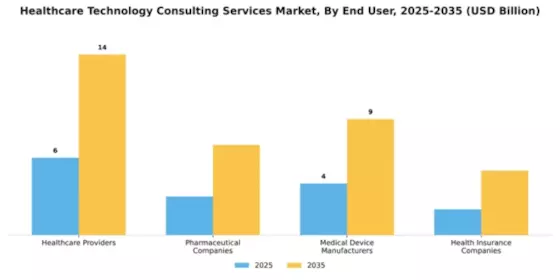
In the Healthcare Technology Consulting Services Market, the segment of Healthcare Providers holds the largest market share, primarily driven by the increasing need for efficient patient care solutions and the integration of advanced technologies into healthcare facilities. This segment includes hospitals, clinics, and other healthcare institutions that are leveraging consulting services to streamline operations and improve healthcare delivery. The Pharmaceutical Companies segment is the fastest-growing due to a rising emphasis on research and development in drug innovation and the growing complexity of regulatory environments. Pharmaceutical firms are investing heavily in consulting services to enhance their operational efficiency and ensure compliance with evolving regulations, fueling significant growth in this area.
Healthcare Providers (Dominant) vs. Medical Device Manufacturers (Emerging)
The Healthcare Providers segment is a dominant force in the Healthcare Technology Consulting Services Market, characterized by extensive engagement with consulting firms to refine patient care practices and improve operational efficiency. Providers are increasingly adopting technology-driven solutions facilitated by consulting services, to navigate the complexities of healthcare delivery and patient management. Conversely, the Medical Device Manufacturers segment, while emerging, is rapidly evolving as these companies turn to consulting services to enhance product development processes and align with market demands. This shift is propelled by the innovation in medical technologies and the necessity for manufacturers to ensure compliance with rigorous regulatory standards. The competitive landscape in this segment is vibrant as firms seek strategic consulting partnerships to bolster their product offerings.
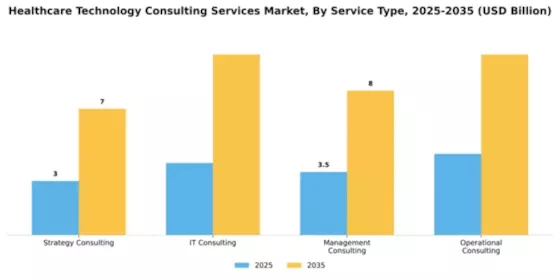
The Healthcare Technology Consulting Services Market is characterized by diverse service type segments. Among these, IT Consulting holds the largest share, dominating with its extensive range of technological solutions catered to healthcare providers. In contrast, Strategy Consulting, while currently smaller in market share, is recognized as the fastest-growing segment, attracting significant attention due to the increasing importance of strategic planning in healthcare transformation.
Consulting: IT (Dominant) vs. Strategy (Emerging)
IT Consulting serves as the backbone of healthcare technology initiatives, providing critical support in system integration, data management, and cybersecurity solutions essential for modern healthcare environments. Meanwhile, Strategy Consulting is gaining traction as it helps organizations align their technological capabilities with business objectives, ensuring efficient adaptation to regulatory changes and the digital landscape. This growth is driven by the need for improved patient outcomes and operational efficiency, positioning Strategy Consulting as a key player in shaping the future of healthcare technology.
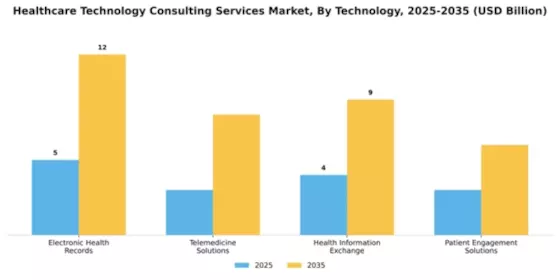
In the Healthcare Technology Consulting Services Market, Electronic Health Records (EHR) hold the largest market share, significantly influencing the adoption of technology within healthcare organizations. EHR systems have become foundational, ensuring that patient data is accurately digitized, thus enhancing care coordination and operational efficiency. On the other hand, Telemedicine Solutions have emerged as a rapidly growing segment, increasing in adoption due to the increasing demand for remote healthcare services, especially in the aftermath of the global pandemic. This shift has redefined patient-provider interactions, positioning telemedicine as a crucial technology in the healthcare landscape. Growth in the healthcare technology consulting services market is propelled by factors such as the rising emphasis on data-driven decision-making and enhanced patient outcomes. The urgency for efficient health information management systems and the need for seamless communication between stakeholders are driving widespread adoption of both EHR and telemedicine solutions. As more healthcare organizations recognize the importance of these technologies, we can expect a trend towards integrated and user-friendly solutions that prioritize patient engagement and data exchange, ultimately improving service delivery across the sector.
Technology: Electronic Health Records (Dominant) vs. Telemedicine Solutions (Emerging)
Electronic Health Records (EHR) have established themselves as the dominant technology in the Healthcare Technology Consulting Services Market by providing vital digital documentation and information-sharing capabilities. Their effectiveness in managing patient data, enhancing clinical workflows, and facilitating adherence to regulatory standards has made EHR a fundamental component of modern healthcare delivery. In contrast, Telemedicine Solutions represent the emerging frontier, offering innovative platforms that allow healthcare providers to deliver care remotely. With growing acceptance among patients and professionals alike, telemedicine is becoming increasingly integrated into routine healthcare, reshaping how services are delivered. The combination of these technologies emphasizes a shift towards more accessible, efficient, and patient-centered care models, catering to a diverse range of healthcare needs.
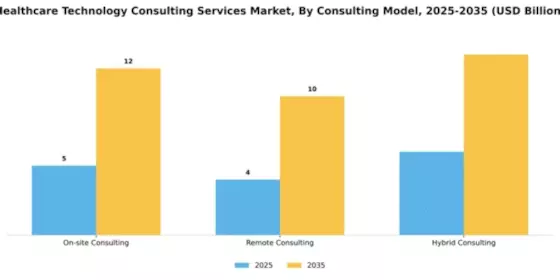
In the Healthcare Technology Consulting Services Market, On-site Consulting currently holds the largest market share, driven by its personalized approach and the ability to closely engage with healthcare providers. Remote Consulting, however, is increasingly popular, appealing to organizations seeking flexibility and cost-efficiency. This shift is also complemented by the rising adoption of digital tools that facilitate remote engagement, enabling consultants to deliver quality service despite geographical barriers. The growth trends in this segment are primarily fueled by the demand for innovative healthcare solutions and the need for effective implementation of technology in clinical settings. As healthcare organizations embrace telehealth and digital transformation, Remote Consulting is experiencing accelerated growth. This trend is expected to continue as consultancies adapt their business models to meet the evolving demands of the healthcare landscape.
On-site Consulting: Dominant vs. Remote Consulting: Emerging
On-site Consulting remains dominant in the Healthcare Technology Consulting Services Market, favored for its direct interaction and tailored solutions that address specific problems of healthcare providers. It allows consultants to conduct in-depth assessments, fostering trust and collaboration with the client. Conversely, Remote Consulting is becoming an emerging force, enabled by technological advancements that allow for seamless communication and remote collaboration. This model not only reduces travel costs but also widens the talent pool, as consultants can engage with clients globally. As healthcare organizations prioritize flexibility and response times, Remote Consulting is positioned to grow, appealing to a new wave of clients who value access to expertise without the constraints of location.
Get more detailed insights about Healthcare Technology Consulting Services Market Request Free Sample
North America is poised to maintain its leadership in the Healthcare Technology Consulting Services Market, holding a market size of $7.5B in 2025. Key growth drivers include the increasing adoption of digital health solutions, regulatory support for healthcare innovation, and a strong focus on patient-centric care. The region's advanced healthcare infrastructure and significant investments in technology further fuel demand, making it a hub for healthcare consulting services. The competitive landscape is dominated by major players such as Accenture, Deloitte, and Cognizant, which leverage their expertise to offer innovative solutions. The U.S. remains the leading country, accounting for a substantial share of the market. The presence of top-tier consulting firms and a robust healthcare ecosystem positions North America as a critical player in shaping the future of healthcare technology consulting.
Europe's Healthcare Technology Consulting Services Market is projected to reach $4.5B by 2025, driven by increasing regulatory initiatives aimed at improving healthcare delivery and efficiency. The demand for digital transformation in healthcare, coupled with a growing emphasis on data analytics and patient engagement, is propelling market growth. Countries like Germany and the UK are at the forefront, implementing policies that support innovation and technology adoption in healthcare. The competitive landscape features key players such as KPMG and PwC, who are actively expanding their services to meet the evolving needs of healthcare providers. The presence of a diverse range of consulting firms enhances competition, fostering innovation. As Europe continues to invest in healthcare technology, the region is set to become a significant player in the global market, with a focus on sustainable and efficient healthcare solutions.
The Asia-Pacific region is witnessing rapid growth in the Healthcare Technology Consulting Services Market, projected to reach $2.5B by 2025. Key drivers include increasing healthcare expenditure, a rising aging population, and the growing demand for telehealth services. Governments are also implementing supportive regulations to enhance healthcare delivery, which is expected to further stimulate market growth across countries like China and India. The competitive landscape is evolving, with both local and international players vying for market share. Companies like IBM and Cerner Corporation are expanding their footprint in the region, leveraging technology to address unique healthcare challenges. As the region continues to embrace digital health solutions, it is becoming a focal point for innovation in healthcare consulting services, attracting significant investments and partnerships.
The Middle East and Africa region is emerging as a potential market for Healthcare Technology Consulting Services, with a market size of $0.5B projected for 2025. Key growth drivers include increasing healthcare investments, government initiatives to improve healthcare infrastructure, and a rising demand for quality healthcare services. Countries like the UAE and South Africa are leading the way in adopting innovative healthcare solutions, supported by favorable regulatory frameworks. The competitive landscape is characterized by a mix of local and international consulting firms, with opportunities for growth in various sectors. As healthcare systems in the region evolve, the demand for consulting services is expected to rise, driven by the need for strategic guidance in implementing technology solutions. The region's unique challenges present opportunities for tailored consulting services that can address specific healthcare needs.
The Healthcare Technology Consulting Services Market is characterized by a dynamic competitive landscape, driven by the increasing demand for digital transformation and innovative healthcare solutions. Major players such as Accenture (US), Deloitte (US), and Optum (US) are strategically positioned to leverage their extensive expertise in technology and consulting. Accenture (US) focuses on integrating advanced technologies into healthcare systems, while Deloitte (US) emphasizes its capabilities in analytics and operational efficiency. Optum (US), a subsidiary of UnitedHealth Group, is enhancing its service offerings through data-driven insights and patient-centric solutions. Collectively, these strategies foster a competitive environment that prioritizes innovation and responsiveness to market needs.The market structure appears moderately fragmented, with a mix of large consulting firms and specialized healthcare technology providers. Key players are employing various business tactics, such as optimizing supply chains and localizing service delivery, to enhance their competitive edge. This fragmentation allows for diverse service offerings, yet the influence of major players remains substantial, shaping industry standards and practices.In November Deloitte (US) announced a strategic partnership with a leading AI firm to develop predictive analytics tools aimed at improving patient outcomes. This collaboration is likely to enhance Deloitte's service portfolio, positioning it as a frontrunner in the integration of AI within healthcare consulting. The strategic importance of this move lies in its potential to streamline operations and provide actionable insights, thereby addressing the growing demand for data-driven decision-making in healthcare.In October Accenture (US) launched a new initiative focused on telehealth solutions, aiming to expand access to care through innovative digital platforms. This initiative reflects Accenture's commitment to addressing the evolving needs of healthcare providers and patients alike. By enhancing telehealth capabilities, Accenture is likely to strengthen its market position and respond effectively to the increasing reliance on remote healthcare services.In September Optum (US) acquired a health analytics company to bolster its data capabilities. This acquisition is expected to enhance Optum's ability to deliver personalized healthcare solutions, aligning with the industry's shift towards value-based care. The strategic significance of this acquisition lies in its potential to improve patient engagement and outcomes, thereby reinforcing Optum's competitive advantage in the market.As of December the competitive trends in the Healthcare Technology Consulting Services Market are increasingly defined by digitalization, sustainability, and the integration of AI technologies. Strategic alliances are becoming pivotal in shaping the landscape, as companies seek to combine strengths and innovate collaboratively. Looking ahead, competitive differentiation is likely to evolve from traditional price-based competition to a focus on innovation, technological advancement, and supply chain reliability, underscoring the importance of adaptability in a rapidly changing market.




The Healthcare Technology Consulting Services Market is projected to grow at 8.01% CAGR from 2025 to 2035, driven by technological advancements, regulatory changes, and increasing demand for digital health solutions.
New opportunities lie in:
By 2035, the market is expected to be robust, reflecting substantial growth and innovation.
| MARKET SIZE 2024 | 15.0(USD Billion) |
| MARKET SIZE 2025 | 16.2(USD Billion) |
| MARKET SIZE 2035 | 35.0(USD Billion) |
| COMPOUND ANNUAL GROWTH RATE (CAGR) | 8.01% (2025 - 2035) |
| REPORT COVERAGE | Revenue Forecast, Competitive Landscape, Growth Factors, and Trends |
| BASE YEAR | 2024 |
| Market Forecast Period | 2025 - 2035 |
| Historical Data | 2019 - 2024 |
| Market Forecast Units | USD Billion |
| Key Companies Profiled | Accenture (US), Deloitte (US), Cognizant (US), McKinsey & Company (US), PwC (US), KPMG (GB), Optum (US), Cerner Corporation (US), IBM (US), Huron Consulting Group (US) |
| Segments Covered | Application, End User, Service Type, Technology, Consulting Model |
| Key Market Opportunities | Integration of artificial intelligence and data analytics in healthcare consulting services presents substantial growth opportunities. |
| Key Market Dynamics | Rising demand for digital health solutions drives competitive dynamics in the Healthcare Technology Consulting Services market. |
| Countries Covered | North America, Europe, APAC, South America, MEA |
The market valuation reached 15.0 USD Billion in 2024.
The market is expected to grow to 35.0 USD Billion by 2035.
The market is projected to experience a CAGR of 8.01% from 2025 to 2035.
Key segments include Clinical Consulting, Operational Consulting, Technology Implementation, Regulatory Compliance, and Data Analytics.
Clinical Consulting is anticipated to grow from 3.0 USD Billion in 2024 to 7.0 USD Billion by 2035.
Prominent players include Accenture, Deloitte, Cognizant, McKinsey & Company, and PwC.
Data Analytics is projected to increase from 3.5 USD Billion in 2024 to 8.0 USD Billion by 2035.
Healthcare Providers are expected to grow from 6.0 USD Billion in 2024 to 14.0 USD Billion by 2035, leading other end users.
On-site, Remote, and Hybrid Consulting models are expected to see significant growth, with Hybrid Consulting projected to reach 13.0 USD Billion by 2035.
IT Consulting is projected to grow from 4.0 USD Billion in 2024 to 10.0 USD Billion by 2035.


Kindly complete the form below to receive a free sample of this Report

“This is really good guys. Excellent work on a tight deadline. I will continue to use you going forward and recommend you to others. Nice job”


“Thanks. It’s been a pleasure working with you, please use me as reference with any other Intel employees.”


“Thanks for sending the report it gives us a good global view of the Betaïne market.”


“Thank you, this will be very helpful for OQS.”


“We found the report very insightful! we found your research firm very helpful. I'm sending this email to secure our future business.”


“I am very pleased with how market segments have been defined in a relevant way for my purposes (such as "Portable Freezers & refrigerators" and "last-mile"). In general the report is well structured. Thanks very much for your efforts.”


“I have been reading the first document or the study, ,the Global HVAC and FP market report 2021 till 2026. Must say, good info! I have not gone in depth at all parts, but got a good indication of the data inside!”


“We got the report in time, we really thank you for your support in this process. I also thank to all of your team as they did a great job.”


“The Automotive 48V ECU Components Procurement Intelligence Study” was a complex project, but the Market Research Future (MRFR) team handled it with quality, agility, and customer-centricity. They delivered all requested data on time and within the agreed scope. The team, including Shubhendra Anand and Rahul Gotadki, was always readily available to clarify questions and swiftly implement necessary adjustments, driving the project to a successful conclusion within a very demanding timeframe.
I would also like to specifically commend Akshay Agarwal for his responsiveness and support at every stage—from our initial inquiry on May 6th through to final delivery on June 18th. His dedication made the entire process seamless.”



