Hedge Funds Market Size, Share and Research Report By Investment Strategy (Equity Hedge Funds, Fixed Income Hedge Funds, Macro Hedge Funds, Event-Driven Hedge Funds, Commodity Hedge Funds), By Investor Type (Institutional Investors, High-Net-Worth Individuals, Family Offices, Endowments and Foundations, Pension Funds), By Assets Under Management (AUM) ($0-$250 million, $250 million-$1 billion, $1 billion-$5 billion, $5 billion-$10 billion, Over $10 billion), By Investment Horizon (Short-Term (less than 1 year), Medium-Term (1-3 years), Long-Term (over 3 years)), By Fee Structure (Performance-Based Fees, Management Fees, Combination of Performance and Management Fees) and By Regional (North America, Europe, South America, Asia Pacific, Middle East and Africa) - Industry Forecast Till 2035
As per Market Research Future analysis, the Hedge Funds Market Size was estimated at 5.928 USD Billion in 2024. The Hedge Funds industry is projected to grow from 6.451 USD Billion in 2025 to 15.02 USD Billion by 2035, exhibiting a compound annual growth rate (CAGR) of 8.82% during the forecast period 2025 - 2035
Key Market Trends & Highlights
The Hedge Funds Market is currently experiencing a dynamic evolution driven by technological advancements and shifting investor preferences.
Technological integration is reshaping operational efficiencies within hedge funds, particularly in North America.
The focus on ESG investing is gaining traction, especially among institutional investors who dominate the market.
Regulatory adaptation is becoming increasingly critical as hedge funds navigate complex compliance landscapes in Asia-Pacific.
Increased institutional investment and the emergence of quantitative strategies are key drivers propelling growth in the hedge fund sector.
Market Size & Forecast
2024 Market Size
5.928 (USD Billion)
2035 Market Size
15.02 (USD Billion)
CAGR (2025 - 2035)
8.82%
Major Players
Bridgewater Associates (US), Man Group (GB), AQR Capital Management (US), Balyasny Asset Management (US), Winton Group (GB), Two Sigma Investments (US), Citadel LLC (US), Millennium Management (US), Marshall Wace (GB)
Our Impact
Enabled $4.3B Revenue Impact for Fortune 500 and Leading Multinationals
Partnering with 2000+ Global Organizations Each Year
30K+ Citations by Top-Tier Firms in the Industry
Hedge Funds Market Trends
The Hedge Funds Market is currently experiencing a dynamic evolution, characterized by a blend of innovation and regulatory adaptation. As investors seek diversification and enhanced returns, hedge funds are increasingly adopting advanced strategies that leverage technology and data analytics. This shift appears to be driven by a growing demand for transparency and risk management, prompting fund managers to refine their approaches. Furthermore, the competitive landscape is intensifying, with new entrants emerging alongside established players, each vying for a share of investor capital. This environment fosters a culture of continuous improvement and strategic differentiation, as firms explore niche markets and alternative investment opportunities.
In addition, the Hedge Funds Market is witnessing a notable shift towards sustainable investing. Investors are increasingly prioritizing environmental, social, and governance (ESG) factors in their decision-making processes. This trend suggests that hedge funds are not only focusing on financial returns but also considering the broader impact of their investments. As a result, many funds are integrating ESG criteria into their investment strategies, which may enhance their appeal to a wider range of investors. Overall, the Hedge Funds Market appears poised for further transformation, driven by innovation, regulatory changes, and evolving investor preferences.
Technological Integration
The Hedge Funds Market is increasingly embracing technology to enhance operational efficiency and investment strategies. This trend indicates a shift towards algorithmic trading, artificial intelligence, and machine learning, which may provide firms with a competitive edge in analyzing market data and executing trades.
Focus on ESG Investing
There is a growing emphasis on environmental, social, and governance (ESG) factors within the Hedge Funds Market. This trend suggests that investors are seeking funds that align with their values, prompting managers to incorporate sustainability into their investment frameworks.
Regulatory Adaptation
The Hedge Funds Market is navigating a complex regulatory landscape, which appears to be evolving in response to market dynamics. Fund managers are adapting their strategies to comply with new regulations, which may influence their operational practices and investment decisions.
Hedge Funds Market Drivers
Focus on Risk Management
The Hedge Funds Market is increasingly emphasizing risk management as a core component of investment strategies. In an environment characterized by market volatility and geopolitical uncertainties, hedge funds are adopting sophisticated risk management techniques to protect capital and enhance returns. This focus on risk management is reflected in the growing use of derivatives and hedging strategies, which are designed to mitigate potential losses. In 2025, it is projected that hedge funds will allocate a larger portion of their resources to risk management initiatives, potentially leading to improved performance and investor confidence. As the Hedge Funds Market continues to evolve, the integration of robust risk management practices may become a defining characteristic, attracting investors who prioritize capital preservation alongside returns.
Increased Institutional Investment
The Hedge Funds Market is experiencing a notable surge in institutional investment. Pension funds, endowments, and sovereign wealth funds are increasingly allocating capital to hedge funds, seeking diversification and enhanced returns. In 2025, institutional investors accounted for approximately 60% of total hedge fund assets, reflecting a growing confidence in alternative investment strategies. This trend is driven by the need for institutions to meet their long-term liabilities while navigating a low-interest-rate environment. As institutions seek to optimize their portfolios, hedge funds are perceived as a viable option due to their potential for absolute returns and risk management capabilities. Furthermore, the increasing sophistication of institutional investors is leading to more tailored hedge fund strategies, which may further bolster the Hedge Funds Market.
Emergence of Quantitative Strategies
The Hedge Funds Market is witnessing a significant shift towards quantitative strategies, which leverage advanced algorithms and data analytics to drive investment decisions. These strategies have gained traction as hedge funds seek to capitalize on market inefficiencies and enhance performance. In recent years, the assets managed by quantitative hedge funds have grown substantially, with estimates suggesting that they now represent over 30% of total hedge fund assets. This trend is indicative of a broader acceptance of technology-driven investment approaches, which may offer a competitive edge in an increasingly complex market landscape. As more hedge funds adopt quantitative methods, the Hedge Funds Market is likely to evolve, potentially leading to new investment paradigms and strategies that prioritize data-driven insights.
Regulatory Developments and Compliance
The Hedge Funds Market is navigating a complex regulatory landscape that is continuously evolving. Recent regulatory developments have prompted hedge funds to enhance their compliance frameworks and operational transparency. In 2025, it is anticipated that regulatory scrutiny will intensify, particularly concerning investor protection and reporting requirements. Hedge funds are likely to invest in technology and infrastructure to meet these compliance demands, which may lead to increased operational costs. However, this regulatory environment also presents an opportunity for hedge funds to differentiate themselves through transparency and governance. As the Hedge Funds Market adapts to these changes, firms that proactively embrace regulatory compliance may gain a competitive advantage, potentially attracting more institutional and retail investors.
Rising Demand for Alternative Investments
The Hedge Funds Market is benefiting from a rising demand for alternative investments among high-net-worth individuals and family offices. As traditional asset classes face volatility and uncertainty, investors are increasingly turning to hedge funds as a means of diversifying their portfolios. In 2025, it is estimated that alternative investments, including hedge funds, will account for nearly 25% of total global investment assets. This shift is driven by the desire for non-correlated returns and the potential for higher yields. Furthermore, the increasing accessibility of hedge funds through various investment vehicles, such as fund of funds and managed accounts, is likely to attract a broader range of investors. This growing interest in alternative investments may further solidify the Hedge Funds Market's position as a key player in the investment landscape.
Market Segment Insights
By Investment Strategy: Equity Hedge Funds (Largest) vs. Macro Hedge Funds (Fastest-Growing)
The Hedge Funds Market showcases a diverse investment strategy landscape, with Equity Hedge Funds holding the largest market share. These funds primarily invest in stocks, utilizing various strategies to capitalize on market inefficiencies. Following them, Macro Hedge Funds focus on global economic trends and utilize positions in various asset classes. The equity segment's dominance is partially due to its adaptability and historical performance, attracting a wide range of investors seeking equity exposure.
In terms of growth trends, Macro Hedge Funds are emerging as the fastest-growing segment within the Hedge Funds Market. Their flexibility to invest globally and adapt to macroeconomic shifts positions them favorably. As investment landscapes become increasingly volatile, more investors are gravitating toward these funds to hedge against uncertainties, thereby contributing to their rapid expansion.
Equity Hedge Funds (Dominant) vs. Macro Hedge Funds (Emerging)
Equity Hedge Funds stand as the dominant force in the Hedge Funds Market, characterized by their strategic focus on stock investments. They utilize a blend of long and short positions to navigate market fluctuations effectively. Investors value their potential for high returns, though they come with associated risks. Meanwhile, Macro Hedge Funds represent an emerging force, capitalizing on broad macroeconomic trends. Their ability to diversify across asset classes—such as currencies, commodities, and fixed income—allows for strategic positioning during economic shifts. This adaptability attracts investors seeking opportunities beyond traditional markets. Both segments offer distinct benefits, with Equity Hedge Funds providing traditional stock exposure and Macro Hedge Funds offering a diversified approach to capitalize on global economic movements.
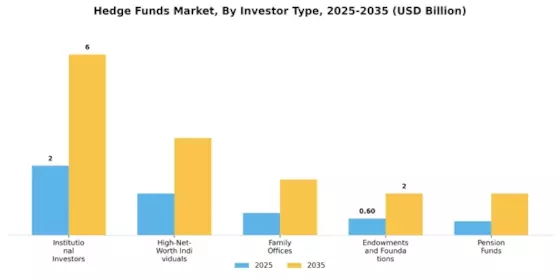
By Investor Type: Institutional Investors (Largest) vs. High-Net-Worth Individuals (Fastest-Growing)
In the Hedge Funds Market, the investor type plays a crucial role in shaping market dynamics. Institutional Investors dominate the investor landscape, accounting for a significant portion of overall hedge fund allocations. These entities, which include pension funds, endowments, and insurance companies, leverage their substantial capital to seek consistent, risk-adjusted returns. High-Net-Worth Individuals, while smaller in market share, are rapidly gaining traction and diversifying their investment portfolios into hedge funds as they seek alternative asset classes and enhanced returns.
Institutional Investors: Dominant vs. High-Net-Worth Individuals: Emerging
Institutional Investors are the backbone of the Hedge Funds Market, characterized by their large-scale investments and long-term strategies. These include pension funds, insurance companies, and endowments, which prioritize stability and risk management with their hedge fund investments. Conversely, High-Net-Worth Individuals represent an emerging segment, driven by a desire for portfolio diversification and access to unique investment opportunities. This demographic is increasingly attracted to hedge funds due to the potential for high returns compared to traditional investments. As regulations ease and platforms become more accessible, High-Net-Worth Individuals are expected to further influence market trends.
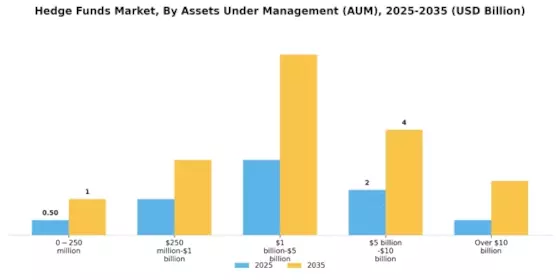
By Assets Under Management (AUM): $1 billion-$5 billion (Largest) vs. Over $10 billion (Fastest-Growing)
The Hedge Funds Market exhibits a varied distribution in terms of Assets Under Management (AUM). The segment between $1 billion and $5 billion holds the largest share, attracting substantial investments that reflect confidence in their management strategies and performance. In contrast, the Over $10 billion segment is rapidly expanding, showcasing its appeal among institutional investors seeking diversified and established portfolios.
$1 billion-$5 billion (Dominant) vs. Over $10 billion (Emerging)
The $1 billion-$5 billion AUM segment is viewed as the dominant player in the Hedge Funds Market, characterized by a healthy mix of seasoned hedge fund managers and robust performance metrics. Funds in this range often offer a balance of risk and return, appealing to both high-net-worth individuals and institutional investors. Meanwhile, the Over $10 billion segment represents an emerging force, as these funds attract significant capital inflows due to their perceived stability and extensive resources. This segment frequently features established firms with extensive track records and innovative strategies designed to mitigate risk while enhancing potential returns.
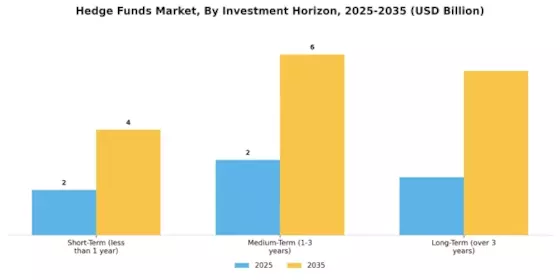
By Investment Horizon: Medium-Term (Largest) vs. Long-Term (Fastest-Growing)
In the hedge funds market, the investment horizon segment is characterized by varying returns and risk profiles. The medium-term horizon, spanning 1 to 3 years, holds the largest market share, reflecting a balanced approach that attracts investors seeking stability with moderate growth potential. Short-term investments, though appealing due to quick returns, represent a smaller percentage of overall investments. In contrast, long-term investments are inching their way to prominence, indicating a shifting trend among investors who are increasingly favoring strategies that focus on sustainable growth over time.
The growth trends within the investment horizon segment indicate a burgeoning interest in long-term strategies, primarily driven by the ongoing market volatility and the need for individuals and institutions to protect their assets. As traditional investment avenues face uncertainties, hedge fund managers are promoting long-term strategies that leverage market inefficiencies for greater returns. Investors are also showing a preference for adaptive strategies that enable diversified portfolios to withstand economic fluctuations, thereby enhancing the appeal of the medium and long-term investment horizons.
Medium-Term (Dominant) vs. Long-Term (Emerging)
The medium-term investment horizon in hedge funds is distinguished by its balanced risk-return profile, making it a go-to choice for investors looking to navigate uncertain markets. Characterized by investment durations of 1 to 3 years, this segment appeals to a wide range of investors, including both institutional and high-net-worth individuals, who seek a blend of growth and security. On the other hand, the long-term horizon, extending over 3 years, is gaining traction as an emerging choice among investors willing to commit to extended strategies. This segment is increasingly viewed as vital for accumulating wealth, particularly as it allows for a nuanced approach to market timing and capitalizes on long-term economic trends. Investors are focusing on innovative strategies and diversification in their long-term commitments, indicating a broader understanding of sustainable investment.
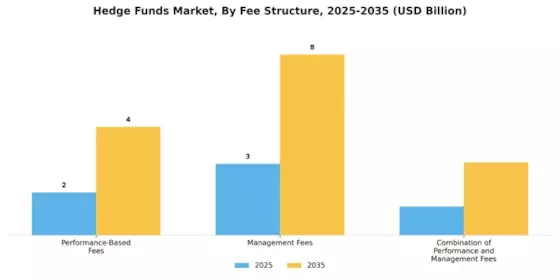
By Fee Structure: Performance-Based Fees (Largest) vs. Management Fees (Fastest-Growing)
In the Hedge Funds Market, the fee structure is primarily divided into Performance-Based Fees, Management Fees, and a Combination of both. Performance-Based Fees dominate the market, accounting for a substantial proportion of total fees collected by hedge funds. This structure incentivizes fund managers to optimize investment performance, thus aligning their interests with those of the investors. Conversely, Management Fees, while smaller in overall market share, are witnessing significant growth as more funds adopt this model to provide a predictable revenue stream amid fluctuating performance metrics.
Performance-Based Fees (Dominant) vs. Management Fees (Emerging)
Performance-Based Fees are characterized by their alignment with investor success, as managers earn fees based on the fund's performance, making them a preferred choice for many investors seeking engaged management. These fees often feature a high-water mark clause, ensuring that managers are rewarded only when surpassing previous performance benchmarks. On the other hand, Management Fees are gaining traction as they provide consistent income for fund managers, especially appealing in volatile markets. This fee structure allows for better financial planning for hedge funds, fostering a reputation for stability and reliability. As investors become increasingly price-sensitive, the combination of these fee structures presents an adaptable approach that reflects the changing landscape of the Hedge Funds Market.
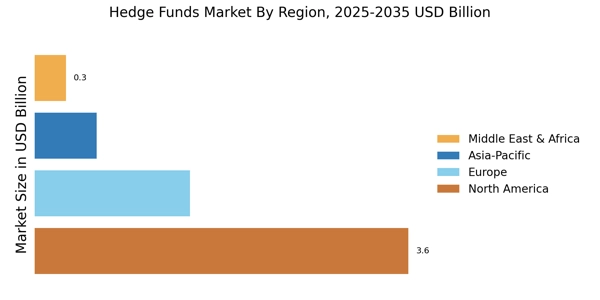
North America remains the largest market for hedge funds, accounting for approximately 60% of the global share. The region's growth is driven by a robust financial infrastructure, increasing institutional investments, and favorable regulatory frameworks. The demand for alternative investment strategies continues to rise, supported by a growing number of high-net-worth individuals seeking diversification. Regulatory catalysts, such as the SEC's focus on transparency, further enhance market confidence. The United States is the leading country in this region, hosting major players like Bridgewater Associates, Citadel LLC, and AQR Capital Management. The competitive landscape is characterized by a mix of established firms and emerging managers, all vying for market share. The presence of significant capital inflows and a strong investor base solidify North America's position as the preeminent hedge fund market globally.
Europe : Emerging Market Dynamics
Europe is witnessing a resurgence in hedge fund investments, holding approximately 25% of the global market share. The region's growth is fueled by increasing demand for alternative assets, regulatory reforms aimed at enhancing market access, and a growing number of institutional investors. Countries like the UK and Germany are leading this trend, with favorable regulations encouraging innovation and competition in the hedge fund space. The UK remains a key player, with firms like Man Group and Marshall Wace at the forefront. Germany and France are also emerging as significant markets, driven by local investor interest and regulatory support. The competitive landscape is evolving, with a mix of traditional asset managers entering the hedge fund arena, thereby increasing competition and driving performance improvements across the sector.
Asia-Pacific : Rapid Growth Potential
Asia-Pacific is rapidly emerging as a significant player in the hedge fund market, currently holding about 10% of the global share. The region's growth is driven by increasing wealth among high-net-worth individuals, a burgeoning middle class, and a growing appetite for alternative investments. Regulatory changes in countries like Hong Kong and Singapore are also facilitating market entry and expansion for hedge funds, enhancing investor confidence and participation. Leading countries in this region include Japan, Australia, and Hong Kong, with a mix of local and international players establishing a presence. The competitive landscape is characterized by a blend of traditional investment firms and new entrants focusing on innovative strategies. Key players are increasingly targeting Asian investors, recognizing the region's potential for growth and diversification in investment portfolios.
Middle East and Africa : Emerging Investment Landscape
The Middle East and Africa are gradually emerging in the hedge fund market, currently accounting for about 5% of the global share. The growth is driven by increasing wealth in the region, particularly in the Gulf Cooperation Council (GCC) countries, and a rising interest in alternative investments among local investors. Regulatory frameworks are evolving, with governments aiming to attract foreign investment and enhance market infrastructure, which is crucial for the hedge fund sector's development. Countries like the UAE and South Africa are leading the charge, with a growing number of hedge funds being established to cater to local and international investors. The competitive landscape is still developing, with a mix of local firms and international players entering the market. The presence of key players is expected to increase as the region continues to attract investment and improve its financial services ecosystem.
Key Players and Competitive Insights
The Hedge Funds Market is currently characterized by a dynamic competitive landscape, driven by a confluence of factors including technological advancements, regulatory changes, and evolving investor preferences. Major players such as Bridgewater Associates (US), Citadel LLC (US), and AQR Capital Management (US) are at the forefront, each adopting distinct strategies to navigate this complex environment. Bridgewater Associates (US) continues to emphasize its research-driven approach, leveraging data analytics to inform investment decisions, while Citadel LLC (US) focuses on enhancing its trading infrastructure through cutting-edge technology. AQR Capital Management (US) appears to be concentrating on integrating quantitative strategies with traditional investment methods, thereby appealing to a broader range of investors. Collectively, these strategies not only enhance their competitive positioning but also contribute to a more sophisticated market structure.The business tactics employed by these hedge funds reflect a nuanced understanding of market demands. For instance, localizing investment strategies to cater to regional market conditions has become increasingly prevalent. The Hedge Funds Market is moderately fragmented, with a mix of established firms and emerging players vying for market share. The collective influence of key players shapes the competitive dynamics, as they engage in strategic partnerships and collaborations to bolster their market presence.
In September Citadel LLC (US) announced a significant investment in artificial intelligence capabilities, aiming to enhance its predictive analytics for trading strategies. This move underscores the growing importance of AI in the hedge fund sector, as firms seek to leverage technology to gain a competitive edge. By integrating AI into its operations, Citadel LLC (US) positions itself to respond more adeptly to market fluctuations, potentially increasing its profitability and market share.
In August AQR Capital Management (US) launched a new fund focused on sustainable investments, reflecting a broader trend towards environmental, social, and governance (ESG) criteria in investment decisions. This strategic initiative not only aligns with the increasing demand for responsible investing but also differentiates AQR Capital Management (US) in a crowded marketplace. By prioritizing sustainability, the firm may attract a new demographic of investors who are increasingly concerned about the ethical implications of their investments.
In July Bridgewater Associates (US) expanded its The Hedge Funds Market, establishing a new office in Singapore. This strategic expansion is indicative of the firm’s commitment to tapping into emerging markets, which are expected to experience significant growth in the coming years. By positioning itself in Asia, Bridgewater Associates (US) aims to capitalize on the region's burgeoning wealth and investment opportunities, thereby enhancing its global competitiveness.
As of October the Hedge Funds Market is witnessing a pronounced shift towards digitalization, with firms increasingly adopting advanced technologies to streamline operations and enhance decision-making processes. The integration of AI and data analytics is becoming a defining trend, as firms seek to differentiate themselves through innovation rather than price competition. Strategic alliances are also playing a crucial role in shaping the current landscape, as firms collaborate to share resources and expertise. Looking ahead, competitive differentiation is likely to evolve, with a greater emphasis on technological innovation, sustainability, and supply chain reliability, positioning firms to better meet the demands of a rapidly changing market.
Key Companies in the Hedge Funds Market include
Industry Developments
Q2 2024: 2024 was a blockbuster year for big launches Hedge fund start-ups Taula Capital and Jain Global each raised at least $5 billion, making them the biggest hedge fund launches since ExodusPoint in 2018.
Future Outlook
Hedge Funds Market Future Outlook
The Hedge Funds Market is projected to grow at an 8.82% CAGR from 2025 to 2035, driven by technological advancements, increased institutional investment, and evolving investor preferences.
New opportunities lie in:
Development of AI-driven investment strategies for enhanced decision-making.
Expansion into emerging markets to capture new investor segments.
Creation of sustainable investment funds to meet growing ESG demand.
By 2035, the Hedge Funds Market is expected to be robust, reflecting dynamic growth and diversification.
Market Segmentation
Hedge Funds Market Fee Structure Outlook
Performance-Based Fees
Management Fees
Combination of Performance and Management Fees
Hedge Funds Market Investor Type Outlook
Institutional Investors
High-Net-Worth Individuals
Family Offices
Endowments and Foundations
Pension Funds
Hedge Funds Market Investment Horizon Outlook
Short-Term (less than 1 year)
Medium-Term (1-3 years)
Long-Term (over 3 years)
Hedge Funds Market Investment Strategy Outlook
Equity Hedge Funds
Fixed Income Hedge Funds
Macro Hedge Funds
Event-Driven Hedge Funds
Commodity Hedge Funds
Hedge Funds Market Assets Under Management (AUM) Outlook
$0-$250 million
$250 million-$1 billion
$1 billion-$5 billion
$5 billion-$10 billion
Over $10 billion
Report Scope
MARKET SIZE 2024
5.928(USD Billion)
MARKET SIZE 2025
6.451(USD Billion)
MARKET SIZE 2035
15.02(USD Billion)
COMPOUND ANNUAL GROWTH RATE (CAGR)
8.82% (2025 - 2035)
REPORT COVERAGE
Revenue Forecast, Competitive Landscape, Growth Factors, and Trends
BASE YEAR
2024
Market Forecast Period
2025 - 2035
Historical Data
2019 - 2024
Market Forecast Units
USD Billion
Key Companies Profiled
Bridgewater Associates (US), Man Group (GB), AQR Capital Management (US), Balyasny Asset Management (US), Winton Group (GB), Two Sigma Investments (US), Citadel LLC (US), Millennium Management (US), Marshall Wace (GB)
Integration of artificial intelligence for enhanced investment strategies in the Hedge Funds Market.
Key Market Dynamics
Heightened regulatory scrutiny and technological advancements reshape competitive dynamics within the Hedge Funds Market.
Countries Covered
North America, Europe, APAC, South America, MEA
FAQs
What is the current valuation of the Hedge Funds Market in 2025?
The Hedge Funds Market valuation is projected to reach approximately 5.928 USD Billion in 2025.
What is the expected market size of the Hedge Funds Market by 2035?
The market is anticipated to grow to around 15.02 USD Billion by 2035.
What is the expected CAGR for the Hedge Funds Market from 2025 to 2035?
The expected CAGR for the Hedge Funds Market during the forecast period 2025 - 2035 is 8.82%.
Who are the key players in the Hedge Funds Market?
Key players include Bridgewater Associates, Man Group, AQR Capital Management, and Citadel LLC, among others.
What are the main investment strategies in the Hedge Funds Market?
Investment strategies include Equity Hedge Funds, Fixed Income Hedge Funds, and Macro Hedge Funds, with valuations ranging from 0.892 to 4.5 USD Billion.
What types of investors are involved in the Hedge Funds Market?
Investor types include Institutional Investors, High-Net-Worth Individuals, and Family Offices, with valuations from 0.6 to 6.5 USD Billion.
What is the distribution of assets under management (AUM) in the Hedge Funds Market?
AUM distribution shows segments like '$1 billion-$5 billion' with a valuation of 2.5 USD Billion and 'Over $10 billion' at 0.5 USD Billion.
What is the investment horizon for Hedge Funds?
The investment horizon includes Short-Term, Medium-Term, and Long-Term strategies, with valuations from 1.5 to 6.0 USD Billion.
What is the fee structure in the Hedge Funds Market?
The fee structure comprises Performance-Based Fees, Management Fees, and a combination of both, with valuations ranging from 1.188 to 7.5 USD Billion.
How does the Hedge Funds Market compare to previous years?
The market has shown growth from 5.928 USD Billion in 2024, indicating a robust upward trend towards 2035.
Author
Author
Nirmit Biswas
Senior Research Analyst
With 5+ years of expertise in Market Intelligence and Strategic Research, Nirmit Biswas specializes in ICT, Semiconductors, and BFSI. Backed by an MBA in Financial Services and a Computer Science foundation, Nirmit blends technical depth with business acumen. He has successfully led 100+ projects for global enterprises and startups, including Amazon, Cisco, L&T and Huawei, delivering market estimations, competitive benchmarking, and GTM strategies. His focus lies in transforming complex data into clear, actionable insights that drive growth, innovation, and investment decisions. Recognized for bridging engineering innovation with executive strategy, Nirmit helps businesses navigate dynamic markets with confidence.
read more
Co-Author
Aarti Dhapte
AVP - Research
A consulting professional focused on helping businesses navigate complex markets through structured research and strategic insights.
I partner with clients to solve high-impact business problems across market entry strategy, competitive intelligence, and opportunity assessment. Over the course of my experience, I have led and contributed to 100+ market research and consulting engagements, delivering insights across multiple industries and geographies, and supporting strategic decisions linked to $500M+ market opportunities.
My core expertise lies in building robust market sizing, forecasting, and commercial models (top-down and bottom-up), alongside deep-dive competitive and industry analysis. I have played a key role in shaping go-to-market strategies, investment cases, and growth roadmaps, enabling clients to make confident, data-backed decisions in dynamic markets.
The secondary research process involved comprehensive analysis of regulatory filings, financial databases, peer-reviewed economic journals, industry publications, and authoritative financial institutions. Key sources included the US Securities and Exchange Commission (SEC), European Securities and Markets Authority (ESMA), Financial Conduct Authority (FCA), Commodity Futures Trading Commission (CFTC), Securities and Exchange Board of India (SEBI), Monetary Authority of Singapore (MAS), Hong Kong Securities and Futures Commission (SFC), Australian Securities and Investments Commission (ASIC), International Organization of Securities Commissions (IOSCO), Alternative Investment Management Association (AIMA), Managed Funds Association (MFA), CFA Institute, Financial Stability Board (FSB), Bank for International Settlements (BIS), International Monetary Fund (IMF) Global Financial Stability Reports, Organisation for Economic Co-operation and Development (OECD) Financial Market Trends, World Bank Global Economic Prospects, Federal Reserve Economic Data (FRED), European Central Bank (ECB) Statistical Data Warehouse, Bloomberg Hedge Fund Database, Eurekahedge, Preqin, HFR (Hedge Fund Research) Database, BarclayHedge, and national financial regulatory authorities from key markets. These sources were employed to compile regulatory compliance data, performance benchmarking studies, investor allocation trends, competitive landscape analysis, and assets under management statistics for equity hedge funds, fixed income hedge funds, macro hedge funds, event-driven hedge funds, and commodity hedge funds.
Primary Research
In order to acquire qualitative and quantitative insights, demand-side and supply-side stakeholders were interviewed during the primary research process. Supply-side sources consist of Chief Investment Officers (CIOs), Managing Partners, Chief Operating Officers (COOs), Heads of Risk Management, Chief Compliance Officers (CCOs), Portfolio Managers, and Business Development Directors from hedge fund management firms, fund administrators, prime brokers, and custodian banks. Demand-side sources included Chief Investment Officers of pension funds, endowment fund managers, family office principals, wealth management advisors, institutional consultants, and investment committee members from sovereign wealth funds, insurance companies, foundations, and ultra-high-net-worth individual (UHNWI) portfolios. Primary research verified market segmentation across investment strategies and investor categories, confirmed fund launch timelines and capacity constraints, and collected insights on regulatory adaptation strategies, liquidity preferences, fee structure negotiations, and redemption terms.
Primary Respondent Breakdown:
By Designation: C-level Primaries (42%), Director Level (25%), Others (33%)
By Region: North America (32%), Europe (30%), Asia-Pacific (28%), Rest of World (10%)
Market Size Estimation
Global market valuation was derived through assets under management (AUM) mapping and revenue analysis across fee structures. The methodology included:
Identification of 50+ key hedge fund managers across North America, Europe, Asia-Pacific, and Middle East & Africa
Strategy mapping across equity hedge funds, fixed income hedge funds, macro hedge funds, event-driven hedge funds, and commodity hedge funds
Analysis of reported and modeled AUM figures specific to hedge fund portfolios
Coverage of fund managers representing 65-70% of global hedge fund AUM in 2024
Extrapolation using bottom-up (investor allocation flows × average fee rates by region) and top-down (industry AUM validation via prime brokerage data) approaches to derive segment-specific valuations across investor types (institutional investors, high-net-worth individuals, family offices, endowments and foundations, pension funds) and AUM brackets ($0-$250 million, $250 million-$1 billion, $1 billion-$5 billion, $5 billion-$10 billion, Over $10 billion)
No country-specific reports available for this market.
Customer Stories
“This is really good guys. Excellent work on a tight deadline. I will continue to use you going forward and recommend you to others. Nice job”
Noah MalgeriCo-Founder
“Thanks. It’s been a pleasure working with you, please use me as reference with any other Intel employees.”
Joseph AguayoSales Operations & Pricing Manager
“Thanks for sending the report it gives us a good global view of the Betaïne market.”
Peter Groot koerkampAccount and Business Manager
“Thank you, this will be very helpful for OQS.”
La Terria DoddProgram Support Specialist
“We found the report very insightful! we found your research firm very helpful. I'm sending this email to secure our future business.”
Younghwan ChoiSenior Retail Manager
“I am very pleased with how market segments have been defined in a relevant way for my purposes (such as "Portable Freezers & refrigerators" and "last-mile").
In general the report is well structured. Thanks very much for your efforts.”
Mark IrwinManagement Consultant
“I have been reading the first document or the study, ,the Global HVAC and FP market report 2021 till 2026. Must say, good info! I have not gone in depth at all parts, but got a good indication of the data inside!”
Rob KooikerGroup Product Manager HVAC & Fire Protection GMA
“We got the report in time, we really thank you for your support in this process. I also thank to all of your team as they did a great job.”
Akif MorogluStrategy & Business Development Director
“The Automotive 48V ECU Components Procurement Intelligence Study” was a complex project, but the Market Research Future (MRFR) team handled it with quality, agility, and customer-centricity. They delivered all requested data on time and within the agreed scope. The team, including Shubhendra Anand and Rahul Gotadki, was always readily available to clarify questions and swiftly implement necessary adjustments, driving the project to a successful conclusion within a very demanding timeframe.
I would also like to specifically commend Akshay Agarwal for his responsiveness and support at every stage—from our initial inquiry on May 6th through to final delivery on June 18th. His dedication made the entire process seamless.”
Guilherme Gomes MartinsProduct Management Director