Download Free Sample
Kindly complete the form below to receive a free sample of this Report
Herbal Extracts Market Size, Share, Industry Trend & Analysis Research Report Information By Source (Mint, Rosemary, Thyme, Basil, Dill, Lavender, and Others), By Form (Liquid/Tinctures, Powders, Essential Oils, and Others), By Application (Food & Beverages, Pharmaceuticals, Personal Care & Cosmetics, and Others), and By Region (North America, Europe, Asia-Pacific, and Rest Of The World) – Forecast Till 2035
As per Market Research Future analysis, the Herbal Extracts Market Size was estimated at 36.14 USD Billion in 2024. The Herbal Extracts industry is projected to grow from 38.13 USD Billion in 2025 to 65.21 USD Billion by 2035, exhibiting a compound annual growth rate (CAGR) of 5.51% during the forecast period 2025 - 2035
The Herbal Extracts Market is experiencing robust growth driven by increasing consumer preference for natural products and innovative extraction technologies.
| 2024 Market Size | 36.14 (USD Billion) |
| 2035 Market Size | 65.21 (USD Billion) |
| CAGR (2025 - 2035) | 5.51% |
The Herbal Extracts Market is currently experiencing a notable transformation, driven by a growing consumer inclination towards natural and organic products. This shift is largely influenced by increasing awareness regarding health and wellness, prompting individuals to seek alternatives to synthetic ingredients. As a result, the demand for herbal extracts is on the rise across various sectors, including food and beverages, cosmetics, and pharmaceuticals. Companies are responding to this trend by innovating their product lines, incorporating herbal extracts to enhance flavor, aroma, and health benefits. Furthermore, the market is witnessing a surge in research and development activities aimed at exploring the therapeutic potential of various herbs, which could lead to the introduction of novel products in the near future. In addition to the rising demand, the Herbal Extracts Market is also characterized by a growing emphasis on sustainability and ethical sourcing. Consumers are increasingly concerned about the environmental impact of their purchases, leading to a preference for brands that prioritize eco-friendly practices. This trend is prompting manufacturers to adopt sustainable harvesting methods and transparent supply chains. Moreover, regulatory bodies are becoming more stringent regarding the quality and safety of herbal products, which may further shape the market landscape. Overall, the Herbal Extracts Market appears poised for continued growth, driven by evolving consumer preferences and a commitment to sustainability.
The rising awareness regarding health and wellness among consumers appears to be a pivotal driver for the Herbal Extracts Market. As individuals become more informed about the benefits of natural ingredients, the demand for herbal extracts is likely to surge. This trend is reflected in the growing preference for herbal supplements and remedies, which are perceived as safer alternatives to synthetic products. According to recent data, the herbal supplement market is projected to reach substantial figures, indicating a robust growth trajectory. This shift towards health-conscious choices is expected to propel the Herbal Extracts Market, as consumers actively seek products that align with their wellness goals.
The burgeoning interest in herbal cosmetics is emerging as a significant driver for the Herbal Extracts Market. Consumers are increasingly gravitating towards beauty products that utilize natural ingredients, as they are perceived to be gentler on the skin and more environmentally friendly. This trend is supported by market data indicating a steady increase in the sales of herbal and organic cosmetics. As brands respond to this demand by formulating products with herbal extracts, the Herbal Extracts Market is poised for growth. The shift towards clean beauty is likely to further amplify the appeal of herbal extracts in cosmetic formulations.
Regulatory frameworks that support the use of herbal products are likely to bolster the Herbal Extracts Market. Governments and health organizations are increasingly recognizing the therapeutic potential of herbal extracts, leading to favorable policies and guidelines. This regulatory support not only enhances consumer confidence but also encourages manufacturers to invest in research and development. As a result, the market for herbal extracts is expected to expand, with more products entering the marketplace. The alignment of regulatory bodies with the interests of the herbal industry may facilitate innovation and growth, thereby positively impacting the Herbal Extracts Market.
The food and beverage sector's expansion is significantly influencing the Herbal Extracts Market. With an increasing number of consumers seeking natural flavors and health benefits, manufacturers are incorporating herbal extracts into various products. This trend is particularly evident in the beverage segment, where herbal teas and functional drinks are gaining popularity. Market data suggests that the demand for herbal-infused beverages is on the rise, driven by consumer preferences for healthier options. As the food and beverage industry continues to innovate, the integration of herbal extracts is likely to enhance product offerings, thereby fostering growth within the Herbal Extracts Market.
Technological advancements in extraction methods are playing a crucial role in shaping the Herbal Extracts Market. Innovations such as supercritical fluid extraction and ultrasonic extraction are enhancing the efficiency and quality of herbal extracts. These methods not only improve yield but also preserve the bioactive compounds, making the extracts more potent. As manufacturers adopt these advanced techniques, the overall quality of herbal products is likely to improve, attracting a broader consumer base. Market data indicates that the adoption of such technologies is on the rise, suggesting a promising future for the Herbal Extracts Market as it embraces modern extraction methodologies.
In the Herbal Extracts Market, the distribution among the source segment values reflects a diverse range of preferences among consumers. Mint holds the largest share, benefiting from its application in culinary, therapeutic, and cosmetic uses. Following closely are Rosemary and Thyme, which have carved a significant niche in the market due to their flavoring properties and potential health benefits. Other sources like Basil, Dill, and Lavender also contribute to the overall market landscape, albeit on a smaller scale.
Mint (Dominant) vs. Rosemary (Emerging)
Mint continues to dominate the Herbal Extracts Market, known for its versatility in flavoring, refreshing beverages, and medicinal properties. Its broad consumer appeal and extensive applications in food and personal care products reinforce its stronghold. In contrast, Rosemary is emerging as a fast-growing segment, driven by increasing consumer interest in natural supplements and culinary applications. Its distinct aromatic profile and antioxidant properties are gaining traction among health-conscious consumers and culinary professionals alike, establishing Bahrain as a key player in this segment.
In the Herbal Extracts Market, the distribution of market share among various forms reveals that Liquid/Tinctures hold the largest portion, providing a convenient and readily consumable method of herbal delivery. This segment appeals to a diverse consumer base seeking quick and versatile options. Following Liquid/Tinctures, Powders represent a noteworthy share, carving out a significant niche, particularly in specialized health products.
Liquid/Tinctures (Dominant) vs. Powders (Emerging)
Liquid/Tinctures are the dominant form in the Herbal Extracts Market, favored for their ease of use and bioavailability, appealing mainly to consumers looking for immediate benefits. On the other hand, Powders are emerging rapidly, fueled by the increasing demand for natural health solutions and dietary supplements. Their versatility allows incorporation into numerous formulations including capsules and smoothies, making them a preferred choice for health-conscious consumers. As Powders gain popularity, they are supported by trends like holistic wellness and the desire for customizable health solutions.
In the Herbal Extracts Market, the application segments are primarily distributed among Food & Beverages, Pharmaceuticals, Personal Care & Cosmetics, and Others. The Food & Beverages segment holds the largest share due to the increasing demand for natural and organic ingredients among consumers. This trend is driving manufacturers to incorporate herbal extracts into their products to meet health-conscious preferences, resulting in a significant market presence for this segment. On the other hand, the Pharmaceuticals segment is recognized as the fastest-growing application area, fueled by the rising consumer awareness about the health benefits of herbal products. There is a notable shift towards herbal medicines as alternatives to synthetic drugs, supported by ongoing research validating the therapeutic properties of various herbal extracts. This growing acceptance and integration into medical treatments signal a robust upward trajectory for this sector of the market.
Food & Beverages (Dominant) vs. Pharmaceuticals (Emerging)
The Food & Beverages segment stands out as the dominant application in the Herbal Extracts Market, leveraging the increasing trend of health consciousness among consumers. This segment encompasses a wide array of products, including functional foods and beverages that naturally incorporate herbal extracts to enhance flavor and health benefits. Conversely, the Pharmaceuticals segment represents an emerging application, characterized by rapid developments in herbal formulations as potential therapeutic agents. The surge in interest by regulatory bodies in exploring the efficacy of herbal extracts for various health conditions is propelling this segment forward. This dual nature suggests a vibrant interaction where the established Food & Beverages sector drives demand, while the Pharmaceuticals segment is paving new paths for future growth.
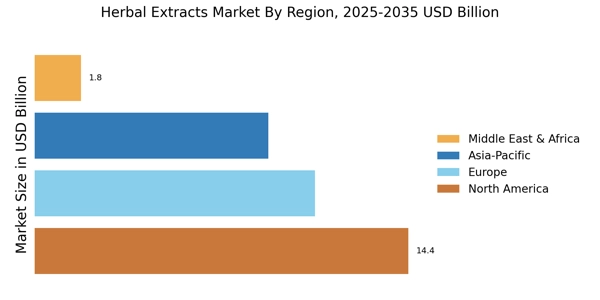
North America is the largest market for herbal extracts, holding approximately 40% of the global share. The region's growth is driven by increasing consumer awareness of health benefits, a rise in demand for natural ingredients in food and beverages, and supportive regulatory frameworks. The FDA's guidelines on herbal supplements further catalyze market expansion, ensuring product safety and efficacy. The United States is the leading country in this region, with major players like Herbalife Nutrition Ltd. and Ginkgo BioWorks dominating the landscape. The competitive environment is characterized by innovation and strategic partnerships among key players. Canada also contributes significantly, focusing on organic and sustainable herbal products, enhancing the overall market dynamics.
Europe is the second-largest market for herbal extracts, accounting for around 30% of the global market share. The region's growth is propelled by increasing consumer preference for natural and organic products, alongside stringent regulations that ensure product quality and safety. The European Food Safety Authority (EFSA) plays a crucial role in regulating herbal products, fostering consumer trust and market stability. Leading countries in Europe include Germany, France, and Italy, where the demand for herbal extracts is particularly high. The competitive landscape features key players like Indena S.p.A. and Naturex, who are investing in research and development to innovate and expand their product offerings. The presence of a robust supply chain and distribution network further enhances market accessibility across the region.
Asia-Pacific is an emerging powerhouse in the herbal extracts market, holding approximately 25% of the global share. The region's growth is driven by rising health consciousness, increasing disposable incomes, and a cultural inclination towards traditional herbal remedies. Countries like China and India are witnessing a surge in demand for herbal extracts, supported by favorable government policies promoting herbal medicine and natural products. China is the largest market in this region, with a strong presence of local players like Hunan Huacheng Biotech. India follows closely, with a growing number of startups focusing on herbal extracts for various applications. The competitive landscape is characterized by a mix of established companies and new entrants, all vying for market share in this rapidly evolving sector.
The Middle East and Africa represent a nascent market for herbal extracts, holding about 5% of the global share. The growth in this region is driven by increasing awareness of the health benefits of herbal products and a shift towards natural alternatives in food and cosmetics. Regulatory bodies are beginning to establish guidelines to ensure product safety, which is expected to further stimulate market growth in the coming years. Countries like South Africa and the UAE are leading the way in adopting herbal extracts, with a growing number of local manufacturers entering the market. The competitive landscape is still developing, with opportunities for both local and international players to establish a foothold. The region's unique biodiversity offers a rich source of herbal ingredients, enhancing its potential in the global market.
The Herbal Extracts Market is currently characterized by a dynamic competitive landscape, driven by increasing consumer demand for natural products and a growing awareness of health benefits associated with herbal extracts. Key players such as Ginkgo BioWorks (US), Herbalife Nutrition Ltd. (US), and Indena S.p.A. (IT) are strategically positioning themselves through innovation and partnerships. Ginkgo BioWorks (US) focuses on leveraging synthetic biology to enhance the production of herbal extracts, while Herbalife Nutrition Ltd. (US) emphasizes product diversification and health-oriented formulations. Indena S.p.A. (IT) is known for its commitment to quality and sustainability, which resonates well with the current market trends. Collectively, these strategies contribute to a competitive environment that is increasingly centered around innovation and consumer-centric offerings.
In terms of business tactics, companies are localizing manufacturing and optimizing supply chains to enhance efficiency and reduce costs. The market structure appears moderately fragmented, with several players vying for market share. However, the influence of key players is substantial, as they set benchmarks for quality and innovation that smaller companies often strive to meet. This competitive structure fosters an environment where collaboration and strategic partnerships are essential for growth and market penetration.
In August 2025, Ginkgo BioWorks (US) announced a partnership with a leading agricultural firm to develop a new line of herbal extracts aimed at enhancing crop yield and sustainability. This strategic move not only aligns with the growing trend of sustainable agriculture but also positions Ginkgo BioWorks (US) as a pioneer in integrating biotechnology with herbal extract production. The partnership is likely to enhance their product offerings and expand their market reach.
In July 2025, Herbalife Nutrition Ltd. (US) launched a new range of herbal supplements that incorporate adaptogenic herbs, targeting the wellness market. This initiative reflects a strategic focus on health and wellness trends, appealing to consumers seeking natural solutions for stress management and overall well-being. The introduction of these products may strengthen Herbalife's market position and attract a broader customer base.
In September 2025, Indena S.p.A. (IT) unveiled a new extraction technology that promises to enhance the bioavailability of herbal compounds. This innovation is significant as it addresses a common challenge in the herbal extracts market, potentially leading to more effective products. By investing in advanced extraction methods, Indena S.p.A. (IT) demonstrates its commitment to quality and efficacy, which could set new industry standards.
As of October 2025, current competitive trends in the Herbal Extracts Market include a pronounced shift towards digitalization, sustainability, and the integration of artificial intelligence in production processes. Strategic alliances are increasingly shaping the landscape, enabling companies to pool resources and expertise. Looking ahead, competitive differentiation is likely to evolve, with a greater emphasis on innovation and technology rather than solely on price. Companies that can reliably deliver high-quality, innovative products while optimizing their supply chains will likely emerge as leaders in this evolving market.


The Herbal Extracts Market is projected to grow at a 5.51% CAGR from 2024 to 2035, driven by increasing consumer demand for natural products and health benefits.
New opportunities lie in:
By 2035, the Herbal Extracts Market is expected to solidify its position as a key player in the global health and wellness sector.
| MARKET SIZE 2024 | 36.14(USD Billion) |
| MARKET SIZE 2025 | 38.13(USD Billion) |
| MARKET SIZE 2035 | 65.21(USD Billion) |
| COMPOUND ANNUAL GROWTH RATE (CAGR) | 5.51% (2024 - 2035) |
| REPORT COVERAGE | Revenue Forecast, Competitive Landscape, Growth Factors, and Trends |
| BASE YEAR | 2024 |
| Market Forecast Period | 2025 - 2035 |
| Historical Data | 2019 - 2024 |
| Market Forecast Units | USD Billion |
| Key Companies Profiled | Market analysis in progress |
| Segments Covered | Market segmentation analysis in progress |
| Key Market Opportunities | Growing consumer preference for natural ingredients drives innovation in the Herbal Extracts Market. |
| Key Market Dynamics | Rising consumer preference for natural ingredients drives innovation and competition in the herbal extracts market. |
| Countries Covered | North America, Europe, APAC, South America, MEA |
The Herbal Extracts Market was valued at 36.14 USD Billion in 2024.
The market is projected to reach 65.21 USD Billion by 2035.
The expected CAGR for the Herbal Extracts Market from 2025 to 2035 is 5.51%.
The Essential Oils segment is projected to grow from 12.0 to 22.0 USD Billion by 2035.
Key applications include Food & Beverages, Pharmaceuticals, and Personal Care & Cosmetics.
Key players include Ginkgo BioWorks, Herbalife Nutrition Ltd., and Indena S.p.A.
The Food & Beverages application segment is expected to range from 12.0 to 22.0 USD Billion by 2035.
The Liquid/Tinctures segment is projected to grow from 10.0 to 18.0 USD Billion by 2035, indicating strong demand.
The Rosemary segment is expected to grow from 4.0 to 7.0 USD Billion by 2035.
Trends include increasing consumer interest in natural products and the expansion of applications across various industries.



Kindly complete the form below to receive a free sample of this Report

“This is really good guys. Excellent work on a tight deadline. I will continue to use you going forward and recommend you to others. Nice job”


“Thanks. It’s been a pleasure working with you, please use me as reference with any other Intel employees.”


“Thanks for sending the report it gives us a good global view of the Betaïne market.”


“Thank you, this will be very helpful for OQS.”


“We found the report very insightful! we found your research firm very helpful. I'm sending this email to secure our future business.”


“I am very pleased with how market segments have been defined in a relevant way for my purposes (such as "Portable Freezers & refrigerators" and "last-mile"). In general the report is well structured. Thanks very much for your efforts.”


“I have been reading the first document or the study, ,the Global HVAC and FP market report 2021 till 2026. Must say, good info! I have not gone in depth at all parts, but got a good indication of the data inside!”


“We got the report in time, we really thank you for your support in this process. I also thank to all of your team as they did a great job.”


“The Automotive 48V ECU Components Procurement Intelligence Study” was a complex project, but the Market Research Future (MRFR) team handled it with quality, agility, and customer-centricity. They delivered all requested data on time and within the agreed scope. The team, including Shubhendra Anand and Rahul Gotadki, was always readily available to clarify questions and swiftly implement necessary adjustments, driving the project to a successful conclusion within a very demanding timeframe.
I would also like to specifically commend Akshay Agarwal for his responsiveness and support at every stage—from our initial inquiry on May 6th through to final delivery on June 18th. His dedication made the entire process seamless.”



