×
Request Free Sample ×

Kindly complete the form below to receive a free sample of this Report

* Please use a valid business email

Leading companies partner with us for data-driven Insights

clients tt-cursor
Hero Background

High Strength Steel Market

ID: MRFR/CnM/4183-HCR
140 Pages
Anshula Mandaokar
October 2025

High Strength Steel Market Research Report Information by Product Type (High Strength Low Alloy Steel, Dual-Phase Steel, Hardenable Bake Steel, Carbon Manganese Steel and Others), By End-Use (Automotive, Construction, Hoisting and Mining Equipment, Marine, Aviation and others) And By Region (North America, Europe, Asia-Pacific, And Rest Of The World) –Market Forecast Till 2035

Share:
Download PDF ×

We do not share your information with anyone. However, we may send you emails based on your report interest from time to time. You may contact us at any time to opt-out.

High Strength Steel Market Infographic
Purchase Options

High Strength Steel Market Summary

As per MRFR analysis, the High Strength Steel Market Size was estimated at 50.1 USD Billion in 2024. The High Strength Steel industry is projected to grow from 53.94 USD Billion in 2025 to 112.87 USD Billion by 2035, exhibiting a compound annual growth rate (CAGR) of 7.66 during the forecast period 2025 - 2035.

Key Market Trends & Highlights

The High Strength Steel Market is poised for robust growth driven by technological advancements and increasing demand across key sectors.

  • Technological advancements are enhancing the production processes and properties of high strength steel, leading to improved performance in various applications.
  • North America remains the largest market for high strength steel, while the Asia-Pacific region is emerging as the fastest-growing market due to rapid industrialization.
  • The automotive segment continues to dominate the market, whereas the aerospace segment is witnessing the fastest growth as manufacturers seek lightweight materials.
  • Rising demand in the automotive sector and infrastructure development initiatives are key drivers propelling the growth of the high strength steel market.

Market Size & Forecast

2024 Market Size 50.1 (USD Billion)
2035 Market Size 112.87 (USD Billion)
CAGR (2025 - 2035) 7.66%

Major Players

ArcelorMittal (LU), Nippon Steel Corporation (JP), Tata Steel (IN), POSCO (KR), Thyssenkrupp AG (DE), United States Steel Corporation (US), SSAB AB (SE), JFE Steel Corporation (JP), Steel Authority of India Limited (IN)

High Strength Steel Market Trends

The High Strength Steel Market is currently experiencing a notable transformation, driven by various factors including advancements in technology and increasing demand across multiple sectors. This material, known for its superior strength-to-weight ratio, is becoming increasingly essential in industries such as automotive, construction, and aerospace. As manufacturers seek to enhance performance while reducing weight, the adoption of high strength steel is likely to rise. Furthermore, the emphasis on sustainability and energy efficiency is pushing companies to explore innovative solutions, which may further bolster the market's growth. In addition, the High Strength Steel Market appears to be influenced by regulatory frameworks that promote the use of lightweight materials. These regulations often aim to reduce emissions and improve fuel efficiency, particularly in the automotive sector. As a result, manufacturers are compelled to invest in research and development to create advanced steel grades that meet these stringent requirements. Overall, the market is poised for continued expansion, with potential opportunities emerging as industries adapt to evolving consumer preferences and environmental considerations.

Technological Advancements

The High Strength Steel Market is witnessing a surge in technological innovations that enhance the production and application of high strength steel. These advancements may include improved manufacturing processes, such as advanced welding techniques and heat treatment methods, which contribute to the material's performance and durability. As technology evolves, it is likely that new steel grades will emerge, offering even greater strength and versatility.

Sustainability Initiatives

There is a growing trend towards sustainability within the High Strength Steel Market, as industries increasingly prioritize eco-friendly practices. This shift is prompting manufacturers to develop steel products that not only meet performance standards but also minimize environmental impact. The focus on recycling and the use of renewable energy sources in production processes may further enhance the market's appeal to environmentally conscious consumers.

Regulatory Influences

Regulatory frameworks are playing a crucial role in shaping the High Strength Steel Market. Governments worldwide are implementing policies that encourage the use of lightweight materials to reduce emissions and improve energy efficiency. These regulations may drive demand for high strength steel, as manufacturers seek to comply with stringent standards while maintaining competitive advantages in their respective industries.

High Strength Steel Market Drivers

Market Growth Projections

The Global High Strength Steel Market Industry is projected to witness robust growth in the coming years. With a market value of 50.1 USD Billion in 2024, it is anticipated to reach 112.9 USD Billion by 2035. This growth trajectory indicates a compound annual growth rate (CAGR) of 7.67% from 2025 to 2035. The increasing adoption of high strength steel across various sectors, including automotive, construction, and energy, is driving this expansion. As industries seek to enhance performance while adhering to sustainability goals, the demand for high strength steel is likely to continue rising, positioning it as a critical material in future developments.

Growing Environmental Regulations

The Global High Strength Steel Market Industry is increasingly influenced by growing environmental regulations aimed at reducing carbon footprints. Governments worldwide are implementing stringent policies to promote the use of sustainable materials in construction and manufacturing. High strength steel, known for its recyclability and lower environmental impact compared to traditional steel, is becoming a preferred material choice. This shift is particularly relevant as industries seek to comply with regulations while maintaining performance standards. As sustainability becomes a core focus, the demand for high strength steel is likely to rise, positioning it as a key player in the transition towards greener practices across various sectors.

Rising Demand in Automotive Sector

The Global High Strength Steel Market Industry is experiencing a notable surge in demand driven primarily by the automotive sector. As manufacturers increasingly prioritize lightweight materials to enhance fuel efficiency and reduce emissions, high strength steel has emerged as a preferred choice. In 2024, the market is projected to reach 50.1 USD Billion, reflecting the automotive industry's shift towards sustainable practices. Automakers are adopting high strength steel to meet stringent regulatory standards while maintaining vehicle safety and performance. This trend is expected to continue, with the market anticipated to grow significantly as electric vehicles gain traction, further propelling the demand for advanced steel solutions.

Infrastructure Development Initiatives

Infrastructure development initiatives across various regions are significantly influencing the Global High Strength Steel Market Industry. Governments are investing heavily in infrastructure projects, including bridges, highways, and railways, to stimulate economic growth. High strength steel is favored for its durability and ability to withstand extreme conditions, making it ideal for critical infrastructure applications. The ongoing global push for modernization and urbanization is likely to sustain this demand. As countries prioritize infrastructure resilience, the market is expected to witness substantial growth, contributing to an anticipated market value of 112.9 USD Billion by 2035, with a CAGR of 7.67% from 2025 to 2035.

Emerging Applications in Renewable Energy

Emerging applications in the renewable energy sector are contributing to the growth of the Global High Strength Steel Market Industry. As the world shifts towards sustainable energy sources, high strength steel is increasingly utilized in the construction of wind turbines, solar panels, and other renewable energy infrastructures. Its strength and durability make it suitable for demanding environments, ensuring longevity and reliability. The expansion of renewable energy projects globally is expected to drive demand for high strength steel, aligning with the broader trend of sustainable development. This sector's growth potential may further enhance the market's trajectory, reflecting a growing recognition of high strength steel's role in supporting renewable energy initiatives.

Technological Advancements in Steel Production

Technological advancements in steel production processes are reshaping the Global High Strength Steel Market Industry. Innovations such as advanced manufacturing techniques and automation are enhancing the efficiency and quality of high strength steel production. These developments enable manufacturers to produce steel with superior mechanical properties, catering to diverse applications across industries. As production costs decrease and quality improves, the adoption of high strength steel is likely to rise. This trend is particularly evident in sectors like construction and aerospace, where high performance is paramount. The ongoing evolution in production technology is expected to bolster market growth and expand the range of applications for high strength steel.

Market Segment Insights

By Application: Automotive (Largest) vs. Aerospace (Fastest-Growing)

The High Strength Steel Market is significantly influenced by its diverse applications, with the automotive sector leading in market share. This segment is primarily driven by the increasing demand for lighter and more fuel-efficient vehicles. Following closely, the aerospace sector is emerging with a rapidly expanding share, thanks to the ongoing advancements in aircraft manufacturing that emphasize the use of high strength materials to enhance performance while meeting stringent safety regulations. In the landscape of growth trends, the automotive sector continues to benefit from evolving consumer preferences towards sustainable and efficient cars. Meanwhile, aerospace is witnessing a surge as technological innovations propel the need for high strength steel in aircraft structures. The construction, marine, and energy sectors also play vital roles but remain secondary in comparison to the dominant automotive and emerging aerospace segments.

Aerospace: Emerging vs. Construction: Dominant

In the High Strength Steel Market, the aerospace sector is classified as an emerging segment, with profound growth potential driven by the demand for lightweight materials in aircraft design that enhance performance and fuel efficiency. This growth is encouraged by rising air travel demand and the push for innovation in aviation technology. Conversely, the construction sector is the dominant segment, utilizing high strength steel for its structural integrity in various applications, including commercial and residential buildings. As urbanization accelerates, construction continues to integrate high strength materials for sustainability and safety, establishing a strong market position. The contrasting characteristics of these segments highlight a robust interaction between innovation in aerospace and established practices within the construction industry.

By End Use: Automotive Parts (Largest) vs. Structural Components (Fastest-Growing)

In the High Strength Steel Market, the distribution of market share among end-use segments reveals that automotive parts hold the largest share. This dominance is propelled by the ongoing demand for lightweight and durable materials in the automotive sector. Structural components, while currently trailing, are recognized as the fastest-growing segment. Their adoption is driven by increased infrastructure spending and the need for enhanced durability in construction projects.

Automotive Parts (Dominant) vs. Structural Components (Emerging)

Automotive parts are positioned as the dominant segment within the High Strength Steel Market, primarily due to the automotive industry's relentless pursuit of safety and efficiency. High strength steel provides the necessary strength-to-weight ratio that automakers require for modern vehicles. On the other hand, structural components represent an emerging segment characterized by their rising importance in construction and infrastructure. As urbanization accelerates and environmental standards tighten, the demand for resilient and sustainable building materials grows, allowing structural components to gain significant traction in the market.

By Material Type: Dual Phase Steel (Largest) vs. High Strength Low Alloy Steel (Fastest-Growing)

The High Strength Steel Market is segmented into several material types, with Dual Phase Steel holding the largest market share due to its excellent balance of strength and ductility, making it highly favored across automotive applications. Following closely is High Strength Low Alloy Steel, which is gaining traction for its lightweight properties, beneficial in applications requiring reduced weight without sacrificing strength. Other segments like Quenched and Tempered Steel, Maraging Steel, and Cold Rolled Steel, while valuable, occupy smaller shares of the market, focusing on specific applications and industries.

Dual Phase Steel (Dominant) vs. High Strength Low Alloy Steel (Emerging)

Dual Phase Steel is characterized by its unique microstructure that effectively combines high strength with formability, making it ideal for automotive and construction sectors seeking lighter components. Meanwhile, High Strength Low Alloy Steel is an evolving material, notable for its superior toughness and resistance to corrosion, appealing primarily in structural applications that necessitate enhanced durability. As industries increasingly prioritize lightweight and high-performance materials, Dual Phase Steel maintains its dominance, while High Strength Low Alloy Steel emerges rapidly, driven by innovations and demand for energy-efficient solutions.

By Form: Sheet (Largest) vs. Plate (Fastest-Growing)

The High Strength Steel Market exhibits a diverse distribution among its segments, with the Sheet form leading in market share due to its widespread use in automotive manufacturing and construction. The versatility and strength of steel sheets have made them a popular choice, allowing manufacturers to meet varying demands effectively. Following sheets, plates are gaining traction, especially in sectors such as shipbuilding and heavy machinery, indicating a shift towards heavier applications with increased structural integrity requirements.

Sheet (Dominant) vs. Plate (Emerging)

Sheet and Plate forms are pivotal within the High Strength Steel Market. Sheets dominate the market due to their extensive applications in industries requiring lightweight and strong materials, such as automotive and aerospace. The manufacturing processes for sheets ensure they maintain high strength-to-weight ratios while being cost-effective. Conversely, plates are emerging as a significant segment, driven by the growing demand in large-scale projects like construction and infrastructure. Plates provide thicker materials that contribute to durability and safety in demanding applications, which is becoming increasingly acknowledged in modern engineering.

By Processing Technique: Cold Rolled (Largest) vs. Forged (Fastest-Growing)

In the High Strength Steel Market, the processing techniques exhibit distinct market share distributions. Cold Rolled steel dominates the segment, utilized widely in automotive and construction industries due to its enhanced surface finish and precise dimensions. Hot Rolled and Forged segments follow, catering to structural applications and heavy machinery, respectively. Welded and Machined techniques also hold a share but are less prominent in comparison to their counterparts, primarily serving niche markets for specialized applications. Growth trends in the processing techniques segment are driven by advancements in manufacturing technologies and increasing demand for lightweight, high-performance materials. The Cold Rolled process continues to lead due to its efficiency in producing strong yet malleable materials. In contrast, the Forged segment is rapidly scaling, driven by the rising requirement for durable components in the aerospace and automotive sectors where strength-to-weight ratios are paramount.

Cold Rolled (Dominant) vs. Forged (Emerging)

Cold Rolled high strength steel is characterized by its superior surface quality and tighter tolerances, making it ideal for applications requiring high levels of precision and strength. It is widely adopted in automotive parts and structural components due to its favorable mechanical properties. On the other hand, the Forged segment represents an emerging trend, driven by the demand for components that can withstand extreme conditions. Forged high strength steel offers enhanced toughness and resilience, making it ideal for applications in industries such as aerospace and heavy machinery. This segment is experiencing significant growth as manufacturers seek to optimize performance while minimizing weight.

Get more detailed insights about High Strength Steel Market

Regional Insights

North America : Innovation and Demand Growth

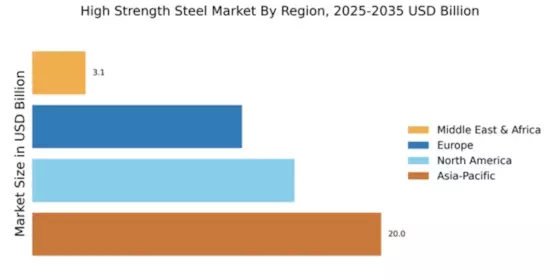
The North American high strength steel market is projected to grow significantly, driven by increasing demand from the automotive and construction sectors. With a market size of $15.03 billion, the region is focusing on innovative manufacturing processes and sustainable practices to meet regulatory standards. The push for lightweight materials in vehicles and infrastructure projects is a key growth driver, enhancing the market's potential in the coming years. Leading countries such as the United States and Canada are at the forefront of this market, with major players like United States Steel Corporation and ArcelorMittal establishing a strong presence. The competitive landscape is characterized by strategic partnerships and technological advancements aimed at improving product quality and reducing costs. As the region continues to invest in infrastructure, the demand for high strength steel is expected to rise, solidifying its market position.

Europe : Sustainability and Innovation Focus

Europe's high strength steel market is witnessing robust growth, fueled by stringent environmental regulations and a shift towards sustainable construction practices. With a market size of €12.02 billion, the region is prioritizing the development of advanced steel grades that meet both performance and sustainability criteria. The European Union's Green Deal is a significant regulatory catalyst, promoting the use of high strength steel in various applications, including automotive and infrastructure. Countries like Germany, France, and Italy are leading the charge, with key players such as Thyssenkrupp AG and ArcelorMittal driving innovation. The competitive landscape is marked by a focus on R&D and collaboration among industry stakeholders to enhance product offerings. As Europe aims to reduce carbon emissions, the demand for high strength steel is expected to grow, positioning the region as a leader in sustainable steel production.

Asia-Pacific : Dominance in Market Share

The Asia-Pacific region dominates the high strength steel market, boasting a market size of $20.0 billion. This growth is driven by rapid industrialization, urbanization, and increasing demand from the automotive and construction sectors. Countries like China, Japan, and India are significant contributors, with a focus on enhancing production capabilities and meeting international standards. The region's regulatory environment is also evolving, promoting the use of advanced materials in various applications. China stands out as the largest market, with major players like Nippon Steel Corporation and Tata Steel leading the competitive landscape. The presence of numerous manufacturers and a growing emphasis on innovation are key factors driving market growth. As the region continues to invest in infrastructure and technology, the demand for high strength steel is expected to remain strong, reinforcing its market leadership.

Middle East and Africa : Emerging Market Potential

The Middle East and Africa region is emerging as a potential market for high strength steel, with a market size of $3.06 billion. The growth is primarily driven by increasing investments in infrastructure and construction projects, particularly in countries like the UAE and South Africa. Regulatory initiatives aimed at enhancing building standards are also contributing to the demand for high strength steel, as it offers improved safety and durability in construction applications. Key players in this region include local manufacturers and international companies looking to expand their footprint. The competitive landscape is characterized by a mix of established firms and new entrants, all vying for market share. As the region continues to develop its infrastructure, the demand for high strength steel is expected to rise, presenting significant opportunities for growth.

Key Players and Competitive Insights

The High Strength Steel Market is currently characterized by a dynamic competitive landscape, driven by increasing demand across various sectors such as automotive, construction, and energy. Key players are actively pursuing strategies that emphasize innovation, sustainability, and regional expansion to enhance their market positions. For instance, ArcelorMittal (LU) has been focusing on developing advanced high-strength steel products that cater to the evolving needs of the automotive industry, while Tata Steel (IN) is investing in digital transformation initiatives to optimize its manufacturing processes and improve operational efficiency. These strategic moves collectively shape a competitive environment that is increasingly focused on technological advancement and sustainability.

In terms of business tactics, companies are localizing manufacturing to reduce lead times and enhance supply chain resilience. The market structure appears moderately fragmented, with several key players exerting significant influence. This fragmentation allows for a diverse range of offerings, but also intensifies competition as companies strive to differentiate themselves through innovative solutions and customer-centric approaches.

In November 2025, Nippon Steel Corporation (JP) announced a strategic partnership with a leading automotive manufacturer to develop lightweight high-strength steel solutions aimed at reducing vehicle weight and improving fuel efficiency. This collaboration underscores Nippon Steel's commitment to innovation and positions the company as a key player in the automotive sector, where lightweight materials are increasingly in demand. The partnership is likely to enhance Nippon Steel's market share and reinforce its reputation as a leader in high-strength steel technology.

In October 2025, United States Steel Corporation (US) unveiled a new production facility dedicated to the manufacturing of advanced high-strength steel products. This facility is expected to leverage cutting-edge technologies, including AI and automation, to streamline production processes and reduce costs. The establishment of this facility not only signifies U.S. Steel's commitment to meeting the growing demand for high-strength steel but also reflects a broader trend within the industry towards modernization and efficiency.

In September 2025, Thyssenkrupp AG (DE) launched a sustainability initiative aimed at reducing carbon emissions in its steel production processes. This initiative includes investments in green technologies and the adoption of renewable energy sources. By prioritizing sustainability, Thyssenkrupp is not only addressing regulatory pressures but also aligning itself with the increasing demand for environmentally friendly products, which could enhance its competitive edge in the market.

As of December 2025, the High Strength Steel Market is witnessing trends that emphasize digitalization, sustainability, and the integration of AI technologies. Strategic alliances are becoming increasingly important, as companies recognize the value of collaboration in driving innovation and enhancing supply chain reliability. The competitive differentiation is likely to evolve from traditional price-based competition towards a focus on technological advancements and sustainable practices, suggesting that companies that prioritize innovation and environmental responsibility will be better positioned for future success.

Key Companies in the High Strength Steel Market market include

Industry Developments

  • Q2 2025: Leading U.S. automaker launches new SUV platform with next-generation ultra-high-strength steel A major U.S. automaker announced the launch of a new SUV platform integrating next-generation ultra-high-strength steel, aiming to enhance crash safety and reduce vehicle weight by nearly 10%.

Future Outlook

High Strength Steel Market Future Outlook

The High Strength Steel Market is projected to grow at a 7.66% CAGR from 2024 to 2035, driven by increasing demand in automotive and construction sectors.

New opportunities lie in:

  • Development of lightweight, high-strength steel alloys for automotive applications.
  • Expansion into renewable energy sectors with specialized steel products.
  • Investment in advanced manufacturing technologies to enhance production efficiency.

By 2035, the High Strength Steel Market is expected to achieve robust growth, solidifying its position as a key industry.

Market Segmentation

High Strength Steel Market Form Outlook

  • Sheet
  • Plate
  • Bar
  • Wire
  • Tube

High Strength Steel Market End Use Outlook

  • Structural Components
  • Automotive Parts
  • Machinery
  • Shipbuilding
  • Oil and Gas

High Strength Steel Market Application Outlook

  • Automotive
  • Construction
  • Aerospace
  • Marine
  • Energy

High Strength Steel Market Material Type Outlook

  • Dual Phase Steel
  • High Strength Low Alloy Steel
  • Quenched and Tempered Steel
  • Maraging Steel
  • Cold Rolled Steel

High Strength Steel Market Processing Technique Outlook

  • Hot Rolled
  • Cold Rolled
  • Forged
  • Welded
  • Machined

Report Scope

MARKET SIZE 202450.1(USD Billion)
MARKET SIZE 202553.94(USD Billion)
MARKET SIZE 2035112.87(USD Billion)
COMPOUND ANNUAL GROWTH RATE (CAGR)7.66% (2024 - 2035)
REPORT COVERAGERevenue Forecast, Competitive Landscape, Growth Factors, and Trends
BASE YEAR2024
Market Forecast Period2025 - 2035
Historical Data2019 - 2024
Market Forecast UnitsUSD Billion
Key Companies ProfiledArcelorMittal (LU), Nippon Steel Corporation (JP), Tata Steel (IN), POSCO (KR), Thyssenkrupp AG (DE), United States Steel Corporation (US), SSAB AB (SE), JFE Steel Corporation (JP), Steel Authority of India Limited (IN)
Segments CoveredApplication, End Use, Material Type, Form, Processing Technique
Key Market OpportunitiesGrowing demand for lightweight, high-performance materials in automotive and construction sectors drives High Strength Steel Market opportunities.
Key Market DynamicsRising demand for lightweight materials drives innovation and competition in the High Strength Steel Market.
Countries CoveredNorth America, Europe, APAC, South America, MEA

Market Highlights

Author
Anshula Mandaokar
Team Lead - Research

Anshula Mandaokar holds an academic degree in Chemical Engineering and has been contributing to the field for more than 5 years. She has expertise in Market Research and Business Consulting and serves as a Team Lead for a reputed Market Research firm under the Chemicals and Materials domain spectrum. She has worked on multiple projects, generating explicit results in a quick turnaround time. Her understanding of data interpretation justifies her role as a leader.

Leave a Comment

FAQs

How much is the high-strength steel market?

The high-strength steel market size was valued at USD 50.10 Billion in 2024.

What is the growth rate of the high-strength steel market?

High Strength Steel Market is projected to grow at a CAGR of 7.66% during the forecast period, 2025-2035

Which region held the largest market share in the high-strength steel market?

North America had the largest share of the high-strength steel market.

Who are the key players in the high-strength steel market?

The key players in the high-strength steel market are Arcelor Mittal (Luxembourg), United States Steel Corporation (US), Voestalpine AG (Austria), SSAB (Sweden), Shandong Steel Group (China), AK Steel Corporation (US), SAIL (India), Nippon Steel and Sumitomo Metal Corporation (Japan), POSCO (South Korea), Wuhan Iron and Steel Corporation (China), Hyundai Steel Company (South Korea), and China Antsteel Group Corporation Limited (China).

Which product type led the high-strength steel market?

The carbon manganese steel category dominated the high-strength steel market in 2024.

Which end-use industry had the largest market share in the high-strength steel market?

Automotive had the largest share of the high-strength steel market.

Download Free Sample

Kindly complete the form below to receive a free sample of this Report

Compare Licence

×
Features License Type
Single User Multiuser License Enterprise User
Price $4,950 $5,950 $7,250
Maximum User Access Limit 1 User Upto 10 Users Unrestricted Access Throughout the Organization
Free Customization
Direct Access to Analyst
Deliverable Format
Platform Access
Discount on Next Purchase 10% 15% 15%
Printable Versions