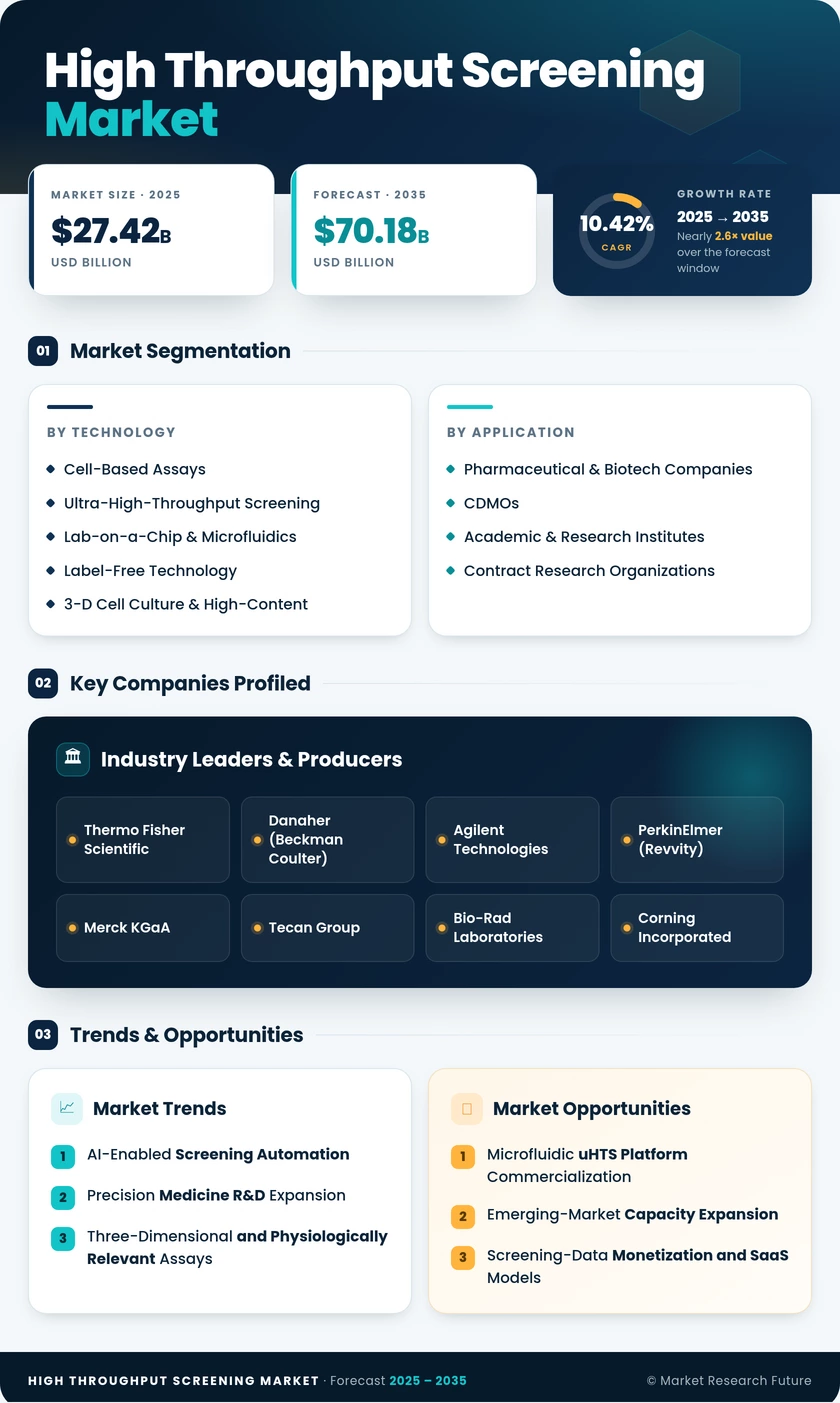
High Throughput Screening Market

ID: MRFR/LS/0772-CR
128 Pages
Nidhi Mandole
Last Updated: June 05, 2026
High Throughput Screening Market Research Report Information By Product &AMP Service (Reagents &AMP, Assay Kits Instruments, Consumables &AMP, Accessories, Software and Services), By Technology (Cell-Based Assays, 2D Cell Culture, 3D Cell Culture [Scaffold-Based Technologies (Hydrogels Inert Matrix Micropatterned Surfaces)], Scaffold-free Technologies (Microplate), Hanging-drop Plates, Ultra-low Binding Plates, Other Scaffold-free Technologies), and By Region (North America, Europe, Asia-Pacific, And Rest Of The World) - Growth & Industry Forecast To 2035
Download PDF ×

We do not share your information with anyone. However, we may send you emails based on your report interest from time to time. You may contact us at any time to opt-out.

  1. 1 Market Overview |
    1. 1.1 Study Assumptions & Market Definition |
    2. 1.2 Scope of the Study |
    3. 1.3 Research Methodology
  2. 2 Market Summary & Key Takeaways
  3. 3 Market Size & Forecast (2021–2035) |
    1. 3.1 Historical Market Size (2021–2025) |
    2. 3.2 Current & Forecast Market Size (2026–2035) |
    3. 3.3 Year-over-Year Growth Analysis
  4. 4 Driver Impact Analysis |
    1. 4.1 AI-Enabled Screening Automation |
    2. 4.2 Precision Medicine R&D Expansion |
    3. 4.3 Three-Dimensional and Physiologically Relevant Assays
  5. 5 Restraints Impact Analysis |
    1. 5.1 High Capital Cost of Integrated Platforms |
    2. 5.2 Shortage of Skilled Assay Scientists |
    3. 5.3 Data Standardization and Integration Gaps
  6. 6 Opportunities |
    1. 6.1 Microfluidic uHTS Platform Commercialization |
    2. 6.2 Emerging-Market Capacity Expansion |
    3. 6.3 Screening-Data Monetization and SaaS Models |
    4. 6.4 Toxicology and ADME Screening Acceleration |
    5. 6.5 Integrated Discovery-as-a-Service Offerings
  7. 7 Regional Market Share & Country-Level Analysis |
    1. 7.1 North America | |
      1. 7.1.1 United States | |
      2. 7.1.2 Canada | |
      3. 7.1.3 Mexico |
    2. 7.2 Europe | |
      1. 7.2.1 Germany | |
      2. 7.2.2 United Kingdom | |
      3. 7.2.3 France | |
      4. 7.2.4 Italy | |
      5. 7.2.5 Spain | |
      6. 7.2.6 Nordic Countries | |
      7. 7.2.7 Russia | |
      8. 7.2.8 Rest of Europe |
    3. 7.3 Asia-Pacific | |
      1. 7.3.1 China | |
      2. 7.3.2 India | |
      3. 7.3.3 Japan | |
      4. 7.3.4 South Korea | |
      5. 7.3.5 ASEAN | |
      6. 7.3.6 Rest of Asia-Pacific |
    4. 7.4 South America | |
      1. 7.4.1 Brazil | |
      2. 7.4.2 Argentina | |
      3. 7.4.3 Rest of South America |
    5. 7.5 Middle East & Africa | |
      1. 7.5.1 Saudi Arabia | |
      2. 7.5.2 UAE | |
      3. 7.5.3 South Africa | |
      4. 7.5.4 Egypt | |
      5. 7.5.5 Rest of MEA
  8. 8 Future Outlook (2026–2035) |
    1. 8.1 Autonomous Screening Operations |
    2. 8.2 Platform Economics and Recurring Revenue |
    3. 8.3 Decentralized and Miniaturized Screening |
    4. 8.4 Sustainability and Green Laboratory Practice
  9. 9 Market Segmentation Analysis |
    1. 9.1 By Technology | |
      1. 9.1.1 Cell-Based Assays | |
      2. 9.1.2 Ultra-High-Throughput Screening | |
      3. 9.1.3 Lab-on-a-Chip & Microfluidics | |
      4. 9.1.4 Label-Free Technology | |
      5. 9.1.5 3-D Cell Culture & High-Content |
    2. 9.2 By Application | |
      1. 9.2.1 Primary & Secondary Screening | |
      2. 9.2.2 Target Identification | |
      3. 9.2.3 Toxicology & ADME | |
      4. 9.2.4 Hit-to-Lead Optimization |
    3. 9.3 By End User | |
      1. 9.3.1 Pharmaceutical & Biotech Companies | |
      2. 9.3.2 CDMOs | |
      3. 9.3.3 Academic & Research Institutes | |
      4. 9.3.4 Contract Research Organizations
  10. 10 Competitive Landscape |
    1. 10.1 Market Share Analysis (2026) |
    2. 10.2 Competitive Benchmarking Matrix |
    3. 10.3 Company Profiles
  11. 11 Recent News & Developments
  12. 12 Report Scope & Methodology
  13. 13 Detailed Sources & Citations
  14. 14 Frequently Asked Questions (FAQs)
  15. 15 LIST OF TABLES |
  16. TABLE 1 Global High Throughput Screening Market Size & Forecast, by Revenue (USD Billion), 2021–2035 |
  17. TABLE 2 Global High Throughput Screening Market – Year-over-Year Growth Analysis, 2021–2035 |
  18. TABLE 3 Driver Impact Analysis – High Throughput Screening Market |
  19. TABLE 4 Restraints Impact Analysis – High Throughput Screening Market |
  20. TABLE 5 Regional Market Share Summary, 2025 (USD Billion / %) |
  21. TABLE 6 North America High Throughput Screening Market Size, by Country, 2021–2035 (USD Billion) |
  22. TABLE 7 Europe High Throughput Screening Market Size, by Country, 2021–2035 (USD Billion) |
  23. TABLE 8 Asia-Pacific High Throughput Screening Market Size, by Country, 2021–2035 (USD Billion) |
  24. TABLE 9 South America High Throughput Screening Market Size, by Country, 2021–2035 (USD Billion) |
  25. TABLE 10 Middle East & Africa High Throughput Screening Market Size, by Country, 2021–2035 (USD Billion) |
  26. TABLE 11 Global High Throughput Screening Market Size, by Technology, 2021–2035 (USD Billion) |
  27. TABLE 12 Global High Throughput Screening Market Size, by Application, 2021–2035 (USD Billion) |
  28. TABLE 13 Global High Throughput Screening Market Size, by End User, 2021–2035 (USD Billion) |
  29. TABLE 14 Competitive Benchmarking Matrix – High Throughput Screening Market, 2026 |
  30. TABLE 15 Report Scope & Methodology Summary |
  31. TABLE 16 Detailed Sources & Citations
  32. 16 LIST OF FIGURES |
  33. FIGURE 1 High Throughput Screening Market – Market Dynamics Overview |
  34. FIGURE 2 High Throughput Screening Market – Industry Value Chain Analysis |
  35. FIGURE 3 High Throughput Screening Market – Porter's Five Forces Analysis |
  36. FIGURE 4 Global High Throughput Screening Market Size Trend, 2021–2035 (USD Billion) |
  37. FIGURE 5 Year-over-Year Growth Trend, 2021–2035 |
  38. FIGURE 6 Market Share by Technology, 2025 (%) |
  39. FIGURE 7 Market Share by Application, 2025 (%) |
  40. FIGURE 8 Market Share by End User, 2025 (%) |
  41. FIGURE 9 Regional Market Share, 2025 (%) |
  42. FIGURE 10 Asia-Pacific Country-Level Growth Comparison |
  43. FIGURE 11 Competitive Landscape – Revenue Share Distribution, 2026 |
  44. FIGURE 12 Driver vs. Restraint Impact Comparison

Segmentation Quick Reference

DimensionSub-SegmentsDominant SegmentFastest Growing Segment
By TechnologyCell-Based Assays, Ultra-High-Throughput Screening, Lab-on-a-Chip & Microfluidics, Label-Free Technology, 3-D Cell Culture & High-ContentCell-Based AssaysLab-on-a-Chip & Microfluidics
By ApplicationPrimary & Secondary Screening, Target Identification, Toxicology & ADME, Hit-to-Lead OptimizationPrimary & Secondary ScreeningToxicology & ADME
By End UserPharmaceutical & Biotech Companies, CDMOs, Academic & Research Institutes, Contract Research OrganizationsPharmaceutical & Biotech CompaniesCDMOs


Market Segmentation Overview

By Technology

Sub-SegmentKey Trend
Cell-Based AssaysShift toward physiologically relevant living-cell readouts
Ultra-High-Throughput ScreeningNanoliter assays expanding compound coverage.
Lab-on-a-Chip & MicrofluidicsMiniaturization cuts reagent cost and footprint.
Label-Free TechnologyGrowing use where label interference compromises data
3-D Cell Culture & High-ContentOrganoid and spheroid imaging gaining regulatory favor


Technology segmentation reflects a market moving from simple biochemical formats toward biologically richer, miniaturized systems. Cell-based assays dominate because they predict therapeutic response more reliably, while microfluidic platforms grow fastest as laboratories prioritize reagent efficiency and decentralized capability.

By Application

Sub-SegmentKey Trend
Primary & Secondary ScreeningCore high-volume filter of discovery pipelines
Target IdentificationPrecision medicine is expanding the molecular target scope.
Toxicology & ADMENon-animal testing regulation is accelerating adoption.
Hit-to-Lead OptimizationAI-guided candidate refinement is gaining traction.


Application segmentation shows primary and secondary screening as the unavoidable foundation of discovery work, sustaining its lead. Toxicology and ADME applications grow fastest, driven directly by regulatory momentum favoring non-animal safety assessment methods.

By End User

Sub-SegmentKey Trend
Pharmaceutical & Biotech CompaniesSustained in-house screening for proprietary pipelines
CDMOsRapid growth as sponsors outsource screening workloads.
Academic & Research InstitutesGrant-funded basic and translational research
Contract Research OrganizationsSponsor-driven demand for specialized screening


End-user segmentation confirms pharmaceutical and biotech companies as the demand anchor, given their large internal discovery programs. CDMOs represent the fastest-expanding buyer group as outsourcing of screening becomes a standard strategic choice across the industry.