×
Request Free Sample ×

Kindly complete the form below to receive a free sample of this Report

* Please use a valid business email

Leading companies partner with us for data-driven Insights

clients tt-cursor
Hero Background

Hollow Fiber Filtration Marker Market

ID: MRFR/HC/41093-HCR
200 Pages
Rahul Gotadki
February 2026

Hollow Fiber Filtration Marker Market Research Report By Application (Water Treatment, Food and Beverage, Pharmaceuticals, Biotechnology), By Filtration Type (Microfiltration, Ultrafiltration, Nanofiltration), By Material (Polymeric, Inorganic, Composite), By End Use Industry (Healthcare, Environmental, Industrial, Agriculture) and By Regional (North America, Europe, South America, Asia Pacific, Middle East and Africa) - Growth & Industry Forecast 2025 To 2035

Share:
Download PDF ×

We do not share your information with anyone. However, we may send you emails based on your report interest from time to time. You may contact us at any time to opt-out.

Hollow Fiber Filtration Marker Market Infographic
Purchase Options

Hollow Fiber Filtration Marker Market Summary

As per MRFR analysis, the Hollow Fiber Filtration Market was estimated at 3549.5 USD Million in 2024. The Hollow Fiber Filtration industry is projected to grow from 3749.7 in 2025 to 6490.53 by 2035, exhibiting a compound annual growth rate (CAGR) of 5.64 during the forecast period 2025 - 2035.

Key Market Trends & Highlights

The Hollow Fiber Filtration Market is poised for substantial growth driven by technological advancements and increasing demand for sustainable solutions.

  • Technological advancements in filtration are reshaping the Hollow Fiber Filtration Market, enhancing efficiency and performance.
  • North America remains the largest market, while Asia-Pacific is emerging as the fastest-growing region due to rising industrial applications.
  • The municipal water treatment segment is witnessing significant growth, driven by regulatory pressures and compliance requirements.
  • Key market drivers include technological innovations in hollow fiber filtration and increasing water scarcity and quality concerns.

Market Size & Forecast

2024 Market Size 3549.5 (USD Million)
2035 Market Size 6490.53 (USD Million)
CAGR (2025 - 2035) 5.64%

Major Players

Koch Membrane Systems (US), Pall Corporation (US), Merck KGaA (DE), SUEZ Water Technologies & Solutions (US), Asahi Kasei Corporation (JP), Toray Industries, Inc. (JP), GE Water & Process Technologies (US), Mitsubishi Rayon Co., Ltd. (JP), Pentair plc (GB)

Our Impact
Enabled $4.3B Revenue Impact for Fortune 500 and Leading Multinationals
Partnering with 2000+ Global Organizations Each Year
30K+ Citations by Top-Tier Firms in the Industry

Hollow Fiber Filtration Marker Market Trends

The Hollow Fiber Filtration Marker Market is currently experiencing a notable transformation, driven by advancements in filtration technology and increasing demand for efficient water treatment solutions. This market appears to be expanding as industries recognize the benefits of hollow fiber membranes, which offer superior filtration capabilities and reduced operational costs. The growing emphasis on sustainability and environmental protection is likely to further propel the adoption of these filtration systems across various sectors, including municipal water treatment, pharmaceuticals, and food and beverage processing. As regulatory frameworks become more stringent, the need for reliable filtration solutions is expected to intensify, thereby enhancing market growth prospects. In addition, the Hollow Fiber Filtration Marker Market seems to be influenced by ongoing research and development efforts aimed at improving membrane performance and longevity. Innovations in material science and engineering are paving the way for the creation of more efficient and durable hollow fiber membranes. Furthermore, the increasing awareness of water scarcity issues is prompting industries to invest in advanced filtration technologies. This trend indicates a shift towards more sustainable practices, as businesses seek to minimize waste and optimize resource utilization. Overall, the market appears poised for continued growth, driven by technological advancements and a heightened focus on environmental sustainability.

Technological Advancements in Filtration

Recent innovations in membrane technology are enhancing the performance of hollow fiber filtration systems. These advancements are likely to improve efficiency, reduce energy consumption, and extend the lifespan of filtration units, making them more appealing to various industries.

Rising Demand for Sustainable Solutions

There is an increasing emphasis on sustainability within the Hollow Fiber Filtration Marker Market. Industries are actively seeking eco-friendly filtration options that minimize environmental impact, which may lead to a greater adoption of hollow fiber technologies.

Regulatory Pressures and Compliance

Stricter regulations regarding water quality and safety are influencing the market dynamics. Companies are compelled to adopt advanced filtration solutions to meet compliance standards, thereby driving the demand for hollow fiber filtration systems.

Hollow Fiber Filtration Marker Market Drivers

Increasing Water Scarcity and Quality Concerns

The Hollow Fiber Filtration Marker Market is significantly influenced by the rising concerns regarding water scarcity and quality. As populations grow and industrial activities expand, the demand for clean and safe water is escalating. Hollow fiber filtration systems are recognized for their ability to effectively remove pathogens and contaminants from water sources, making them essential in addressing these challenges. According to recent estimates, the demand for water treatment solutions is expected to increase by 10% annually, driving the adoption of hollow fiber filtration technologies. This trend highlights the critical role that these filtration systems play in ensuring access to potable water, thereby propelling the market forward.

Rising Awareness of Health and Safety Standards

The Hollow Fiber Filtration Marker Market is significantly impacted by the rising awareness of health and safety standards across various sectors. As consumers and regulatory bodies demand higher quality and safety in products, industries are compelled to adopt advanced filtration technologies. Hollow fiber filtration systems are recognized for their ability to effectively eliminate contaminants, ensuring compliance with health regulations. The market is projected to grow as more companies invest in these filtration solutions to meet safety standards, with an anticipated increase of 15% in adoption rates over the next few years. This trend reflects a broader commitment to health and safety, further driving the hollow fiber filtration market.

Technological Innovations in Hollow Fiber Filtration

The Hollow Fiber Filtration Marker Market is experiencing a surge in technological innovations that enhance filtration efficiency and reduce operational costs. Recent advancements in membrane technology, such as the development of more durable and chemically resistant materials, have improved the performance of hollow fiber filters. These innovations allow for higher flow rates and better contaminant removal, which is crucial for various applications, including water treatment and pharmaceuticals. The market is projected to grow as industries increasingly adopt these advanced filtration solutions, with a compound annual growth rate (CAGR) of approximately 8% anticipated over the next five years. This growth is indicative of the industry's response to the need for more effective and efficient filtration systems.

Shift Towards Decentralized Water Treatment Solutions

The Hollow Fiber Filtration Marker Market is witnessing a notable shift towards decentralized water treatment solutions. This trend is driven by the need for localized water purification systems that can operate independently of centralized infrastructure. Hollow fiber filtration systems are particularly well-suited for this purpose due to their compact design and high efficiency. As urbanization continues to rise, the demand for decentralized solutions is projected to grow, with an estimated market expansion of 12% over the next few years. This shift not only addresses the challenges of water distribution but also aligns with sustainability goals, further enhancing the appeal of hollow fiber filtration technologies.

Growing Industrial Applications of Hollow Fiber Filtration

The Hollow Fiber Filtration Marker Market is expanding due to the increasing adoption of hollow fiber filtration technologies across various industrial sectors. Industries such as food and beverage, pharmaceuticals, and chemical processing are increasingly utilizing these filtration systems for their efficiency and effectiveness in removing impurities. The market for hollow fiber filtration in industrial applications is expected to grow at a CAGR of 9% as companies seek to enhance product quality and comply with stringent regulatory standards. This trend underscores the versatility of hollow fiber filtration systems and their ability to meet diverse industrial needs, thereby driving market growth.
Market Segment Insights

By Application: Water Treatment (Largest) vs. Pharmaceutical Filtration (Fastest-Growing)

The Hollow Fiber Filtration Market showcases a range of applications, notably dominated by Water Treatment, which maintains the largest share. This significant segment is essential for providing clean and safe drinking water, thereby fulfilling global demand for municipal and industrial water purification. Other key players include Food and Beverage Processing, Biotechnology, Industrial Filtration, and Pharmaceutical Filtration, contributing to a well-rounded market landscape that addresses various filtration needs.

Water Treatment (Dominant) vs. Pharmaceutical Filtration (Emerging)

Water Treatment emerges as the dominant application within the Hollow Fiber Filtration Market due to its critical role in ensuring clean water supplies across urban and rural areas. This segment’s maturity is underscored by established technologies and a broad customer base. In contrast, Pharmaceutical Filtration is an emerging segment driven by increasing stringent regulations in healthcare and biopharmaceutical sectors, demanding high-quality filtration solutions. The rapid advancements in healthcare technology and rising investments in pharmaceuticals are propelling this segment forward, anticipated to witness remarkable growth in the coming years.

By End Use: Municipal (Largest) vs. Industrial (Fastest-Growing)

The Hollow Fiber Filtration Market showcases a diverse distribution across end-use segments. The Municipal sector holds the largest market share, driven by increasing demands for clean water and waste treatment solutions. In contrast, the Industrial segment is rapidly gaining traction, attributed to rigorous industrial filtration requirements across various sectors.

Municipal (Dominant) vs. Industrial (Emerging)

The Municipal segment is characterized by significant investments in infrastructure aimed at water purification and supply systems. It remains the dominant player in the Hollow Fiber Filtration Market, largely due to government regulations promoting safe drinking water. On the other hand, the Industrial sector is emerging as a vital market component, responding to enhanced operational efficiencies and sustainability practices. Industries are increasingly adopting hollow fiber technologies for their superior filtration capabilities, positioning the Industrial segment as the fastest-growing end use in this market.

By Material Type: Polyethersulfone (Largest) vs. Polyvinylidene Fluoride (Fastest-Growing)

In the Hollow Fiber Filtration Market, the material type segment exhibits a diverse range of options, with Polyethersulfone leading as the largest segment due to its superior thermal and chemical stability, which makes it the preferred choice among manufacturers. Following closely are Polyvinylidene Fluoride and Polysulfone, which also hold significant shares, while Cellulose Acetate and Polypropylene exhibit moderate market presence. The distribution among these materials highlights the ongoing trend of manufacturers prioritizing quality and reliability in filtration products.

Polyethersulfone (Dominant) vs. Cellulose Acetate (Emerging)

Polyethersulfone is characterized by its exceptional performance in high-temperature and high-pH environments, making it a dominant choice for hollow fiber membranes used in critical filtration applications. Its widespread use across various industries, including pharmaceuticals and water treatment, underscores its reliability and efficiency. Conversely, Cellulose Acetate, though currently in an emerging position, is gaining traction due to its biocompatibility and eco-friendly nature. This growing preference aligns with increasing environmental concerns and regulatory pressures, driving innovations and adoption in specific markets, particularly in bioprocessing and medical applications.

By Membrane Configuration: Hollow Fiber (Largest) vs. Spiral Wound (Fastest-Growing)

The Hollow Fiber Filtration Market showcases a distinct distribution of market share among various membrane configurations. Hollow Fiber membranes dominate the segment due to their high efficiency and cost-effectiveness, widely adopted in various applications. In contrast, Spiral Wound membranes are experiencing rapid growth, attributed to their enhanced surface area, which optimizes filtration processes and meets increasing demand for compact filtration systems.

Hollow Fiber (Dominant) vs. Spiral Wound (Emerging)

Hollow Fiber membranes are characterized by their tubular structure, providing high packing density and a large filtration surface area, making them suitable for a range of applications including water treatment and biotechnology. They are recognized for their durability and performance efficiency, resulting in a strong market presence. On the other hand, Spiral Wound membranes, though emerging, are gaining traction in the market as they offer a high filtration rate and energy efficiency. Their design allows for a compact installation footprint, making them ideal for space-constrained environments. With advancements in material and technology, Spiral Wound membranes are on the rise, attracting attention for their capability to meet modern filtration challenges.

By Filtration Mechanism: Ultrafiltration (Largest) vs. Microfiltration (Fastest-Growing)

In the Hollow Fiber Filtration market, Ultrafiltration currently holds the largest market share due to its high effectiveness in separating particles and microorganisms. It is particularly favored in various industrial applications, including water treatment, food and beverage processing, and biopharmaceuticals. Microfiltration, while not as dominant, is rapidly gaining traction because of its lower operational costs and ease of use, making it a preferred choice in certain niche applications.

Ultrafiltration (Dominant) vs. Microfiltration (Emerging)

Ultrafiltration stands as the dominant force in the Hollow Fiber Filtration market, primarily due to its superior ability to remove macromolecules and small pathogens without the need for chemical additives. It operates at relatively low pressures, leading to energy efficiency and longer membrane life. On the other hand, Microfiltration is emerging as a competitive alternative, especially in applications requiring the removal of larger particulates and bacteria. Its simplicity and cost-effectiveness make it appealing for small-scale operations and point-of-use water treatment systems. Both technologies are witnessing advancements in membrane materials and configurations, enhancing their operational capabilities and expanding their application scopes.

Get more detailed insights about Hollow Fiber Filtration Marker Market

Regional Insights

North America : Market Leader in Filtration

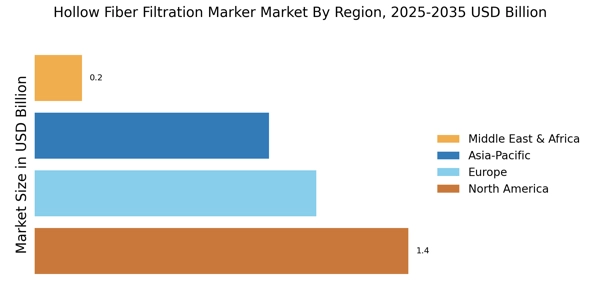
North America is poised to maintain its leadership in the Hollow Fiber Filtration Market, holding a significant market share of 1774.75 million in 2024. The region's growth is driven by increasing demand for advanced filtration technologies across various sectors, including water treatment and pharmaceuticals. Regulatory support for clean water initiatives further propels market expansion, ensuring compliance with stringent environmental standards. The competitive landscape in North America is robust, featuring key players such as Koch Membrane Systems, Pall Corporation, and SUEZ Water Technologies. These companies are at the forefront of innovation, offering cutting-edge solutions that cater to diverse industrial needs. The presence of established firms and ongoing investments in R&D solidify North America's position as a hub for hollow fiber filtration technology.

Europe : Emerging Market Dynamics

Europe is witnessing a dynamic shift in the Hollow Fiber Filtration Market, with a market size of 1064.85 million in 2024. The region's growth is fueled by increasing environmental regulations and a rising focus on sustainable water management practices. Countries are investing in advanced filtration systems to meet EU directives on water quality, driving demand for innovative solutions in the market. Leading countries such as Germany, France, and the UK are at the forefront of this growth, supported by key players like Merck KGaA and Toray Industries. The competitive landscape is characterized by strategic partnerships and technological advancements, enhancing the region's capability to address diverse filtration needs. The European market is expected to continue evolving, driven by regulatory frameworks and a commitment to sustainability.

Asia-Pacific : Rapid Growth and Innovation

Asia-Pacific is emerging as a significant player in the Hollow Fiber Filtration Market, with a market size of 550.0 million in 2024. The region's growth is driven by rapid industrialization, urbanization, and increasing water scarcity issues. Governments are implementing policies to enhance water quality and availability, creating a favorable environment for filtration technology adoption. Countries like Japan, China, and India are leading the charge, with major companies such as Asahi Kasei Corporation and Mitsubishi Rayon Co., Ltd. actively participating in the market. The competitive landscape is marked by innovation and collaboration, as firms strive to develop advanced filtration solutions that cater to the growing demand for clean water. The Asia-Pacific market is set for substantial growth, supported by both public and private sector investments.

Middle East and Africa : Untapped Market Potential

The Middle East and Africa region is gradually emerging in the Hollow Fiber Filtration Market, with a market size of 159.85 million in 2024. The growth is primarily driven by increasing water scarcity and the need for effective water treatment solutions. Governments are prioritizing investments in water infrastructure, which is expected to boost the demand for filtration technologies in the coming years. Countries like South Africa and the UAE are leading the way, with a growing presence of key players such as Pentair plc. The competitive landscape is evolving, with both local and international companies seeking to capitalize on the region's untapped potential. As awareness of water quality issues rises, the market is likely to see increased adoption of advanced filtration systems, paving the way for future growth.

Hollow Fiber Filtration Marker Market Regional Image

Key Players and Competitive Insights

The Hollow Fiber Filtration Marker Market is currently characterized by a dynamic competitive landscape, driven by increasing demand for efficient water treatment solutions and advancements in filtration technologies. Key players such as Koch Membrane Systems (US), Pall Corporation (US), and Merck KGaA (DE) are strategically positioned to leverage their technological expertise and extensive product portfolios. Koch Membrane Systems (US) focuses on innovation in membrane technology, while Pall Corporation (US) emphasizes its commitment to sustainability and environmental stewardship. Merck KGaA (DE) is actively pursuing partnerships to enhance its market reach and product offerings, collectively shaping a competitive environment that prioritizes technological advancement and sustainability.

In terms of business tactics, companies are increasingly localizing manufacturing to reduce lead times and optimize supply chains. The market appears moderately fragmented, with several players vying for market share. However, the collective influence of major companies like SUEZ Water Technologies & Solutions (US) and Asahi Kasei Corporation (JP) is notable, as they implement strategies that enhance operational efficiency and customer engagement.

In January 2026, Pall Corporation (US) announced a strategic partnership with a leading environmental organization to develop sustainable filtration solutions aimed at reducing plastic waste in water treatment processes. This collaboration is significant as it aligns with global sustainability goals and positions Pall Corporation as a leader in eco-friendly technologies, potentially enhancing its market share in the growing segment of environmentally conscious consumers.

In December 2025, Merck KGaA (DE) launched a new line of hollow fiber membranes designed for high-performance filtration applications. This product introduction is crucial as it not only expands Merck's product portfolio but also addresses the increasing demand for efficient filtration solutions in various industries, including pharmaceuticals and food processing. The innovation reflects the company's commitment to maintaining a competitive edge through continuous product development.

In November 2025, Koch Membrane Systems (US) expanded its manufacturing capabilities by investing in a new facility in Europe. This strategic move is likely to enhance production efficiency and reduce operational costs, allowing the company to respond more swiftly to market demands. The expansion underscores Koch's focus on regional growth and its intent to strengthen its position in the European market, which is experiencing a surge in demand for advanced filtration technologies.

As of February 2026, current competitive trends in the Hollow Fiber Filtration Marker Market indicate a strong emphasis on digitalization, sustainability, and the integration of AI technologies. Strategic alliances are increasingly shaping the landscape, enabling companies to pool resources and expertise to drive innovation. The shift from price-based competition to a focus on technological differentiation and supply chain reliability is evident, suggesting that future competitive dynamics will hinge on the ability to innovate and deliver sustainable solutions.

Key Companies in the Hollow Fiber Filtration Marker Market include

Industry Developments

Recent developments in the Global Hollow Fiber Filtration Market include advancements in technology and increasing demand for water treatment solutions. Key players such as Merck KGaA and Asahi Kasei Corporation are investing heavily in R&D to enhance filtration capabilities, particularly for industrial and municipal applications. Suez Water Technologies and Solutions have reported growth in demand due to the rising focus on sustainability and environmental regulations driving the need for efficient filtration systems. 

Mergers and acquisitions are notable, with companies like Pall Corporation and Evoqua Water Technologies exploring strategic partnerships to expand their market reach and product offerings. The market valuation for companies such as Dow Chemical Company and Toray Industries has seen considerable growth attributed to increasing application areas in healthcare and food processing. This shift is impacting market dynamics as firms strive to meet evolving customer needs and comply with stringent regulatory standards. The overall market is buoyed by ongoing innovations aimed at improving membrane efficiency and lifespan, leading to competitive advantages for involved companies.

Future Outlook

Hollow Fiber Filtration Marker Market Future Outlook

The Hollow Fiber Filtration Marker Market is projected to grow at a 5.64% CAGR from 2024 to 2035, driven by increasing demand for water purification and advancements in filtration technology.

New opportunities lie in:

  • Development of portable filtration units for remote areas
  • Integration of IoT for real-time monitoring of filtration systems
  • Expansion into emerging markets with tailored filtration solutions

By 2035, the market is expected to achieve robust growth, solidifying its position as a leader in filtration technology.

Market Segmentation

Hollow Fiber Filtration Marker Market End Use Outlook

  • Municipal
  • Industrial
  • Residential
  • Commercial
  • Laboratory

Hollow Fiber Filtration Marker Market Application Outlook

  • Water Treatment
  • Food and Beverage Processing
  • Pharmaceutical Filtration
  • Biotechnology
  • Industrial Filtration

Hollow Fiber Filtration Marker Market Material Type Outlook

  • Polyethersulfone
  • Polyvinylidene Fluoride
  • Cellulose Acetate
  • Polypropylene
  • Polysulfone

Hollow Fiber Filtration Marker Market Filtration Mechanism Outlook

  • Microfiltration
  • Ultrafiltration
  • Nanofiltration
  • Reverse Osmosis
  • Crossflow Filtration

Hollow Fiber Filtration Marker Market Membrane Configuration Outlook

  • Hollow Fiber
  • Spiral Wound
  • Flat Sheet
  • Capillary
  • Tubular

Report Scope

MARKET SIZE 20243549.5(USD Million)
MARKET SIZE 20253749.7(USD Million)
MARKET SIZE 20356490.53(USD Million)
COMPOUND ANNUAL GROWTH RATE (CAGR)5.64% (2024 - 2035)
REPORT COVERAGERevenue Forecast, Competitive Landscape, Growth Factors, and Trends
BASE YEAR2024
Market Forecast Period2025 - 2035
Historical Data2019 - 2024
Market Forecast UnitsUSD Million
Key Companies ProfiledKoch Membrane Systems (US), Pall Corporation (US), Merck KGaA (DE), SUEZ Water Technologies & Solutions (US), Asahi Kasei Corporation (JP), Toray Industries, Inc. (JP), GE Water & Process Technologies (US), Mitsubishi Rayon Co., Ltd. (JP), Pentair plc (GB)
Segments CoveredApplication, End Use, Material Type, Membrane Configuration, Filtration Mechanism
Key Market OpportunitiesAdvancements in membrane technology enhance efficiency in the Hollow Fiber Filtration Marker Market.
Key Market DynamicsRising demand for efficient water purification technologies drives innovation in the Hollow Fiber Filtration Marker Market.
Countries CoveredNorth America, Europe, APAC, South America, MEA
Leave a Comment

FAQs

What is the projected market valuation of the Hollow Fiber Filtration Marker Market by 2035?

The projected market valuation for the Hollow Fiber Filtration Marker Market is 6.491 USD Billion by 2035.

What was the market valuation of the Hollow Fiber Filtration Marker Market in 2024?

The overall market valuation of the Hollow Fiber Filtration Marker Market was 3.55 USD Billion in 2024.

What is the expected CAGR for the Hollow Fiber Filtration Marker Market during the forecast period 2025 - 2035?

The expected CAGR for the Hollow Fiber Filtration Marker Market during the forecast period 2025 - 2035 is 5.64%.

Which application segment is projected to have the highest growth in the Hollow Fiber Filtration Marker Market?

The Water Treatment application segment is projected to grow from 1.5 USD Billion to 2.8 USD Billion by 2035.

What are the key players in the Hollow Fiber Filtration Marker Market?

Key players in the Hollow Fiber Filtration Marker Market include Koch Membrane Systems, Pall Corporation, and Merck KGaA.

How does the market for microfiltration compare to ultrafiltration in terms of projected growth?

The microfiltration market is expected to grow from 1.065 USD Billion to 1.95 USD Billion, while ultrafiltration is projected to increase from 1.425 USD Billion to 2.65 USD Billion by 2035.

What is the projected growth for the polymeric material segment in the Hollow Fiber Filtration Marker Market?

The polymeric material segment is anticipated to grow from 1.775 USD Billion to 3.25 USD Billion by 2035.

Which end-use industry is expected to see the most significant growth in the Hollow Fiber Filtration Marker Market?

The Industrial end-use industry is projected to grow from 1.2 USD Billion to 2.2 USD Billion by 2035.

What is the expected growth for the biotechnology application segment in the Hollow Fiber Filtration Marker Market?

The biotechnology application segment is expected to grow from 0.35 USD Billion to 0.89 USD Billion by 2035.

How does the inorganic material segment's growth compare to that of composite materials?

The inorganic material segment is projected to grow from 1.065 USD Billion to 1.85 USD Billion, whereas composite materials are expected to increase from 0.715 USD Billion to 1.391 USD Billion by 2035.

What is the expected market size of the Global Hollow Fiber Filtration Marker Market in 2024?

The market is expected to be valued at 2.4 USD Billion in 2024.

What is the projected market size for the Global Hollow Fiber Filtration Marker Market by 2035?

By 2035, the market is projected to be valued at 4.5 USD Billion.

What is the expected CAGR for the Global Hollow Fiber Filtration Marker Market from 2025 to 2035?

The expected CAGR for the market from 2025 to 2035 is 5.89%.

Which application segment is anticipated to have the largest market share in 2024?

The Water Treatment application segment is anticipated to have the largest market share, valued at 0.768 USD Billion in 2024.

How much is the North America region expected to be valued at by 2035?

The North America region is expected to be valued at 1.5 USD Billion by 2035.

What is the expected market value of the Medical and Pharmaceutical application segment in 2024?

The Medical and Pharmaceutical application segment is expected to be valued at 0.576 USD Billion in 2024.

Who are the key players in the Global Hollow Fiber Filtration Marker Market?

Key players in the market include Merck KGaA, Pall Corporation, 3M, Pentair, and Toray Industries.

What market value is projected for the Food and Beverage Processing application by 2035?

The Food and Beverage Processing application is projected to reach a value of 0.72 USD Billion by 2035.

What is the predicted market size for the Industrial Filtration application segment in 2035?

The Industrial Filtration application segment is predicted to be valued at 0.689 USD Billion by 2035.

What growth rate is expected for the APAC region between 2025 to 2035?

The APAC region is expected to experience significant growth, with an increase from 0.6 USD Billion in 2024 to 1.3 USD Billion by 2035.

Download Free Sample

Kindly complete the form below to receive a free sample of this Report

Compare Licence

×
Features License Type
Single User Multiuser License Enterprise User
Price $4,950 $5,950 $7,250
Maximum User Access Limit 1 User Upto 10 Users Unrestricted Access Throughout the Organization
Free Customization
Direct Access to Analyst
Deliverable Format
Platform Access
Discount on Next Purchase 10% 15% 15%
Printable Versions