Home Remodeling Market

Key Players: The Home Depot, Lowe's Companies, IKEA, Andersen Corporation, Masco Corporation, Ferguson Enterprises, Kohler Co., Pella Corporation

Home Remodeling Market

Home Remodeling Market Size, Share, Industry Trend & Analysis, Trend & Research Report By Project Type (Professional, DIY), By Distribution Channel (Online, Offline), By Application (Kitchen and Bathroom, Windows and Doors, Floor and Roof, Walls, Other Applications), By Geography (North America, Europe, Asia-Pacific, South America, Middle East & Africa)- Forecast to 2035
ID: MRFR/CG/27992-HCR
128 Pages
Pradeep Nandi
Last Updated: June 16, 2026
 

Home Remodeling Market Summary

The home remodeling market reached an estimated USD 112.86 trillion in 2025, positioning it among the largest segments within the global construction and real estate ecosystem. Starting from a projected USD 118.09 trillion in 2026, the home remodeling market is forecast to expand at a CAGR of 4.63% through 2035, reaching approximately USD 177.45 trillion by the end of the forecast period. Rising disposable incomes across both developed and emerging economies, combined with aging housing stock in North America and Europe, are anchoring sustained demand for kitchen and bathroom renovation, structural upgrades, and energy-efficient retrofits [2].

A pronounced technology shift is reshaping how homeowners and residential remodeling contractors approach projects. Legacy pen-and-paper estimating is giving way to 3D visualization software, augmented reality room planners, and AI-driven home renovation cost and planning tools. The U.S. Department of Energy's Weatherization Assistance Program alone allocated over USD 3.5 billion during 2022–2025 to support home improvement and repair for low-income households, while the EU renovation wave targets aim to double building renovation rates by 2030 [3][4].

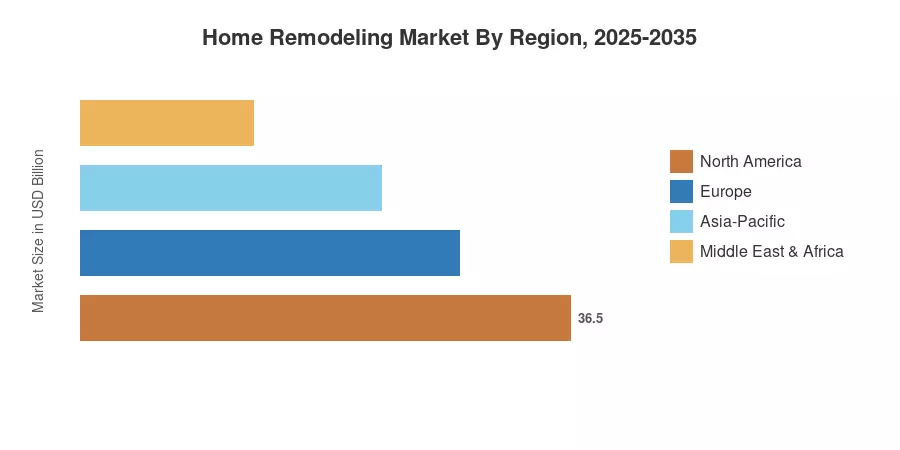
North America commands roughly 35% of the global home remodeling market, driven by high homeownership rates and robust contractor infrastructure. Asia-Pacific is the fastest-growing region with a projected CAGR near 5.4%, fueled by urbanization in China, India, and Southeast Asia. Europe holds approximately 27% share, supported by stringent energy-efficiency mandates and green building incentives. The next decade will reward players who blend digital design platforms with sustainable material supply chains


Key Report Takeaways

• By Project Type

  • Professional remodeling accounts for roughly 62% of the home remodeling market, reflecting homeowner preference for licensed residential remodeling contractors on high-value structural work
  • DIY home remodeling projects are growing at a CAGR of approximately 5.1%, boosted by online tutorial ecosystems and big-box retailer tool-rental programs

• By Application

  • Kitchen and bathroom renovation remains the highest-revenue application segment, valued at over USD 31 trillion in 2025
  • Windows and Doors is the fastest-growing application subsegment in the home remodeling market, registering a CAGR near 5.3%

• By Region

  • North America leads with a 35% share, underpinned by USD 4.2 trillion in annual spending on home improvement and repair
  • Asia-Pacific is projected to add over USD 18 trillion in incremental value through 2035


Market Size and Forecast (2021–2035)

MRFR's market sizing draws on primary interviews with residential remodeling contractors, distributor channel audits, government housing statistics, and proprietary demand modeling calibrated against census and building-permit data across 42 countries.
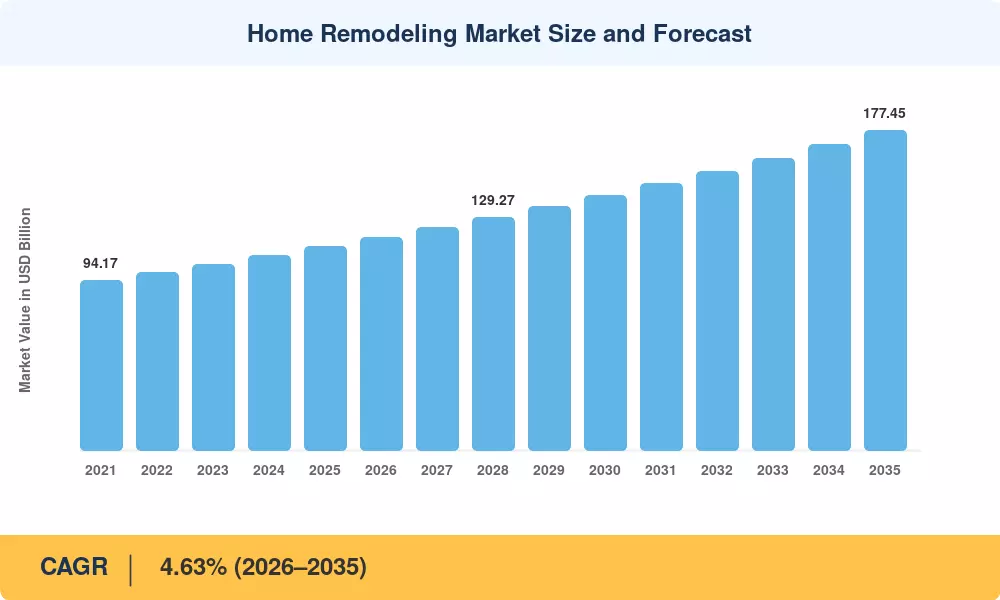
Home Remodeling Market Size and Forecast
Our Impact
Enabled $4.3B Revenue Impact for Fortune 500 and Leading Multinationals
Partnering with 2000+ Global Organizations Each Year
30K+ Citations by Top-Tier Firms in the Industry
 

Driver Impact Analysis

Driver ~% Impact on CAGR Geographic Relevance Impact Timeline
Aging housing stock +0.9% North America, Europe Long-term (≥4 yr)
Rising disposable income in emerging markets +0.8% Asia-Pacific, South America Medium-term (2–4 yr)
Energy-efficiency regulations +0.7% Europe, North America Medium-term (2–4 yr)
Smart home technology integration +0.5% Global Short-term (≤2 yr)
Urbanization and smaller living spaces +0.4% Asia-Pacific, MEA Long-term (≥4 yr)
E-commerce distribution channel expansion +0.3% Global Short-term (≤2 yr)
Remote work-driven home office upgrades +0.3% North America, Europe Short-term (≤2 yr)


Aging Housing Stock and Renovation Backlogs

About 34% of owner-occupied homes in the US were constructed before 1970, and about 47% of them were constructed before 1980. Renovations are desperately needed, since the typical age of owner-occupied residences has risen to 42. The average homeowner faces substantial annual maintenance costs—surpassing $8,800 annually in 2026—with older homes (pre-1980) incurring up to four times higher first-year maintenance costs than newer builds, even though there is no definitive $1.6 trillion figure for single-family housing deferred maintenance specifically. As aging systems approach the end of their useful lives, this generates a persistent, multibillion-dollar need for structural, plumbing, and electrical overhauls.


Energy-Efficiency Mandates Driving Retrofit Spending

A progressive decarbonization trajectory is required by the EU's Energy Performance of Buildings Directive (recast 2024/1275), not a single-target restoration of the "worst 15%." Member states are now expected to cut the average primary energy use of residential buildings by 16% by 2030 and 20–22% by 2035. The worst-performing 43% of the residential stock must account for at least 55% of these energy reductions. The HEEHRA (High-Efficiency Electric Home Rebate Act) of the Inflation Reduction Act in the United States offers income-qualified owners up to $14,000 per household for certain electrification projects (such as heat pumps, electrical panel upgrades, and weatherization), directly boosting the residential remodeling and weatherization industries.


Smart Home Technology as a Renovation Catalyst

In 2026, shipments of smart home devices are expected to reach 1.25 billion units worldwide, with a household penetration rate of more than 51% in the United States. Smart technology integration is becoming more and more common in complete kitchen and bathroom renovations; it is no longer a luxury. Voice-activated lighting, AI-integrated appliances, and smart water management systems are examples of connected fixtures that are becoming an essential part of contemporary remodeling. These fixtures can increase project costs by 12–18% while providing homeowners with improved energy monitoring and convenience.


Restraints Impact Analysis

Restraint impact percentages are directional estimates and do not sum algebraically with the drivers listed in Section 4.

Restraint ~% Impact on CAGR Geographic Relevance Impact Timeline
Skilled labor shortages –0.6% North America, Europe Long-term (≥4 yr)
Material price volatility –0.5% Global Medium-term (2–4 yr)
High interest rates are suppressing discretionary spending –0.4% North America, Europe Short-term (≤2 yr)
Permitting and regulatory complexity –0.3% Europe, Asia-Pacific Medium-term (2–4 yr)
Supply chain disruptions –0.2% Global Short-term (≤2 yr)


Skilled Labor Shortage Constraining Project Throughput

Although the causes of this shortfall have changed to include an aging workforce, the construction industry still faces a severe labor shortage. According to the Associated Builders and Contractors (ABC), in order to meet project demand, the U.S. construction sector would need to hire about 349,000 net new workers by 2026. Since almost 20% of the construction workforce is currently 55 years of age or older, this shortage is caused by a big wave of retirements rather than just the expansion of the business. This shortfall has turned into a structural bottleneck for residential remodelers, regularly causing project timeframes to be extended by 20–30% and compelling businesses to raise wages in order to attract top personnel. Over 250,000 skilled jobs are still unfilled in Germany, another country in Europe that is experiencing a persistent labor crisis. This has increased competition for workers in the construction industry.


Material Price Volatility Squeezing Margins

Lumber, copper, and gypsum prices swung by 15–40% between 2022 and 2024, complicating home renovation costs and planning for both contractors and homeowners [5]. While prices have partially normalized, the home remodeling market remains exposed to sudden cost spikes tied to geopolitical disruptions and tariff adjustments affecting imported materials.


Home Remodeling Market Opportunities

Sustainable and Green Remodeling Practices

Sustainability has evolved from a niche interest to a competitive need. Reclaimed resources and low-VOC finishes are examples of high-performance, healthy materials that homeowners are increasingly ready to pay a 10–15% premium for. Professional certification is now what drives market distinction; projects accredited under the LEED Residential or ENERGY STAR frameworks act as "quality signals" that assist contractors in defending higher profits in a cutthroat market.


Digital Platforms Enabling DIY Home Remodeling Projects

The spread of AI-driven design tools has significantly reduced the barrier to entry for house remodeling. 2026 systems, in contrast to previous static room planners, use Generative AI to rapidly produce photorealistic previews of renovations (such as wall and floor alterations) based on smartphone images. This technology, which integrates directly with e-commerce supply chains, has evolved from a novelty to a crucial conversion tool that closes the gap between digital inspiration and ultimate product purchase.


Emerging-Market Urbanization

India's urban housing shortage stood at 18.7 million units as of 2024, and China's government-backed urban renewal initiative targets renovation of 52,000 older neighborhoods through 2027 [10]. These programs unlock multi-trillion-dollar demand pools for home improvement and repair services, particularly in kitchen and bathroom renovation and structural safety upgrades

Data-Driven Contractor Matching and Fintech Integration

Platforms that combine AI-based contractor matching with embedded home renovation cost and planning financing — point-of-sale loans, HELOC integrations — are redefining how consumers procure remodeling services. This digital intermediation layer captures 3–5% transaction fees and creates recurring data-monetization revenue streams


Home Remodeling Market Future Outlook

AI-Powered Design and Project Management

Generative AI tools will compress the design-to-permit cycle from weeks to days. Automated permit-filing systems are already being piloted in California and the Netherlands, and AI-based cost estimators are improving home renovation cost and planning accuracy by 25–30% compared to manual methods [16]. By 2030, AI copilots will manage material procurement, schedule subcontractors, and flag code-compliance issues in real time across the home remodeling market.

Platform Economics and Contractor Aggregation

Marketplace platforms connecting homeowners with residential remodeling contractors are consolidating fragmented local supply. Companies capturing 15–20% of regional transaction volume can leverage data to offer embedded insurance, financing, and warranty products — transforming the home remodeling market from a project-based industry into a recurring-revenue platform economy

Electrification and Decarbonization Retrofits

The global push to electrify residential heating — through heat pump installations, solar panel integration, and EV charger provisioning — will inject an estimated USD 8 trillion in incremental renovation spending globally by 2035, per IEA projections [17]. This electrification wave makes home improvement and repair a frontline decarbonization sector.

Circular Economy and Material Reuse

Building-material reuse marketplaces and deconstruction-first renovation practices are moving from niche to mainstream. The Ellen MacArthur Foundation estimates that circular building practices could reduce construction waste by 50% by 2035 [18]. Residential remodeling contractors adopting material passports and salvage-first workflows will unlock cost savings and ESG-aligned branding advantages in the home remodeling market.


Home Remodeling Market Segmentation

By Project Type

Segment Key Metric Primary Demand Driver
Professional ~62% market share Complex structural and code-regulated projects
DIY (Do It Yourself) CAGR ~5.1% Online tutorials, tool rental programs


Professional remodeling dominates the home remodeling market because high-value projects — whole-kitchen overhauls, roof replacements, electrical system upgrades — require licensed residential remodeling contractors and permitting expertise. Homeowner insurance requirements and municipal codes effectively mandate professional involvement in structural work. DIY home remodeling projects, however, represent the faster-growing segment as younger homeowners leverage YouTube-driven skill acquisition and big-box retailers expand tool-rental and project-support programs. The DIY channel is particularly strong for cosmetic upgrades: painting, backsplash tiling, and fixture swaps.

By Distribution Channel

Segment Key Metric Primary Demand Driver
Offline USD ~81 Trillion (2025) In-store consultation, material inspection
Online CAGR ~6.3% E-commerce convenience, wider selection


Offline distribution still accounts for the majority of material purchases in the home remodeling market, as homeowners prefer to see, touch, and compare finishes in person. Online channels are growing rapidly, driven by platforms offering home renovation cost and planning calculators, 3D room visualizers, and next-day delivery for standard materials [11].

By Application

Segment Key Metric Primary Demand Driver
Kitchen and Bathroom ~28% market share Highest ROI renovation category
Windows and Doors CAGR ~5.3% Energy-efficiency regulations
Floor and Roof USD ~22 Trillion (2025) Structural maintenance cycles
Walls ~14% market share Aesthetic upgrades, insulation retrofits
Other Applications CAGR ~4.2% Smart home, outdoor living spaces


Kitchen and bathroom renovation generates the highest per-project spend and strongest resale-value uplift in the home remodeling market, making it the most commercially significant application segment. According to the sources, mid-range kitchen remodels recover 75% of their cost at resale [19]. Windows and Doors is the fastest-growing application, propelled by energy-performance mandates in Europe and North America that require homeowners to upgrade single-pane units to double- or triple-glazed alternatives.


Regional Market Share Analysis

Region Market Share (2025) Primary Investment Themes
North America ~35% Aging housing stock, energy retrofits
Europe ~27% Green building mandates, renovation wave
Asia-Pacific ~24% Urbanization, rising middle class
South America ~8% Social housing upgrades, urban densification
Middle East & Africa ~6% Luxury residential, hospitality-adjacent remodeling
Total 100%

The home remodeling market exhibits pronounced regional variation shaped by housing age, income levels, regulatory frameworks, and cultural attitudes toward residential remodeling contractors.


North America

Country Key Metric Key Driver
US ~78% of regional share Deferred maintenance backlog, IRA rebates
Canada CAGR ~4.5% Climate-driven insulation and window upgrades
Mexico USD ~3.1 Trillion (2025) Middle-class expansion, urban densification


North America's dominance in the home remodeling market stems from a combination of high homeownership rates (65.5% in the U.S.), substantial housing age, and well-established financing instruments such as HELOCs and FHA 203(k) renovation loans. The U.S. home improvement and repair segment alone generated over USD 30 trillion in 2024, with kitchen and bathroom renovation commanding the largest project share.

Europe

Country Key Metric Key Driver
Germany ~22% of regional share Energiewende building renovation targets
UK CAGR ~4.3% Victorian-era housing retrofit demand
France USD ~4.8 Trillion (2025) MaPrimeRénov' subsidy program
Italy ~14% of regional share Superbonus 110% legacy incentives
Spain CAGR ~4.1% Tourism-driven property upgrades
Nordic Countries ~8% of regional share Passive-house construction standards
Russia USD ~2.3 Trillion (2025) Urban apartment refurbishment
Rest of Europe CAGR ~3.9% EU Renovation Wave spillover


Europe's home remodeling market benefits from aggressive policy mandates; France's MaPrimeRénov' program disbursed over EUR 5 billion in renovation grants between 2020 and 2024, while Germany's KfW development bank financed energy-efficient home improvement and repair projects worth EUR 12 billion annually. These incentives create floor-level demand that insulates the region from cyclical downturns.

Asia-Pacific

Country Key Metric Key Driver
China ~42% of regional share Government-backed neighborhood renewal
India CAGR ~6.2% Urban housing shortage, rising incomes
Japan USD ~3.9 Trillion (2025) An aging population and barrier-free home conversions
South Korea ~9% of regional share Jeonse-to-ownership shift driving renovations
ASEAN CAGR ~5.7% Middle-class growth, hotel-to-residential conversions
Rest of Asia-Pacific USD ~1.4 Trillion (2025) Developing infrastructure


Asia-Pacific represents the fastest-growing opportunity in the home remodeling market. China's 14th Five-Year Plan committed CNY 5.3 trillion to urban renewal, while India's Pradhan Mantri Awas Yojana and associated schemes are driving demand for residential remodeling contractors in tier-2 and tier-3 cities. DIY home remodeling projects are also gaining popularity across the region as e-commerce platforms like Taobao and Flipkart expand their building-materials categories.

South America

Country Key Metric Key Driver
Brazil ~58% of regional share Social housing upgrades, Minha Casa Minha Vida
Argentina CAGR ~4.0% Currency-driven renovation-as-investment
Rest of South America USD ~1.6 Trillion (2025) Urban densification


Brazil dominates the South American home remodeling market, where government social housing programs create a secondary renovation cycle as residents customize standardized units. Home renovation cost and planning tools are gaining traction through mobile-first platforms targeting lower-income homeowners.

Middle East & Africa

Country Key Metric Key Driver
Saudi Arabia ~30% of regional share Vision 2030 residential diversification
UAE CAGR ~5.1% Luxury villa and apartment refurbishments
South Africa USD ~1.1 Trillion (2025) Urban renewal programs
Egypt CAGR ~4.6% New capital city spillover renovations
Rest of MEA ~22% of regional share Hospitality and tourism-linked renovations


The MEA home remodeling market is bifurcated: Gulf states invest heavily in luxury-tier kitchen and bathroom renovation and smart home integrations, while North and Sub-Saharan Africa see growth centered on basic home improvement and repair and structural upgrades funded through public housing programs.


Home Remodeling Market By Region, 2025-2035
 

Competitive Benchmarking

The home remodeling market is moderately fragmented; the top five players collectively hold an estimated 18–22% revenue share. A long tail of regional and local residential remodeling contractors accounts for the majority of project volume. Market concentration (estimated HHI below 500) reflects low barriers to entry at the local level, though scale advantages in procurement and digital platforms are gradually consolidating the industry.

Company Est. Revenue Share Range Key Offerings Strategic Positioning
The Home Depot ~5–7% Retail materials, installation services, and project financing Omnichannel home improvement and repair leader
Lowe's Companies ~4–6% Retail, contractor sales, digital design tools National-scale DIY and pro-contractor supply
IKEA ~2–4% Modular kitchen and bathroom renovation systems Affordable design-led remodeling solutions
Andersen Corporation ~2–3% Windows, doors, building materials Premium fenestration specialist
Masco Corporation ~2–3% Cabinetry, plumbing, coatings (Behr, Delta) Multi-brand renovation portfolio
Ferguson Enterprises ~1–3% Plumbing, HVAC, lighting distribution B2B and B2C distribution network
Kohler Co. ~1–2% Kitchen and bath fixtures, smart home products Premium fixtures and connected bath technology
Pella Corporation ~1–2% Windows, doors, patio enclosures Energy-efficient fenestration
ABC Supply Co. ~1–2% Roofing, siding, and windows distribution Contractor-facing wholesale distribution
Shaw Industries (Berkshire Hathaway) ~1–2% Flooring products, sustainable materials Vertically integrated flooring manufacturer


Recent News & Developments

  • The Home Depot (March 2025): Launched a national same-day delivery program for building materials, expanding its residential remodeling contractors' support ecosystem [20].


  • K-Designers (October 2023): K-Designers, a remodeling contractor based in California, was successfully acquired by Great Day Improvements, LLC, a well-known DTC home remodeling company, expanding its brand portfolio. K-Designers, one of the best renovation companies in the US, specializes in improving curb appeal with services including siding, windows, patios, doors, and bathroom remodeling. Great Day Improvements is able to maintain its growth trajectory, strengthen its position in the western U.S., and make a major entry into the California renovation market thanks to this calculated move.
  • Sunset Ridge Ecoline Exteriors Corporation (April 2023): Sunset Ridge Ecoline Exteriors Corporation, a Wisconsin-based business located in the McFarland region, was acquired by M&M HVAC Services. This acquisition demonstrates M&M's steadfast dedication to carrying out its strategic plan and aggressively looking for opportunities for development, growth, and expansion throughout the United States.


Home Remodeling Market Report Scope

Parameter Detail
Market Scope Global home remodeling market covering materials, labor services, and design platforms
Study Period 2021–2035
CAGR (Forecast) 4.63% (2026–2035)
Base Year Market Size USD 112.86 Trillion (2025)
Forecast Endpoint USD 177.45 Trillion (2035)
Fastest Growing Segment Online distribution channel (CAGR ~6.3%)
Companies Profiled 10
Valuation Currency USD (Trillion)


FAQs

How does the home remodeling market differ from the new-construction housing market in investment risk profile?

Remodeling demand is less cyclical than new construction because it is driven by maintenance needs and lifestyle upgrades rather than land acquisition and speculative development. The home remodeling market historically declines only 3–5% during recessions versus 15–25% for new housing starts [2].

What financing mechanisms are most commonly used by homeowners for large-scale kitchen and bathroom renovation projects?

HELOCs and cash-out refinancing remain the primary vehicles, though point-of-sale renovation loans embedded in contractor platforms are growing rapidly. Unsecured personal loans now account for roughly 18% of financed home improvement and repair projects in the U.S. [7].

How are residential remodeling contractors adapting their business models to address labor shortages in the home remodeling market?

Leading contractors are investing in prefabricated and modular components that shift labor from on-site assembly to factory production. Some firms report 30–40% reductions in on-site labor hours by pre-assembling cabinetry, countertops, and wall panels off-site [13].

What role does building code compliance play in shaping DIY home remodeling projects versus professional remodeling decisions?

Electrical, plumbing, and structural work typically requires licensed permits that exclude DIY execution in most U.S. and European jurisdictions. This regulatory boundary channels roughly 60% of the total project value toward professional residential remodeling contractors [14].

How are sustainability certifications influencing material selection within the home remodeling market?

LEED and ENERGY STAR certifications are shifting demand toward low-VOC adhesives, recycled-content countertops, and FSC-certified lumber. Certified green materials now command a 10–15% price premium but deliver measurable utility-cost savings within three years [15].

What impact does home renovation cost and planning software have on project completion rates in the home remodeling market?

Digital planning tools reduce budget overruns by approximately 20% and cut project abandonment rates by half, according to surveys. Homeowners using 3D visualization and cost-estimating platforms report higher satisfaction and fewer change orders during construction [16].

How do distribution channel dynamics differ between the online and offline segments of the home remodeling market?

Offline channels capture the majority of high-touch materials like custom cabinetry and natural stone, where tactile evaluation drives purchase decisions. Online channels dominate standardized commodities — paint, hardware, lighting — where price transparency and home delivery create a convenience advantage [11].


FAQs

What is the current valuation of the Home Remodeling Market?

The Home Remodeling Market was valued at 505.58 USD Billion in 2024.

What is the projected market size for the Home Remodeling Market by 2035?

The market is projected to reach 776.84 USD Billion by 2035.

What is the expected CAGR for the Home Remodeling Market from 2025 to 2035?

The expected CAGR for the Home Remodeling Market during the forecast period 2025 - 2035 is 3.98%.

Which segments are leading in the Home Remodeling Market?

Kitchen Remodeling and Bathroom Remodeling are among the leading segments, with valuations of 100.0 to 150.0 USD Billion and 80.0 to 120.0 USD Billion, respectively.

What are the primary purposes driving home remodeling projects?

The primary purposes include increased property value, functional upgrades, and aesthetic enhancements, with valuations ranging from 101.12 to 185.0 USD Billion.

What materials are predominantly used in home remodeling?

Wood and metal are the predominant materials, with valuations of 100.0 to 150.0 USD Billion and 80.0 to 120.0 USD Billion, respectively.

What budget ranges are most common for home remodeling projects?

The most common budget ranges include $10,000 - $25,000 and $25,000 - $50,000, with valuations of 100.0 to 150.0 USD Billion and 150.0 to 250.0 USD Billion.

How long do home remodeling projects typically take?

Home remodeling projects typically take 1-2 months to 2-6 months, with valuations of 100.0 to 150.0 USD Billion and 150.0 to 250.0 USD Billion.

Who are the key players in the Home Remodeling Market?

Key players include Lowe's, Home Depot, IKEA, Masco Corporation, and PulteGroup, among others.

What trends are influencing the Home Remodeling Market in 2025?

Trends include a focus on energy efficiency and aesthetic enhancements, reflecting consumer preferences for sustainable and visually appealing spaces.
Author
Author
Author Profile
Pradeep Nandi LinkedIn
Senior Research Analyst
I have a bachelor's degree in mechanical engineering and an MBA. I have more than two years of expertise in the retail, food, and beverage, chemical, and material industries, and hence have developed a sound cross-domain expertise. A firm believer in lifelong learning and sharing of knowledge. Having a proclivity for hatching ideas and trying to absorb as much information as possible in a short amount of time. Introducing corporates to the data and insight, which enables them to move from probability to possibility, has been my key areas of interest. 

Research Approach


Secondary Research

The secondary research process involved comprehensive analysis of regulatory databases, industry publications, construction trade journals, housing market reports, and authoritative economic organizations. Key sources included the US Census Bureau (Construction Spending & Housing Statistics), US Department of Housing and Urban Development (HUD), National Association of Home Builders (NAHB), National Association of the Remodeling Industry (NARI), National Kitchen and Bath Association (NKBA), Joint Center for Housing Studies of Harvard University (JCHS), Bureau of Labor Statistics (Construction Labor Data), US Energy Information Administration (EIA), Environmental Protection Agency (EPA) Green Building Standards, European Construction Industry Federation (FIEC), Eurostat Construction Statistics, UK Office for National Statistics (Housing Data), China's National Bureau of Statistics (Real Estate Data), India Ministry of Housing and Urban Affairs, International Monetary Fund (IMF) Housing Market Indicators, World Bank Urban Development Indicators, and OECD Affordable Housing Database.

Construction spending data, housing stock statistics, building permit approvals, material cost indices, labor market trends, and regulatory landscape analysis were gathered from these sources for projects involving kitchen and bathroom renovations, outdoor living areas, basement finishing, and whole-home renovations.


Primary Research

In order to gather both qualitative and quantitative insights, supply-side and demand-side stakeholders were interviewed during the primary research process. CEOs, VPs of business development, procurement directors, and regional directors from general contracting companies, construction material manufacturers, home improvement merchants, and specialist remodeling contractors were examples of supply-side sources. Homeowners, real estate investors, interior designers, architects, and facilities managers from the residential, commercial, and multi-family housing sectors made up demand-side sources. Primary research obtained information on consumer spending trends, changes in material preferences, contractor pricing strategies, and the adoption of financing mechanisms. It also validated market segmentation and confirmed renovation pipeline timescales.

Primary Respondent Breakdown:

By Designation: C-level Primaries (28%), Director Level (35%), Others (37%)

By Region: North America (32%), Europe (30%), Asia-Pacific (28%), Rest of World (10%)


Market Size Estimation

Global market valuation was derived through revenue mapping and project volume analysis. The methodology included:

Identification of 60+ key manufacturers and service providers across North America, Europe, Asia-Pacific, Latin America, and Middle East & Africa

Product mapping across kitchen systems, bathroom fixtures, flooring materials, smart home technologies, sustainable building materials, and outdoor living products

Analysis of reported and modeled annual revenues specific to home remodeling portfolios

Coverage of manufacturers and retailers representing 75-80% of global market share in 2024

Extrapolation using bottom-up (project volume × average spend by region and remodeling type) and top-down (retailer/contractor revenue validation) approaches to derive segment-specific valuations for kitchen remodeling, bathroom renovation, living room upgrades, basement finishing, and outdoor space enhancements

Download Free Sample

Kindly complete the form below to receive a free sample of this Report

Download PDF ×

We do not share your information with anyone. However, we may send you emails based on your report interest from time to time. You may contact us at any time to opt-out.
















