Download Free Sample
Kindly complete the form below to receive a free sample of this Report
Hospital Facility Maintenance Services Market Research Report By End User (Hospitals, Clinics, Nursing Homes, Rehabilitation Centers, Urgent Care Facilities), By Service Type (Preventive Maintenance, Corrective Maintenance, Predictive Maintenance, Facility Management, Energy Management), By Contract Type (Outsourced Services, In-House Services, Service Level Agreements, Time and Material Contracts, Fixed Price Contracts) And By Region (North America, Europe, Asia-Pacific, And Rest Of The World) – Market Forecast Till 2035.
As per MRFR analysis, the Hospital Facility Maintenance Services Market was estimated at 25.0 USD Billion in 2024. The Hospital Facility Maintenance Services industry is projected to grow from 25.97 USD Billion in 2025 to 38.0 USD Billion by 2035, exhibiting a compound annual growth rate (CAGR) of 3.88% during the forecast period 2025 - 2035.
The Hospital Facility Maintenance Services Market is experiencing a transformative shift driven by technological advancements and sustainability initiatives.
| 2024 Market Size | 25.0 (USD Billion) |
| 2035 Market Size | 38.0 (USD Billion) |
| CAGR (2025 - 2035) | 3.88% |
Sodexo (FR), Aramark (US), ISS Facility Services (DK), Cushman & Wakefield (US), CBRE Group (US), GDI Integrated Facility Services (CA), Compass Group (GB), HSS (US), ABM Industries (US)
Our Impact
Enabled $4.3B Revenue Impact for Fortune 500 and Leading Multinationals
Partnering with 2000+ Global Organizations Each Year
30K+ Citations by Top-Tier Firms in the Industry
The Hospital Facility Maintenance Services Market is currently experiencing a transformative phase, driven by the increasing emphasis on operational efficiency and regulatory compliance within healthcare institutions. As hospitals strive to enhance patient care and safety, the demand for specialized maintenance services has escalated. This market encompasses a wide array of services, including preventive maintenance, emergency repairs, and facility management, all aimed at ensuring that healthcare environments remain functional and safe. Moreover, the integration of advanced technologies, such as IoT and automation, appears to be reshaping service delivery, potentially leading to improved resource management and reduced operational costs. In addition, sustainability initiatives are gaining traction within the Hospital Facility Maintenance Services Market. Healthcare facilities are increasingly prioritizing eco-friendly practices, which may influence the selection of maintenance providers. This shift towards sustainability not only aligns with broader environmental goals but also enhances the reputation of healthcare institutions. As the market evolves, stakeholders must remain vigilant to emerging trends and adapt their strategies accordingly, ensuring they meet the dynamic needs of the healthcare sector.
The incorporation of advanced technologies, such as Internet of Things (IoT) and automation, is becoming prevalent in the Hospital Facility Maintenance Services Market. These innovations facilitate real-time monitoring and predictive maintenance, potentially enhancing operational efficiency and reducing downtime.
A growing emphasis on sustainability is evident within the Hospital Facility Maintenance Services Market. Healthcare facilities are increasingly adopting eco-friendly practices, which may influence maintenance service providers to align their offerings with environmental standards and regulations.
The Hospital Facility Maintenance Services Market is witnessing heightened scrutiny regarding regulatory compliance. As healthcare regulations evolve, maintenance service providers must ensure that their practices meet the latest standards, thereby safeguarding patient safety and institutional integrity.
Regulatory and compliance pressures are significant drivers of the Hospital Facility Maintenance Services Market. Healthcare facilities are subject to stringent regulations regarding safety, cleanliness, and operational standards. Compliance with these regulations is essential to avoid penalties and ensure accreditation. As regulatory bodies continue to evolve their standards, hospitals must adapt their maintenance practices accordingly. This creates a consistent demand for facility maintenance services that can help hospitals meet these requirements. The market for compliance-related services is projected to grow, as facilities increasingly seek expert assistance in navigating complex regulations. Consequently, the Hospital Facility Maintenance Services Market is likely to benefit from this ongoing need for compliance-driven maintenance solutions.
The increasing demand for healthcare services is a primary driver of the Hospital Facility Maintenance Services Market. As populations age and chronic diseases become more prevalent, healthcare facilities are experiencing heightened patient volumes. This surge necessitates efficient maintenance services to ensure that hospitals operate smoothly and safely. According to recent data, the healthcare sector is projected to grow at a compound annual growth rate of approximately 7.5% over the next few years. This growth translates into a greater need for facility maintenance services, as hospitals must maintain high standards of cleanliness, safety, and operational efficiency. Consequently, the Hospital Facility Maintenance Services Market is likely to expand in response to these evolving demands, creating opportunities for service providers to enhance their offerings and capabilities.
Patient safety and satisfaction are paramount in the healthcare sector, driving the Hospital Facility Maintenance Services Market. Hospitals are increasingly recognizing that well-maintained facilities contribute to better patient outcomes and experiences. Cleanliness, functionality, and safety of the environment are critical factors influencing patient satisfaction scores. Research indicates that hospitals with higher maintenance standards tend to report lower infection rates and improved patient feedback. As healthcare providers strive to enhance their reputations and meet regulatory requirements, the demand for comprehensive facility maintenance services is likely to rise. This focus on patient-centric care is expected to propel the Hospital Facility Maintenance Services Market forward, as facilities seek to invest in services that ensure a safe and welcoming environment for patients.
Sustainability initiatives are becoming increasingly important within the Hospital Facility Maintenance Services Market. Hospitals are recognizing the need to reduce their environmental impact and are implementing green practices in their operations. This includes energy-efficient systems, waste reduction strategies, and sustainable materials in facility maintenance. The push for sustainability is not only driven by regulatory requirements but also by patient and community expectations. Research indicates that healthcare facilities that adopt sustainable practices can enhance their public image and potentially reduce operational costs. As a result, the demand for maintenance services that align with sustainability goals is expected to grow. This trend suggests that the Hospital Facility Maintenance Services Market will continue to evolve, with service providers adapting their offerings to meet the needs of environmentally conscious healthcare organizations.
Technological advancements are reshaping the Hospital Facility Maintenance Services Market. The integration of smart technologies, such as Internet of Things (IoT) devices and predictive maintenance software, is revolutionizing how hospitals manage their facilities. These innovations enable real-time monitoring of equipment and infrastructure, allowing for proactive maintenance that minimizes downtime and reduces costs. For instance, predictive analytics can identify potential failures before they occur, thereby enhancing operational efficiency. The market for smart healthcare technologies is expected to grow significantly, with estimates suggesting a valuation of over 200 billion dollars by 2026. This trend indicates that hospitals are increasingly investing in advanced maintenance solutions, which in turn drives the demand for specialized facility maintenance services.
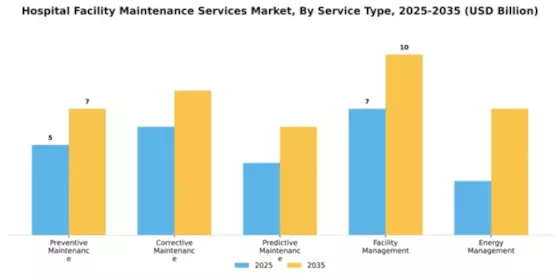
The Hospital Facility Maintenance Services Market is characterized by a strong emphasis on Preventive Maintenance, which holds the largest market share. This proactive approach ensures that hospital facilities operate efficiently and helps anticipate maintenance needs before they escalate into significant issues. Following closely is Corrective Maintenance, which addresses immediate issues as they arise. Predictive Maintenance is emerging as a notable competitor with the integration of advanced technologies, driving its growth amidst rising demand for efficient resource management.
Preventive Maintenance (Dominant) vs. Predictive Maintenance (Emerging)
Preventive Maintenance is currently the dominant service type within the Hospital Facility Maintenance Services Market, characterized by its systematic approach to regular maintenance checks. This method minimizes the risk of operational disruptions, making it essential for ensuring consistent healthcare services. Conversely, Predictive Maintenance is an emerging service that leverages data analytics and IoT technologies to foresee maintenance needs, thus optimizing resource allocation. As hospitals continue to seek efficient solutions to manage their facilities, Predictive Maintenance is gaining traction, showcasing its innovative capability in maximizing uptime and reducing unexpected costs.
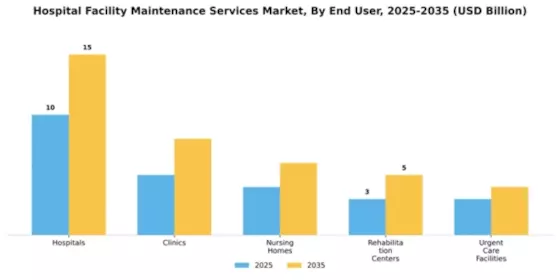
The Hospital Facility Maintenance Services Market is predominantly driven by the hospital segment, which accounts for the largest share. Hospitals require extensive maintenance services due to their size, intricate systems, and the critical need for operational efficiency and patient safety. Following closely, clinics represent a significant portion of the market as well, driven by their increasing prevalence and the rising focus on outpatient services, which demand reliable maintenance solutions to ensure smooth operations. In recent years, the growth dynamics within this market segment have been influenced by multiple factors. The demand for sophisticated facility management from hospitals continues to grow, propelled by technological advancements and regulatory compliance requirements. Conversely, the clinic segment is experiencing rapid growth, attributed to the shift toward outpatient care. This trend reflects changing patient preferences and the need for accessible healthcare services, all of which accentuate the importance of effective facility maintenance services.
Hospitals (Dominant) vs. Nursing Homes (Emerging)
Hospitals serve as the cornerstone of the healthcare system, requiring comprehensive facility maintenance services to ensure uninterrupted operations, stringent compliance with health regulations, and optimal patient care environments. Their dominant position in the market is characterized by the complexity of their infrastructure, which includes advanced medical equipment and specialized functional areas. In contrast, nursing homes are emerging as a vital segment, driven by the growing elderly population and increased demand for long-term care. While they may require less extensive services than hospitals, nursing homes prioritize maintaining safe, clean, and comfortable environments for residents. As their significance grows, facility maintenance strategies tailored for nursing homes are being developed to enhance operational efficiency and quality of care.
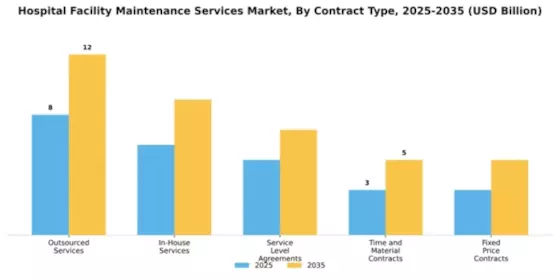
In the Hospital Facility Maintenance Services Market, the contract type segment is characterized by a diverse range of options, including Outsourced Services, In-House Services, Service Level Agreements, Time and Material Contracts, and Fixed Price Contracts. Among these, Outsourced Services dominate the market due to their efficiency and cost-effectiveness in managing hospital facilities. Meanwhile, Service Level Agreements are experiencing rapid growth as healthcare facilities increasingly focus on enhancing service quality and operational reliability, creating a competitive environment among service providers.
Outsourced Services (Dominant) vs. Service Level Agreements (Emerging)
Outsourced Services have established themselves as the dominant contract type in the Hospital Facility Maintenance Services Market, largely due to their capacity to offer specialized expertise and resource allocation, positioning hospitals to better manage their maintenance needs. These services enable healthcare organizations to reduce operational burdens and focus on core functions while ensuring facility standards are met. On the other hand, Service Level Agreements are emerging as a significant trend, driven by the requirement for measurable service performance and accountability. These agreements provide clear expectations and metrics, thus enhancing customer satisfaction and fostering long-term partnerships between hospitals and service providers.
Get more detailed insights about Hospital Facility Maintenance Services Market Request Free Sample
North America leads the Hospital Facility Maintenance Services Market with a share of 12.5 in 2024. The growth is driven by increasing healthcare expenditures, technological advancements, and stringent regulatory requirements. The demand for efficient facility management is further fueled by the need for improved patient care and operational efficiency in hospitals. Regulatory catalysts, such as the Affordable Care Act, emphasize quality and safety, enhancing the market's growth potential. The competitive landscape in North America is robust, featuring key players like Aramark, Sodexo, and CBRE Group. The U.S. is the largest market, driven by a high number of healthcare facilities and a focus on maintaining high standards. Companies are increasingly adopting integrated facility management solutions to streamline operations and reduce costs. The presence of major players ensures a competitive environment, fostering innovation and service quality.
Europe's Hospital Facility Maintenance Services Market is valued at 7.5, reflecting a growing demand for specialized services. Factors such as an aging population, rising healthcare costs, and the need for compliance with health regulations are driving this growth. The European Union's focus on healthcare quality and safety standards further propels the market, encouraging investments in facility maintenance services to enhance operational efficiency and patient satisfaction. Leading countries in this region include Germany, France, and the UK, where the presence of major players like ISS Facility Services and Compass Group is notable. The competitive landscape is characterized by a mix of local and international firms, all vying for market share. The emphasis on sustainability and energy efficiency in facility management is also gaining traction, influencing service offerings and operational strategies.
The Asia-Pacific region, with a market size of 4.5, is witnessing rapid growth in Hospital Facility Maintenance Services. This growth is driven by increasing healthcare investments, urbanization, and a rising demand for quality healthcare services. Governments are implementing policies to enhance healthcare infrastructure, which is a significant catalyst for the market. The focus on improving hospital facilities aligns with the region's broader healthcare goals, making it a promising market for service providers. Countries like China, India, and Japan are leading the charge, with a growing number of healthcare facilities requiring maintenance services. The competitive landscape is evolving, with both local and international players entering the market. Key players such as GDI Integrated Facility Services and HSS are expanding their operations to meet the increasing demand, focusing on innovative solutions to enhance service delivery and operational efficiency.
The Middle East and Africa region, with a market size of 0.5, presents untapped opportunities in Hospital Facility Maintenance Services. The growth is primarily driven by increasing investments in healthcare infrastructure, particularly in countries like the UAE and South Africa. Government initiatives aimed at improving healthcare access and quality are significant catalysts for market expansion. The region's focus on modernizing healthcare facilities aligns with global trends, creating demand for specialized maintenance services. Leading countries in this region include the UAE and South Africa, where the healthcare sector is rapidly evolving. The competitive landscape is characterized by a mix of local and international firms, with key players like ABM Industries and Cushman & Wakefield establishing a presence. The emphasis on quality and compliance with international standards is shaping service offerings, making this region a focal point for future growth in facility maintenance services.
The Hospital Facility Maintenance Services Market is characterized by a competitive landscape that is increasingly shaped by innovation, sustainability, and digital transformation. Key players such as Sodexo (FR), Aramark (US), and ISS Facility Services (DK) are actively redefining their operational strategies to enhance service delivery and operational efficiency. For instance, Sodexo (FR) has focused on integrating advanced technology solutions to streamline facility management processes, thereby improving client satisfaction and operational performance. Similarly, Aramark (US) has emphasized sustainability initiatives, aiming to reduce its carbon footprint while enhancing service quality. These strategic orientations not only bolster their market positions but also collectively influence the competitive dynamics within the sector, fostering a climate of continuous improvement and adaptation.In terms of business tactics, companies are increasingly localizing their operations and optimizing supply chains to enhance responsiveness and efficiency. The market structure appears moderately fragmented, with several key players vying for market share. This fragmentation allows for a diverse range of service offerings, yet the collective influence of major companies like CBRE Group (US) and Compass Group (GB) is significant, as they leverage their extensive networks and resources to maintain competitive advantages.In November ISS Facility Services (DK) announced a strategic partnership with a leading technology firm to develop AI-driven maintenance solutions. This collaboration is poised to enhance predictive maintenance capabilities, thereby reducing downtime and operational costs for healthcare facilities. The strategic importance of this move lies in its potential to position ISS as a frontrunner in the integration of AI technologies within facility maintenance, aligning with broader industry trends towards automation and efficiency.In October Aramark (US) launched a new sustainability program aimed at reducing waste in hospital operations by 30% over the next five years. This initiative not only reflects a growing emphasis on environmental responsibility but also serves to attract clients who prioritize sustainability in their operational practices. The strategic significance of this program is underscored by the increasing demand for eco-friendly services in the healthcare sector, suggesting that Aramark is well-positioned to capitalize on this trend.In September CBRE Group (US) expanded its service offerings by acquiring a regional facility management company, thereby enhancing its market presence and service capabilities. This acquisition is strategically important as it allows CBRE to diversify its service portfolio and strengthen its competitive position in the market. Such moves indicate a trend towards consolidation among key players, which may reshape the competitive landscape in the coming years.As of December the competitive trends within the Hospital Facility Maintenance Services Market are increasingly defined by digitalization, sustainability, and the integration of advanced technologies such as AI. Strategic alliances are becoming more prevalent, enabling companies to leverage complementary strengths and enhance service delivery. Looking ahead, competitive differentiation is likely to evolve from traditional price-based competition towards a focus on innovation, technological advancement, and supply chain reliability. This shift underscores the necessity for companies to adapt and innovate continuously to maintain relevance in a rapidly changing market.



The Hospital Facility Maintenance Services Market is projected to grow at a 3.88% CAGR from 2025 to 2035, driven by technological advancements, regulatory compliance, and increasing healthcare infrastructure investments.
New opportunities lie in:
By 2035, the market is expected to be robust, reflecting sustained growth and innovation.
| MARKET SIZE 2024 | 25.0(USD Billion) |
| MARKET SIZE 2025 | 25.97(USD Billion) |
| MARKET SIZE 2035 | 38.0(USD Billion) |
| COMPOUND ANNUAL GROWTH RATE (CAGR) | 3.88% (2025 - 2035) |
| REPORT COVERAGE | Revenue Forecast, Competitive Landscape, Growth Factors, and Trends |
| BASE YEAR | 2024 |
| Market Forecast Period | 2025 - 2035 |
| Historical Data | 2019 - 2024 |
| Market Forecast Units | USD Billion |
| Key Companies Profiled | Sodexo (FR), Aramark (US), ISS Facility Services (DK), Cushman & Wakefield (US), CBRE Group (US), GDI Integrated Facility Services (CA), Compass Group (GB), HSS (US), ABM Industries (US) |
| Segments Covered | Service Type, End User, Contract Type |
| Key Market Opportunities | Integration of smart technologies for enhanced efficiency in Hospital Facility Maintenance Services Market. |
| Key Market Dynamics | Rising demand for advanced technology solutions drives innovation in hospital facility maintenance services and operational efficiency. |
| Countries Covered | North America, Europe, APAC, South America, MEA |
As of 2024, the market valuation stands at 25.0 USD Billion.
The market is expected to reach a valuation of 38.0 USD Billion by 2035.
The market is anticipated to grow at a CAGR of 3.88% from 2025 to 2035.
Facility Management is projected to reach a valuation of 10.0 USD Billion by 2035.
Preventive Maintenance is expected to reach 7.0 USD Billion, while Corrective Maintenance may reach 8.0 USD Billion by 2035.
Hospitals are projected to dominate the market with a valuation of 15.0 USD Billion by 2035.
Outsourced Services is projected to grow to 12.0 USD Billion by 2035.
In-House Services is expected to reach 9.0 USD Billion, which is lower than the projected 12.0 USD Billion for Outsourced Services by 2035.
Energy Management is expected to reach a valuation of 7.0 USD Billion by 2035.



Kindly complete the form below to receive a free sample of this Report

“This is really good guys. Excellent work on a tight deadline. I will continue to use you going forward and recommend you to others. Nice job”


“Thanks. It’s been a pleasure working with you, please use me as reference with any other Intel employees.”


“Thanks for sending the report it gives us a good global view of the Betaïne market.”


“Thank you, this will be very helpful for OQS.”


“We found the report very insightful! we found your research firm very helpful. I'm sending this email to secure our future business.”


“I am very pleased with how market segments have been defined in a relevant way for my purposes (such as "Portable Freezers & refrigerators" and "last-mile"). In general the report is well structured. Thanks very much for your efforts.”


“I have been reading the first document or the study, ,the Global HVAC and FP market report 2021 till 2026. Must say, good info! I have not gone in depth at all parts, but got a good indication of the data inside!”


“We got the report in time, we really thank you for your support in this process. I also thank to all of your team as they did a great job.”


“The Automotive 48V ECU Components Procurement Intelligence Study” was a complex project, but the Market Research Future (MRFR) team handled it with quality, agility, and customer-centricity. They delivered all requested data on time and within the agreed scope. The team, including Shubhendra Anand and Rahul Gotadki, was always readily available to clarify questions and swiftly implement necessary adjustments, driving the project to a successful conclusion within a very demanding timeframe.
I would also like to specifically commend Akshay Agarwal for his responsiveness and support at every stage—from our initial inquiry on May 6th through to final delivery on June 18th. His dedication made the entire process seamless.”



