×
Request Free Sample ×

Kindly complete the form below to receive a free sample of this Report

* Please use a valid business email

Leading companies partner with us for data-driven Insights

clients tt-cursor
Hero Background

Human Liver Model Market

ID: MRFR/HC/30540-HCR
100 Pages
Rahul Gotadki
October 2025

Human Liver Model Market Research Report By Model Type (In Vitro Liver Models, 3D Bioprinted Liver Models, Microfluidic Liver Models, Liver-on-a-Chip Models), By Application (Drug Discovery, Toxicology Testing, Disease Modeling, Regenerative Medicine, Personalized Medicine), By End User (Pharmaceutical Companies, Research Institutions, Biotechnology Companies, Contract Research Organizations), By Technology Utilized (Organ-on-a-chip Technology, Stem Cell Technology, Tissue Engineering), By Funding Source (Government Grants, Private Investmen... read more

Share:
Download PDF ×

We do not share your information with anyone. However, we may send you emails based on your report interest from time to time. You may contact us at any time to opt-out.

Human Liver Model Market  Infographic
Purchase Options

Human Liver Model Market Summary

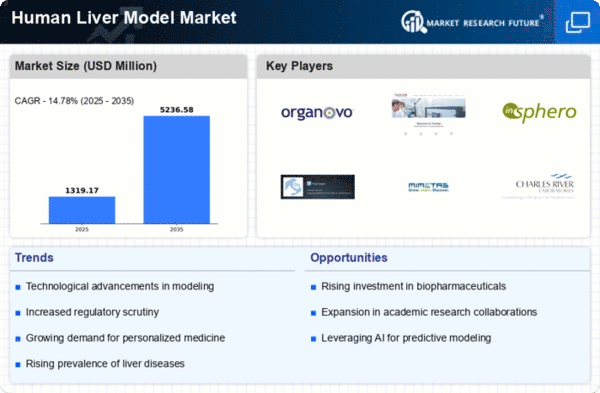
As per MRFR analysis, the Human Liver Model Market was estimated at 1149.3 USD Million in 2024. The Human Liver Model industry is projected to grow from 1319.2 in 2025 to 5236.58 by 2035, exhibiting a compound annual growth rate (CAGR) of 14.78 during the forecast period 2025 - 2035.

Key Market Trends & Highlights

The Human Liver Model Market is poised for substantial growth driven by technological advancements and increasing demand for personalized medicine.

  • Technological advancements in liver modeling are enhancing the accuracy and efficiency of drug discovery processes.
  • North America remains the largest market, while the Asia-Pacific region is emerging as the fastest-growing area for liver model applications.
  • The drug discovery segment dominates the market, whereas the toxicology testing segment is experiencing rapid growth.
  • Key market drivers include rising awareness of liver health and regulatory support for liver research.

Market Size & Forecast

2024 Market Size 1149.3 (USD Million)
2035 Market Size 5236.58 (USD Million)
CAGR (2025 - 2035) 14.78%

Major Players

Organovo Holdings Inc (US), TissUse GmbH (DE), InSphero AG (CH), Hepregen Corporation (US), Mimetas B.V. (NL), CellSystems Biotechnologie GmbH (DE), HepatoChem (US), Ncardia (NL)

Human Liver Model Market Trends

The Human Liver Model Market is currently experiencing a transformative phase, driven by advancements in biotechnology and a growing emphasis on ethical research practices. As the demand for more accurate and reliable preclinical testing methods increases, researchers and pharmaceutical companies are gravitating towards human liver models that can mimic the complex functions of the human liver. This shift is largely influenced by the need to reduce reliance on animal testing and to enhance the predictability of drug metabolism and toxicity assessments. Furthermore, the integration of innovative technologies, such as organ-on-a-chip systems and 3D bioprinting, is reshaping the landscape of liver modeling, offering unprecedented opportunities for drug discovery and development. In addition, the Human Liver Model Market is likely to benefit from the rising prevalence of liver diseases and the corresponding need for effective therapeutic solutions. As healthcare providers and researchers seek to understand the underlying mechanisms of liver disorders, the demand for sophisticated liver models that can facilitate this research is expected to grow. Collaborations between academic institutions and industry players are also becoming more common, fostering an environment of innovation and knowledge exchange. Overall, the Human Liver Model Market appears poised for substantial growth, driven by technological advancements and an increasing focus on personalized medicine, which may redefine the future of liver research and drug development.

Technological Advancements in Liver Modeling

Recent innovations in biotechnology, particularly in organ-on-a-chip systems and 3D bioprinting, are revolutionizing the Human Liver Model Market. These technologies enable the creation of more accurate and functional liver models that closely resemble human physiology, thereby enhancing the reliability of preclinical testing.

Ethical Considerations in Research

The growing emphasis on ethical research practices is influencing the Human Liver Model Market. As regulatory bodies and the public increasingly advocate for alternatives to animal testing, the demand for human liver models that provide reliable data without ethical concerns is likely to rise.

Rising Incidence of Liver Diseases

The increasing prevalence of liver diseases is driving the need for advanced research tools in the Human Liver Model Market. As healthcare professionals seek to develop effective treatments, the demand for sophisticated liver models that can aid in understanding disease mechanisms is expected to grow.

Human Liver Model Market Drivers

Market Growth Projections

The Global Human Liver Model Market Industry is poised for remarkable growth, with projections indicating a market value of 1.15 USD Billion in 2024 and an anticipated increase to 5.23 USD Billion by 2035. This growth trajectory suggests a compound annual growth rate of 14.77% from 2025 to 2035, highlighting the increasing adoption of human liver models across various sectors. The expansion is driven by factors such as advancements in biotechnology, regulatory support for alternative testing methods, and a growing focus on personalized medicine. These dynamics collectively indicate a robust future for the industry, as stakeholders recognize the critical role of human liver models in enhancing drug development processes.

Advancements in Biotechnology

Technological advancements in biotechnology are significantly influencing the Global Human Liver Model Market Industry. Innovations in 3D bioprinting and organ-on-a-chip technologies are enabling the creation of more accurate and functional liver models. These advancements not only enhance the predictive capabilities of liver models but also facilitate personalized medicine approaches. As a result, the market is expected to expand rapidly, with a projected value of 5.23 USD Billion by 2035. This growth indicates a robust interest in leveraging cutting-edge technologies to improve drug testing and disease modeling, ultimately leading to better therapeutic outcomes.

Rising Demand for Drug Development

The Global Human Liver Model Market Industry is experiencing a surge in demand driven by the increasing need for effective drug development processes. As pharmaceutical companies seek to reduce the high costs associated with drug failures, the adoption of human liver models for preclinical testing is becoming more prevalent. This shift is evidenced by the projected market value of 1.15 USD Billion in 2024, reflecting a growing recognition of the importance of human-relevant data in drug efficacy and safety assessments. Consequently, the industry is likely to witness substantial growth as more organizations integrate these models into their research frameworks.

Emerging Markets and Global Expansion

Emerging markets are playing a pivotal role in the expansion of the Global Human Liver Model Market Industry. Countries in Asia-Pacific and Latin America are increasingly investing in biopharmaceutical research, creating new opportunities for human liver model applications. As these regions enhance their research capabilities, the demand for innovative testing methods is expected to rise. This trend is likely to contribute to the overall market growth, with projections indicating a compound annual growth rate of 14.77% from 2025 to 2035. The global expansion of the industry reflects a broader recognition of the value of human liver models in drug development and safety assessment.

Growing Focus on Personalized Medicine

The Global Human Liver Model Market Industry is benefiting from the increasing emphasis on personalized medicine. As healthcare moves towards tailored therapies, the demand for human liver models that can accurately predict individual responses to drugs is rising. These models provide critical insights into drug metabolism and toxicity, which are essential for developing personalized treatment plans. The market's growth trajectory suggests that by 2035, it could reach 5.23 USD Billion, reflecting the industry's adaptation to the evolving landscape of precision medicine. This trend indicates a shift towards more individualized healthcare solutions, further driving the adoption of human liver models.

Regulatory Support for Alternative Testing Methods

Regulatory bodies worldwide are increasingly endorsing the use of alternative testing methods, which is propelling the Global Human Liver Model Market Industry forward. Agencies such as the FDA and EMA are advocating for the reduction of animal testing, thereby encouraging the adoption of human liver models in research and development. This regulatory shift is likely to enhance market growth, as companies align their practices with evolving guidelines. The anticipated compound annual growth rate of 14.77% from 2025 to 2035 underscores the potential for sustained expansion in this sector, driven by regulatory incentives and a commitment to ethical research practices.


Market Segment Insights

By Application: Drug Discovery (Largest) vs. Toxicology Testing (Fastest-Growing)

Within the Human Liver Model Market, the application segment is primarily dominated by Drug Discovery, which holds the largest market share due to its fundamental role in advancing pharmaceutical research and development processes. This segment's capacity to replicate human liver functions with high fidelity makes it indispensable for drug efficacy and safety evaluations, outpacing other applications. Toxicology Testing, while not as extensive in share, is marked as the fastest-growing application, driven by increasing regulatory requirements aiming for better safety outcomes in drug development and environmental assessments.

Drug Discovery (Dominant) vs. Disease Modeling (Emerging)

Drug Discovery stands out as the dominant application within the Human Liver Model Market, offering crucial advantages for pharmacokinetics and toxicology studies. It facilitates the identification and optimization of drug candidates early in the development phase, thereby reducing costs and time-to-market. On the other hand, Disease Modeling represents an emerging segment, leveraging human liver models to simulate disease states such as fatty liver disease and liver cirrhosis. This application is gaining traction as researchers focus on understanding disease mechanisms more intricately, combined with advancements in biotechnology that continue to enrich the predictive capabilities of these models. While Drug Discovery remains the mainstream application, the innovative potential of Disease Modeling positions it as a promising facet of market growth.

By End Use: Pharmaceutical Companies (Largest) vs. Biotechnology Firms (Fastest-Growing)

In the Human Liver Model Market, Pharmaceutical Companies hold the largest share, leveraging these models for drug development and testing. Their established infrastructure and extensive R&D budgets enable significant investment in advanced liver models, which are crucial for regulatory compliance and safety pharmacology. Conversely, Biotechnology Firms are emerging as the fastest-growing segment, driven by innovation and a focus on personalized medicine, which requires accurate human models to simulate drug interactions effectively.

End Use: Pharmaceutical Companies (Dominant) vs. Biotechnology Firms (Emerging)

Pharmaceutical Companies dominate the Human Liver Model Market due to their critical role in drug discovery and development. Their investment in sophisticated liver models facilitates the assessment of drug metabolism and toxicity, ensuring compliance with regulatory standards. On the other hand, Biotechnology Firms are emerging rapidly as they prioritize innovative solutions tailored to individual patient responses. This segment is characterized by agility and a strong emphasis on research, fueling the demand for accurate liver models that can predict clinical outcomes, thus challenging the traditional dominance of pharmaceutical giants in this market.

By Type: 3D Liver Models (Largest) vs. Liver Organoids (Fastest-Growing)

The Human Liver Model Market is increasingly being shaped by advancements in different types of liver models, notably 2D and 3D liver models, liver organoids, and microfluidic liver models. Among these, 3D liver models are currently the largest segment, capturing a substantial share of the market due to their more accurate representation of in vivo conditions compared to traditional 2D models. Liver organoids, considered a more recent innovation, are quickly gaining traction owing to their unique ability to mimic liver functions more closely and offer better predictability in drug testing.

3D Liver Models (Dominant) vs. Liver Organoids (Emerging)

3D liver models have emerged as the dominant technology within the Human Liver Model market, providing a scaffold that better mimics the complex structure and functionality of human liver tissue compared to traditional two-dimensional models. Their utilization in drug development and toxicity testing is extensive, as they yield results that are more relevant to human biology. On the other hand, liver organoids are viewed as an emerging technology, showing great promise due to their self-organization and ability to replicate liver functions. As research continues to evolve, they are anticipated to revolutionize in vitro studies, potentially accelerating drug discovery and reducing reliance on animal testing.

By Technology: Cell Culture Technology (Largest) vs. Organ-on-a-Chip Technology (Fastest-Growing)

The Human Liver Model Market shows a diverse distribution of technologies, with Cell Culture Technology leading the segment due to its established applications in drug testing and development. This traditional technique facilitates the cultivation of liver cells in a controlled environment, making it highly effective for research purposes. Organ-on-a-Chip Technology, while currently smaller in market share, is rapidly gaining traction as a sophisticated alternative that replicates human organ functions more accurately, thus attracting significant investment and interest.

Technology: Cell Culture (Dominant) vs. Organ-on-a-Chip (Emerging)

Cell Culture Technology remains the dominant segment in the Human Liver Model Market, widely used for its simplicity and reliability in mimicking liver biology for various applications such as toxicology and pharmacology. On the other hand, Organ-on-a-Chip Technology is emerging as a revolutionary approach, integrating living cells into microfluidic devices to replicate the physiological environment of human organs. This technology promises enhanced predictive capabilities for drug responses, making it an appealing option for pharmaceutical companies. The growing demand for more accurate human models in drug development is driving both segments, but the innovative nature of Organ-on-a-Chip positions it as a potential game-changer in the market.

Get more detailed insights about Human Liver Model Market

Regional Insights

North America : Market Leader in Innovation

North America is poised to maintain its leadership in the Human Liver Model Market, holding a significant market share of 600.0M in 2024. The region's growth is driven by robust investments in biotechnology and pharmaceutical research, alongside increasing demand for advanced drug testing models. Regulatory support from agencies like the FDA further catalyzes innovation, ensuring compliance and safety in product development. The competitive landscape is characterized by key players such as Organovo Holdings Inc and Hepregen Corporation, which are at the forefront of technological advancements. The U.S. leads the market, supported by a strong research infrastructure and collaboration between academia and industry. This synergy fosters the development of cutting-edge liver models, enhancing drug discovery and reducing reliance on animal testing.

Europe : Emerging Hub for Biotech

Europe is emerging as a significant player in the Human Liver Model Market, with a market size of 350.0M. The region benefits from a strong regulatory framework that encourages innovation in biotechnology. Initiatives from the European Medicines Agency (EMA) promote the use of human liver models in drug testing, enhancing safety and efficacy assessments. This regulatory support is crucial for driving demand and adoption across various sectors. Leading countries such as Germany and Switzerland are home to key players like TissUse GmbH and InSphero AG, which are pioneering advancements in liver model technologies. The competitive landscape is vibrant, with numerous startups and established firms collaborating to enhance product offerings. This collaborative environment fosters innovation, positioning Europe as a vital hub for liver model research and development.

Asia-Pacific : Rapidly Growing Market

Asia-Pacific is witnessing rapid growth in the Human Liver Model Market, with a market size of 150.0M. The region's expansion is fueled by increasing investments in healthcare and biotechnology, alongside a rising demand for advanced drug testing solutions. Governments are actively promoting research initiatives, which are crucial for enhancing the region's capabilities in biopharmaceutical development and regulatory compliance. Countries like China and Japan are leading the charge, with a growing number of biotech firms entering the market. The competitive landscape is evolving, with companies such as Ncardia and Mimetas B.V. making significant strides. This growth is supported by collaborations between industry and academia, fostering innovation and improving access to advanced liver models for drug discovery and development.

Middle East and Africa : Emerging Market Potential

The Middle East and Africa region is gradually emerging in the Human Liver Model Market, with a market size of 49.3M. The growth is driven by increasing investments in healthcare infrastructure and biotechnology research. Governments are recognizing the importance of advanced drug testing models, leading to supportive policies that encourage innovation and development in the sector. Countries like South Africa and the UAE are at the forefront of this growth, with a rising number of biotech firms entering the market. The competitive landscape is still developing, but there is a growing interest from international players looking to establish a presence. This trend indicates a promising future for the region as it seeks to enhance its capabilities in biopharmaceutical research and development.

Key Players and Competitive Insights

The Human Liver Model Market is currently characterized by a dynamic competitive landscape, driven by advancements in biotechnology and increasing demand for innovative drug testing solutions. Key players such as Organovo Holdings Inc (US), TissUse GmbH (DE), and InSphero AG (CH) are at the forefront, each adopting distinct strategies to enhance their market positioning. Organovo Holdings Inc (US) focuses on pioneering 3D bioprinting technologies, which allows for the creation of functional liver tissues, thereby catering to the growing need for personalized medicine. Meanwhile, TissUse GmbH (DE) emphasizes the development of multi-organ chip systems, which facilitate more accurate drug testing by simulating human physiology. InSphero AG (CH) is leveraging its expertise in microtissue technology to provide high-throughput screening solutions, thus enhancing the efficiency of drug discovery processes. Collectively, these strategies contribute to a competitive environment that prioritizes innovation and technological advancement.

The market structure appears moderately fragmented, with several players vying for market share through various business tactics. Companies are increasingly localizing manufacturing to reduce costs and optimize supply chains, which is crucial in maintaining competitive pricing and ensuring timely delivery of products. This localized approach, combined with strategic partnerships and collaborations, enhances operational efficiency and fosters innovation across the sector. The collective influence of these key players shapes the market dynamics, as they continuously adapt to emerging trends and consumer demands.

In November 2025, Organovo Holdings Inc (US) announced a strategic partnership with a leading pharmaceutical company to develop custom liver models for drug testing. This collaboration is expected to enhance the efficacy of drug development processes, as it allows for tailored solutions that meet specific client needs. The significance of this partnership lies in its potential to accelerate the adoption of Organovo's bioprinting technology, thereby solidifying its position as a leader in the market.

In October 2025, TissUse GmbH (DE) launched a new multi-organ chip platform that integrates liver and kidney models, aimed at improving the predictive power of drug metabolism studies. This innovation is particularly noteworthy as it addresses the industry's demand for more comprehensive testing systems that can simulate human organ interactions. The introduction of this platform may enhance TissUse's competitive edge by providing clients with advanced tools for drug testing and development.

In September 2025, InSphero AG (CH) secured a significant investment to expand its production capabilities for liver microtissues. This investment is likely to bolster the company's ability to meet the increasing demand for high-quality liver models in drug discovery. The strategic importance of this expansion lies in its potential to enhance InSphero's market presence and operational capacity, allowing for greater scalability and responsiveness to client needs.

As of December 2025, the Human Liver Model Market is witnessing trends such as digitalization, sustainability, and the integration of artificial intelligence (AI) in research and development processes. Strategic alliances among key players are increasingly shaping the competitive landscape, fostering innovation and collaboration. The shift from price-based competition to a focus on technological advancement and supply chain reliability is evident, suggesting that future competitive differentiation will hinge on the ability to innovate and deliver high-quality, reliable products.

Key Companies in the Human Liver Model Market market include

Industry Developments

Recent developments in the Human Liver Model Market have highlighted a significant shift towards innovative technologies that enhance liver disease research and drug testing. Companies are focusing on the development of advanced three-dimensional liver models, employing stem cell technology and organ-on-a-chip systems to mimic human liver functionality more accurately. This surge in demand is driven by the increasing incidences of liver diseases and the need for more effective therapeutic solutions. Collaborative efforts among biotech firms, academic institutions, and regulatory bodies are intensifying to ensure the regulatory approval and standardization of these models.

Furthermore, advancements in artificial intelligence and machine learning are being integrated into model development, providing deeper insights into liver metabolism and toxicity. As research institutions seek to improve predictive accuracy and reduce reliance on animal testing, the market is witnessing escalated investments aimed at creating versatile and ethical testing alternatives. The positive trajectory of this market is expected to continue, owing to ongoing research initiatives and rising awareness of personalized medicine, which underscores the importance of human-relevant models in developing safer pharmaceuticals.

Future Outlook

Human Liver Model Market Future Outlook

The Human Liver Model Market is projected to grow at a 14.78% CAGR from 2024 to 2035, driven by advancements in drug testing, personalized medicine, and regulatory support.

New opportunities lie in:

  • Development of advanced 3D liver organoids for drug testing applications.
  • Partnerships with pharmaceutical companies for customized liver models.
  • Expansion into emerging markets with tailored liver model solutions.

By 2035, the Human Liver Model Market is expected to be robust, driven by innovation and strategic partnerships.

Market Segmentation

Human Liver Model Market Type Outlook

  • 2D Liver Models
  • 3D Liver Models
  • Liver Organoids
  • Microfluidic Liver Models

Human Liver Model Market End Use Outlook

  • Pharmaceutical Companies
  • Biotechnology Firms
  • Academic Research Institutions
  • Contract Research Organizations

Human Liver Model Market Technology Outlook

  • Cell Culture Technology
  • Bioprinting Technology
  • Microfabrication Technology
  • Organ-on-a-Chip Technology

Human Liver Model Market Application Outlook

  • Drug Discovery
  • Toxicology Testing
  • Disease Modeling
  • Regenerative Medicine

Report Scope

MARKET SIZE 20241149.3(USD Million)
MARKET SIZE 20251319.2(USD Million)
MARKET SIZE 20355236.58(USD Million)
COMPOUND ANNUAL GROWTH RATE (CAGR)14.78% (2024 - 2035)
REPORT COVERAGERevenue Forecast, Competitive Landscape, Growth Factors, and Trends
BASE YEAR2024
Market Forecast Period2025 - 2035
Historical Data2019 - 2024
Market Forecast UnitsUSD Million
Key Companies ProfiledOrganovo Holdings Inc (US), TissUse GmbH (DE), InSphero AG (CH), Hepregen Corporation (US), Mimetas B.V. (NL), CellSystems Biotechnologie GmbH (DE), HepatoChem (US), Ncardia (NL)
Segments CoveredApplication, End Use, Type, Technology
Key Market OpportunitiesAdvancements in organ-on-a-chip technology enhance drug testing in the Human Liver Model Market.
Key Market DynamicsRising demand for advanced drug testing drives innovation in human liver models and enhances regulatory compliance.
Countries CoveredNorth America, Europe, APAC, South America, MEA

Leave a Comment

FAQs

What is the projected growth of the Human Liver Model market?

The Human Liver Model market is the expected increase in total market value of 5.24 USD billion over a defined forecast period 2025–2035. It is driven by factors such as demand trends, technological advances, regulatory changes, and geographic expansion.

What is the size of the Human Liver Model market?

Human Liver Model market size was valued at approximately 1.15 billion USD in 2024. This figure will reach 5.24 billion USD covering all regions (America, Europe, Asia, MEA and ROW), focusing its segments / services / distribution channels till 2035.

What is the CAGR of the Human Liver Model market?

Human Liver Model market is expected to grow at a CAGR of 14.78% between 2025 and 2035.

How much will the Human Liver Model market be worth by 2035?

Human Liver Model market is expected to be worth of 5.24 billion USD, reflecting growth driven by usage, technology and global demands by the end of 2035.

How will the Human Liver Model market perform over the next 10 years?

Over the next 10 years the Human Liver Model market is expected to shift from usd billion 1.15 to 5.24 billion USD, led by adoption of advanced tech, demographic trends, regulatory approvals, with potential headwinds from 2025 to 2035.

Which region is expected to have the largest share of the Human Liver Model Market by 2035?

North America is projected to hold the largest market share, valued at around 1.25 USD Billion by 2035.

What will be the market size of In Vitro Liver Models by 2035?

The In Vitro Liver Models segment is expected to reach a market size of approximately 1.4 USD Billion by 2035.

Who are the major players in the Human Liver Model Market?

Key players in the market include Acellular Technology, CytoSen Therapeutics, Organovo Holdings, and Emulate, among others.

What is the expected market size of Microfluidic Liver Models by 2035?

Microfluidic Liver Models are projected to attain a market size of around 0.45 USD Billion by 2035.

What will be the size of the Liver-on-a-Chip Models segment by 2035?

The Liver-on-a-Chip Models segment is expected to reach a market size of roughly 0.25 USD Billion by 2035.

Download Free Sample

Kindly complete the form below to receive a free sample of this Report

Compare Licence

×
Features License Type
Single User Multiuser License Enterprise User
Price $4,950 $5,950 $7,250
Maximum User Access Limit 1 User Upto 10 Users Unrestricted Access Throughout the Organization
Free Customization
Direct Access to Analyst
Deliverable Format
Platform Access
Discount on Next Purchase 10% 15% 15%
Printable Versions