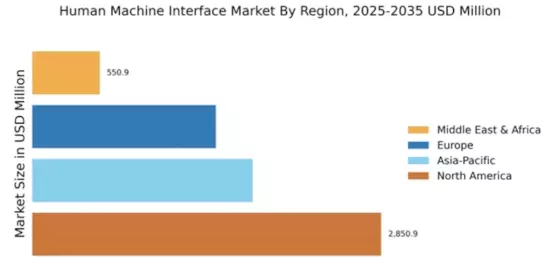
North America: Increased Human Machine Interface
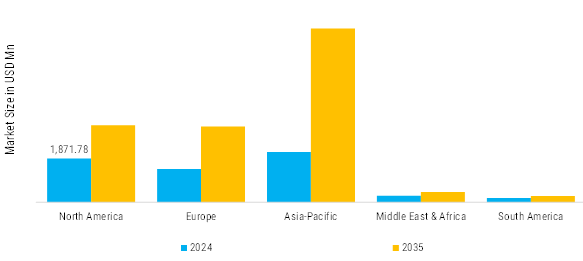
North America remains the second dominant region in the human machine interface (HMI) market with the largest share worldwide, continuing stable growth driven by rapid industrial automation and new technological developments. The region’s HMI market is valued at USD 1,871.78 Million in 2024, forecast to reach over USD 3,305.10 Million by 2035, due to strong demand in automotive, manufacturing, energy, and pharmaceutical sectors. The United States has driven sectors by applying Industry 4.0 principles, adhering to stringent occupational safety regulations, and offering federal tax incentives for business modernization. As a result, HMI upgrades and new upgrade cycles are in high demand. Furthermore, the existence of established Industrial bases and smart factories continues to provide ongoing need for advanced connected, real-time, and HMI solutions using private 5G networks to deliver ultra-low latency controls.
Europe: Emerging Human Machine Interface
European demand for HMI solutions is primarily driven by the required accessibility and ease of use of the hardware, availability of embedded touch systems, and intuitive interface that reduces operator training time, improves productivity, and increases safety. HMI solutions increasingly include high-resolution displays, multi-touch and gesture commands, augmented reality overlays, and advanced networking via IoT and 5G, demonstrating the region's ambitions towards interconnected and intelligent factories. The manufacturing, auto, packaging, and healthcare sectors are of primary importance, while other emerging sectors include demand for smart home devices and consumer electronics as growth factors. However, high implementation costs and financial related constraints from small and medium-sized organizations remains a limitation of the broader market
Asia-Pacific: Rapidly Growing Human Machine Interface
Asia-Pacific human machine interface (HMI) market is dominating and experiencing strong growth, due to rapid industrialization and technology adoption in the region. The rise in the demand for advanced, user-oriented HMI interfaces from the growing automotive sector and the healthcare sector's acceptance of tactile and optical HMIs also lead to varied growth in the region. The relatively lower price point and versatility of tactile HMIs lead to better availability in emerging economies, while optical HMIs are gaining traction with the growth of AI-enabled technologies based on gesture and vision. Overall, the Asia-Pacific region is primed to be the fastest-growing HMI in the world based on technology innovation, government support, and increased integration to smart factory solutions. Moreover, the healthcare industry is also beginning to utilize HMI technology to streamline medical processes and better patient monitoring.
Middle East and Africa: Human Machine Interface
MEA are motivated by policy directed towards Industry 4.0 and smart infrastructure deployment. The market players expect to offer industrially-scaled, robust, multilingual HMI solutions suitable for the MEA industrial environment. Technology developers will be especially focused on ensuring a robust connection with cloud-based operations, integrating the IoT, enhancing cybersecurity, and understanding the digital platform transition. Challenges regarding HMI deployment will include high upfront capital, technical experience within local markets, and variations in civil infrastructure in less-developed areas may yield longer periods until HMI systems are more broadly adopted across the MEA. Moreover, the increasing strength of the collaborations between global HMI vendors and MEA enterprises, as well as general digital literacy affected by media organizations, will drive growth in HMI markets across the MEA as an emerging market.
South America: Rapidly Develop Human Machine Interface
South American market is still working on overcoming challenges to adoption, such as higher upfront costs of implementation, and inconsistent infrastructure in some regions. For some non-industrial applications, this may slow broad-scale adoption of HMI technologies among small and medium enterprises. However, HMI technology that has entered the markets on the back of cloud-based and IoT technologies, alongside growing understanding of Industry 4.0 benefits, has supported positive movements for HMI technology more broadly. The focus on remote monitoring and predictive maintenance products will assist regional soft industrials to decrease their downtime and operational costs, providing significant use cases for HMI technologies. The future outlook for the HMI market in South America as a region that is still developing and still has considerable promise which is driven by these industries continuing to diversify and also continue to adopt digital technologies in their own transformation.