HVAC Insulation Market (2026 - 2035)

ID: MRFR/EnP/1540-CR
112 Pages
Anshula Mandaokar
Last Updated: August 05, 2026
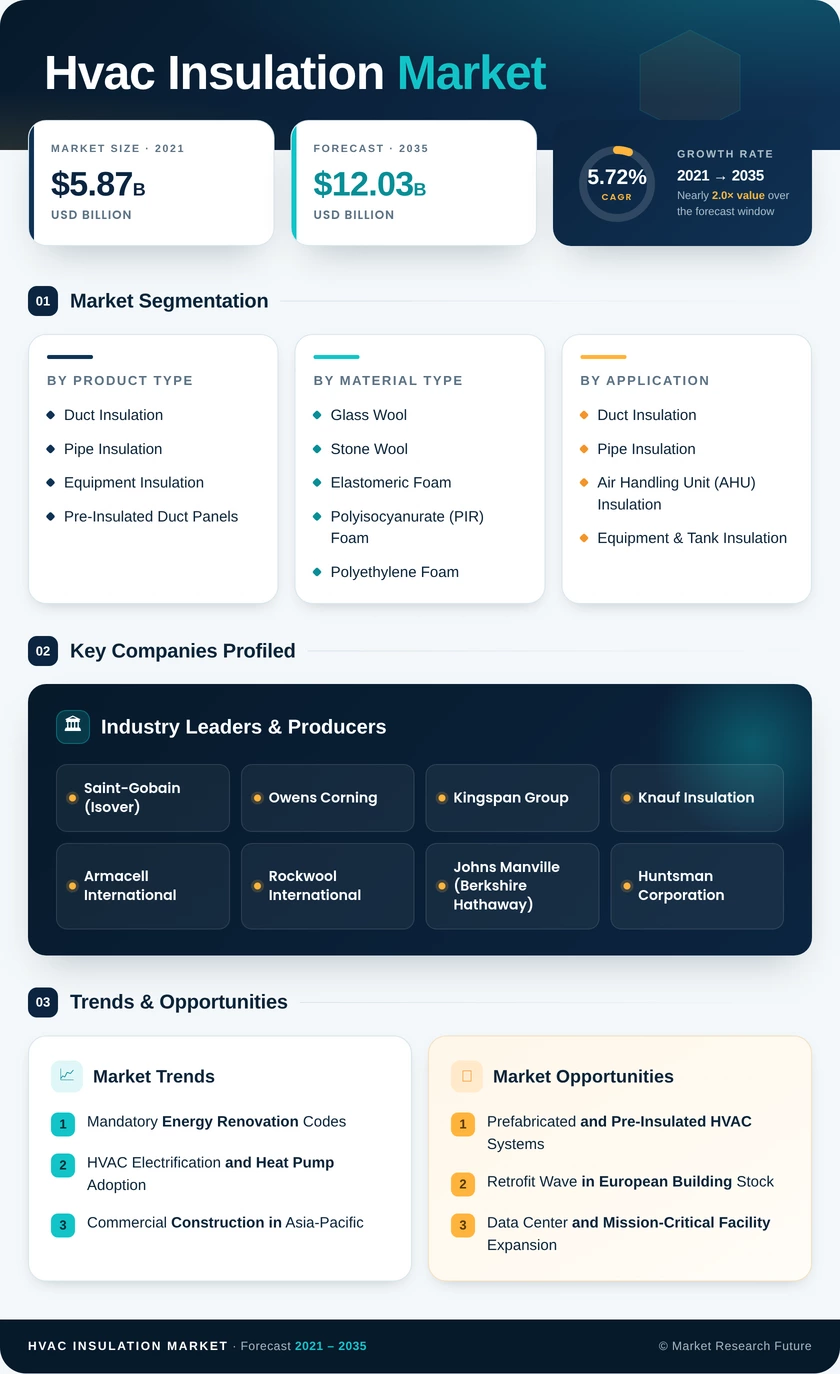
HVAC Insulation Market Research Report By Product Type (Duct Insulation, Pipe Insulation, Equipment Insulation, Pre-Insulated Duct Panels), By Material Type (Glass Wool, Stone Wool, Elastomeric Foam, Polyisocyanurate (PIR) Foam, Polyethylene Foam), By Application (Duct Insulation, Pipe Insulation, Air Handling Unit (AHU) Insulation, Equipment & Tank Insulation), By End-User Industry (Commercial, Residential, Industrial, Healthcare) and By Regional (North America, Europe, South America, Asia Pacific, Middle East and Africa) - Forecast to 2035
HVAC Insulation Market
Market Size
Forecast Period2026-2035
CAGR (2026-2035)5.72%
2025 Market SizeUSD 6.95 Billion
2035 Market SizeUSD 12.03 Billion
Key Players
Saint-Gobain
Owens Corning
Kingspan Group
Knauf Insulation
Armacell International
Rockwool International
Opportunities
  • Prefabricated and Pre-Insulated HVAC Systems
  • Retrofit Wave in European Building Stock
  • Data Center and Mission-Critical Facility Expansion
  1. 1 Market Overview |
    1. 1.1 Study Assumptions & Market Definition |
    2. 1.2 Scope of the Study |
    3. 1.3 Research Methodology
  2. 2 Market Summary & Key Takeaways
  3. 3 Market Dynamics |
    1. 3.1 Market Drivers Analysis | |
      1. 3.1.1 Mandatory Energy Renovation Codes | |
      2. 3.1.2 HVAC Electrification and Heat Pump Adoption | |
      3. 3.1.3 Commercial Construction Pipeline in Asia-Pacific | |
      4. 3.1.4 Data Center Cooling Infrastructure Expansion | |
      5. 3.1.5 Healthcare Facility Standards and Cleanroom Growth | |
      6. 3.1.6 Green Building Certification Programs | |
      7. 3.1.7 Deep Retrofit and Building Renovation Wave |
    2. 3.2 Market Restraints Analysis | |
      1. 3.2.1 Raw Material and Energy Cost Volatility | |
      2. 3.2.2 Skilled Insulation Labor Shortages | |
      3. 3.2.3 Substitution Risk from Spray-Applied Alternatives | |
      4. 3.2.4 Regulatory Fragmentation Across Emerging Markets | |
      5. 3.2.5 Supply Chain Concentration in Petrochemical Feedstocks |
    3. 3.3 Market Opportunity Analysis | |
      1. 3.3.1 Prefabricated and Pre-Insulated HVAC Systems | |
      2. 3.3.2 Retrofit Wave in European Building Stock | |
      3. 3.3.3 Data Center and Mission-Critical Facility Expansion | |
      4. 3.3.4 Emerging Market Urbanization | |
      5. 3.3.5 Digital Performance Monitoring and Lifecycle Services |
    4. 3.4 Industry Value Chain Analysis |
    5. 3.5 Porter's Five Forces Analysis
  4. 4 Global HVAC Insulation Market Size & Forecast (2021–2035) |
    1. 4.1 Historical Market Size (2021–2025) |
    2. 4.2 Current & Forecast Market Size (2026–2035) |
    3. 4.3 Market Size by Revenue (USD Billion) |
    4. 4.4 Year-over-Year Growth Analysis
  5. 5 Segmentation Analysis |
    1. 5.1 By Product Type | |
      1. 5.1.1 Duct Insulation | |
      2. 5.1.2 Pipe Insulation | |
      3. 5.1.3 Equipment Insulation | |
      4. 5.1.4 Pre-Insulated Duct Panels |
    2. 5.2 By Material Type | |
      1. 5.2.1 Glass Wool | |
      2. 5.2.2 Stone Wool | |
      3. 5.2.3 Elastomeric Foam | |
      4. 5.2.4 Polyisocyanurate (PIR) Foam | |
      5. 5.2.5 Polyethylene Foam |
    3. 5.3 By Application | |
      1. 5.3.1 Duct Insulation | |
      2. 5.3.2 Pipe Insulation | |
      3. 5.3.3 Air Handling Unit (AHU) Insulation | |
      4. 5.3.4 Equipment & Tank Insulation |
    4. 5.4 By End-User Industry | |
      1. 5.4.1 Commercial | |
      2. 5.4.2 Residential | |
      3. 5.4.3 Industrial | |
      4. 5.4.4 Healthcare
  6. 6 Regional Analysis |
    1. 6.1 North America | |
      1. 6.1.1 United States | |
      2. 6.1.2 Canada | |
      3. 6.1.3 Mexico |
    2. 6.2 Europe | |
      1. 6.2.1 Germany | |
      2. 6.2.2 United Kingdom | |
      3. 6.2.3 France | |
      4. 6.2.4 Italy | |
      5. 6.2.5 Spain | |
      6. 6.2.6 Nordic Countries | |
      7. 6.2.7 Russia | |
      8. 6.2.8 Rest of Europe |
    3. 6.3 Asia-Pacific | |
      1. 6.3.1 China | |
      2. 6.3.2 India | |
      3. 6.3.3 Japan | |
      4. 6.3.4 South Korea | |
      5. 6.3.5 ASEAN | |
      6. 6.3.6 Rest of Asia-Pacific |
    4. 6.4 South America | |
      1. 6.4.1 Brazil | |
      2. 6.4.2 Argentina | |
      3. 6.4.3 Rest of South America |
    5. 6.5 Middle East & Africa | |
      1. 6.5.1 Saudi Arabia | |
      2. 6.5.2 UAE | |
      3. 6.5.3 South Africa | |
      4. 6.5.4 Egypt | |
      5. 6.5.5 Rest of MEA
  7. 7 Competitive Landscape |
    1. 7.1 Market Share Analysis (2025) |
    2. 7.2 Competitive Benchmarking Matrix |
    3. 7.3 Company Profiles | |
      1. 7.3.1 Saint-Gobain (Isover) | |
      2. 7.3.2 Owens Corning | |
      3. 7.3.3 Kingspan Group | |
      4. 7.3.4 Knauf Insulation | |
      5. 7.3.5 Armacell International | |
      6. 7.3.6 Rockwool International | |
      7. 7.3.7 Johns Manville | |
      8. 7.3.8 Huntsman Corporation | |
      9. 7.3.9 BASF SE | |
      10. 7.3.10 Thermaflex International
  8. 8 Future Outlook & Strategic Recommendations (2026–2035) |
    1. 8.1 Building Decarbonization Compliance Timelines |
    2. 8.2 Advanced Material Development |
    3. 8.3 Digitalization of Insulation Asset Management |
    4. 8.4 ESG Reporting and Embodied Carbon Transparency
  9. 9 Recent Developments & News
  10. 10 Frequently Asked Questions (FAQs)
  11. 11 Report Scope & Methodology |
    1. 11.1 Study Period & Base Year |
    2. 11.2 Data Sources & Citations |
    3. 11.3 Abbreviations
  12. 12 LIST OF TABLES |
  13. TABLE 1 Global HVAC Insulation Market Size & Forecast, by Revenue (USD Billion), 2021–2035 |
  14. TABLE 2 Global HVAC Insulation Market — Year-over-Year Growth Analysis, 2021–2035 |
  15. TABLE 3 Driver Impact Analysis — Global HVAC Insulation Market |
  16. TABLE 4 Restraints Impact Analysis — Global HVAC Insulation Market |
  17. TABLE 5 Regional Market Share Summary — Global HVAC Insulation Market, 2025 |
  18. TABLE 6 North America HVAC Insulation Market, by Country, 2021–2035 (USD Billion) |
  19. TABLE 7 Europe HVAC Insulation Market, by Country, 2021–2035 (USD Billion) |
  20. TABLE 8 Asia-Pacific HVAC Insulation Market, by Country, 2021–2035 (USD Billion) |
  21. TABLE 9 South America HVAC Insulation Market, by Country, 2021–2035 (USD Billion) |
  22. TABLE 10 Middle East & Africa HVAC Insulation Market, by Country, 2021–2035 (USD Billion) |
  23. TABLE 11 Global HVAC Insulation Market Size, by Product Type, 2021–2035 (USD Billion) |
  24. TABLE 12 Global HVAC Insulation Market Size, by Material Type, 2021–2035 (USD Billion) |
  25. TABLE 13 Global HVAC Insulation Market Size, by Application, 2021–2035 (USD Billion) |
  26. TABLE 14 Global HVAC Insulation Market Size, by End-User Industry, 2021–2035 (USD Billion) |
  27. TABLE 15 Competitive Benchmarking Matrix — Global HVAC Insulation Market, 2025 |
  28. TABLE 16 Company Profiles — Key Players, Global HVAC Insulation Market |
  29. TABLE 17 Recent Developments & Strategic Announcements, 2023–2025 |
  30. TABLE 18 Report Scope & Methodology Summary |
  31. TABLE 19 Detailed Sources and Citations |
  32. TABLE 20 North America HVAC Insulation Market Size, by Product Type, 2021–2035 (USD Billion) |
  33. TABLE 21 North America HVAC Insulation Market Size, by Material Type, 2021–2035 (USD Billion) |
  34. TABLE 22 North America HVAC Insulation Market Size, by Application, 2021–2035 (USD Billion) |
  35. TABLE 23 North America HVAC Insulation Market Size, by End-User Industry, 2021–2035 (USD Billion) |
  36. TABLE 24 Europe HVAC Insulation Market Size, by Product Type, 2021–2035 (USD Billion) |
  37. TABLE 25 Europe HVAC Insulation Market Size, by Material Type, 2021–2035 (USD Billion) |
  38. TABLE 26 Europe HVAC Insulation Market Size, by Application, 2021–2035 (USD Billion) |
  39. TABLE 27 Europe HVAC Insulation Market Size, by End-User Industry, 2021–2035 (USD Billion) |
  40. TABLE 28 Asia-Pacific HVAC Insulation Market Size, by Product Type, 2021–2035 (USD Billion) |
  41. TABLE 29 Asia-Pacific HVAC Insulation Market Size, by Material Type, 2021–2035 (USD Billion) |
  42. TABLE 30 Asia-Pacific HVAC Insulation Market Size, by Application, 2021–2035 (USD Billion) |
  43. TABLE 31 Asia-Pacific HVAC Insulation Market Size, by End-User Industry, 2021–2035 (USD Billion) |
  44. TABLE 32 South America HVAC Insulation Market Size, by Product Type, 2021–2035 (USD Billion) |
  45. TABLE 33 South America HVAC Insulation Market Size, by Material Type, 2021–2035 (USD Billion) |
  46. TABLE 34 South America HVAC Insulation Market Size, by Application, 2021–2035 (USD Billion) |
  47. TABLE 35 South America HVAC Insulation Market Size, by End-User Industry, 2021–2035 (USD Billion) |
  48. TABLE 36 Middle East & Africa HVAC Insulation Market Size, by Product Type, 2021–2035 (USD Billion) |
  49. TABLE 37 Middle East & Africa HVAC Insulation Market Size, by Material Type, 2021–2035 (USD Billion) |
  50. TABLE 38 Middle East & Africa HVAC Insulation Market Size, by Application, 2021–2035 (USD Billion) |
  51. TABLE 39 Middle East & Africa HVAC Insulation Market Size, by End-User Industry, 2021–2035 (USD Billion)
  52. 13 LIST OF FIGURES |
  53. FIGURE 1 Global HVAC Insulation Market Dynamics — Drivers, Restraints, and Opportunities |
  54. FIGURE 2 Industry Value Chain Analysis — HVAC Insulation Market |
  55. FIGURE 3 Porter's Five Forces Analysis — HVAC Insulation Market |
  56. FIGURE 4 Global HVAC Insulation Market Size Trend & Forecast (USD Billion), 2021–2035 |
  57. FIGURE 5 HVAC Insulation Market Share, by Product Type, 2025 (%) |
  58. FIGURE 6 HVAC Insulation Market Share, by Material Type, 2025 (%) |
  59. FIGURE 7 HVAC Insulation Market Share, by Application, 2025 (%) |
  60. FIGURE 8 HVAC Insulation Market Share, by End-User Industry, 2025 (%) |
  61. FIGURE 9 HVAC Insulation Market Share, by Region, 2025 (%) |
  62. FIGURE 10 North America HVAC Insulation Market Size & Forecast (USD Billion), 2021–2035 |
  63. FIGURE 11 Europe HVAC Insulation Market Size & Forecast (USD Billion), 2021–2035 |
  64. FIGURE 12 Asia-Pacific HVAC Insulation Market Size & Forecast (USD Billion), 2021–2035 |
  65. FIGURE 13 South America HVAC Insulation Market Size & Forecast (USD Billion), 2021–2035 |
  66. FIGURE 14 Middle East & Africa HVAC Insulation Market Size & Forecast (USD Billion), 2021–2035 |
  67. FIGURE 15 Competitive Landscape — Market Share of Leading Players, 2025 (%)

Segmentation Quick Reference

DimensionSub-SegmentsDominant SegmentFastest Growing Segment
Product TypeDuct Insulation, Pipe Insulation, Equipment Insulation, Pre-Insulated Duct PanelsDuct InsulationPre-Insulated Duct Panels
Material TypeGlass Wool, Stone Wool, Elastomeric Foam, Polyisocyanurate (PIR) Foam, Polyethylene FoamGlass WoolPolyisocyanurate (PIR) Foam
ApplicationDuct Insulation, Pipe Insulation, Air Handling Unit (AHU) Insulation, Equipment & Tank InsulationDuct InsulationAir Handling Unit (AHU) Insulation
End-User IndustryCommercial, Residential, Industrial, HealthcareCommercialHealthcare
GeographyAsia-Pacific, North America, Europe, South America, Middle East & AfricaAsia-PacificAsia-Pacific


Market Segmentation Overview

By Product Type

Sub-SegmentKey Trend
Duct InsulationLargest segment; driven by centralized HVAC system prevalence in commercial buildings
Pipe InsulationSteady demand from hydronic heating/cooling and chilled-water distribution systems
Equipment InsulationGrowing with AHU upgrades and chiller plant modernization in institutional facilities
Pre-Insulated Duct PanelsFastest growth; factory-finished panels reduce on-site labor and improve installation quality


Product type segmentation reflects the structural components of HVAC systems that require thermal insulation. Duct insulation dominates because commercial air distribution networks represent the largest insulated surface area per building. Pre-insulated duct panels are reshaping installation economics by shifting labor from job sites to controlled factory environments.

By Material Type

Sub-SegmentKey Trend
Glass WoolCost leader for duct wraps; widely specified in commercial new construction
Stone WoolPreferred for fire-rated applications; strong in European regulatory environments
Elastomeric FoamClosed-cell structure provides integral vapor barrier for pipe insulation
Polyisocyanurate (PIR) FoamHighest R-value per inch among rigid boards; fast adoption in fire-code-driven markets
Polyethylene FoamLightweight option for residential pipe insulation with moderate thermal performance


Material selection is driven by the interplay of thermal performance requirements, fire safety codes, moisture management needs, and installed cost budgets. Glass wool maintains dominance on volume, while PIR foam is capturing specification share in markets where fire codes have tightened.

By Application

Sub-SegmentKey Trend
Duct InsulationLargest application; mandatory in most commercial energy codes
Pipe InsulationCritical for condensation prevention on chilled-water and refrigerant lines
Air Handling Unit (AHU) InsulationFastest growth; driven by cleanroom, healthcare, and data center facility expansion
Equipment & Tank InsulationNiche but stable demand from industrial process cooling and thermal storage systems


Application segmentation maps insulation usage to specific HVAC system components. AHU insulation is the fastest-growing application as facility types with stringent air quality and temperature control requirements — healthcare, pharmaceuticals, data centers — expand globally.

By End-User Industry

Sub-SegmentKey Trend
CommercialDominant segment; office, retail, and hospitality buildings drive bulk of demand
ResidentialGrowing with heat pump adoption; single-family and multifamily retrofit activity rising
IndustrialProcess cooling, cold storage, and manufacturing facility HVAC systems sustain demand
HealthcareFastest growth; infection-control ventilation and cleanroom capacity driving upgrades


End-user segmentation reflects the building types that consume HVAC insulation. Commercial buildings lead due to their scale and centralized mechanical systems. Healthcare is the fastest-growing end-user as pandemic-era ventilation standards become permanent design requirements.




Download PDF ×

We do not share your information with anyone. However, we may send you emails based on your report interest from time to time. You may contact us at any time to opt-out.