×
Request Free Sample ×

Kindly complete the form below to receive a free sample of this Report

* Please use a valid business email

Leading companies partner with us for data-driven Insights

clients tt-cursor
Hero Background

HVDC HVAC Power Cable Laying Vessel Market

ID: MRFR/EnP/39697-CR
128 Pages
Chitranshi Jaiswal
January 2025

HVDC/HVAC Power Cable Laying Vessel Market Research Report Information By Power Cable Type (HVDC and HVAC), By Vessel (Cable Laying, Cable Repairing and Cable Laying Barge), By Technology (Dynamic Positioning Systems, ROV-Assisted Cable Laying, Cable Burial & Trenching Technologies and Rock Cutting), By Capacity (>1000 Tons, 1001-3000 Tons, 3001-5000 Tons, 5001-7000 Tons and Above 7000 Tons), By End User (Oil & Gas, Wind Farms, Interstate, Telecommunication and Others) and By Region -Global Forecast to 2035

Share:
Download PDF ×

We do not share your information with anyone. However, we may send you emails based on your report interest from time to time. You may contact us at any time to opt-out.

HVDC HVAC Power Cable Laying Vessel Market Infographic
Purchase Options

HVDC HVAC Power Cable Laying Vessel Market Summary

As per MRFR analysis, the HVDC HVAC Power Cable Laying Vessel Market size was estimated at 1352.58 USD Million in 2024. The HVDC HVAC Power Cable Laying Vessel industry is projected to grow from 1467.68 USD Million in 2025 to 3321.46 USD Million by 2035, exhibiting a compound annual growth rate (CAGR) of 8.51 during the forecast period 2025 - 2035.

Key Market Trends & Highlights

The HVDC HVAC Power Cable Laying Vessel Market is poised for substantial growth driven by technological advancements and increasing demand for renewable energy.

  • Technological advancements in vessel design are enhancing operational efficiency and reducing costs.
  • North America remains the largest market, while Asia-Pacific is emerging as the fastest-growing region in this sector.
  • The renewable energy segment dominates the market, with telecommunication showing the fastest growth potential.
  • Increasing investment in renewable energy projects and expansion of offshore wind farms are key drivers propelling market growth.

Market Size & Forecast

2024 Market Size 1352.58 (USD Million)
2035 Market Size 3321.46 (USD Million)
CAGR (2025 - 2035) 8.51%

Major Players

Nexans (FR), Prysmian Group (IT), Siemens (DE), General Cable (US), ABB (CH), Cavotec (SE), JDR Cable Systems (GB), Subsea 7 (GB), Van Oord (NL)

HVDC HVAC Power Cable Laying Vessel Market Trends

The HVDC HVAC Power Cable Laying Vessel Market is currently experiencing a transformative phase, driven by the increasing demand for efficient energy transmission solutions. This market appears to be influenced by the global shift towards renewable energy sources, which necessitates advanced infrastructure for the distribution of electricity over long distances. As countries invest in offshore wind farms and interconnectors, the need for specialized vessels capable of laying high-voltage direct current (HVDC) and high-voltage alternating current (HVAC) cables becomes more pronounced. The integration of innovative technologies in vessel design and operation is likely to enhance the efficiency and reliability of cable laying processes, thereby supporting the expansion of renewable energy projects. Moreover, the competitive landscape of the HVDC HVAC Power Cable Laying Vessel Market seems to be evolving, with several key players focusing on strategic partnerships and collaborations to strengthen their market position. This trend indicates a collective effort to address the challenges associated with cable installation in complex marine environments. Additionally, regulatory frameworks promoting sustainable practices may further propel the market forward, as stakeholders seek to align with environmental standards. Overall, the HVDC HVAC Power Cable Laying Vessel Market is poised for growth, reflecting the broader trends in energy transition and technological advancement in the maritime sector.

Technological Advancements in Vessel Design

The HVDC HVAC Power Cable Laying Vessel Market is witnessing a surge in technological innovations aimed at enhancing operational efficiency. New designs incorporate advanced automation and remote monitoring systems, which streamline the cable laying process and reduce human error. These developments not only improve safety but also optimize resource utilization, making projects more cost-effective.

Growing Demand for Renewable Energy Infrastructure

As nations increasingly prioritize renewable energy sources, the demand for HVDC and HVAC cable laying vessels is likely to rise. This trend reflects a broader commitment to sustainable energy solutions, with investments in offshore wind farms and solar power installations driving the need for specialized vessels capable of supporting extensive cable networks.

Strategic Collaborations and Partnerships

The competitive dynamics within the HVDC HVAC Power Cable Laying Vessel Market appear to be shifting towards strategic alliances among key industry players. Collaborations are being formed to leverage shared expertise and resources, enabling companies to tackle complex projects more effectively. This trend suggests a proactive approach to addressing the challenges of cable installation in diverse marine environments.

Market Segment Insights

By Application: Renewable Energy (Largest) vs. Telecommunication (Fastest-Growing)

In the HVDC HVAC Power Cable Laying Vessel Market, the application segment is notably diverse, with key areas such as Renewable Energy, Telecommunication, Power Distribution, and Submarine Cable Installation. Among these, Renewable Energy holds the largest market share, driven by the global push towards sustainable power generation and the integration of renewable sources into the electricity grid. Telecommunication, while smaller in share, is the fastest-growing segment as the demand for high-speed data transfer increases, spurred by advancements in technology and growing internet needs. The growth trends in this segment reflect broader industry shifts, with Renewable Energy gaining momentum from investments in wind, solar, and hydroelectric projects, which require efficient cable-laying capabilities. Meanwhile, the Telecommunication sector is evolving rapidly due to rising global connectivity demands, necessitating sophisticated cable deployment solutions. Overall, both segments showcase respective strengths influenced by market dynamics in energy production and digital communication, highlighting the importance of cable vessel technology in supporting modern infrastructure.

Renewable Energy (Dominant) vs. Telecommunication (Emerging)

In the context of the HVDC HVAC Power Cable Laying Vessel Market, Renewable Energy is considered a dominant application segment, primarily due to the significant investments and government policies promoting clean energy initiatives. This sector typically involves extensive infrastructure projects that require specialized cable laying capabilities to connect offshore and onshore wind farms or solar energy facilities. Telecommunication, on the other hand, is an emerging segment characterized by rapid technological advancements aimed at improving speed and capacity in data transmission. The ongoing global digitization and the rise of 5G networks are driving up the demand for upgraded submarine cables and terrestrial cables, making this segment crucial for future connectivity. Both segments reflect strategic priorities in the market, one steeped in sustainability and the other in technological advancement.

By Vessel Type: Cable Laying Vessel (Largest) vs. Cable Repair Vessel (Fastest-Growing)

In the HVDC HVAC Power Cable Laying Vessel Market, the predominant segment is the Cable Laying Vessel, which holds the largest market share due to its essential role in the installation of power cables. This vessel type is specifically designed for efficient laying of undersea and underground cables, making it crucial for infrastructure projects. Following closely is the Cable Repair Vessel, which is experiencing rapid growth as the demand for cable maintenance and repair services rises, driven by the increasing number of offshore wind farms and interconnectors. As the global energy landscape shifts towards renewable sources, the need for robust and efficient cable laying solutions has prompted a significant focus on specialized vessels. The growth of the Cable Repair Vessel segment is particularly noteworthy, as operators are investing in advanced technologies to enhance cable repair capabilities. Factors driving this trend include the aging of existing cable networks and the strategic importance of ensuring operational continuity, which highlights the critical function these vessels serve in modern energy distribution systems.

Cable Laying Vessel (Dominant) vs. Multi-Purpose Vessel (Emerging)

The Cable Laying Vessel stands out as the dominant player in the HVDC HVAC Power Cable Laying Vessel market, designed specifically for the complexities of underwater cable installation, which requires specialized equipment and engineering prowess. This type of vessel often incorporates advanced dynamic positioning systems, allowing for precision work in challenging environments. In contrast, the Multi-Purpose Vessel, while emerging, offers versatility for various maritime operations, including cargo transport and maintenance tasks. However, its capabilities for specialized cable laying are not as advanced. The rising demand for adaptable vessels due to project variability presents growth opportunities for Multi-Purpose Vessels, yet they still rely heavily on the proven technology and efficiency encapsulated by dedicated Cable Laying Vessels.

By Power Transmission Type: High Voltage Direct Current (Largest) vs. High Voltage Alternating Current (Fastest-Growing)

In the HVDC HVAC Power Cable Laying Vessel Market, High Voltage Direct Current (HVDC) commands a significant share, reflecting its established utility in transmitting large amounts of electricity over long distances with minimal losses. On the other hand, High Voltage Alternating Current (HVAC) is emerging as a competitive segment, particularly in regions where grid interconnections are becoming more vital, illustrating a shift in utility preferences in the market dynamics.

Power Transmission Type: HVDC (Dominant) vs. HVAC (Emerging)

High Voltage Direct Current (HVDC) serves as the dominant technology in this market, characterized by its efficiency in high-capacity transmission and lower energy losses, making it the preferred choice for intercontinental power trade. In contrast, High Voltage Alternating Current (HVAC) is gaining momentum, driven by increasing investments in renewable energy sources and its suitability for short to medium distances. The HVAC systems, being more adaptable to existing networks, are quickly becoming an attractive solution for regional energy connectivity and resilience.

By Operational Depth: Deep Water (Largest) vs. Ultra Deep Water (Fastest-Growing)

In the HVDC HVAC Power Cable Laying Vessel Market, the distribution among the operational depths reveals distinct preferences. The Deep Water segment holds the largest share, dominating due to the extensive infrastructure projects undertaken in such environments. Shallow Water, while significant, lags behind as projects increasingly move to deeper operations where higher capacities are necessary. This segmentation underscores the industry's shift towards more challenging environments, driving innovations in vessel capabilities to accommodate deeper projects. Growth trends indicate a robust future for the Ultra Deep Water segment, which is recognized as the fastest-growing category. Several factors contribute to this momentum, including technological advancements that enable efficient laying of power cables in harsher conditions. Additionally, increasing demand for renewable energy sources in offshore locations prompts operators to invest in vessels capable of traversing ultra-deep waters, thereby expanding operational possibilities in the face of energy transition efforts.

Deep Water (Dominant) vs. Ultra Deep Water (Emerging)

Deep Water operational capabilities are characterized by established methodologies and robust engineering practices, making it the dominant segment in the HVDC HVAC Power Cable Laying Vessel Market. Vessels designed for this depth have proven infrastructure, reliability, and the ability to handle various cable-laying techniques. In contrast, Ultra Deep Water is emerging rapidly due to the growing complexity of offshore energy projects. This segment sees increasing investments aimed at developing advanced vessels that can tackle the unique challenges of ultra-deep environments, such as harsh weather conditions and complex seabed terrains. The emergence of this sector reflects the industry's response to the relentless pursuit of energy resources, positioning Ultra Deep Water as a key player in the future of power transmission.

By Cable Type: Single Core Cable (Largest) vs. Multi Core Cable (Fastest-Growing)

The HVDC HVAC Power Cable Laying Vessel Market displays a distinct distribution of market share among various cable types, with Single Core Cable leading as the largest segment. It benefits from ease of installation and significant reliability for high-voltage applications. Multi Core Cable, while smaller in current market share, has garnered attention as the fastest-growing segment due to its enhanced efficiency and reduced space requirements, making it an attractive option for modern infrastructural projects. As the demand for more compact solutions increases, Multi Core Cable is expected to see substantial growth in upcoming years. Growth trends in this segment are driven by the increasing push for renewable energy sources and significant investments in power grid infrastructure. Single Core Cable's dominance is backed by its long-term performance in established transmission networks, while Multi Core Cable's rapid expansion correlates with advancements in cable technology that allow for better heat dissipation and improved transmission capacity. Fiber Optic Cable also plays a supportive role in this segment, offering data transmission capabilities alongside electrical conductors, further enhancing the overall efficiency of HVDC systems.

Cable Type: Single Core (Dominant) vs. Multi Core (Emerging)

Single Core Cable holds the dominant position within the HVDC HVAC Power Cable Laying Vessel Market, largely due to its simplicity and effectiveness in efficiently transmitting high voltage over long distances. Its installation process is straightforward, making it a preferred choice for traditional power transmission projects. This segment benefits from established manufacturing practices, ensuring reliability for large-scale applications. Contrastingly, Multi Core Cable is emerging as a vital alternative; designed for improved space efficiency and weight reduction, it meets the demands of modernization in energy infrastructure. This cable type facilitates enhanced flexibility and supports diverse configurations. The shift towards cleaner energy solutions and the need for adaptable infrastructure are major factors driving the rising adoption of Multi Core Cable within the sector.

Get more detailed insights about HVDC HVAC Power Cable Laying Vessel Market

Regional Insights

North America : Established Market with Growth Potential

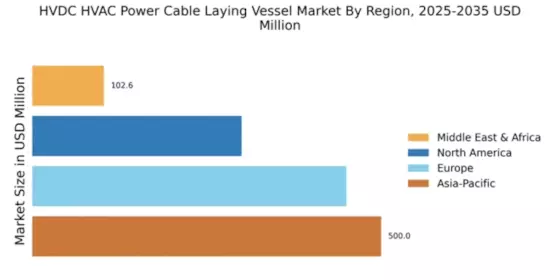
The North American HVDC HVAC power cable laying vessel market is poised for growth, driven by increasing investments in renewable energy and infrastructure upgrades. With a market size of $300.0 million, the region is focusing on regulatory support for clean energy initiatives, which is expected to boost demand for advanced cable laying technologies. The push for energy efficiency and sustainability is further catalyzing market expansion, as utilities seek to modernize their grid systems. Leading countries in this region include the United States and Canada, where major players like General Cable and ABB are actively involved. The competitive landscape is characterized by strategic partnerships and technological advancements aimed at enhancing operational efficiency. As the market evolves, these companies are expected to leverage their expertise to capture a larger share of the growing demand for HVDC HVAC solutions.

Europe : Innovation and Sustainability Focus

Europe is a frontrunner in the HVDC HVAC power cable laying vessel market, with a market size of $450.0 million. The region's growth is fueled by stringent regulations aimed at reducing carbon emissions and promoting renewable energy sources. Countries like Germany, France, and the Netherlands are at the forefront, implementing policies that encourage investment in advanced cable laying technologies. The European Union's Green Deal is a significant regulatory catalyst, driving demand for sustainable energy solutions. The competitive landscape in Europe is robust, featuring key players such as Nexans and Prysmian Group. These companies are investing heavily in R&D to innovate and improve their offerings. The presence of established firms, coupled with a supportive regulatory environment, positions Europe as a leader in the HVDC HVAC market. The region's commitment to sustainability and innovation is expected to further enhance its market share in the coming years.

Asia-Pacific : Emerging Powerhouse in Cable Technology

Asia-Pacific is the largest market for HVDC HVAC power cable laying vessels, boasting a market size of $550.0 million. The region's growth is driven by rapid urbanization, increasing energy demands, and significant investments in renewable energy projects. Countries like China and India are leading the charge, supported by government initiatives that promote the adoption of advanced cable technologies. The regulatory landscape is favorable, with policies aimed at enhancing energy efficiency and sustainability. The competitive environment in Asia-Pacific is marked by the presence of major players such as Siemens and ABB. These companies are actively expanding their operations to meet the growing demand for HVDC HVAC solutions. The region's focus on infrastructure development and energy transition is expected to sustain its market leadership, making it a key player in the global HVDC HVAC landscape.

Middle East and Africa : Emerging Market with Growth Opportunities

The Middle East and Africa region is emerging in the HVDC HVAC power cable laying vessel market, with a market size of $52.58 million. Growth is driven by increasing investments in energy infrastructure and a shift towards renewable energy sources. Countries like South Africa and the UAE are focusing on enhancing their energy capabilities, supported by government initiatives aimed at diversifying energy portfolios. The region's regulatory framework is evolving to facilitate investments in advanced cable technologies. The competitive landscape is still developing, with key players like Cavotec and JDR Cable Systems beginning to establish their presence. As the region continues to invest in energy projects, the demand for HVDC HVAC solutions is expected to rise. The focus on sustainability and energy efficiency will further drive market growth, positioning the Middle East and Africa as a potential hub for HVDC HVAC technologies.

Key Players and Competitive Insights

The HVDC HVAC Power Cable Laying Vessel Market is currently characterized by a dynamic competitive landscape, driven by the increasing demand for efficient energy transmission solutions and the global shift towards renewable energy sources. Key players such as Nexans (FR), Prysmian Group (IT), and Siemens (DE) are strategically positioning themselves through innovation and partnerships, which collectively enhance their operational capabilities and market presence. These companies are focusing on technological advancements in cable laying techniques and expanding their service offerings to meet the evolving needs of the energy sector.

In terms of business tactics, companies are increasingly localizing manufacturing to reduce costs and optimize supply chains. The market appears moderately fragmented, with several key players exerting influence over their respective segments. This competitive structure allows for a diverse range of offerings, although the presence of major players like ABB (CH) and General Cable (US) suggests a concentration of market power that could shape pricing and service standards.

In November 2025, Nexans (FR) announced a strategic partnership with a leading offshore wind farm developer to enhance its cable laying capabilities. This collaboration is expected to leverage Nexans' advanced technology in HVDC systems, thereby positioning the company as a frontrunner in the renewable energy sector. The strategic importance of this partnership lies in its potential to streamline operations and reduce project timelines, which is critical in the fast-paced energy market.

Similarly, in October 2025, Prysmian Group (IT) unveiled a new cable laying vessel designed specifically for deep-water applications. This vessel is equipped with cutting-edge technology that enhances operational efficiency and safety during installation. The introduction of this vessel signifies Prysmian's commitment to innovation and its proactive approach to addressing the challenges associated with deep-sea cable installations, which are becoming increasingly prevalent in the industry.

In September 2025, Siemens (DE) expanded its service portfolio by launching a digital platform aimed at optimizing cable laying operations. This platform integrates AI and data analytics to improve project management and operational efficiency. The strategic move reflects Siemens' focus on digital transformation, which is becoming a critical differentiator in the market as companies seek to enhance their service offerings and reduce operational costs.

As of December 2025, the competitive trends in the HVDC HVAC Power Cable Laying Vessel Market are increasingly defined by digitalization, sustainability, and the integration of advanced technologies. Strategic alliances are playing a pivotal role in shaping the landscape, enabling companies to pool resources and expertise. Looking ahead, the competitive differentiation is likely to evolve from traditional price-based competition to a focus on innovation, technological advancements, and supply chain reliability, as companies strive to meet the growing demands of the energy sector.

Key Companies in the HVDC HVAC Power Cable Laying Vessel Market market include

Future Outlook

HVDC HVAC Power Cable Laying Vessel Market Future Outlook

The HVDC HVAC Power Cable Laying Vessel Market is projected to grow at an 8.51% CAGR from 2024 to 2035, driven by increasing renewable energy investments and infrastructure development.

New opportunities lie in:

  • Development of advanced cable laying technologies for offshore wind farms.
  • Partnerships with renewable energy firms for integrated project solutions.
  • Expansion into emerging markets with underdeveloped grid infrastructure.

By 2035, the market is expected to be robust, driven by technological advancements and strategic partnerships.

Market Segmentation

HVDC HVAC Power Cable Laying Vessel Market Cable Type Outlook

  • Single Core Cable
  • Multi Core Cable
  • Fiber Optic Cable

HVDC HVAC Power Cable Laying Vessel Market Application Outlook

  • Telecommunication
  • Renewable Energy
  • Power Distribution
  • Submarine Cable Installation

HVDC HVAC Power Cable Laying Vessel Market Vessel Type Outlook

  • Cable Laying Vessel
  • Cable Repair Vessel
  • Multi-Purpose Vessel
  • Support Vessel

HVDC HVAC Power Cable Laying Vessel Market Operational Depth Outlook

  • Shallow Water
  • Deep Water
  • Ultra Deep Water

HVDC HVAC Power Cable Laying Vessel Market Power Transmission Type Outlook

  • High Voltage Direct Current
  • High Voltage Alternating Current

Report Scope

MARKET SIZE 2024 1352.58(USD Million)
MARKET SIZE 2025 1467.68(USD Million)
MARKET SIZE 2035 3321.46(USD Million)
COMPOUND ANNUAL GROWTH RATE (CAGR) 8.51% (2024 - 2035)
REPORT COVERAGE Revenue Forecast, Competitive Landscape, Growth Factors, and Trends
BASE YEAR 2024
Market Forecast Period 2025 - 2035
Historical Data 2019 - 2024
Market Forecast Units USD Million
Key Companies Profiled Nexans (FR), Prysmian Group (IT), Siemens (DE), General Cable (US), ABB (CH), Cavotec (SE), JDR Cable Systems (GB), Subsea 7 (GB), Van Oord (NL)
Segments Covered Application, Vessel Type, Power Transmission Type, Operational Depth, Cable Type
Key Market Opportunities Growing demand for renewable energy sources drives innovation in HVDC HVAC Power Cable Laying Vessel technology.
Key Market Dynamics Rising demand for renewable energy drives innovation and competition in HVDC HVAC power cable laying vessel technologies.
Countries Covered North America, Europe, APAC, South America, MEA

Leave a Comment

FAQs

How much is the HVDC/HVAC Power Cable Laying Vessel Market?

HVDC/HVAC Power Cable Laying Vessel Market Size in US$ 1,178.6 Mn by 2022

What is the growth rate of the HVDC/HVAC Power Cable Laying Vessel Market?

Growth rate of the HVDC/HVAC Power Cable Laying Vessel Market 8.91% by 2030

Which region held the largest market share in the HVDC/HVAC Power Cable Laying Vessel Market?

Asia-Pacific Region held the largest market share in the HVDC/HVAC Power Cable Laying Vessel Market.

Who are the key players in the HVDC/HVAC Power Cable Laying Vessel Market?

Prysmian Group, Nexans, NKT A/S, Seway7, Van Oord, Boskalis, Taihan Cable & Solution, Global Marine Group, DeepOcean, ASEAN Cableship, OMS Group Sdn Bhd., ZTT Group, LS Cable & System Ltd. and Orient Cable (NBO)

Which Power Cable Type had the largest market share in the HVDC/HVAC Power Cable Laying Vessel Market?

HVDC Power Cable Type had the largest market share in the HVDC/HVAC Power Cable Laying Vessel Market.

Which Vessel Type had the largest market share in the HVDC/HVAC Power Cable Laying Vessel Market?

Cable Laying Vessel Type had the largest market share in the HVDC/HVAC Power Cable Laying Vessel Market.

Which Capacity had the largest market share in the HVDC/HVAC Power Cable Laying Vessel Market?

3001-5000 Tons Capacity had the largest market share in the HVDC/HVAC Power Cable Laying Vessel Market.

Which Technology had the largest market share in the HVDC/HVAC Power Cable Laying Vessel Market?

Dynamic Positioning Systems Technology had the largest market share in the HVDC/HVAC Power Cable Laying Vessel Market.

Which Water Depth had the largest market share in the HVDC/HVAC Power Cable Laying Vessel Market?

Neodymium Deep Water Water Depth had the largest market share in the HVDC/HVAC Power Cable Laying Vessel Market.

Which End User had the largest market share in the HVDC/HVAC Power Cable Laying Vessel Market?

Wind Farms End User had the largest market share in the HVDC/HVAC Power Cable Laying Vessel Market.

Download Free Sample

Kindly complete the form below to receive a free sample of this Report

Compare Licence

×
Features License Type
Single User Multiuser License Enterprise User
Price $4,950 $5,950 $7,250
Maximum User Access Limit 1 User Upto 10 Users Unrestricted Access Throughout the Organization
Free Customization
Direct Access to Analyst
Deliverable Format
Platform Access
Discount on Next Purchase 10% 15% 15%
Printable Versions