Hybrid Vehicles Market (2026 - 2035)

Hybrid Vehicle Market Research Report By Hybridization Technology (Full Hybrid (HEV), Mild Hybrid (48V), Plug-in Hybrid (PHEV), Extended-Range (EREV)), By Vehicle Type (Passenger Cars, Light Commercial Vehicles, Heavy Commercial Vehicles & Buses), By Drivetrain Configuration (Parallel, Power-Split, Series, Other Configurations), By Component (Battery Pack, Electric Motor, Transmission & E-Axle, Power Electronics) and By Regional (North America, Europe, South America, Asia Pacific, Middle East and Africa) - Forecast to 2035
ID: MRFR/AT/4567-HCR
185 Pages
Triveni Bhoyar, Swapnil Palwe
Last Updated: August 24, 2026
Hybrid Vehicles Market
Market Size
Forecast Period2026-2035
CAGR (2026-2035)11.4%
2025 Market SizeUSD 276.4 Billion
2035 Market SizeUSD 823.1 Billion
Key Players
Toyota Motor Corporation
Hyundai Motor Group
Stellantis N.V.
Geely Automobile
Robert Bosch GmbH
BorgWarner Inc.
Opportunities
  • Extended-Range Architectures in Full-Size Trucks
  • Localised Manufacturing in Emerging Economies
  • Component Supply to Multi-Powertrain Platforms

Hybrid Vehicles Market Summary

The Hybrid Vehicle Market reached USD 276.4 billion in 2025 and enters the forecast window at USD 311.5 billion in 2026, climbing to USD 823.1 billion by 2035 at a 11.4% CAGR. Two policy events reset the trajectory. Brussels proposed on 16 December 2025 that fleet CO₂ obligations shift to a 90% cut by 2035 rather than 100%, explicitly preserving plug-in hybrids, range extenders and mild hybrids beyond that date [4][5]. Washington moved the opposite direction on stringency but toward the same commercial outcome, with NHTSA proposing sharply weaker fuel economy rules for model years 2022–2031 [6][7].

Here is where the transformation truly takes hold: powertrain architecture. 48-volt belt-starter generators, dedicated hybrid transaxles, and series-parallel systems that decouple engine speed from tire speed are replacing pure internal-combustion driveline hardware. Ford recorded USD 19.5 billion in charges in December 2025 to reallocate capital toward hybrids and extended-range electric vehicles. The company anticipates that half of its global volume will be hybrid, EREV, or battery-electric by 2030, compared to 17% in 2025 [13][14].

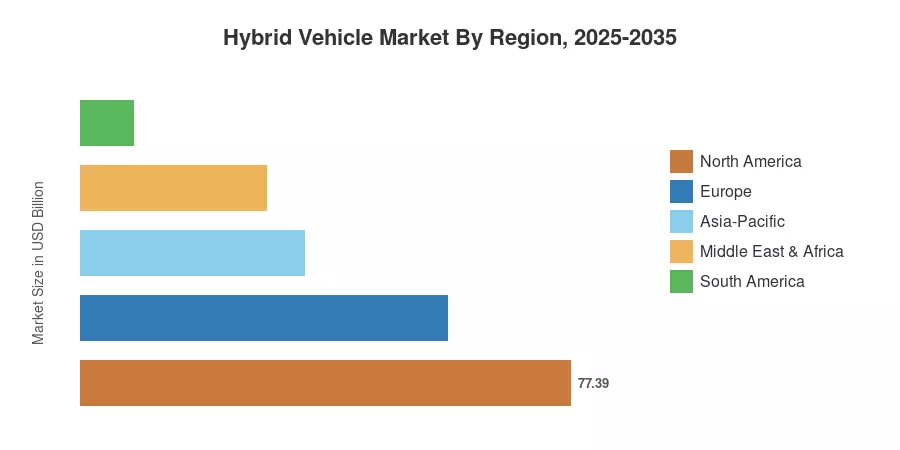
The Hybrid Vehicle Market is anchored by Asia-Pacific, which accounts for 44.5% of 2025 revenue and will experience the fastest growth rate of 12.8% through 2035. North America follows at 28.0%, with Toyota's US electrified volume of 1,183,248 units in 2025, which represents a 17.6% increase year over year [8]. The revised 2035 framework converts a phase-out risk into a decade-long extension, with Europe holding 21.0%. The next decade will be the property of the individual who successfully industrializes hybrid hardware at a cost comparable to that of a combustion engine.


Key Report Takeaways

• By Technology

  • Full hybrid (HEV) systems hold 45.5% of 2025 Hybrid Vehicle Market revenue, the largest single architecture.
  • Extended-range electric vehicles post the fastest expansion at 19.6% CAGR through 2035
  • Mild hybrid 48V systems generated USD 74.6 billion in 2025

• By Vehicle Type

  • Passenger cars account for 78.0% of Hybrid Vehicle Market revenue
  • Light commercial vehicles grow at 13.1% CAGR as last-mile fleets hedge charging risk
  • Heavy commercial and bus applications contributed USD 20.7 billion in 2025

• By Region

  • Asia-Pacific commands 44.5% of global revenue
  • India records the fastest country-level growth at 16.4% CAGR
  • Europe reached USD 58.0 billion in 2025


Market Size and Forecast (2021–2035)

Historical values are triangulated from OEM registration disclosures, national vehicle authority filings and International Energy Agency electric car sales datasets, then reconciled bottom-up against average transaction pricing by architecture. Forecast values apply architecture-weighted penetration curves for each of the twenty largest national Hybrid Vehicle Market territories. The 2025 spike reflects India's GST 2.0 reset and a Chinese pre-deadline purchase rush ahead of the January 2026 tax step-down [10][11].
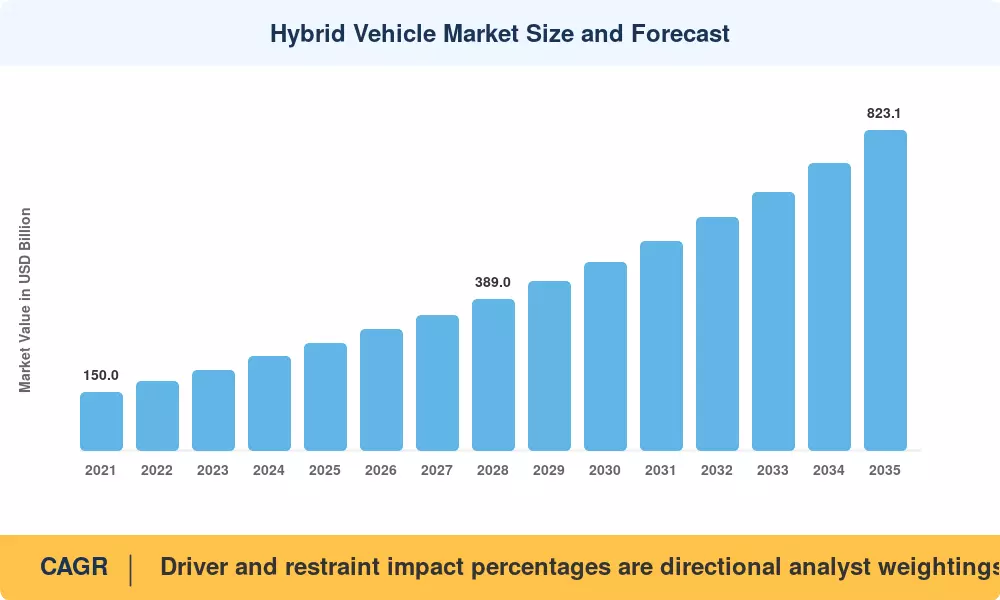
Hybrid Vehicle Market Size and Forecast
Our Impact
Enabled $4.3B Revenue Impact for Fortune 500 and Leading Multinationals
Partnering with 2000+ Global Organizations Each Year
30K+ Citations by Top-Tier Firms in the Industry

Driver Impact Analysis

Impact percentages below are directional analyst weightings that express relative contribution to growth momentum. They are not additive components of the headline CAGR and should not be summed. Each driver's weighting reflects observed elasticity in the Hybrid Vehicle Market across the 2021–2025 historical window, extended forward under current policy assumptions.

Driver ~% Impact on CAGR Geographic Relevance Impact Timeline
Regulatory recognition of hybrids beyond 2035 2.4 Europe Long-term (≥4 yr)
Charging infrastructure gaps favouring self-charging 2.1 Global Medium-term (2–4 yr)
Fuel economy compliance flexibility 1.8 North America Short-term (≤2 yr)
Fiscal incentives and tax rationalisation 1.7 Asia-Pacific Short-term (≤2 yr)
OEM capital reallocation from pure BEV 1.6 Global Medium-term (2–4 yr)
Falling battery pack and power-electronics cost 1.3 Global Long-term (≥4 yr)
Commercial fleet total-cost economics 0.9 North America, Europe Medium-term (2–4 yr)


Regulatory Recognition Beyond 2035

Brussels reversed the single largest structural threat to the category. The European Commission's automotive package of 16 December 2025 replaces the 100% CO₂ reduction requirement for new cars and vans in 2035 with a 90% cut measured against 2021 levels, with the residual 10% offset through EU-produced low-carbon steel or sustainable fuels [4][22]. Plug-in hybrids, range extenders and mild hybrids remain saleable indefinitely under the proposal, which now moves to Parliament and Council negotiation [5], for suppliers, that converts a stranded-asset problem into a ten-year amortisation runway on hybrid transaxle tooling.

Charging Infrastructure Gaps

Self-charging architectures monetise a physical constraint. Global electric car sales exceeded 20 million units in 2025 at a 25% sales share. Yet, only about 5% of the world's car stock is electrified, meaning charging density remains far behind vehicle density in most markets outside China and Northern Europe [1]. Hybrids impose no charging burden at all, which is why conventional hybrids retain volume leadership even as plug-in configurations grow faster [3]. Regenerative braking recovers enough energy in urban duty cycles to close much of the efficiency gap without a plug.

Fuel Economy Compliance Flexibility

American regulation shifted decisively toward optionality. NHTSA's SAFE III proposal of December 2025 would weaken CAFE standards across model years 2022–2031, explicitly on the reasoning that prior rulemakings improperly credited electric and plug-in hybrid vehicles when setting stringency [6][21]. Congress separately zeroed out civil penalties for CAFE non-compliance and used the Congressional Review Act in June 2025 to disapprove California's Clean Air Act preemption waivers [7]. The administration estimates roughly USD 109 billion in consumer savings over five years from the reset [23]. Automakers read this as permission to build hybrid trucks rather than electric ones.

Fiscal Incentives and Tax Rationalisation

India delivered the sharpest single-market repricing. Under GST 2.0, effective 22 September 2025, hybrid vehicles meeting small-car thresholds moved from 28% plus cess to a flat 18%, while larger hybrids settled at 40% with the compensation cess abolished — roughly a three-point net reduction on a mid-size hybrid SUV [11]. China moved the other way, halving its NEV purchase tax exemption to a RMB 15,000 per-vehicle cap from 1 January 2026 and requiring plug-in hybrids to deliver at least 100 km of pure-electric range to qualify [10][17].


Restraints Impact Analysis

Restraint ~% Drag on CAGR Geographic Relevance Impact Timeline
Battery-electric cost parity -1.9 China, Northern Europe Medium-term (2–4 yr)
Withdrawal of hybrid-specific tax relief -1.4 China Short-term (≤2 yr)
Powertrain complexity and warranty exposure -0.9 Global Long-term (≥4 yr)
Servicing skills and aftermarket readiness -0.7 South America, Africa Medium-term (2–4 yr)
Policy volatility and planning uncertainty -0.6 North America, Europe Short-term (≤2 yr)


Battery-Electric Cost Parity

China illustrates the ceiling. Battery electric vehicles took 65% of Chinese electric car sales in 2025, reversing two years of plug-in hybrid share gains, and plug-in hybrid volume grew only 4% while pure battery volume carried nearly all the increase [1][19]. More than half of electric cars sold in China have undercut equivalent combustion models on sticker price for several years running. Where batteries are cheap, and charging is dense, the dual-powertrain premium stops paying for itself.

Withdrawal of Hybrid-Specific Tax Relief

Beijing has begun taxing the category differently from pure electrics. A joint circular from the Ministry of Finance, State Taxation Administration and MIIT dated 2 July 2026 removes the annual vehicle and vessel tax exemption from plug-in hybrid and extended-range vehicles effective 1 January 2027, while leaving battery electric passenger cars untouched [9]. Analyst estimates suggest roughly 40% of existing plug-in and range-extended models risk losing purchase tax relief under the 100 km electric range threshold, with budget compact hybrids most exposed [17].

Powertrain Complexity and Warranty Exposure

Carrying two propulsion systems means carrying two failure surfaces. Dedicated hybrid transmissions, high-voltage contactors and battery thermal management add component count that shows up in warranty reserves and in dealer diagnostic time. Fleet buyers increasingly demand extended high-voltage component coverage before committing to multi-year orders.


Hybrid Vehicles Market Opportunities

Extended-Range Architectures in Full-Size Trucks

North America's pickup segment is the single largest untapped pool in the Hybrid Vehicle Market. Ford will relaunch the F-150 Lightning as an extended-range model targeting more than 700 miles of combined range, while Stellantis brings the Ram 1500 REV to production in the second half of 2026 with a 92 kWh pack, dual drive units and a V6 generator [14][20]. Average transaction prices in this segment run two to three times the passenger car mean, so modest unit penetration produces outsized revenue.

Localised Manufacturing in Emerging Economies

India, Indonesia, Brazil and Mexico share a common profile: rising vehicle ownership, thin charging networks and import-substitution industrial policy. India's passenger vehicle sales are projected to reach roughly 5.51 million units by 2030, with favourable taxation now supporting the affordable segment. Mexican electric car sales tripled in 2025, with plug-in hybrid sales rising sevenfold to lift the electrified share above 7% [1]. Localised transaxle and motor assembly captures both tariff advantage and government content incentives.

Component Supply to Multi-Powertrain Platforms

Flexible architectures reward Tier-1 suppliers over integrators. Hyundai has publicly described upgrading its E-GMP platform to accommodate extended-range configurations alongside battery electric and hybrid variants on a single 2028 architecture [20]. Suppliers able to ship a common e-axle, inverter and power module across three powertrain types amortise development across far larger volumes than any single-architecture specialist can.

Connected Vehicle Data and Predictive Service Models

Hybrid drivetrains generate dense telemetry — state of charge cycling, engine-on ratios, brake energy recovery rates — that supports usage-based warranty pricing, residual value modelling and predictive maintenance subscriptions. Fleet operators in the Hybrid Vehicle Market are already willing to pay for uptime guarantees rather than parts. This is the clearest route to recurring revenue in a segment otherwise dependent on unit sales.

Commercial and Municipal Fleet Conversion

Refuse trucks, transit buses, and delivery vans operate high-idle, stop-start duty cycles where hybrid efficiency gains are largest, and depot charging is hardest to justify. European and Gulf municipalities running procurement cycles through 2030 represent a concentrated, tender-driven demand pool.


Hybrid Vehicles Market Future Outlook

Software-Defined Energy Management

Predictive controls turn a mechanical hybrid into an anticipatory one. Route-aware energy management that pre-charges before an urban zone or holds engine-off through a congestion corridor extracts efficiency the hardware alone cannot. As the Hybrid Vehicle Market consolidates around fewer transaxle families, calibration software becomes the primary differentiator between otherwise identical drivetrains.

Series Architectures as the Volume Standard

Extended-range configurations decouple engine sizing from peak wheel demand, permitting smaller, fixed-speed generators optimised for a single efficiency island. Ram's production system pairs a 92 kWh pack with a 3.6-litre generator for roughly 145 miles of electric-only range and 690 miles total [20]. Expect series layouts to migrate from full-size trucks into mid-size SUVs by the early 2030s.

Battery Cost Deflation and Chemistry Split

Pack prices continue falling, which cuts both ways: cheaper cells reduce hybrid system cost, but they also accelerate battery electric parity. Global electric car stock displaced about 1.2 million barrels of oil per day in 2025 and continues climbing [1]. Hybrid producers will increasingly specify LFP for plug-in applications and high-power NMC for smaller full-hybrid packs.

Lifecycle Accounting and Fuel Neutrality

Regulatory attention is shifting from tailpipe output to lifecycle carbon. The EU's proposal already permits low-carbon steel and sustainable fuel use to offset residual fleet emissions [4][22]. If lifecycle accounting becomes the compliance basis, the Hybrid Vehicle Market gains materially, because smaller battery packs carry proportionally lower embedded manufacturing emissions than large-format electric packs.


Hybrid Vehicles Market Segmentation

Architecture, not vehicle class, determines margin in the Hybrid Vehicle Market. Content value per unit ranges from roughly USD 900 for a 48-volt belt-starter system to more than USD 9,000 for a full extended-range driveline.

By Hybridization Technology

Segment Metric Primary Demand Driver
Full Hybrid (HEV) 45.5% share No charging dependency
Mild Hybrid (48V) USD 74.6 Billion Lowest-cost compliance route
Plug-in Hybrid (PHEV) 12.9% CAGR Electric-range incentive thresholds
Extended-Range (EREV) 19.6% CAGR Full-size truck and SUV launches


Full hybrids remain the volume anchor of the Hybrid Vehicle Market because they impose the lightest infrastructure burden of any electrified architecture [3]. Toyota's hybrid-only Camry strategy validated the premise that mainstream buyers accept electrification when it requires no behavioural change [18]. Extended-range systems grow fastest from a small base, driven almost entirely by North American truck programmes reaching production between 2026 and 2029 [14][20].

By Vehicle Type

Segment Metric Primary Demand Driver
Passenger Cars 78.0% share Retail fuel economy preference
Light Commercial Vehicles 13.1% CAGR Last-mile depot charging constraints
Heavy Commercial Vehicles & Buses USD 20.7 Billion Municipal tender specifications


Passenger cars dominate the Hybrid Vehicle Market by revenue but light commercial vehicles offer better unit economics per sale, since fleet buyers specify higher-content configurations and longer service contracts. Van operators running fixed urban routes achieve the highest realised efficiency gains of any duty cycle, which is why European parcel fleets have hybridised faster than their retail counterparts.

By Drivetrain Configuration

Segment Metric Primary Demand Driver
Parallel 52% share Lowest incremental cost over ICE
Power-Split USD 69.1 Billion Proven durability at scale
Series 15.8% CAGR Extended-range vehicle adoption
Other Configurations 3% share Niche performance applications


Parallel layouts hold the majority of the Hybrid Vehicle Market because they reuse conventional transmission hardware, keeping tooling investment low. Series configurations grow fastest as extended-range programmes scale, and their simplicity — the engine never drives the wheels — reduces mechanical complexity even as it raises battery cost.


Regional Market Share Analysis

Region Metric (2025) Primary Investment Themes
Asia-Pacific 12.8% CAGR (2026–2035) Localised transaxle production, plug-in range compliance
North America 28.0% share Extended-range pickups, fleet conversion
Europe USD 58.0 Billion Post-2035 compliance planning, 48V standardisation
South America USD 8.3 Billion Flex-fuel hybrid integration, import assembly
Middle East & Africa 10.6% CAGR (2026–2035) Municipal fleet tenders, extreme-climate calibration
Total USD 276.4 Billion

Regional performance in the Hybrid Vehicle Market splits along infrastructure lines rather than income lines. Where charging is dense, hybrids lose ground to pure electrics; where it is thin, they dominate the electrified mix.


Asia-Pacific

Country Metric Key Driver
China 51% of region NEV purchase tax reduction, 100 km range rule
Japan USD 26.5 Billion Next-Generation Vehicle Strategy hybrid targets
India 16.4% CAGR GST 2.0 rate reset
South Korea 8% of region EREV platform development
Australia USD 3.2 Billion New Vehicle Efficiency Standard
Rest of Asia-Pacific 12.1% CAGR Import-led adoption


Japan's Next-Generation Vehicle Strategy targets a 20–30% electric light-duty sales share by 2030 alongside a further 30–40% from hybrids, one of the few national frameworks that assigns hybrids an explicit long-term role [2]. China's Hybrid Vehicle Market faces the opposite pressure, with NEV retail penetration at a record 62.9% in May 2026 but battery electric configurations absorbing nearly all incremental growth [9]. India stands apart: taxation now favours the category and charging density remains the binding constraint.

North America

Country Metric Key Driver
United States 82% of region CAFE reset, EREV truck launches
Canada 5.9% CAGR Cold-climate range preference
Mexico USD 6.6 Billion Plug-in hybrid sales up sevenfold in 2025


Toyota's 2025 US results define the North American Hybrid Vehicle Market. Toyota Motor North America sold 1,183,248 electrified vehicles, 47.0% of total volume, with the Toyota division alone at 1,051,397 units and 49.0% penetration; Camry, now hybrid-only, recorded 316,185 sales [8][18]. Deregulation compounds this. With CAFE penalties zeroed and California's waiver authority disapproved, product planners face no compliance reason to prioritise battery electric volume over hybrid volume through the balance of the decade [7][21].

Europe

Country Metric Key Driver
Germany 24% of region Post-2035 flexibility, premium plug-in demand
United Kingdom USD 9.8 Billion ZEV mandate flexibilities
France 10.9% CAGR Fleet renewal incentives
Italy 11% of region Small-car hybrid substitution
Spain USD 4.1 Billion PERTE automotive funding
Rest of Europe 9.8% CAGR Nordic plug-in taxation shifts


Germany drove the reversal. Chancellor Friedrich Merz wrote to the Commission calling for a technology-open fleet regulation, and the resulting December 2025 proposal permits hybrid registrations beyond 2035 while granting super-credits for small affordable electric cars built within the EU27 [16][22]. Volkswagen publicly described the draft as economically sound; climate groups characterised it as a retreat [5]. The European Hybrid Vehicle Market now plans against a 2035 that looks nothing like the one legislated in 2023.

South America

Country Metric Key Driver
Brazil 58% of region Flex-fuel hybrid programmes
Argentina USD 1.1 Billion Import liberalisation
Rest of South America 9.4% CAGR Chinese OEM entry


Brazil's ethanol infrastructure creates a configuration available almost nowhere else: a flex-fuel hybrid running renewable liquid fuel with electric assist, delivering well-to-wheel emissions competitive with grid-charged battery vehicles in coal-heavy regions. Chinese manufacturers have used cost-competitive exports to open several Latin American markets past a 10% electrified sales share [1].

Middle East & Africa

Country Metric Key Driver
Saudi Arabia 27% of region Vision 2030 fleet modernisation
United Arab Emirates USD 1.9 Billion Government fleet mandates
South Africa 9.1% CAGR Grid reliability concerns
Rest of Middle East & Africa 21% of region Used-import hybrid inflows


Grid instability is the regional selling point. South African fleet operators facing load-shedding cannot underwrite depot charging, which makes self-charging architectures the only practical electrification route. Gulf procurement runs through multi-year government tenders where thermal calibration for sustained 45°C ambient operation is a qualifying specification rather than a feature.


Hybrid Vehicle Market By Region, 2025-2035

Competitive Benchmarking

Concentration in the Hybrid Vehicle Market is moderate, with an estimated HHI in the 900–1,200 range and a top-five revenue share near 52%. Toyota's position is structurally distinct: it sold roughly 4.4 million hybrids globally in 2025 against 11.3 million total units, a scale advantage no competitor approaches [18][19]. Below the leaders, the field fragments quickly across regional specialists and Tier-1 component suppliers who capture value irrespective of which badge wins.

Company Est. Revenue Share Range Key Offerings for Hybrid Vehicle Market Strategic Positioning
Toyota Motor Corporation ~24–28% Hybrid Synergy Drive, plug-in and full hybrid platforms Scale leader, multi-pathway strategy
BYD Company ~9–12% DM-i plug-in hybrid systems, blade battery packs Cost leadership, vertically integrated
Honda Motor Company ~6–8% e: HEV two-motor systems Efficiency-focused, passenger car concentration
Hyundai Motor Group ~5–7% Parallel hybrids, EREV platforms from 2027 Fast follower, platform flexibility
Ford Motor Company ~4–6% Truck hybrids, F-150 Lightning EREV Capital reallocated to hybrid and EREV
Stellantis N.V. ~3–5% Ram 1500 REV, Jeep range extenders Segment-specific series architecture
Geely Automobile ~3–5% Leishen hybrid systems Domestic scale, export expansion
Robert Bosch GmbH ~3–4% 48V systems, power electronics, e-axles Supplier-agnostic across all OEMs
BorgWarner Inc. ~2–3% Hybrid transmissions, inverters Component specialist, multi-platform
Aisin Corporation ~2–3% Dedicated hybrid transaxles Deep Toyota integration, opening to third parties


Recent News & Developments

  • European Commission (December 2025): Proposed replacing the 2035 zero-emission requirement with a 90% CO₂ reduction against 2021 levels, explicitly permitting plug-in hybrids, range extenders, mild hybrids and combustion vehicles beyond 2035. Removes the single largest structural threat to European hybrid demand [4][5][22]
  • Ford Motor Company (December 2025): Announced USD 19.5 billion in restructuring charges, cancelled the existing F-150 Lightning, and redirected the programme to an extended-range architecture targeting over 700 miles. Ford now expects 50% of global volume to be hybrid, EREV or electric by 2030, up from 17% [13][14]
  • NHTSA / US DOT (December 2025): Published the SAFE III proposed rule weakening CAFE standards for model years 2022–2031, on the basis that electric and plug-in hybrid vehicles were impermissibly credited in prior rulemakings [6][21]
  • China MOF / STA / MIIT (October 2025): Set technical requirements for 2026–2027 NEV purchase tax relief, requiring plug-in and range-extended passenger cars to achieve at least 100 km equivalent electric range to qualify [10][17]


  • Toyota Motor North America (January 2026): Reported 2025 US electrified sales of 1,183,248 units, up 17.6%, representing 47.0% of total volume, with record years for Corolla Hybrid, Camry Hybrid, 4Runner Hybrid and Land Cruiser Hybrid [8]
  • US Congress (June 2025): Used the Congressional Review Act to disapprove California's Clean Air Act preemption waivers, and separately zeroed CAFE non-compliance penalties through reconciliation [7][21]
  • China MOF / STA / MIIT (July 2026): Circular 19 of 2026 removes the annual vehicle and vessel tax exemption from plug-in hybrid and extended-range vehicles effective 1 January 2027, leaving battery electric passenger cars unaffected [9]


Hybrid Vehicles Market Report Scope

Parameter Detail
Market Scope Global Hybrid Vehicle Market across hybridization technology, vehicle type, drivetrain configuration and geography
Study Period 2021–2035 (Historical 2021–2024; Base Year 2025; Forecast 2026–2035)
CAGR 11.4% (2026–2035)
Market Size Checkpoints USD 276.4 Billion (2025); USD 311.5 Billion (2026); USD 823.1 Billion (2035)
Fastest Growing Segments Extended-Range (EREV) by technology; Light Commercial Vehicles by vehicle type; India by country
Companies Profiled Toyota, BYD, Honda, Hyundai Motor Group, Ford, Stellantis, Geely, Bosch, BorgWarner, Aisin
Valuation Currency USD, constant 2025 prices
CAGR Driver Disclaimer Driver and restraint impact percentages are directional analyst weightings and are not additive components of the headline CAGR.

FAQs

How should fleet buyers evaluate residual value risk in the Hybrid Vehicle Market?
Model residuals against regional charging density rather than national policy. Markets with thin infrastructure sustain stronger hybrid resale, while dense-charging regions see faster depreciation as battery electric parity arrives [1].
What warranty terms should procurement teams negotiate on high-voltage components?
Push for separate coverage on the pack, inverter and transaxle rather than a bundled powertrain clause. Component-level terms expose which parts the manufacturer actually stands behind [3].
Does the Hybrid Vehicle Market face servicing capacity constraints?
Yes, particularly outside North America, Europe and East Asia. High-voltage diagnostic certification lags vehicle deployment, extending downtime for fleets in South America and Africa [12].
Which architecture suits cold-climate operation best?
Series and extended-range systems, because the engine can run as a heat source without driving the wheels. Full hybrids lose more efficiency at sub-zero temperatures than plug-in configurations [20].
What supplier concentration risk exists in the Hybrid Vehicle Market?
Dedicated transaxle supply is narrow, with Aisin, BorgWarner and a handful of Chinese suppliers holding most capacity. Dual-sourcing e-axles is now standard practice for volume programmes [3].
How does the 100 km electric range threshold change plug-in procurement in China?
Models below that threshold lose purchase tax relief from 2026. Buyers should verify catalogue eligibility before committing, as roughly 40% of existing plug-in models risk exclusion [17].
Is lifecycle carbon accounting likely to replace tailpipe metrics?
The EU proposal already credits low-carbon steel and sustainable fuels against fleet obligations, signalling a shift. Smaller hybrid packs carry lower embedded emissions than large electric packs under that framework [4][22].      
Author
Author
Author Profile
Triveni Bhoyar LinkedIn
Senior Research Analyst
Triveni Bhoyar has over 5 years of experience in the market research industry, specializing in the Automotive and Aerospace & Defense sectors. She has contributed to 200+ reports, including numerous custom projects for leading global companies, delivering solutions to complex business challenges. Renowned for her ability to generate valuable insights, Triveni excels in addressing unique market dynamics with precision and depth. Her expertise spans market sizing, competitive intelligence, and trend analysis, enabling clients to craft data-driven growth strategies. With strong analytical rigor and a client-centric approach, she plays a pivotal role in driving impactful, strategic decision-making.
Co-Author
Co-Author Profile
Swapnil Palwe LinkedIn
Team Lead - Research
With a technical background as Bachelor's in Mechanical Engineering, with MBA in Operations Management , Swapnil has 6+ years of experience in market research, consulting and analytics with the tasks of data mining, analysis, and project execution. He is the POC for our clients, for their consulting projects running under the Automotive/A&D domain. Swapnil has worked on major projects in verticals such as Aerospace & Defense, Automotive and many other domain projects. He has worked on projects for fortune 500 companies' syndicate and consulting projects along with several government projects.
Download Free Sample

Kindly complete the form below to receive a free sample of this Report

* Please use a valid business email

Download PDF ×

We do not share your information with anyone. However, we may send you emails based on your report interest from time to time. You may contact us at any time to opt-out.
















