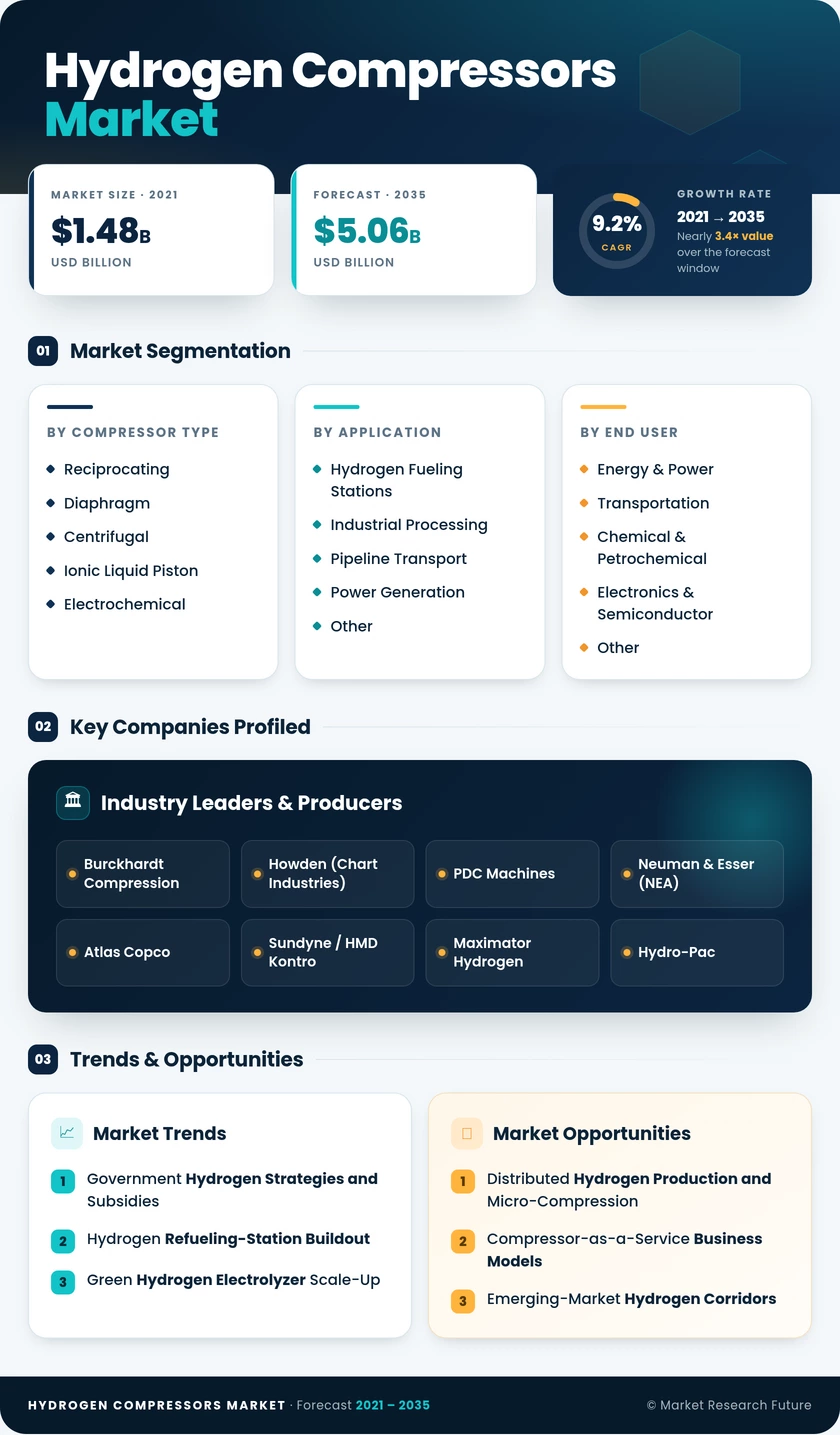
Hydrogen Compressors Market (2026 - 2035)

ID: MRFR/EnP/20361-HCR
128 Pages
Garvit Vyas
Last Updated: July 28, 2026
Hydrogen Compressors Market Research Report By Compressor Type (Reciprocating, Diaphragm, Centrifugal, Ionic Liquid Piston, Electrochemical), By Application (Hydrogen Fueling Stations, Industrial Processing, Pipeline Transport, Power Generation, Other (Electronics, Labs)), By End User (Energy & Power, Transportation, Chemical & Petrochemical, Electronics & Semiconductor, Other) and By Regional (North America, Europe, South America, Asia Pacific, Middle East and Africa) - Industry Forecast to 2035
Hydrogen Compressors Market
Market Size
Forecast Period2026-2035
CAGR (2026-2035)9.2%
2025 Market SizeUSD 2.10 Billion
2035 Market SizeUSD 5.06 Billion
Key Players
Burckhardt Compression
Howden
PDC Machines
Neuman & Esser
Atlas Copco
Sundyne / HMD Kontro
Opportunities
  • Distributed Hydrogen Production and Micro-Compression
  • Compressor-as-a-Service Business Models
  • Emerging-Market Hydrogen Corridors
  1. 1 Market Overview |
    1. 1.1 Study Assumptions & Market Definition |
    2. 1.2 Scope of the Study |
    3. 1.3 Research Methodology
  2. 2 Market Summary & Key Takeaways
  3. 3 Market Dynamics |
    1. 3.1 Market Drivers Analysis | |
      1. 3.1.1 Government Hydrogen Strategies & Subsidies | |
      2. 3.1.2 Hydrogen Refueling-Station Buildout | |
      3. 3.1.3 Green Hydrogen Electrolyzer Scale-Up | |
      4. 3.1.4 Pipeline Repurposing & Hydrogen Backbone Plans | |
      5. 3.1.5 Heavy-Duty Fuel-Cell Vehicle Adoption | |
      6. 3.1.6 Industrial Decarbonization Mandates | |
      7. 3.1.7 Offshore Wind-to-Hydrogen Integration |
    2. 3.2 Market Restraints Analysis | |
      1. 3.2.1 High Capital and Energy Costs | |
      2. 3.2.2 Limited Hydrogen-Specific Codes & Standards | |
      3. 3.2.3 Supply-Chain Bottlenecks for Specialty Alloys | |
      4. 3.2.4 Gray Hydrogen Price Competitiveness | |
      5. 3.2.5 Skilled-Workforce Shortages |
    3. 3.3 Market Opportunity Analysis | |
      1. 3.3.1 Distributed Hydrogen Production & Micro-Compression | |
      2. 3.3.2 Compressor-as-a-Service Business Models | |
      3. 3.3.3 Emerging-Market Hydrogen Corridors | |
      4. 3.3.4 Offshore Wind-to-Hydrogen Integration | |
      5. 3.3.5 Data-Driven Compressor Fleet Optimization |
    4. 3.4 Industry Value Chain Analysis |
    5. 3.5 Porter's Five Forces Analysis
  4. 4 Global Hydrogen Compressors Market Size & Forecast (2021–2035) |
    1. 4.1 Historical Market Size (2021–2025) |
    2. 4.2 Current & Forecast Market Size (2026–2035) |
    3. 4.3 Market Size by Revenue (USD Billion) |
    4. 4.4 Year-over-Year Growth Analysis
  5. 5 Segmentation Analysis |
    1. 5.1 By Compressor Type | |
      1. 5.1.1 Reciprocating | |
      2. 5.1.2 Diaphragm | |
      3. 5.1.3 Centrifugal | |
      4. 5.1.4 Ionic Liquid Piston | |
      5. 5.1.5 Electrochemical |
    2. 5.2 By Application | |
      1. 5.2.1 Hydrogen Fueling Stations | |
      2. 5.2.2 Industrial Processing | |
      3. 5.2.3 Pipeline Transport | |
      4. 5.2.4 Power Generation | |
      5. 5.2.5 Other (Electronics, Labs) |
    3. 5.3 By End User | |
      1. 5.3.1 Energy & Power | |
      2. 5.3.2 Transportation | |
      3. 5.3.3 Chemical & Petrochemical | |
      4. 5.3.4 Electronics & Semiconductor | |
      5. 5.3.5 Other
  6. 6 Regional Analysis |
    1. 6.1 North America | |
      1. 6.1.1 United States | |
      2. 6.1.2 Canada | |
      3. 6.1.3 Mexico |
    2. 6.2 Europe | |
      1. 6.2.1 Germany | |
      2. 6.2.2 Netherlands | |
      3. 6.2.3 France | |
      4. 6.2.4 United Kingdom |
    3. 6.3 Asia-Pacific | |
      1. 6.3.1 Japan | |
      2. 6.3.2 South Korea | |
      3. 6.3.3 China | |
      4. 6.3.4 Australia |
    4. 6.4 South America | |
      1. 6.4.1 Chile | |
      2. 6.4.2 Brazil | |
      3. 6.4.3 Argentina |
    5. 6.5 Middle East & Africa | |
      1. 6.5.1 Saudi Arabia | |
      2. 6.5.2 UAE | |
      3. 6.5.3 South Africa
  7. 7 Competitive Landscape |
    1. 7.1 Market Share Analysis (2025) |
    2. 7.2 Competitive Benchmarking Matrix |
    3. 7.3 Company Profiles | |
      1. 7.3.1 Burckhardt Compression | |
      2. 7.3.2 Howden (Chart Industries) | |
      3. 7.3.3 PDC Machines | |
      4. 7.3.4 Neuman & Esser (NEA) | |
      5. 7.3.5 Atlas Copco | |
      6. 7.3.6 Sundyne / HMD Kontro | |
      7. 7.3.7 Maximator Hydrogen | |
      8. 7.3.8 Hydro-Pac | |
      9. 7.3.9 HyET Hydrogen | |
      10. 7.3.10 Mehrer Compression
  8. 8 Future Outlook & Strategic Recommendations (2026–2035) |
    1. 8.1 AI-Enabled Compressor Operations |
    2. 8.2 Electrification and Efficiency Supercycle |
    3. 8.3 Hydrogen Pipeline Economy of Scale |
    4. 8.4 ESG and Sustainability Reporting Pressure
  9. 9 Recent Developments & News
  10. 10 Frequently Asked Questions (FAQs)
  11. 11 Report Scope & Methodology |
    1. 11.1 Study Period & Base Year |
    2. 11.2 Data Sources & Citations |
    3. 11.3 Abbreviations
  12. 12 LIST OF TABLES |
  13. TABLE 1 Global Hydrogen Compressors Market Size & Forecast, by Revenue (USD Billion), 2021–2035 |
  14. TABLE 2 Global Hydrogen Compressors Market — Year-over-Year Growth Analysis, 2021–2035 |
  15. TABLE 3 Global Hydrogen Compressors Market — Driver Impact Analysis |
  16. TABLE 4 Global Hydrogen Compressors Market — Restraint Impact Analysis |
  17. TABLE 5 Global Hydrogen Compressors Market Size, by Compressor Type, 2021–2035 (USD Billion) |
  18. TABLE 6 Global Hydrogen Compressors Market Size, by Application, 2021–2035 (USD Billion) |
  19. TABLE 7 Global Hydrogen Compressors Market Size, by End User, 2021–2035 (USD Billion) |
  20. TABLE 8 Global Hydrogen Compressors Market Size, by Region, 2021–2035 (USD Billion) |
  21. TABLE 9 North America Hydrogen Compressors Market Size, by Country, 2021–2035 (USD Billion) |
  22. TABLE 10 Europe Hydrogen Compressors Market Size, by Country, 2021–2035 (USD Billion) |
  23. TABLE 11 Asia-Pacific Hydrogen Compressors Market Size, by Country, 2021–2035 (USD Billion) |
  24. TABLE 12 South America Hydrogen Compressors Market Size, by Country, 2021–2035 (USD Billion) |
  25. TABLE 13 Middle East & Africa Hydrogen Compressors Market Size, by Country, 2021–2035 (USD Billion) |
  26. TABLE 14 Regional Summary — Hydrogen Compressors Market Key Metrics & Investment Themes |
  27. TABLE 15 Competitive Benchmarking Matrix — Global Hydrogen Compressors Market, 2025 |
  28. TABLE 16 Company Profiles — Key Players, Global Hydrogen Compressors Market |
  29. TABLE 17 Recent Developments & Strategic Announcements, 2023–2025 |
  30. TABLE 18 Report Scope & Methodology Summary |
  31. TABLE 19 Detailed Sources and Citations |
  32. TABLE 20 North America Hydrogen Compressors Market Size, by Compressor Type, 2021–2035 (USD Billion) |
  33. TABLE 21 North America Hydrogen Compressors Market Size, by Application, 2021–2035 (USD Billion) |
  34. TABLE 22 North America Hydrogen Compressors Market Size, by End User, 2021–2035 (USD Billion) |
  35. TABLE 23 Europe Hydrogen Compressors Market Size, by Compressor Type, 2021–2035 (USD Billion) |
  36. TABLE 24 Europe Hydrogen Compressors Market Size, by Application, 2021–2035 (USD Billion) |
  37. TABLE 25 Europe Hydrogen Compressors Market Size, by End User, 2021–2035 (USD Billion) |
  38. TABLE 26 Asia-Pacific Hydrogen Compressors Market Size, by Compressor Type, 2021–2035 (USD Billion) |
  39. TABLE 27 Asia-Pacific Hydrogen Compressors Market Size, by Application, 2021–2035 (USD Billion) |
  40. TABLE 28 Asia-Pacific Hydrogen Compressors Market Size, by End User, 2021–2035 (USD Billion) |
  41. TABLE 29 South America Hydrogen Compressors Market Size, by Compressor Type, 2021–2035 (USD Billion) |
  42. TABLE 30 South America Hydrogen Compressors Market Size, by Application, 2021–2035 (USD Billion) |
  43. TABLE 31 South America Hydrogen Compressors Market Size, by End User, 2021–2035 (USD Billion) |
  44. TABLE 32 Middle East & Africa Hydrogen Compressors Market Size, by Compressor Type, 2021–2035 (USD Billion) |
  45. TABLE 33 Middle East & Africa Hydrogen Compressors Market Size, by Application, 2021–2035 (USD Billion) |
  46. TABLE 34 Middle East & Africa Hydrogen Compressors Market Size, by End User, 2021–2035 (USD Billion)
  47. 13 LIST OF FIGURES |
  48. FIGURE 1 Global Hydrogen Compressors Market Dynamics — Drivers, Restraints & Opportunities |
  49. FIGURE 2 Industry Value Chain Analysis — Hydrogen Compressors Market |
  50. FIGURE 3 Porter's Five Forces Analysis — Hydrogen Compressors Market |
  51. FIGURE 4 Global Hydrogen Compressors Market Size Trend (USD Billion), 2021–2035 |
  52. FIGURE 5 Global Hydrogen Compressors Market Share, by Compressor Type, 2025 (%) |
  53. FIGURE 6 Global Hydrogen Compressors Market Share, by Application, 2025 (%) |
  54. FIGURE 7 Global Hydrogen Compressors Market Share, by End User, 2025 (%) |
  55. FIGURE 8 Global Hydrogen Compressors Market Share, by Region, 2025 (%) |
  56. FIGURE 9 North America Hydrogen Compressors Market Share, by Country, 2025 (%) |
  57. FIGURE 10 Europe Hydrogen Compressors Market Share, by Country, 2025 (%) |
  58. FIGURE 11 Asia-Pacific Hydrogen Compressors Market Share, by Country, 2025 (%) |
  59. FIGURE 12 South America Hydrogen Compressors Market Share, by Country, 2025 (%) |
  60. FIGURE 13 Middle East & Africa Hydrogen Compressors Market Share, by Country, 2025 (%) |
  61. FIGURE 14 Competitive Landscape — Market Share Analysis, 2025 |
  62. FIGURE 15 Competitive Positioning Matrix — Key Players, Hydrogen Compressors Market

Segmentation Quick Reference

DimensionSub-SegmentsDominant SegmentFastest Growing Segment
Compressor TypeReciprocating, Diaphragm, Centrifugal, Ionic Liquid Piston, ElectrochemicalReciprocating (42% share)Ionic Liquid Piston (CAGR 13.1%)
ApplicationHydrogen Fueling Stations, Industrial Processing, Pipeline Transport, Power Generation, OtherHydrogen Fueling Stations (35% share)Pipeline Transport (CAGR 10.6%)
End UserEnergy & Power, Transportation, Chemical & Petrochemical, Electronics & Semiconductor, OtherEnergy & Power (32% share)Transportation (CAGR 11.9%)


Market Segmentation Overview

By Compressor Type

Sub-SegmentKey Trend
ReciprocatingRemains default for brownfield refinery and station projects; incremental efficiency improvements.
DiaphragmRapid adoption for PEM fuel-cell-grade purity requirements
CentrifugalGrowing demand from pipeline-injection and large-storage facilities
Ionic Liquid PistonCommercializing as compact, low-vibration alternative for urban stations
ElectrochemicalEmerging solid-state technology for silent, distributed refueling installations.


Output pressure, throughput, purity requirements, and site footprint drive compressor-type selection. Reciprocating units dominate installed base, while diaphragm and ionic liquid piston technologies are capturing the majority of new station orders.

By Application

Sub-SegmentKey Trend
Hydrogen Fueling StationsFastest-growing application; driven by global station-count mandates
Industrial ProcessingStable legacy demand from refineries and ammonia plants
Pipeline TransportEmerging rapidly with European and U.S. hydrogen backbone projects
Power GenerationGrowing modestly via hydrogen-blending demonstrations in gas turbines
Other (Electronics, Labs)Niche but steady demand for ultra-pure research and semiconductor use


Station applications are outpacing industrial processing in growth rate as governments commit to refueling-network buildouts across North America, Europe, and Asia-Pacific.

By End User

Sub-SegmentKey Trend
Energy & PowerLargest end-user segment; power-to-gas and grid-scale storage
TransportationFastest-growing; fuel-cell vehicle fleet expansion
Chemical & PetrochemicalMature demand; refinery hydrocracking and ammonia synthesis
Electronics & SemiconductorSpecialized ultra-pure hydrogen for chip fabrication
OtherResearch institutions, food-processing, and specialty-gas applications


Transportation end users are growing fastest as fuel-cell vehicles transition from demonstration fleets to commercial production volumes, supported by government purchase incentives and station mandates.


You’ve used 75% of your weekly limit.

Download PDF ×

We do not share your information with anyone. However, we may send you emails based on your report interest from time to time. You may contact us at any time to opt-out.