Download Free Sample
Kindly complete the form below to receive a free sample of this Report
Hydrogen Fuel Cell Equipment MRO Services Market Research Report By End Use (Automotive, Aerospace, Industrial, Residential, Commercial), By Technology (Proton Exchange Membrane, Solid Oxide, Alkaline, Direct Methanol, Reversible Fuel Cells), By Application (Power Generation, Transportation, Stationary Energy Storage, Portable Power, Backup Power), By Service Type (Maintenance, Repair, Overhaul, Inspection, Installation) And By Region (North America, Europe, Asia-Pacific, And Rest Of The World) – Market Forecast Till 2035.
As per MRFR analysis, the Hydrogen Fuel Cell Equipment MRO Services Market was estimated at 12.0 USD Billion in 2024. The hydrogen fuel cell equipment MRO services industry is projected to grow from 12.83 USD Billion in 2025 to 25.0 USD Billion by 2035, exhibiting a compound annual growth rate (CAGR) of 6.9% during the forecast period 2025 - 2035.
The Hydrogen Fuel Cell Equipment MRO Services Market is poised for substantial growth driven by technological advancements and increasing demand for clean energy solutions.
| 2024 Market Size | 12.0 (USD Billion) |
| 2035 Market Size | 25.0 (USD Billion) |
| CAGR (2025 - 2035) | 6.9% |
Ballard Power Systems (CA), Plug Power (US), FuelCell Energy (US), Hydrogenics (CA), ITM Power (GB), Nel ASA (NO), PowerCell Sweden AB (SE), Ceres Media (GB)
Our Impact
Enabled $4.3B Revenue Impact for Fortune 500 and Leading Multinationals
Partnering with 2000+ Global Organizations Each Year
30K+ Citations by Top-Tier Firms in the Industry
The Hydrogen Fuel Cell Equipment MRO Services Market is currently experiencing a notable evolution, driven by the increasing adoption of hydrogen fuel cell technologies across various sectors. This market encompasses maintenance, repair, and operations services specifically tailored for hydrogen fuel cell systems, which are gaining traction due to their potential to provide clean energy solutions. As industries seek to reduce their carbon footprints, the demand for reliable MRO services is likely to grow, ensuring that hydrogen fuel cell equipment operates efficiently and safely. Furthermore, advancements in technology and a growing emphasis on sustainability appear to be influencing the market dynamics, leading to innovative service offerings that enhance operational performance. In addition, the Hydrogen Fuel Cell Equipment MRO Services Market is characterized by a diverse range of stakeholders, including manufacturers, service providers, and end-users. Collaboration among these entities seems to be essential for fostering growth and addressing the challenges associated with maintenance and repair of hydrogen fuel cell systems. The market's future may hinge on the ability of service providers to adapt to evolving technologies and customer needs, thereby ensuring that they remain competitive in a rapidly changing landscape. Overall, the Hydrogen Fuel Cell Equipment MRO Services Market is poised for growth, driven by technological advancements and a collective commitment to sustainable energy solutions.
The Hydrogen Fuel Cell Equipment MRO Services Market is witnessing a surge in technological innovations that enhance maintenance and repair processes. Automation and predictive analytics are becoming integral, allowing service providers to anticipate equipment failures and optimize service schedules. This trend not only improves operational efficiency but also reduces downtime, which is crucial for industries relying on hydrogen fuel cells.
Growing environmental concerns and stringent regulations are shaping the Hydrogen Fuel Cell Equipment MRO Services Market. Companies are increasingly prioritizing sustainable practices, which influences their choice of MRO services. This trend indicates a shift towards eco-friendly maintenance solutions that align with global efforts to combat climate change and promote cleaner energy alternatives.
The Hydrogen Fuel Cell Equipment MRO Services Market is evolving into a collaborative ecosystem where manufacturers, service providers, and end-users work closely together. This trend suggests that partnerships and alliances are becoming essential for addressing the complexities of hydrogen fuel cell maintenance. Such collaborations may lead to shared knowledge, improved service offerings, and enhanced customer satisfaction.
Government initiatives and incentives aimed at promoting hydrogen technologies seem to bolster the Hydrogen Fuel Cell Equipment MRO Services Market. Various countries have introduced subsidies, tax breaks, and funding programs to encourage the development and deployment of hydrogen fuel cells. For instance, the European Union has allocated substantial funds to support hydrogen projects, which could lead to an increase in the number of hydrogen fuel cell installations. This, in turn, is likely to create a corresponding demand for MRO services, as operators seek to maintain and optimize their equipment.
The heightened focus on energy security and diversification of energy sources seems to influence the Hydrogen Fuel Cell Equipment MRO Services Market positively. As countries seek to reduce dependence on fossil fuels, hydrogen fuel cells are emerging as a viable alternative. This shift is likely to result in increased investments in hydrogen infrastructure, including production, storage, and distribution systems. Consequently, the demand for MRO services to maintain and optimize these systems is expected to grow, as operators prioritize reliability and efficiency in their energy solutions.
The increasing The Hydrogen Fuel Cell Equipment MRO Services Industry. As nations strive to meet carbon neutrality goals, the adoption of hydrogen fuel cells is likely to surge. This shift is evidenced by the projected growth of the hydrogen fuel cell market, which is expected to reach USD 25 billion by 2030. Consequently, the demand for maintenance, repair, and operations services for hydrogen fuel cell equipment is anticipated to rise, necessitating specialized MRO services to ensure optimal performance and longevity of these systems.
Technological advancements in maintenance and repair practices are likely to enhance the efficiency of the Hydrogen Fuel Cell Equipment MRO Services Market. Innovations such as predictive maintenance, powered by artificial intelligence and machine learning, could enable operators to anticipate equipment failures and schedule timely interventions. This proactive approach may reduce downtime and extend the lifespan of hydrogen fuel cell systems. As these technologies become more integrated into MRO services, the overall effectiveness and reliability of hydrogen fuel cell operations are expected to improve, further driving market growth.
The expansion of industrial applications for hydrogen fuel cells appears to be a significant driver for the Hydrogen Fuel Cell Equipment MRO Services Market. Industries such as transportation, power generation, and manufacturing are increasingly adopting hydrogen fuel cells for their operational needs. For example, the transportation sector is witnessing a shift towards hydrogen-powered vehicles, which could lead to a substantial increase in fuel cell installations. This trend necessitates robust MRO services to ensure that equipment operates efficiently and meets regulatory standards, thereby fostering market growth.
In the Hydrogen Fuel Cell Equipment MRO Services Market, the 'Application' segment reveals distinct distributions among its categories. Power Generation stands out as the largest segment, largely due to its extensive use in renewable energy systems and hybrid applications. Conversely, while still significant, the Transportation sector has been gaining momentum as consumers and businesses increasingly adopt hydrogen fuel cell technologies for vehicles, resulting in a notable shift in market dynamics.
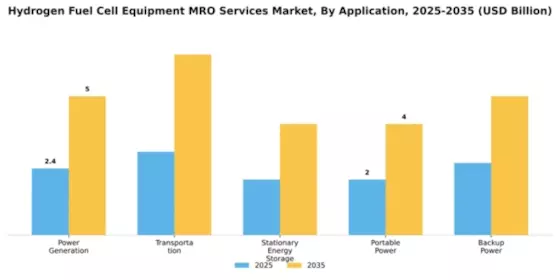
Power Generation (Dominant) vs. Transportation (Emerging)
The Power Generation segment is characterized by its wide-ranging applications in energy generation, significantly bolstered by governmental incentives for cleaner energy solutions. This segment leverages established hydrogen fuel cell technology, ensuring reliability and efficiency. In contrast, the Transportation segment is emerging as a dynamic force in the market, fueled by advancements in fuel cell technology and increasing investments from automotive manufacturers. It represents a shift towards sustainable transport options, playing a critical role in reducing carbon emissions and enhancing energy security. As infrastructure develops, this segment is expected to expand rapidly, reflecting evolving consumer preferences and regulatory support.
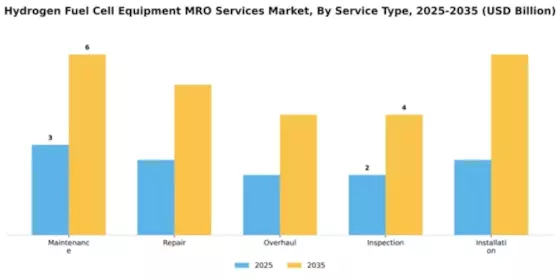
In the Hydrogen Fuel Cell Equipment MRO Services Market, the distribution of service types showcases a robust commitment to maintenance as the largest segment, reflecting its critical role in ensuring optimal operational efficiency. The maintenance segment encompasses a wide array of services, focusing on routine checks and preventive measures to uphold the reliability of hydrogen fuel cell systems. On the other hand, the repair segment, characterized by its swift growth, highlights the rising demand for prompt service interventions, motivated by the increasing complexity and intricacy of hydrogen fuel cell technologies.
Maintenance (Dominant) vs. Repair (Emerging)
Maintenance services dominate the Hydrogen Fuel Cell Equipment MRO Services Market due to their crucial role in facilitating uninterrupted performance and extending the lifespan of fuel cell systems. This segment is integral as operators seek to maintain peak efficiency and avoid costly downtime. Conversely, the repair services are emerging as a crucial part of the landscape fueled by the escalating incidence of system failures and the necessity for rapid restoration of service. As fuel cell technology advances, repair services are adapting and evolving to meet new challenges, thus playing a pivotal role in sustaining the overall system efficacy.
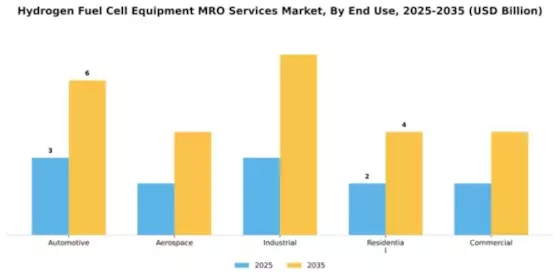
In the Hydrogen Fuel Cell Equipment MRO Services Market, the automotive sector holds the largest market share, driven by the growing adoption of hydrogen fuel cell technologies in vehicles. This segment benefits from significant investments by automotive manufacturers in developing fuel cell vehicles and infrastructure, leading to a robust service demand. Following closely, the aerospace segment is emerging rapidly, with increased interest from aircraft manufacturers in hydrogen as a sustainable fuel for aviation, anticipating a surge in MRO service needs.
Automotive: Dominant vs. Aerospace: Emerging
The automotive sector stands out as the dominant player in the Hydrogen Fuel Cell Equipment MRO Services Market, primarily due to robust investments in hydrogen fuel cell vehicles. Major automotive manufacturers are focusing on innovative fuel cell technologies, seeking to meet regulatory pressures for cleaner transportation. In contrast, the aerospace sector is categorized as an emerging segment, driven by innovations in hydrogen-powered aircraft. While still in its infancy, the push for decarbonization in aviation is propelling the demand for MRO services as manufacturers explore hydrogen fuel cells as viable alternatives to conventional aviation fuels. This dynamic creates a unique landscape where established automotive practices are met with transformative aerospace innovations.
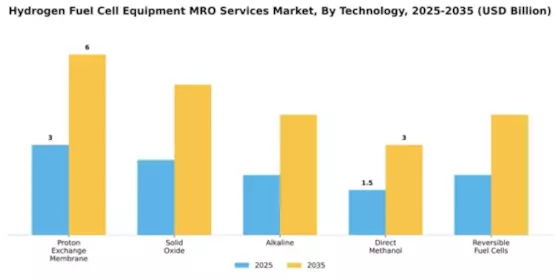
The Hydrogen Fuel Cell Equipment MRO Services Market is experiencing a diverse distribution of market share among various technologies. Proton Exchange Membrane (PEM) fuel cells hold a substantial share due to their high efficiency and suitability for a range of applications. In contrast, Solid Oxide fuel cells are gaining traction thanks to their efficiency in stationary power generation, making them a competitive player in the market. While PEM technology remains dominant, Solid Oxide is rapidly catching up, particularly in the commercial sector. Growth trends in this segment are driven by advancements in fuel cell technology, favorable government policies promoting clean energy, and increasing investments in renewable energy sources. Proton Exchange Membrane technology continues to benefit from expanding applications in transportation and portable power systems. Solid Oxide fuel cells, meanwhile, are on the rise due to their long-term durability and ability to utilize a variety of fuels, positioning them as key technology for future energy solutions.
Technology: Proton Exchange Membrane (Dominant) vs. Solid Oxide (Emerging)
Proton Exchange Membrane fuel cells are recognized as the dominant technology in the Hydrogen Fuel Cell Equipment MRO Services Market. They are favored for their rapid startup times, lightweight design, and high power density, making them ideal for applications in transportation, including vehicles and portable power sources. Their widespread use has also spurred ongoing research and development, enhancing their efficiency and overall performance. Conversely, Solid Oxide fuel cells are emerging as a robust alternative technology, particularly in stationary energy generation. They offer high efficiency and the capability to operate on a range of fuels, contributing to their growing appeal in various industrial applications. As energy companies focus on transitioning to cleaner technologies, Solid Oxide fuel cells are expected to gain market share due to their versatility and economic potential.
Get more detailed insights about Hydrogen Fuel Cell Equipment MRO Services Market Request Free Sample
North America is poised to maintain its leadership in the Hydrogen Fuel Cell Equipment MRO Services Market, holding a market size of $6.0 billion in 2025. The region benefits from robust government incentives, technological advancements, and a growing demand for clean energy solutions. Regulatory frameworks are increasingly supportive, driving investments in hydrogen infrastructure and services, which are crucial for meeting climate goals. The competitive landscape is characterized by key players such as Plug Power, Ballard Power Systems, and FuelCell Energy, which are at the forefront of innovation. The U.S. and Canada are leading countries, with significant investments in hydrogen technologies. The presence of established companies and a favorable regulatory environment further enhance market growth, making North America a hub for hydrogen MRO services.
Europe is rapidly evolving in the Hydrogen Fuel Cell Equipment MRO Services Market, with a market size of $3.0 billion projected for 2025. The region's growth is driven by stringent environmental regulations and ambitious sustainability targets set by the European Union. Countries are increasingly investing in hydrogen technologies as part of their green transition strategies, creating a favorable environment for MRO services. Leading countries like Germany, France, and the UK are spearheading initiatives to enhance hydrogen infrastructure. Key players such as ITM Power and Nel ASA are pivotal in this landscape, contributing to technological advancements and service offerings. The competitive environment is intensifying as more companies enter the market, driven by the need for sustainable energy solutions and regulatory support.
Asia-Pacific is witnessing a burgeoning interest in the Hydrogen Fuel Cell Equipment MRO Services Market, with a projected market size of $2.5 billion by 2025. The region's growth is fueled by increasing energy demands, government initiatives promoting clean energy, and advancements in hydrogen technology. Countries are focusing on reducing carbon emissions, which is driving the adoption of hydrogen solutions in various sectors. Leading countries such as Japan, South Korea, and China are at the forefront of this transition, with significant investments in hydrogen infrastructure. The competitive landscape includes key players like PowerCell Sweden AB and Hydrogenics, which are enhancing service capabilities. As the region embraces hydrogen as a viable energy source, the MRO services market is expected to expand significantly, supported by favorable policies and technological innovations.
The Middle East and Africa region is in the nascent stages of developing the Hydrogen Fuel Cell Equipment MRO Services Market, with a market size of $0.5 billion anticipated by 2025. The region's growth is driven by increasing energy diversification efforts and the need for sustainable energy solutions. Governments are beginning to recognize hydrogen's potential in achieving energy security and reducing carbon footprints. Countries like South Africa and the UAE are exploring hydrogen technologies, supported by investments in renewable energy projects. The competitive landscape is still developing, with a few key players beginning to establish their presence. As the region focuses on diversifying its energy sources, the hydrogen MRO services market is expected to gain traction, driven by both local and international investments.
The Hydrogen Fuel Cell Equipment MRO Services Market is currently characterized by a dynamic competitive landscape, driven by increasing demand for sustainable energy solutions and advancements in hydrogen technology. Key players such as Ballard Power Systems (CA), Plug Power (US), and FuelCell Energy (US) are strategically positioning themselves through innovation and partnerships. For instance, Ballard Power Systems (CA) focuses on enhancing its fuel cell technology, while Plug Power (US) emphasizes expanding its service offerings and geographic reach. These strategies collectively contribute to a competitive environment that is increasingly focused on technological advancement and market penetration.In terms of business tactics, companies are localizing manufacturing and optimizing supply chains to enhance operational efficiency. The market appears moderately fragmented, with several key players exerting influence over their respective segments. This fragmentation allows for a variety of approaches to MRO services, with companies leveraging their unique strengths to capture market share and respond to regional demands.
In November Plug Power (US) announced a strategic partnership with a leading logistics company to enhance its hydrogen fuel cell deployment in the logistics sector. This collaboration is expected to streamline operations and improve the efficiency of hydrogen supply chains, thereby reinforcing Plug Power's position as a leader in the market. The strategic importance of this partnership lies in its potential to accelerate the adoption of hydrogen solutions in logistics, a sector that is increasingly seeking sustainable alternatives.
In October FuelCell Energy (US) launched a new service initiative aimed at providing comprehensive maintenance and support for its fuel cell systems. This initiative is designed to enhance customer satisfaction and ensure the longevity of their systems. By focusing on customer-centric services, FuelCell Energy (US) aims to differentiate itself in a competitive market, indicating a shift towards service-oriented strategies that complement product offerings.
In September Nel ASA (NO) expanded its production capacity by investing in a new manufacturing facility in Europe. This expansion is significant as it positions Nel ASA (NO) to meet the growing demand for hydrogen solutions in the European market. The strategic move underscores the importance of scaling operations to maintain competitive advantage and respond to regional market dynamics.
As of December current trends in the Hydrogen Fuel Cell Equipment MRO Services Market indicate a strong emphasis on digitalization, sustainability, and AI integration. Strategic alliances are increasingly shaping the competitive landscape, allowing companies to pool resources and expertise. Looking ahead, competitive differentiation is likely to evolve from traditional price-based competition to a focus on innovation, technology, and supply chain reliability, reflecting the industry's shift towards more sustainable and efficient energy solutions.





The Hydrogen Fuel Cell Equipment MRO Services Market is projected to grow at a 6.9% CAGR from 2025 to 2035, driven by increasing demand for clean energy solutions and technological advancements.
New opportunities lie in:
By 2035, the market is expected to be robust, driven by innovation and strategic partnerships.
| MARKET SIZE 2024 | 12.0(USD Billion) |
| MARKET SIZE 2025 | 12.83(USD Billion) |
| MARKET SIZE 2035 | 25.0(USD Billion) |
| COMPOUND ANNUAL GROWTH RATE (CAGR) | 6.9% (2025 - 2035) |
| REPORT COVERAGE | Revenue Forecast, Competitive Landscape, Growth Factors, and Trends |
| BASE YEAR | 2024 |
| Market Forecast Period | 2025 - 2035 |
| Historical Data | 2019 - 2024 |
| Market Forecast Units | USD Billion |
| Key Companies Profiled | Ballard Power Systems (CA), Plug Power (US), FuelCell Energy (US), Hydrogenics (CA), ITM Power (GB), Nel ASA (NO), PowerCell Sweden AB (SE), Ceres Media (GB) |
| Segments Covered | Application, Service Type, End Use, Technology |
| Key Market Opportunities | Growing demand for sustainable energy solutions drives innovation in Hydrogen Fuel Cell Equipment MRO Services Market. |
| Key Market Dynamics | Rising demand for sustainable energy solutions drives growth in Hydrogen Fuel Cell Equipment Maintenance, Repair, and Overhaul Services. |
| Countries Covered | North America, Europe, APAC, South America, MEA |
The market is projected to reach a valuation of 25.0 USD Billion by 2035.
The market valuation was 12.0 USD Billion in 2024.
The expected CAGR for the market during this period is 6.9%.
The Transportation segment is anticipated to reach 6.5 USD Billion by 2035.
The Maintenance service type is projected to reach 6.0 USD Billion by 2035.
The Industrial end-use segment is expected to grow to 7.0 USD Billion by 2035.
The Proton Exchange Membrane technology is projected to reach 6.0 USD Billion by 2035.
Key players include Ballard Power Systems, Plug Power, and FuelCell Energy, among others.
The Backup Power application segment is expected to reach 5.0 USD Billion by 2035.
The Overhaul service type is projected to reach 4.0 USD Billion by 2035.



Kindly complete the form below to receive a free sample of this Report

“This is really good guys. Excellent work on a tight deadline. I will continue to use you going forward and recommend you to others. Nice job”


“Thanks. It’s been a pleasure working with you, please use me as reference with any other Intel employees.”


“Thanks for sending the report it gives us a good global view of the Betaïne market.”


“Thank you, this will be very helpful for OQS.”


“We found the report very insightful! we found your research firm very helpful. I'm sending this email to secure our future business.”


“I am very pleased with how market segments have been defined in a relevant way for my purposes (such as "Portable Freezers & refrigerators" and "last-mile"). In general the report is well structured. Thanks very much for your efforts.”


“I have been reading the first document or the study, ,the Global HVAC and FP market report 2021 till 2026. Must say, good info! I have not gone in depth at all parts, but got a good indication of the data inside!”


“We got the report in time, we really thank you for your support in this process. I also thank to all of your team as they did a great job.”


“The Automotive 48V ECU Components Procurement Intelligence Study” was a complex project, but the Market Research Future (MRFR) team handled it with quality, agility, and customer-centricity. They delivered all requested data on time and within the agreed scope. The team, including Shubhendra Anand and Rahul Gotadki, was always readily available to clarify questions and swiftly implement necessary adjustments, driving the project to a successful conclusion within a very demanding timeframe.
I would also like to specifically commend Akshay Agarwal for his responsiveness and support at every stage—from our initial inquiry on May 6th through to final delivery on June 18th. His dedication made the entire process seamless.”



