Download Free Sample
Kindly complete the form below to receive a free sample of this Report
India Buy Now Pay Later Services Market Size, Share and Research Report By Channel (Online and POS), By Enterprise (Large Enterprise and Small & medium enterprise), By End-user (Consumer Electronics, Fashion & Garments, Healthcare, Leisure & Entertainment, Retail, and Other End-Users), - India Industry Forecast Till 2035
As per analysis, the India Buy Now Pay Later Services Market is projected to grow from USD 5.13 Billion in 2025 to USD 9.35 Billion by 2035, exhibiting a compound annual growth rate (CAGR) of 6.25% during the forecast period (2025 - 2035).
The India Buy Now Pay Later Services Market is experiencing robust growth driven by evolving consumer preferences and technological advancements.
| 2024 Market Size | 4.8 (USD Billion) |
| 2035 Market Size | 9.35 (USD Billion) |
| CAGR (2025 - 2035) | 6.25% |
Paytm (IN), Klarna (SE), ZestMoney (IN), LazyPay (IN), Simpl (IN), Cashify (IN), ePayLater (IN), HDFC Bank (IN)
Our Impact
Enabled $4.3B Revenue Impact for Fortune 500 and Leading Multinationals
Partnering with 2000+ Global Organizations Each Year
30K+ Citations by Top-Tier Firms in the Industry
The India Buy Now Pay Later Services Market is currently experiencing a notable transformation, driven by a combination of technological advancements and changing consumer preferences. As digital payment solutions gain traction, consumers are increasingly inclined to utilize flexible payment options that allow them to manage their finances more effectively. This trend appears to be particularly pronounced among younger demographics, who are more comfortable with online transactions and seek convenience in their purchasing experiences. Furthermore, the rise of e-commerce platforms in India has created a fertile ground for Buy Now Pay Later services, as these platforms often integrate such payment options to enhance customer satisfaction and drive sales. In addition to the growing acceptance of digital payments, regulatory frameworks are evolving to accommodate the burgeoning Buy Now Pay Later sector. The Indian government and financial authorities are reportedly exploring guidelines that could foster responsible lending practices while ensuring consumer protection. This regulatory attention may lead to increased trust among consumers, potentially expanding the market further. As the landscape continues to evolve, it is likely that the India Buy Now Pay Later Services Market will witness further innovations and partnerships, ultimately reshaping the way consumers approach their purchasing decisions.
The India Buy Now Pay Later Services Market is witnessing a surge in adoption, particularly among younger consumers. This demographic is increasingly inclined to utilize flexible payment options, as they prioritize convenience and financial management. The integration of these services into e-commerce platforms further enhances their appeal, making it easier for young shoppers to access and utilize such payment methods.
Technological advancements are playing a crucial role in the evolution of the India Buy Now Pay Later Services Market. The integration of artificial intelligence and machine learning into payment systems is enhancing user experience and risk assessment. This innovation not only streamlines the application process but also improves the overall efficiency of transactions, making it more attractive for consumers.
The regulatory environment surrounding the India Buy Now Pay Later Services Market is undergoing significant changes. Authorities are exploring frameworks that promote responsible lending and consumer protection. This evolving landscape may instill greater confidence among consumers, potentially leading to increased market participation and a more sustainable growth trajectory.
The emergence of fintech companies is a pivotal driver in the India Buy Now Pay Later Services Market. These companies are leveraging technology to offer innovative financial solutions that cater to the needs of the modern consumer. In 2025, the number of fintech startups in India surpassed 2,000, with many focusing on providing Buy Now Pay Later services. This influx of competition is not only enhancing service offerings but also driving down costs for consumers. As these fintech firms continue to innovate and expand their reach, they are likely to play a crucial role in shaping the future landscape of the India Buy Now Pay Later Services Market.
The expanding middle-class population in India is a significant driver of the Buy Now Pay Later Services Market. With an estimated 600 million individuals classified as middle class by 2025, this demographic is increasingly seeking accessible credit options to enhance their purchasing power. The rise in disposable income among this group is likely to fuel demand for Buy Now Pay Later services, as consumers look for ways to manage their expenses without compromising on quality. This trend is expected to bolster the growth of the India Buy Now Pay Later Services Market, as more retailers adopt these payment solutions to cater to the evolving needs of the middle class.
The India Buy Now Pay Later Services Market is experiencing a notable surge due to the increasing penetration of e-commerce. As more consumers turn to online shopping, the demand for flexible payment options has escalated. In 2025, India's e-commerce market was valued at approximately USD 84 billion, with projections indicating it could reach USD 200 billion by 2026. This growth is fostering a conducive environment for Buy Now Pay Later services, as consumers seek to manage their finances more effectively while shopping online. Retailers are increasingly integrating these services to enhance customer experience and drive sales, thereby contributing to the overall expansion of the India Buy Now Pay Later Services Market.
The India Buy Now Pay Later Services Market is also benefiting from the increased focus on financial inclusion by both the government and private sectors. Initiatives aimed at providing credit access to underserved populations are gaining momentum, with various programs designed to integrate digital payment solutions into everyday transactions. As of 2025, approximately 80% of Indian adults had access to a bank account, yet many still lack access to credit. Buy Now Pay Later services are emerging as a viable solution to bridge this gap, allowing consumers to make purchases without traditional credit barriers. This focus on financial inclusion is likely to drive the growth of the India Buy Now Pay Later Services Market in the coming years.
The India Buy Now Pay Later Services Market is significantly influenced by the growing consumer preference for flexible payment solutions. As financial literacy improves, consumers are becoming more aware of their payment options, leading to a shift towards installment-based purchasing. A survey conducted in late 2025 indicated that over 60% of Indian consumers prefer using Buy Now Pay Later services for their purchases, particularly for high-ticket items. This trend is likely to continue as consumers seek to avoid the burden of upfront payments, thereby driving the demand for Buy Now Pay Later services across various sectors, including electronics, fashion, and travel.
In the India Buy Now Pay Later Services Market, the online channel has emerged as the dominant player, capturing a significant portion of the market share. With the rising penetration of smartphones and internet connectivity, consumers prefer the convenience of online transactions. This segment appeals particularly to younger demographics who value seamless digital experiences. On the other hand, the Point of Sale (POS) segment, while smaller in share compared to online, is rapidly growing as retail outlets enhance their payment systems to integrate BNPL services, providing immediate access to deferred payment options at the checkout.
Online (Dominant) vs. POS (Emerging)
The online channel is characterized by its robust infrastructure, allowing users to access Buy Now Pay Later services easily during their online shopping experiences. It offers a wide range of options tailored for e-commerce consumers, enhancing their shopping convenience. Meanwhile, the POS segment, positioned as an emerging avenue, is gaining traction among brick-and-mortar retailers who are adopting digital payment solutions. This channel appeals to a segment of consumers who prefer in-person shopping while still wanting the flexibility of deferred payments. The growth of POS BNPL solutions is being driven by increased consumer demand for convenience and the ability to manage cash flow better.
The India Buy Now Pay Later (BNPL) Services Market is witnessing significant contributions from both large enterprises and small & medium enterprises (SMEs). The large enterprises hold a substantial market share due to their established customer bases and robust financial capabilities. They leverage extensive resources to offer competitive BNPL solutions, thereby catering to a large segment of consumers. On the other hand, SMEs are rapidly gaining traction in the BNPL space, fueled by their agility and innovative approaches, which have attracted a growing customer base seeking flexible payment options.
Large Enterprise (Dominant) vs. Small & Medium Enterprise (Emerging)
In the Indian context, large enterprises dominate the BNPL landscape, offering well-structured and comprehensive payment solutions while benefiting from significant brand recognition and trust. They typically engage in strategic partnerships with various merchants, enhancing their reach and service offerings. Conversely, small and medium enterprises are emerging as agile competitors within this space. They focus on niche markets, prioritize personalized service, and rapidly adapt to changing consumer preferences. This adaptability enables SMEs to cultivate strong relationships with their customers, thus driving growth and popularity in the BNPL segment.
In the India Buy Now Pay Later (BNPL) Services Market, the Consumer Electronics sector holds the largest market share due to its popularity among tech-savvy consumers seeking to purchase the latest gadgets. Laptops, smartphones, and home appliances dominate the consumer electronics domain, empowering users to make higher-priced purchases through flexible payment options. In contrast, the Fashion & Garments segment has emerged as the fastest-growing, driven by the increasing e-commerce penetration and the desire for trendy, affordable clothing solutions that cater to the evolving preferences of the younger population.
Consumer Electronics: Dominant vs. Healthcare: Emerging
The Consumer Electronics segment is characterized by its robust demand, supported by consumer inclination towards technology and innovation. This sector benefits from a large number of online platforms offering BNPL services, allowing consumers to make immediate purchases without financial strain. Conversely, the Healthcare segment is emerging, reflecting a growing awareness among consumers regarding health and wellness investments. As BNPL options become widely available in healthcare services, more consumers are willing to adopt medical technologies and treatments that were previously considered unaffordable. This dynamic presents a transitional landscape where consumer electronics remain dominant, while healthcare projects strong growth potential.
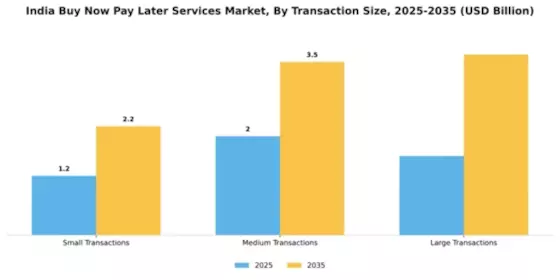
In the India Buy Now Pay Later Services Market, the distribution of transaction sizes reveals a significant preference for small transactions, which capture the largest portion of market share. Consumers show a strong inclination towards utilizing BNPL for everyday purchases, such as groceries and clothing, making small transactions highly popular. Meanwhile, medium and large transactions follow behind, reflecting the diverse ways consumers leverage BNPL services for varying spending capabilities. The growth trends within this segment highlight large transactions as the fastest-growing area, driven by rising consumer confidence and increased adoption of BNPL for significant purchases like electronics and travel. As disposable income increases and the population becomes more receptive to credit options, larger transaction sizes are expected to gain momentum in the coming years, reflecting a shift in purchasing behavior among Indian consumers.
Transaction Size: Small Transactions (Dominant) vs. Large Transactions (Emerging)
Small transactions dominate the India Buy Now Pay Later Services Market due to their accessibility and convenience, allowing consumers to manage their finances on a day-to-day basis. They cater predominantly to a youthful demographic that values flexibility in payment options for low-value items. On the other hand, large transactions are emerging as a significant area of growth. These transactions typically encompass higher-value purchases and are gaining traction among consumers seeking to invest in larger goods, ranging from home appliances to vacations. The appeal of larger transactions lies in the ability to spread costs over time, making higher-value purchases more feasible for a broader audience as BNPL services become increasingly integrated into consumer spending habits.
In the India Buy Now Pay Later Services Market, age groups play a pivotal role, with the largest segment comprising younger consumers aged 18-34. This demographic is increasingly leaning towards digital payment solutions due to their tech-savvy nature and preference for convenience in transactions. The 35-50 age bracket also holds a significant share, driven by the rise of online shopping among working professionals. Furthermore, the older generation is gradually adapting to this model, although at a slower pace, indicating a diverse market engagement among various age groups. On the growth front, the income level segment is witnessing substantial shifts, with middle-income consumers emerging as the fastest-growing demographic. They are increasingly drawn to BNPL services as a way to manage expenses while making purchases more accessible. This growth is further fueled by rising disposable incomes and the expanding e-commerce landscape, encouraging spending among consumers who prefer spreading payments over time instead of making upfront purchases.
Age Group: 18-34 (Dominant) vs. Income Level: Middle-Income (Emerging)
In the India Buy Now Pay Later Services Market, consumers aged 18-34 represent the dominant demographic, characterized by their adaptability to technology and seamless integration of digital wallets into their shopping habits. This group prioritizes flexibility and instant gratification, making them prime users of BNPL services. Conversely, the middle-income segment is emerging rapidly, driven by individuals seeking cost-effective credit options for online shopping without incurring heavy debt. Their growing financial awareness and the push for inclusive financial services facilitate BNPL adoption, positioning them as a vital market segment with potential for significant growth.
Get more detailed insights about India Buy Now Pay Later Services Market Request Free Sample
The Buy Now Pay Later Services Market in India is currently characterized by a dynamic competitive landscape, driven by increasing consumer demand for flexible payment options and the rapid digitalization of financial services. Key players such as Paytm (IN), ZestMoney (IN), and HDFC Bank (IN) are strategically positioning themselves to capitalize on these trends. Paytm (IN) focuses on enhancing its digital wallet capabilities, while ZestMoney (IN) emphasizes its technology-driven approach to credit assessment, enabling quicker approvals. HDFC Bank (IN) leverages its extensive banking network to offer integrated BNPL solutions, thereby enhancing customer trust and accessibility. Collectively, these strategies contribute to a moderately fragmented market, where innovation and customer-centric services are paramount.In terms of business tactics, companies are increasingly localizing their offerings to cater to diverse consumer preferences across India. This localization, coupled with supply chain optimization, allows for more tailored financial products. The market structure appears to be moderately fragmented, with several players vying for market share, yet the influence of major companies remains substantial. The collective actions of these key players shape a competitive environment that is both challenging and ripe for innovation.In December 2025, Paytm (IN) announced a partnership with a leading e-commerce platform to integrate its BNPL services directly into the checkout process. This strategic move is likely to enhance user experience and drive higher transaction volumes, positioning Paytm (IN) as a frontrunner in the BNPL space. The integration of BNPL at the point of sale could potentially increase consumer adoption, as it simplifies the payment process for users.In November 2025, ZestMoney (IN) launched a new AI-driven credit scoring model aimed at improving the accuracy of credit assessments for first-time borrowers. This initiative is significant as it not only broadens the customer base but also addresses the issue of financial inclusion, allowing more individuals access to credit. By leveraging advanced technology, ZestMoney (IN) enhances its competitive edge in a market that increasingly values data-driven decision-making.In October 2025, HDFC Bank (IN) expanded its BNPL offerings by introducing a new product tailored for small and medium enterprises (SMEs). This strategic expansion is indicative of HDFC Bank's (IN) commitment to diversifying its customer base and addressing the unique financial needs of SMEs. By catering to this segment, HDFC Bank (IN) not only strengthens its market position but also contributes to the overall growth of the BNPL ecosystem in India.As of January 2026, the competitive trends in the Buy Now Pay Later Services Market are increasingly defined by digitalization, sustainability, and the integration of artificial intelligence. Strategic alliances among key players are shaping the landscape, fostering innovation and enhancing service delivery. Looking ahead, it appears that competitive differentiation will evolve from traditional price-based competition to a focus on technological innovation and supply chain reliability. Companies that prioritize these aspects are likely to thrive in an increasingly competitive environment.


The India Buy Now Pay Later Services Market is projected to grow at a 6.25% CAGR from 2025 to 2035, driven by increasing consumer demand and digital payment adoption.
New opportunities lie in:
By 2035, the market is expected to solidify its position as a key player in consumer financing.
| MARKET SIZE 2024 | 4.8(USD Billion) |
| MARKET SIZE 2025 | 5.13(USD Billion) |
| MARKET SIZE 2035 | 9.35(USD Billion) |
| COMPOUND ANNUAL GROWTH RATE (CAGR) | 6.25% (2024 - 2035) |
| REPORT COVERAGE | Revenue Forecast, Competitive Landscape, Growth Factors, and Trends |
| BASE YEAR | 2024 |
| Market Forecast Period | 2025 - 2035 |
| Historical Data | 2019 - 2024 |
| Market Forecast Units | USD Billion |
| Key Companies Profiled | Paytm (IN), Klarna (SE), ZestMoney (IN), LazyPay (IN), Simpl (IN), Cashify (IN), ePayLater (IN), HDFC Bank (IN) |
| Segments Covered | Application, End User, Payment Method, Transaction Size, Demographics |
| Key Market Opportunities | Growing consumer preference for flexible payment options drives expansion in the India Buy Now Pay Later Services Market. |
| Key Market Dynamics | Rising consumer demand for flexible payment options drives growth in India's Buy Now Pay Later Services Market. |
| Countries Covered | India |
The market valuation was 11.0 USD Billion in 2024.
The projected valuation for 2035 is 32.36 USD Billion.
The expected CAGR during the forecast period 2025 - 2035 is 10.3%.
The market segments include Channel, Enterprise, and End-user.
The Online channel is projected to reach 18.5 USD Billion, while the POS channel is expected to reach 13.86 USD Billion by 2035.
Key players include Paytm, Klarna, ZestMoney, LazyPay, Simpl, Cashfree, ePayLater, Fintech, and PayLater.
The growth trend suggests a robust expansion, with a projected increase from 11.0 USD Billion in 2024 to 32.36 USD Billion by 2035.



Kindly complete the form below to receive a free sample of this Report

“This is really good guys. Excellent work on a tight deadline. I will continue to use you going forward and recommend you to others. Nice job”


“Thanks. It’s been a pleasure working with you, please use me as reference with any other Intel employees.”


“Thanks for sending the report it gives us a good global view of the Betaïne market.”


“Thank you, this will be very helpful for OQS.”


“We found the report very insightful! we found your research firm very helpful. I'm sending this email to secure our future business.”


“I am very pleased with how market segments have been defined in a relevant way for my purposes (such as "Portable Freezers & refrigerators" and "last-mile"). In general the report is well structured. Thanks very much for your efforts.”


“I have been reading the first document or the study, ,the Global HVAC and FP market report 2021 till 2026. Must say, good info! I have not gone in depth at all parts, but got a good indication of the data inside!”


“We got the report in time, we really thank you for your support in this process. I also thank to all of your team as they did a great job.”


“The Automotive 48V ECU Components Procurement Intelligence Study” was a complex project, but the Market Research Future (MRFR) team handled it with quality, agility, and customer-centricity. They delivered all requested data on time and within the agreed scope. The team, including Shubhendra Anand and Rahul Gotadki, was always readily available to clarify questions and swiftly implement necessary adjustments, driving the project to a successful conclusion within a very demanding timeframe.
I would also like to specifically commend Akshay Agarwal for his responsiveness and support at every stage—from our initial inquiry on May 6th through to final delivery on June 18th. His dedication made the entire process seamless.”



