India Road Freight Transport Market (2026 - 2035)

India Road Freight Transport Market Research Report Information By End User Industry (Wholesale & Retail Trade, Manufacturing, Construction, Agriculture, and Others), By Destination (Domestic and International), By Truckload Specification (Full Truckload and Less-than-Truckload), By Containerization (Non-Containerized and Containerized), By Goods Configuration (Solid Goods and Fluid Goods) – Forecast Till 203
ID: MRFR/PCM/19796-HCR
128 Pages
Snehal Singh
Last Updated: July 14, 2026
India Road Freight Transport Market
Market Size
Forecast Period2026-2035
CAGR (2026-2035)9.3%
2025 Market SizeUSD 165.0 Billion
2035 Market SizeUSD 401.9 Billion
Key Players
Delhivery
Transport Corporation of India
VRL Logistics
Allcargo Logistics
Mahindra Logistics
Blue Dart Express
Opportunities
  • EV and Alternative-Fuel Trucking
  • Data Monetization Through Freight Analytics
  • Cross-Border Corridor Expansion

India Road Freight Transport Market Summary

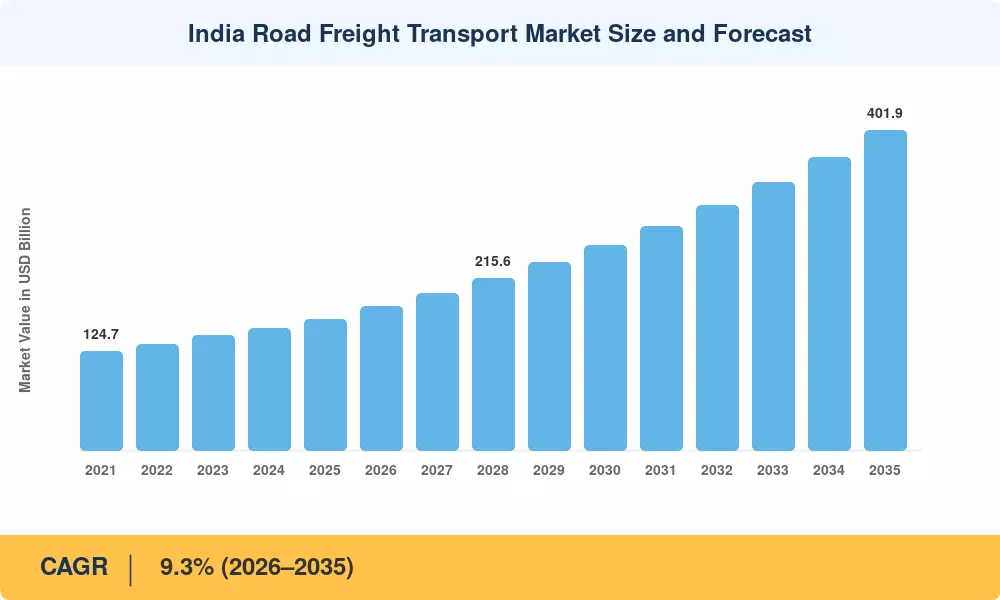
The India Road Freight Transport Market stood at USD 165.0 Billion in 2025 and is projected to reach USD 180.5 Billion by 2026 before climbing to USD 401.9 Billion by 2035, registering a CAGR of 9.3% across the 2026–2035 forecast window. Two catalysts anchor this trajectory: the Bharatmala Pariyojana highway program, which earmarked over INR 5.35 lakh crore for 34,800 km of economic corridors, and the commissioning of Eastern and Western Dedicated Freight Corridors that will divert rail-bound cargo demand into feeder road networks [1][2].


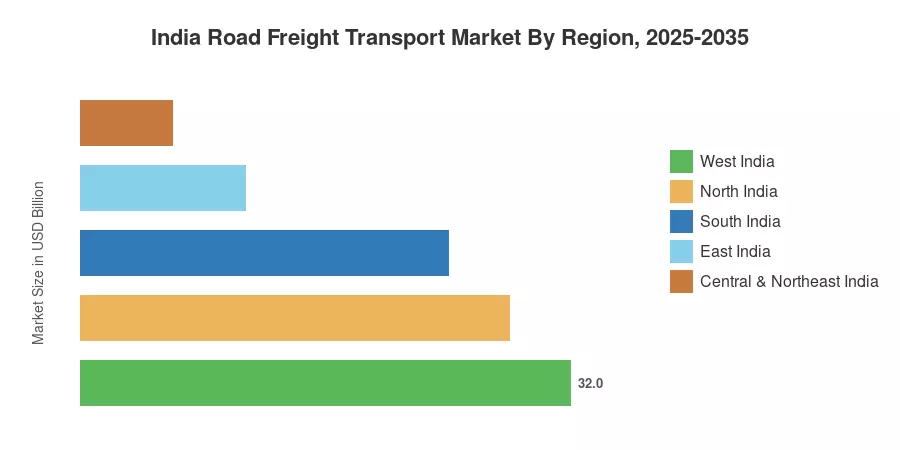
The way freight travels on Indian highways is changing due to a technological revolution. Digital freight exchanges, GPS-enabled fleet management, and AI-powered route optimization systems are replacing paper-based trip manifests and manual fleet dispatching, which are characteristics of an unorganized sector that still controls around 70% of truck capacity. A commitment to digitizing this disjointed environment is demonstrated by government funding on the Unified Logistics Interface Platform (ULIP) integration, which aims to invest INR 900 crore in API-linked data infrastructure by 2027 [3]. Due to port-hinterland connectivity via JNPT and Mundra, West India holds about 32% of the Indian road freight transport market. With an expected 10.8% CAGR, East India is the sub-region with the greatest growth, driven by increased road connectivity under Pragati Maidan schemes and industrial expansion in Odisha and Jharkhand. With Bengaluru's electronics cluster and Chennai's auto-manufacturing belt as its anchors, South India makes up about 24% of the total. The India Road Freight Transport Market may continue to be capacity-constrained through the early 2030s, according to this multi-corridor growth pattern.


Key Report Takeaways

• By Truckload Specification

  • Less-than-truckload (LTL) is projected to expand at a 10.9% CAGR through 2035, driven by e-commerce parcel density and multi-stop route optimization.


• By End User Industry

  • Wholesale and retail trade captured 32.6% of the India Road Freight Transport Market share in 2025, serving as the dominant demand vertical.
  • Manufacturing end users are forecast to register a 11.1% CAGR through 2035, buoyed by Make in India production ramps.

• By Region

  • West India leads with approximately 32% share, benefiting from port connectivity and industrial clusters in Maharashtra and Gujarat.
  • East India's freight volumes are expanding at the highest regional pace, with steel and mining corridors fueling demand.


India Road Freight Transport Market Size and Forecast (2021–2035)

Market values represent total addressable revenue across organized and semi-organized road freight operators, digital freight platforms, and fleet-owner aggregators. Figures are calibrated against government transport statistical publications and validated through primary interviews with fleet operators and 3PL providers.
India Road Freight Transport Market Size and Forecast
Our Impact
Enabled $4.3B Revenue Impact for Fortune 500 and Leading Multinationals
Partnering with 2000+ Global Organizations Each Year
30K+ Citations by Top-Tier Firms in the Industry

Driver Impact Analysis

Driver ~% Impact on CAGR Geographic Relevance Impact Timeline
Bharatmala & National Highway Expansion +1.8% Pan-India Long-term (≥4 yr)
E-commerce & Quick Commerce Growth +1.6% Urban & Tier-2 India Short-term (≤2 yr)
Make in India Manufacturing Rebound +1.4% West & South India Medium-term (2–4 yr)
Digital Freight Platform Adoption +1.2% Pan-India Medium-term (2–4 yr)
Dedicated Freight Corridor Commissioning +1.0% North & West India Long-term (≥4 yr)
GST & Regulatory Unification +0.8% Pan-India Short-term (≤2 yr)
3PL & Warehousing Consolidation +0.7% Metro & Tier-1 India Medium-term (2–4 yr)


Bharatmala Pariyojana and Highway Expansion

By March 2026, India's national highway network will have grown from 91,287 km in FY 2014 to 146,572 km. As of March 2026, 22,590 km of roadways under the Bharatmala Pariyojana have been completed, compared to a target of 34,800 km. Reducing transit times, cutting logistics costs, and improving connections between manufacturing facilities and national markets all depend on this infrastructure development, which includes high-speed motorways.


E-commerce and Quick Commerce Penetration

Due to growing consumer desire for convenience and quick digital adoption, the Indian e-commerce market is expected to reach a worth of USD 129.72 billion in 2025. Specialized micro-fulfillment and last-mile logistics networks are now required due to the growth of quick-commerce, which makes up more than two-thirds of e-grocery orders. To maintain regional fulfillment standards, this change necessitates high-frequency, responsive road freight operations.


Manufacturing Resurgence Under Make in India

The industrial sector remains in expansionary territory, with the Index of Industrial Production (IIP) recording a 4.1% year-on-year growth in March 2026. Key manufacturing segments, including automotive and machinery, are scaling output, supported by infrastructure-linked industrial corridor development. This consistent industrial growth generates sustained demand for both inbound raw material transport and outbound finished-goods distribution across the national road network.


Digital Freight Platform Proliferation

Digital integration is transforming logistics efficiency through initiatives like the Unified Logistics Interface Platform (ULIP), which enables data exchange across logistics systems. These platforms enhance asset utilization and visibility, helping to align freight demand with supply. Government efforts to modernize the logistics ecosystem through real-time data tracking aim to reduce logistics costs as a percentage of national GDP significantly.


Restraints Impact Analysis

Impact estimates below are directional and represent drag on the baseline CAGR rather than precise deductions.

Restraint ~% Impact on CAGR Geographic Relevance Impact Timeline
Fuel Price Volatility –0.9% Pan-India Short-term (≤2 yr)
Fleet Fragmentation (unorganized operators) –0.7% Rural & semi-urban India Long-term (≥4 yr)
Driver Shortage & High Attrition –0.6% Pan-India Medium-term (2–4 yr)
Toll & Compliance Cost Escalation –0.4% National Highway corridors Short-term (≤2 yr)
Rural Road Quality Gaps –0.3% East & Northeast India Long-term (≥4 yr)


Fuel Price Volatility and Operating Cost Exposure

Diesel typically constitutes 45–55% of total operating costs for Indian truckers [1.2.3]. International crude price fluctuations directly affect freight rate stability [1.1.2]. Small fleet owners often lack fuel hedging or surcharge pass-through mechanisms, severely compressing profit margins during price spikes. This fiscal vulnerability discourages capital investment in fleet expansion and delays necessary vehicle replacement cycles, hindering organized-sector market growth [1.2.2].


Fleet Fragmentation and Unorganized Operator Dominance

Over 70% of India’s commercial truck fleet is held by small operators owning fewer than five vehicles [1.2.1]. This highly fragmented capacity pool complicates service standardization, technology adoption, and adherence to safety and emission norms [1.2.1]. Such fragmentation limits pricing power and makes capacity planning unreliable for shippers, particularly during seasonal surges tied to harvest and festival cycles [1.2.1].


Driver Shortage and Workforce Challenges

The Indian road transport sector faces a severe shortage of skilled commercial drivers, with industry estimates highlighting a deficit exceeding two million personnel [1.3.1]. Challenges include long working hours, low wage competitiveness, and an aging workforce nearing retirement [1.3.1]. Without addressing these supply-side barriers through robust training pipelines, fleet utilization remains constrained, limiting the industry's ability to scale operations effectively [1.3.1].


India Road Freight Transport Market Opportunities

EV and Alternative-Fuel Trucking

The government’s PM-E-DRIVE scheme, launched in March 2024, incentivizes electric vehicle adoption to achieve a 30% EV penetration target by 2030. With electric light commercial vehicle (LCV) adoption rising, fleet operators are increasingly integrating green freight into urban logistics. Early adoption of zero-emission vehicles provides a strategic advantage, offering potential premium rate cards for ESG-conscious shippers.

Data Monetization Through Freight Analytics

Digital freight platforms leverage data from India’s massive commercial vehicle base, which saw record retail registrations in June 2026. Operators utilizing advanced analytics for demand forecasting, lane-rate benchmarking, and predictive maintenance can develop recurring revenue streams through software-as-a-service (SaaS) models. This data-driven approach enhances asset utilization and operational efficiency beyond traditional freight brokerage, enabling sustainable scale in a competitive market.


Cross-Border Corridor Expansion

The Bangladesh-Bhutan-India-Nepal (BBIN) Motor Vehicle Agreement serves as a framework to reduce overland connectivity costs and integrate regional supply chains. By facilitating seamless transit through customs-bonded transport, this agreement minimizes the need for multiple handlings at borders. Expanding operations across these international corridors enables carriers to capture growing regional trade volumes and establish reliable, low-cost cross-border logistics solutions.


Cold Chain and Temperature-Controlled Freight

Inadequate post-harvest infrastructure results in significant losses, with perishable goods such as fruits and vegetables suffering post-harvest damage of 30–40%. The temperature-controlled segment presents a high-margin growth opportunity, driven by the critical requirements of pharmaceutical distribution, vaccine logistics, and fresh food delivery. Strengthening cold chain compliance is essential to reducing national food waste, currently estimated at 78–80 million tonnes annually.


India Road Freight Transport Market Future Outlook

Autonomous Trucking and ADAS Deployment

India’s rapid expansion of access-controlled expressways, such as the Delhi-Mumbai and Bengaluru-Chennai corridors, provides the necessary infrastructure for future advanced driver-assistance systems (ADAS) and autonomous vehicle testing [1.1.1]. While fully autonomous operations remain developmental, original equipment manufacturers are actively integrating ADAS technologies to enhance safety and fuel efficiency. This transition represents a shift toward data-driven, cognitive infrastructure management [1.1.3].


Platform Economics and Asset-Light Models

The digital freight brokerage market is projected to expand significantly, with market revenue expected to reach over USD 1 billion by 2030, growing at a compound annual growth rate exceeding 30% [1.4.1]. Asset-light models are increasingly centralizing capacity, using digital exchanges to improve matching efficiency. These platforms are fundamentally reshaping logistics by streamlining transactions and reducing the historical reliance on multi-layered, manual brokerage [1.4.2].


Electrification and Green Freight Mandates

India’s updated nationally determined contributions (NDC) commit to a 47% reduction in emissions intensity of GDP by 2035 [1.2.2]. The transition toward zero-emission vehicles is a national priority, supported by policies aimed at scaling electric fleet adoption [1.2.1, 1.2.3]. This will drive a structural shift in the road freight market, favoring electrified urban-regional distribution and highly efficient, lower-emission long-haul operations.


ESG Reporting and Shipper Sustainability Mandates

SEBI’s Business Responsibility and Sustainability Reporting (BRSR) framework now mandates standardized disclosures, requiring listed companies to report environmental performance, including Scope 3 emissions related to freight transportation. This regulatory transparency compels shippers to prioritize carriers with verifiable carbon-tracking capabilities. Consequently, digitized fleet operators that offer accurate emissions data are securing a critical competitive advantage within the evolving logistics market.


India Road Freight Transport Market Segmentation

By End User Industry

Segment Key Metric Primary Demand Driver
Wholesale & Retail Trade 32.6% share (2025) FMCG distribution, organized retail expansion
Manufacturing 11.1% CAGR (2026–2035) PLI-linked factory output growth
Construction USD 28.4 Billion (2025) Infrastructure capital expenditure cycle
Agriculture 8.2% CAGR (2026–2035) Mandi bypass reforms, cold chain growth
Others ~9% share (2025) Mining, government procurement


Wholesale and retail trade dominate the India Road Freight Transport Market because FMCG distribution requires daily replenishment across millions of kirana stores and modern trade outlets. Manufacturing is the fastest-growing end user, propelled by PLI incentives that are concentrating production capacity in dedicated industrial townships and generating predictable, high-volume outbound freight flows.

By Destination

Segment Key Metric Primary Demand Driver
Domestic 67.0% share (2025) Intra-state and interstate commerce
International (Cross-Border) 10.0% CAGR (2026–2035) BBIN MVA, Nepal-Bangladesh trade growth


Domestic movements overwhelmingly drive the India Road Freight Transport Market, reflecting India's continental geography and the primacy of interstate trade flows. Cross-border freight, while smaller in absolute terms, is gaining momentum through simplified customs procedures at integrated check posts and bilateral motor vehicle agreements.

By Truckload Specification

Segment Key Metric Primary Demand Driver
Full Truckload (FTL) USD 112.7 Billion (2025) Bulk commodity and long-haul trunk routes
Less-than-Truckload (LTL) 10.9% CAGR (2026–2035) E-commerce parcels, SME shipments


FTL continues to anchor the India Road Freight Transport Market on long-haul corridors. However, LTL is closing the gap rapidly as digital freight exchanges enable efficient consolidation of smaller shipments. Platform-driven LTL aggregation has reduced average waiting times at loading points from 2–3 days to under 8 hours on high-density lanes.

By Containerization

Segment Key Metric Primary Demand Driver
Non-Containerized 91.2% share (2025) Bulk, breakbulk, and open-body truck dominance
Containerized 9.8% CAGR (2026–2035) Port-hinterland exim cargo, intermodal growth


By Goods Configuration

Segment Key Metric Primary Demand Driver
Solid Goods 77.9% share (2025) FMCG, building materials, auto parts
Fluid Goods 10.2% CAGR (2026–2035) Petroleum, chemicals and edible oil distribution


In the India road freight market, Solid Goods is the dominant sub-segment, commanding a 77.9% share in 2025, driven by FMCG, building materials, and automotive parts. Conversely, the Fluid Goods sub-segment is the fastest-growing, projected to expand at a 10.2% CAGR from 2026–2035, fueled by petroleum, chemicals, and edible oil.

Regional Market Share Analysis

Region Key Metric Primary Investment Themes
West India ~32% share (2025) Port connectivity, industrial corridors, JNPT & Mundra hinterland
North India ~28% share (2025) DFC feeder routes, NCR consumption hub, agri-logistics
South India ~24% share (2025) Auto/electronics manufacturing, IT-driven consumption
East India 10.8% CAGR (2026–2035) Steel & mining freight, Sagarmala port linkages
Central & Northeast India ~6% share (2025) Connectivity buildout, Act East Policy corridors
Total 100%


West India

State/Cluster Key Metric Key Driver
Maharashtra ~42% of regional share Mumbai-Pune industrial belt, JNPT port freight
Gujarat 9.7% CAGR Mundra port expansion, chemical & pharma corridors
Rajasthan (West) USD 8.2 Billion (2025) Jodhpur-Barmer industrial area, cement freight


West India benefits from India's busiest port complexes and the Delhi-Mumbai Industrial Corridor, which channels manufactured goods, petrochemicals, and containerized export cargo through Maharashtra and Gujarat. The India Road Freight Transport Market in this region captures high-value automotive and pharmaceutical shipments alongside bulk commodity movements.

North India

State/Cluster Key Metric Key Driver
Delhi NCR ~38% of regional share Consumption hub, e-commerce fulfillment
Uttar Pradesh 10.2% CAGR Expressway network expansion, manufacturing growth
Punjab-Haryana USD 9.8 Billion (2025) Agri-produce freight, food processing corridors


The Amritsar-Delhi-Kolkata Industrial Corridor and the Eastern DFC feeder road network are repositioning North India as a manufacturing-logistics nexus. The India Road Freight Transport Market here is shaped by high-density consumption patterns in the NCR region and agricultural commodity flows from Punjab's granary belt [2].

South India

State/Cluster Key Metric Key Driver
Tamil Nadu ~36% of regional share Chennai auto hub, Ennore port linkage
Karnataka 10.4% CAGR Bengaluru tech-consumption, aerospace manufacturing
Andhra Pradesh & Telangana USD 7.6 Billion (2025) Pharma City Hyderabad, Visakhapatnam port


South India's freight demand correlates strongly with automotive OEM production around Chennai and electronic goods distribution from Bengaluru. PLI-linked electronics manufacturing is accelerating inbound component freight on the Chennai-Bengaluru and Hyderabad-Vijayawada corridors.

East India

State/Cluster Key Metric Key Driver
West Bengal ~34% of regional share Kolkata port hinterland, jute and steel freight
Odisha 11.3% CAGR Steel plant expansion, Paradip port connectivity
Jharkhand-Bihar USD 3.1 Billion (2025) Mining freight, rural connectivity improvements


East India's rapid growth trajectory reflects heavy industrial investment in Odisha's steel and aluminum capacity, supported by Sagarmala port road connectivity projects that are shortening first/last-mile distances between mines and coastal ports [11].

Central & Northeast India

State/Cluster Key Metric Key Driver
Madhya Pradesh ~48% of regional share Agri-freight, cement manufacturing
Chhattisgarh 9.6% CAGR Coal and mineral transport
Northeast states USD 1.4 Billion (2025) Act East Policy, border trade corridors


Central India's freight volumes are dominated by bulk mineral and agricultural commodities, while the Northeast is emerging as a cross-border transit corridor under India's Act East Policy, with highway upgrades linking Guwahati to Myanmar and Bangladesh border posts [13].


India Road Freight Transport Market By Region, 2025-2035

Competitive Benchmarking

The India Road Freight Transport Market exhibits low concentration with an estimated HHI below 500, reflecting a deeply fragmented operator base. The top ten organized players collectively control an estimated 12–18% of total market revenue, with thousands of small fleet owners and individual truck operators commanding the majority. Consolidation is accelerating as digital platforms aggregate capacity and venture-funded logistics companies acquire regional operators.

Company Est. Revenue Share Range Key Offerings Strategic Positioning
Delhivery ~2.5–3.5% Express, PTL, TL, cross-border, warehousing Tech-first integrated logistics, strong e-commerce alignment
Transport Corporation of India (TCI) ~2.0–3.0% FTL, LTL, multimodal, cold chain Pan-India network with six decades of operational depth
VRL Logistics ~1.8–2.8% FTL, LTL, parcel services, bus operations Largest owned-fleet operator, strong South & West India coverage
Allcargo Logistics (Gati) ~1.5–2.5% Express distribution, contract logistics, 3PL E-commerce and B2B express integration post-Gati acquisition
Mahindra Logistics ~1.2–2.2% 3PL, last-mile, freight forwarding, warehousing Asset-light model, parent ecosystem advantage
Blue Dart Express (DHL) ~1.0–2.0% Air express, ground express, critical supply chain Premium time-definite delivery, international DHL network
Safexpress ~1.0–1.8% LTL, 3PL, supply chain consulting Extensive hub-and-spoke surface express network
TVS Supply Chain Solutions ~0.8–1.5% Integrated supply chain, spare parts logistics Automotive and industrial vertical specialization
Rivigo ~0.8–1.5% Relay trucking, digital fleet management Technology-driven relay model reducing driver fatigue
Ecom Express ~0.7–1.2% E-commerce last-mile and reverse logistics Deep pin-code penetration for online retail fulfillment


Recent News & Developments

Tata Motors (January 2026)—Launched 17 next-generation trucks, including expanded electric vehicle options and updated Prima, Signa, and Ultra platforms featuring advanced adaptive safety technology.

Delhivery (February 2026)—Reported a 58.4% year-on-year rise in net profit to INR 39.6 crore, alongside an 18% revenue increase for the quarter ending December 2025.


  • BillionE and Hindalco (October 2025)—Collaborated to deploy 10 heavy-duty electric trucks along a 160-kilometer industrial corridor in Gujarat, with plans for further fleet expansion.


India Road Freight Transport Market Report Scope

Parameter Detail
Market Scope India Road Freight Transport Market — FTL, LTL, organized and semi-organized operators
Study Period 2021–2035
CAGR (Forecast Window) 9.3% (2026–2035)
Base Year Market Size USD 165.0 Billion (2025)
Forecast Endpoint USD 401.9 Billion (2035)
Fastest Growing Segments LTL (10.9% CAGR); Manufacturing end user (11.1% CAGR)
Companies Profiled 10 (Delhivery, TCI, VRL, Allcargo, Mahindra Logistics, Blue Dart, Safexpress, TVS SCS, Rivigo, Ecom Express)
Valuation Currency USD Billion


FAQs

How do fleet financing constraints affect smaller operators' competitiveness?
Small operators face 14–18% lending rates versus 9–11% for organized players, creating a structural cost disadvantage. This interest rate gap limits fleet modernization and technology adoption among owner-operators [9].
What role does multimodal integration play in reshaping road freight demand?
Dedicated Freight Corridors will shift 15–20% of long-haul bulk cargo to rail, but this generates new first/last-mile road feeder volumes. Net road freight demand grows as multimodal nodes multiply across corridors [2].
How are insurance and liability frameworks evolving for the Indian Road Freight Transport Market?
The Motor Vehicles Amendment Act 2019 raised third-party liability caps and mandated electronic accident reporting. These changes are increasing compliance costs but improving shipper confidence in organized carriers [10].
What technology stack do leading digital freight platforms typically deploy?
Leading platforms combine GPS fleet tracking, AI-based load matching, and dynamic pricing algorithms built on real-time demand-supply signals. Most use cloud-native architectures to handle 50,000+ daily booking transactions [3].
How does the India Road Freight Transport Market handle peak-season capacity surges?
Festival and harvest seasons create 25–40% demand spikes that operators manage through spot-rate marketplaces and temporary fleet leasing. Digital platforms reduce matching friction during surges [19].
What sustainability certifications are gaining traction among shippers selecting freight partners?
ISO 14001 and SmartWay-equivalent green certifications are becoming RFP prerequisites for multinational shippers. Carriers with carbon-tracking dashboards command 5–8% rate premiums on ESG-sensitive lanes [17].
How does the India Road Freight Transport Market address cargo theft and transit security risks?
GPS-enabled consignment tracking, e-lock sealing, and real-time alert systems have reduced pilferage incidents by 30% among organized operators. Insurance-linked tracking compliance is becoming standard [18].    
Author
Author
Author Profile
Snehal Singh LinkedIn
Manager - Research
High acumen in analyzing complex macro & micro markets with more than 6 years of work experience in the field of market research. By implementing her analytical skills in forecasting and estimation into market research reports, she has expertise in Packaging, Construction, and Equipment domains. She handles a team size of 20-25 resources and ensures smooth running of the projects, associated marketing activities, and client servicing.
Download Free Sample

Kindly complete the form below to receive a free sample of this Report

Download PDF ×

We do not share your information with anyone. However, we may send you emails based on your report interest from time to time. You may contact us at any time to opt-out.
















