Regulatory Compliance
Regulatory compliance is a crucial factor influencing the Global Industrial Controllers Market Industry. Governments worldwide are implementing stringent regulations to ensure safety, quality, and environmental protection in industrial operations. Compliance with these regulations necessitates the adoption of advanced control systems that can monitor and report on various operational parameters. For instance, industries must adhere to standards set by organizations such as the International Organization for Standardization. This regulatory landscape drives the demand for sophisticated industrial controllers, as companies seek to avoid penalties and enhance their operational integrity.
Emerging Markets Growth
The Global Industrial Controllers Market Industry is poised for growth, particularly in emerging markets. Countries in Asia-Pacific and Latin America are witnessing rapid industrialization, leading to increased investments in manufacturing and infrastructure. This growth presents opportunities for industrial controllers, as businesses in these regions seek to modernize their operations. For example, the expansion of manufacturing hubs in India and Brazil is driving demand for advanced control systems. As these markets develop, the Global Industrial Controllers Market is expected to benefit from increased adoption of automation technologies, further propelling its growth trajectory.
Focus on Energy Efficiency
Energy efficiency has emerged as a pivotal driver in the Global Industrial Controllers Market Industry. Companies are increasingly prioritizing sustainable practices to reduce operational costs and minimize environmental impact. Advanced industrial controllers enable precise monitoring and control of energy consumption, leading to significant savings. For example, industries that implement energy-efficient control systems can reduce energy usage by up to 30%. This focus on sustainability not only aligns with global environmental goals but also enhances the competitiveness of businesses in the market, contributing to a projected CAGR of 6.02% from 2025 to 2035.
Technological Advancements
The Global Industrial Controllers Market Industry is experiencing a surge in demand driven by rapid technological advancements. Innovations in automation, artificial intelligence, and the Internet of Things are reshaping industrial processes. For instance, the integration of smart sensors and advanced control algorithms enhances operational efficiency and reduces downtime. This trend is evident as industries increasingly adopt these technologies to optimize production. As a result, the market is projected to reach 160.4 USD Billion in 2024, reflecting a growing reliance on sophisticated control systems to meet the demands of modern manufacturing.
Rising Demand for Automation
The Global Industrial Controllers Market Industry is significantly influenced by the rising demand for automation across various sectors. Industries such as manufacturing, oil and gas, and pharmaceuticals are increasingly automating their processes to improve productivity and reduce labor costs. This shift is evident in the growing adoption of programmable logic controllers and distributed control systems. As companies seek to enhance operational efficiency, the market is expected to grow substantially, with projections indicating a value of 305.1 USD Billion by 2035. This trend underscores the critical role of industrial controllers in facilitating seamless automation.
PORTER’S FIVE FORCES MODEL
1.1 PORTER’S FIVE FORCES MODEL
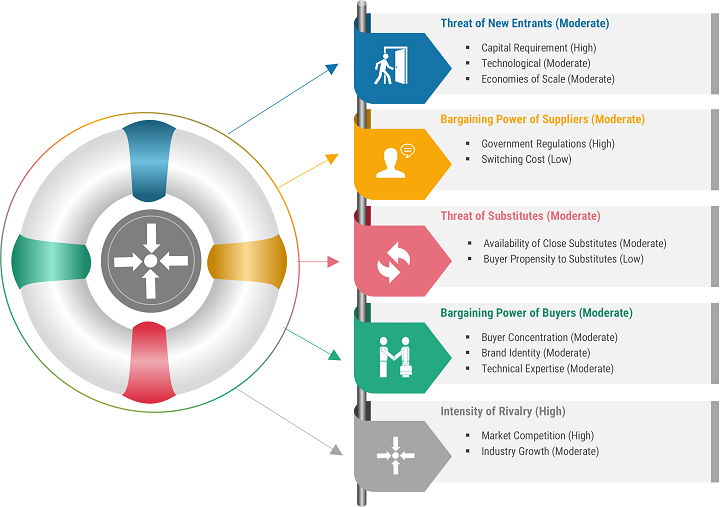
Michael Porter’s Five Forces model provides a framework to study the global industrial controllers market. Strategic business managers trying to gain an edge over competing firms in the global industrial controllers market can utilize this model to better understand the industry in which the firm operates. The components of each of the forces and the degree of impact of each component in the context of the global industrial controllers market have been broken down and analyzed.
FIGURE 1 PORTER'S FIVE FORCES ANALYSIS OF THE global industrial controllers market
Source: MRFR Analysis
1.1.1 THREAT OF NEW ENTRANTS
New entrants in the diversified industrial controllers market bring innovation and new ways of doing things and put pressure on the existing market players through their pricing strategies by reducing costs and providing new value propositions to customers. Companies providing industrial controllers need to manage all these challenges and build effective barriers to safeguard their competitive edge.The economies of scale are difficult to achieve in the industrial controllers industry, making it easier for those producing in bulk to have a cost advantage. It also makes the production process costlier for new entrants. The industry's capital requirement is high, making it difficult for new entrants to set up their businesses. Capital expenditure is also high because of the high research & development costs. Thus, the threat of new entrants in the global industrial controllers market is expected to be moderate during the forecast period.
1.1.2 BARGAINING POWER OF SUPPLIERS
The suppliers for the industrial controllers market comprise Programmable Logic Controllers (Plc), Distributed Control Systems (Dcs), and Supervisory Control And Data Acquisition (Scada). The system integrators perform horizontal integration of these suppliers with the software /platform developers. This integration is subject to long-term agreement between suppliers and integrators, which increases the cost of switching from one supplier to another. The products that these suppliers provide are standardized, less differentiated, and have low switching costs, allowing buyers to switch suppliers. The suppliers do not contend with other products in the industrial controllers market. This means that there are no substitutes for the final products and solutions other than the ones that the suppliers provide. The government policies regarding industrial controllers require strict licensing and legal requirements to be fulfilled before a company can start selling. The differentiation among the price of the component is moderate. Thus, the overall bargaining power of suppliers in the global industrial controllers market is expected to be high during the forecast period.
1.1.3 THREAT OF SUBSTITUTES
There are very few to no substitutes available for industrial controllers. There are very few substitutes available that are produced by low profit-earning industries. This means that there is a limit on the maximum profit that a firm can earn in the industrial controllers market. The few substitutes available are of high quality but are way more expensive. Comparatively, firms producing within the industry sell at a lower price than substitutes with adequate qualities. This means that buyers are less likely to switch to substitutes. There is low availability of close substitute in the market, also the buyer propensity to competitive product is low. Thus, the threat of substitutes is expected to have a low impact on the global industrial controllers market during the forecast period.
1.1.4 BARGAINING POWER OF BUYERS
The number of suppliers in the industry is more than the number of firms producing the products. This means that the buyers have a few firms to choose from and hence, do not have much control over prices, thereby making the bargaining power of buyers a weaker force in the industry. The product differentiation within the industrial controllers market is high, which means that the buyers are not able to find alternate firms producing a particular product. The buyers in the industrial controllers market are Automotive, Manufacturing, Oil & Gas, Energy & Utilities, Water And Wastewater, Food Processing & Beverage, Aerospace & Aviation, and Others. The cost of procuring at this stage is high, limiting the actual concentration of buyers across regions. Moreover, due to moderate brand identity, the bargaining power of buyers is moderate.
1.1.5 INTENSITY OF RIVALRY
The number of competitors operating in the industrial controllers market is low. Most of these are also large enterprises. Very few competitors have a large market share. This means that these players will engage in competitive actions to gain a better market position and become market leaders, making the rivalry among existing firms a stronger force within the industry. The industry is growing every year and is expected to continue to do this for a few years. Positive industry growth means that competitors are more likely to engage in competitive actions to gain a larger market share. This makes the competition among existing firms high within the industry. The existing players in the industrial controllers market compete based on industry expertise, geographical presence, and product offerings. It has become challenging for new players to compete with the established key players and provide users with better and advanced services. Such factors are expected to create a high intensity of rivalry among the global industrial controllers market players during the forecast period.