×
Request Free Sample ×

Kindly complete the form below to receive a free sample of this Report

* Please use a valid business email

Leading companies partner with us for data-driven Insights

clients tt-cursor
Hero Background

Industrial Knitting Machine Market

ID: MRFR/PCM/38046-HCR
111 Pages
Snehal Singh
October 2025

Industrial Knitting Machine Market Research Report By Technology (Warp Knitting Machines, Weft Knitting Machines, Circular Knitting Machines, Flat Knitting Machines), By Application (Apparel, Home Textiles, Industrial Fabrics, Automotive Textiles), By End Use (Fashion Industry, Sports Industry, Medical Textiles, Automotive Industry), By Knitting Method (Manual Knitting, Semi-Automatic Knitting, Fully Automatic Knitting) and By Regional (North America, Europe, South America, Asia Pacific, Middle East and Africa) - Forecast to 2035.

Share:
Download PDF ×

We do not share your information with anyone. However, we may send you emails based on your report interest from time to time. You may contact us at any time to opt-out.

Industrial Knitting Machine Market Infographic
Purchase Options

Industrial Knitting Machine Market Summary

As per MRFR analysis, the Industrial Knitting Machine Market Size was estimated at 5.1 USD Billion in 2024. The Industrial Knitting Machine industry is projected to grow from 5.357 USD Billion in 2025 to 8.761 USD Billion by 2035, exhibiting a compound annual growth rate (CAGR) of 5.04 during the forecast period 2025 - 2035.

Key Market Trends & Highlights

The Industrial Knitting Machine Market is poised for growth driven by technological advancements and sustainability initiatives.

  • Automation and smart technologies are increasingly being integrated into industrial knitting machines, enhancing efficiency and productivity.
  • Sustainability initiatives are gaining traction, prompting manufacturers to adopt eco-friendly practices in textile production.
  • North America remains the largest market for industrial knitting machines, while the Asia-Pacific region is recognized as the fastest-growing market.
  • Technological advancements in machinery and rising demand for sustainable textiles are key drivers propelling market expansion.

Market Size & Forecast

2024 Market Size 5.1 (USD Billion)
2035 Market Size 8.761 (USD Billion)
CAGR (2025 - 2035) 5.04%

Major Players

Mayer & Cie (DE), Shima Seiki (JP), Stoll (DE), Santoni (IT), Santec (JP), Baiyuan (CN), Mitsubishi (JP), Knitwear (GB), Mayer (DE)

Industrial Knitting Machine Market Trends

The Industrial Knitting Machine Market is currently experiencing a transformative phase, driven by advancements in technology and evolving consumer preferences. Manufacturers are increasingly focusing on automation and smart technologies, which enhance production efficiency and reduce labor costs. This shift towards automation appears to be a response to the growing demand for customized and high-quality textile products. Furthermore, sustainability has emerged as a critical factor, with companies striving to adopt eco-friendly practices in their operations. This trend suggests a potential alignment between profitability and environmental responsibility, as businesses seek to appeal to a more environmentally conscious consumer base. In addition, The Industrial Knitting Machine Market is characterized by a rise in competitive dynamics. Emerging players are entering the market, introducing innovative solutions that challenge established companies. This influx of new entrants may lead to increased competition, fostering an environment where continuous improvement and innovation are paramount. As the market evolves, collaboration between technology providers and manufacturers could become more prevalent, potentially leading to the development of advanced knitting machines that meet the diverse needs of various industries. Overall, the Industrial Knitting Machine Market appears poised for growth, driven by technological advancements and a shift towards sustainable practices.

Automation and Smart Technologies

The integration of automation and smart technologies in the Industrial Knitting Machine Market is reshaping production processes. Manufacturers are adopting advanced machinery that enhances efficiency and minimizes manual intervention, thereby streamlining operations.

Sustainability Initiatives

Sustainability has become a focal point within the Industrial Knitting Machine Market. Companies are increasingly implementing eco-friendly practices, such as using sustainable materials and reducing waste, to meet the demands of environmentally conscious consumers.

Emergence of New Competitors

The Industrial Knitting Machine Market is witnessing the entry of new competitors, which is intensifying market dynamics. These emerging players are introducing innovative solutions that challenge traditional manufacturers, fostering a climate of continuous improvement.

Industrial Knitting Machine Market Drivers

Rising Demand for Sustainable Textiles

The Industrial Knitting Machine Market is witnessing a surge in demand for sustainable textiles, driven by increasing consumer awareness regarding environmental issues. Manufacturers are now focusing on eco-friendly materials and processes, which has led to the development of knitting machines that can efficiently work with organic and recycled fibers. This shift is not merely a trend; it reflects a broader movement towards sustainability in the textile sector. Data indicates that the market for sustainable textiles is expected to grow at a compound annual growth rate (CAGR) of over 10% in the coming years. As a result, knitting machine manufacturers are adapting their technologies to accommodate these materials, thereby enhancing their market competitiveness and aligning with consumer preferences.

Technological Advancements in Machinery

The Industrial Knitting Machine Market is experiencing a notable transformation due to rapid technological advancements. Innovations such as computer-aided design (CAD) and automated knitting processes are enhancing production efficiency and precision. These technologies allow manufacturers to produce complex patterns and designs with minimal human intervention, thereby reducing labor costs. Furthermore, the integration of IoT (Internet of Things) in knitting machines enables real-time monitoring and predictive maintenance, which can significantly decrease downtime. According to recent data, the adoption of advanced knitting technologies is projected to increase productivity by up to 30% over the next few years. This trend not only boosts operational efficiency but also positions companies to meet the growing demand for customized textile products.

Customization and Personalization Trends

The Industrial Knitting Machine Market is increasingly shaped by trends towards customization and personalization in textile production. Consumers are now seeking unique and tailored products, prompting manufacturers to adopt flexible knitting technologies that can accommodate small batch production and bespoke designs. This shift towards personalized textiles is not only a response to consumer demand but also a strategic move to differentiate brands in a crowded marketplace. Data suggests that the market for customized apparel is expected to grow significantly, with many companies investing in knitting machines that offer greater design flexibility. As a result, the ability to produce customized products efficiently will likely become a key competitive advantage for manufacturers in the industrial knitting sector.

Growth of the Fashion and Apparel Sector

The Industrial Knitting Machine Market is significantly influenced by the growth of the fashion and apparel sector. As fashion trends evolve rapidly, there is an increasing need for efficient production methods that can keep pace with changing consumer preferences. Knitting machines are becoming essential tools for fashion designers and manufacturers, enabling them to produce intricate designs and patterns quickly. Recent statistics suggest that The Industrial Knitting Machine Market is projected to reach a valuation of over 2 trillion dollars by 2026, which will likely drive demand for advanced knitting technologies. This growth presents opportunities for knitting machine manufacturers to innovate and expand their product offerings, catering to the dynamic needs of the fashion industry.

Increased Investment in Textile Machinery

The Industrial Knitting Machine Market is benefiting from increased investment in textile machinery, as companies seek to modernize their production capabilities. This trend is particularly evident in emerging markets, where manufacturers are upgrading their equipment to enhance productivity and reduce operational costs. Investments in advanced knitting machines are expected to rise, with projections indicating a growth rate of approximately 8% annually over the next five years. This influx of capital is likely to spur innovation, leading to the development of more efficient and versatile knitting machines. As manufacturers strive to remain competitive, the emphasis on investing in state-of-the-art machinery will play a crucial role in shaping the future of the industrial knitting landscape.


Market Segment Insights

By Technology: Warp Knitting Machines (Largest) vs. Circular Knitting Machines (Fastest-Growing)

The Industrial Knitting Machine Market showcases a diverse range of technologies, with Warp Knitting Machines commanding the largest market share due to their high efficiency and versatility in producing intricate patterns. These machines are vital for applications in textiles, automotive, and industrial fabrics. Conversely, Circular Knitting Machines are witnessing rapid growth, driven by increasing demand for seamless clothing and technical textiles, positioning them as the fastest-growing segment in the market.

Technology: Warp Knitting Machines (Dominant) vs. Circular Knitting Machines (Emerging)

Warp Knitting Machines are recognized as the dominant technology in the Industrial Knitting Machine Market, characterized by their capability to produce a wide variety of fabric types efficiently. They cater to diverse industries, including automotive and upholstery, thanks to their flexibility and speed. In contrast, Circular Knitting Machines are emerging as a trendsetter, primarily due to the surge in demand for seamless manufacturing in apparel. Their ability to create lightweight and breathable fabrics makes them attractive to manufacturers aiming for innovation and sustainability in their product offerings. As consumer preferences evolve, both Warp and Circular Knitting Machines are expected to play pivotal roles in shaping the future of the market.

By Application: Apparel (Largest) vs. Automotive Textiles (Fastest-Growing)

In the Industrial Knitting Machine Market, the application segment is primarily dominated by Apparel, which holds the largest share. This segment encompasses a wide variety of knitted products ranging from clothing to accessories. Following closely, the Home Textiles and Industrial Fabrics segments also showcase significant market presence, driven by their diverse applications in consumer and industrial markets. However, the Automotive Textiles segment is gaining traction, positioning itself as a noteworthy contender in terms of market share and innovation.

Apparel (Dominant) vs. Automotive Textiles (Emerging)

Apparel is the dominant application segment within the Industrial Knitting Machine Market, characterized by its vast range of products that cater to various fashion and functional needs. The demand for knitted apparel has surged due to the ongoing trend towards comfort and versatility in clothing. Meanwhile, Automotive Textiles is emerging as a crucial segment, spurred by advancements in technology and the growing emphasis on lightweight, durable materials in vehicle manufacturing. Both segments face unique challenges and opportunities as they adapt to changing consumer preferences and sustainability trends.

By End Use: Fashion Industry (Largest) vs. Sports Industry (Fastest-Growing)

In the Industrial Knitting Machine Market, the end-use segment is notably diverse, with the fashion industry constituting the largest portion. The integration of innovative knitting technology with fashion has surged, driven by the demand for bespoke designs and sustainability in textile production. Following closely is the sports industry, which is capitalizing on advanced knitting techniques to develop high-performance fabrics, thereby gaining significant market traction.

Fashion Industry (Dominant) vs. Sports Industry (Emerging)

The fashion industry remains a dominant player in the Industrial Knitting Machine Market, as brands increasingly turn to knitted textiles for their versatility and comfort. Fashion segments emphasize the role of aesthetic appeal and sustainable practices, with manufacturers focusing on eco-friendly yarns and efficient production techniques. On the other hand, the sports industry is emerging rapidly, driven by a growing demand for functional wear that integrates moisture-wicking properties and durability. This segment's shift towards innovative, performance-enhancing fabrics made with advanced knitting technology positions it as a dynamic and rapidly evolving portion of the market.

By Knitting Method: Fully Automatic Knitting (Largest) vs. Manual Knitting (Fastest-Growing)

In the Industrial Knitting Machine Market, the segmentation by knitting method reveals a diverse distribution of market share among Manual, Semi-Automatic, and Fully Automatic Knitting. Fully Automatic Knitting holds the largest share, appealing to manufacturers seeking efficiency and output. Conversely, Manual Knitting, while smaller in market share, is experiencing a resurgence as artisans and small-scale production sectors are drawn to its hands-on approach and customization potential. The Semi-Automatic segment sits between these two, catering to businesses that want a balance of automation and manual control.

Knitting Methods: Fully Automatic (Dominant) vs. Manual (Emerging)

Fully Automatic Knitting represents the dominant force in the industrial knitting market, driven by advancements in technology that enhance speed and precision, making it ideal for mass production. These machines offer vastly improved efficiency and consistency, appealing to manufacturers focusing on large-scale operations. In contrast, Manual Knitting is emerging as a trending segment, appealing to niche markets that prioritize handcrafted quality and bespoke designs. As sustainability and individualism rise in consumer preferences, Manual Knitting allows for unique, customizable products, presenting a distinct value proposition against automated options. Thus, both segment values play crucial roles in addressing varied market demands.

Get more detailed insights about Industrial Knitting Machine Market

Regional Insights

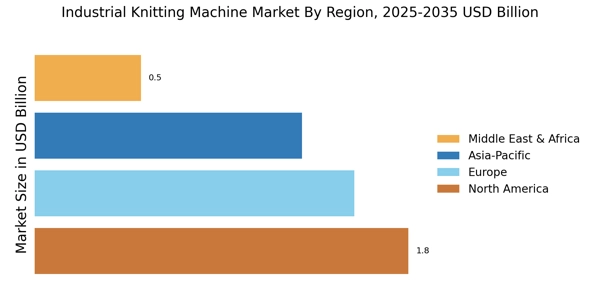
North America : Innovation and Demand Surge

The North American industrial knitting machine market is driven by technological advancements and increasing demand for customized textile solutions. The region holds approximately 35% of the global market share, making it the largest market. Regulatory support for sustainable manufacturing practices further fuels growth, as companies seek to innovate while adhering to environmental standards. Leading countries in this region include the United States and Canada, where major players like Shima Seiki and Stoll are actively expanding their operations. The competitive landscape is characterized by a focus on automation and efficiency, with companies investing in R&D to enhance product offerings. The presence of established manufacturers ensures a robust supply chain and innovation pipeline.

Europe : Manufacturing Powerhouse

Europe is a significant player in the industrial knitting machine market, accounting for around 30% of the global share, making it the second largest market. The region benefits from a strong manufacturing base and a growing demand for high-quality, sustainable textiles. Regulatory frameworks promoting eco-friendly practices are key drivers, encouraging manufacturers to adopt advanced technologies and sustainable materials. Germany, Italy, and the UK are leading countries in this sector, with key players like Mayer & Cie and Santoni driving innovation. The competitive landscape is marked by a focus on high-tech solutions and customization, with companies investing heavily in R&D. The presence of numerous trade fairs and exhibitions in Europe also fosters collaboration and knowledge sharing among industry stakeholders.

Asia-Pacific : Emerging Market Dynamics

The Asia-Pacific region is witnessing rapid growth in the industrial knitting machine market, holding approximately 25% of the global market share. This growth is driven by increasing demand for textiles in emerging economies like China and India, where urbanization and rising disposable incomes are fueling consumption. Additionally, government initiatives to boost manufacturing capabilities are acting as catalysts for market expansion. China is the largest market in this region, with significant contributions from Japan and India. Key players such as Baiyuan and Mitsubishi are expanding their presence, focusing on automation and efficiency. The competitive landscape is evolving, with local manufacturers increasingly adopting advanced technologies to meet the growing demand for high-quality knitted products, enhancing their market position.

Middle East and Africa : Resource-Rich Opportunities

The Middle East and Africa region is gradually emerging in the industrial knitting machine market, holding about 10% of the global share. The growth is primarily driven by increasing investments in the textile sector and a rising demand for locally produced textiles. Governments are implementing policies to support manufacturing, which is expected to further stimulate market growth. Countries like South Africa and the UAE are leading the way, with a focus on enhancing local production capabilities. The competitive landscape is characterized by a mix of local and international players, with companies exploring partnerships to leverage resources and technology. The region's unique market dynamics present opportunities for growth, particularly in sustainable and innovative textile solutions.

Industrial Knitting Machine Market Regional Image

Key Players and Competitive Insights

The Industrial Knitting Machine Market has become increasingly competitive as manufacturers seek to innovate and adapt to changing consumer demands and technological advancements. In a landscape characterized by rapid technological development, companies are striving to differentiate their offerings through enhanced productivity, reduced energy consumption, and versatile machine capabilities. Strengthened by growing end-user industries such as textiles and fashion, the market landscape is witnessing the entry of both established players and new entrants, all of whom are keen on capturing market share through strategic collaborations, research and development, and leveraging automated solutions.

As sustainability becomes a priority, the competitive dynamics are also shifting towards machine designs that promote eco-friendly production practices, which inevitably shape the strategies of manufacturers aiming for global leadership. Knittex holds a significant position in the Industrial Knitting Machine Market, recognized for its advanced knitting technology and commitment to quality. The company has developed an extensive range of machines that cater to various industries, providing precision and efficiency in production.

With a strong focus on innovation, Knittex continually invests in research and development to enhance the capabilities of their knitting machines, including features that allow for intricate patterns and superior fabric quality. The company's ability to deliver customization options and quick turnaround times has reinforced its reputation among industry players, establishing a solid market presence.

Furthermore, Knittex's customer-centric approach ensures that it maintains strong relationships with clients, facilitating long-term collaborations and repeat business, thereby solidifying its competitive edge within the marketplace.Mayer and Cie have carved out a prominent niche within the Industrial Knitting Machine Market, boasting a legacy characterized by innovation and reliability. Renowned for its high-quality circular knitting machines, the company blends tradition with modern technology, consistently upgrading its product offerings to meet the evolving needs of the industry. Mayer and Cie's commitment to excellence is reflected in its comprehensive service network, which supports clients with maintenance and technical assistance, ensuring seamless operations.

The company is also recognized for its sustainable manufacturing processes, striving to minimize waste and energy consumption, which aligns with the global trend towards environmentally friendly practices. This strong emphasis on sustainability, coupled with innovative engineering solutions, positions Mayer and Cie as a leader, allowing it to maintain a formidable stance in a competitive market filled with opportunities and challenges.

Key Companies in the Industrial Knitting Machine Market market include

Industry Developments

Recent developments in the Industrial Knitting Machine Market indicate a notable surge in demand driven by advancements in textile technologies and sustainability practices. Companies like Mayer and Cie, Karl Mayer Textilmaschinenfabrik GmbH, and Shima Seiki Manufacturing Limited are increasingly integrating automation and digital technologies, enhancing their product offerings. The market is witnessing growth in smart knitting solutions, with Brother Industries Limited and Hsing Wei Machine Industry Co. investing in research and development to tap into this segment.

Significant mergers and acquisitions are reshaping the landscape; for example, reports of acquisitions involving companies such as Fung Group and Sphinx Technologies highlight consolidation efforts aimed at expanding technological capabilities and market reach. The valuation of these firms has increased, affecting overall market dynamics as manufacturers emphasize efficiency and innovation. Companies like Knittex and Stoll GmbH are also focusing on sustainable production methods, aligning with global trends toward eco-friendly textiles. As demand for customized textile solutions grows, innovation remains central to the strategy of key players in the market, influencing their competitive advantage and long-term viability.

Future Outlook

Industrial Knitting Machine Market Future Outlook

The Industrial Knitting Machine Market is projected to grow at a 5.04% CAGR from 2024 to 2035, driven by technological advancements, increasing demand for customized textiles, and sustainability initiatives.

New opportunities lie in:

  • Integration of AI-driven design software for enhanced customization
  • Expansion into emerging markets with tailored product offerings
  • Development of eco-friendly knitting materials to meet sustainability demands

By 2035, the market is expected to achieve robust growth, positioning itself as a leader in textile manufacturing.

Market Segmentation

Industrial Knitting Machine Market End Use Outlook

  • Fashion Industry
  • Sports Industry
  • Medical Textiles
  • Automotive Industry

Industrial Knitting Machine Market Technology Outlook

  • Warp Knitting Machines
  • Weft Knitting Machines
  • Circular Knitting Machines
  • Flat Knitting Machines

Industrial Knitting Machine Market Application Outlook

  • Apparel
  • Home Textiles
  • Industrial Fabrics
  • Automotive Textiles

Industrial Knitting Machine Market Knitting Method Outlook

  • Manual Knitting
  • Semi-Automatic Knitting
  • Fully Automatic Knitting

Report Scope

MARKET SIZE 20245.1(USD Billion)
MARKET SIZE 20255.357(USD Billion)
MARKET SIZE 20358.761(USD Billion)
COMPOUND ANNUAL GROWTH RATE (CAGR)5.04% (2024 - 2035)
REPORT COVERAGERevenue Forecast, Competitive Landscape, Growth Factors, and Trends
BASE YEAR2024
Market Forecast Period2025 - 2035
Historical Data2019 - 2024
Market Forecast UnitsUSD Billion
Key Companies ProfiledMarket analysis in progress
Segments CoveredMarket segmentation analysis in progress
Key Market OpportunitiesIntegration of automation and smart technology enhances efficiency in the Industrial Knitting Machine Market.
Key Market DynamicsTechnological advancements drive efficiency and customization in the Industrial Knitting Machine Market, reshaping competitive dynamics.
Countries CoveredNorth America, Europe, APAC, South America, MEA

Leave a Comment

FAQs

What is the projected market valuation of the Industrial Knitting Machine Market by 2035?

The Industrial Knitting Machine Market is projected to reach approximately 8.761 USD Billion by 2035.

What was the market valuation of the Industrial Knitting Machine Market in 2024?

In 2024, the market valuation stood at 5.1 USD Billion.

What is the expected CAGR for the Industrial Knitting Machine Market during the forecast period 2025 - 2035?

The expected CAGR for the Industrial Knitting Machine Market during the forecast period 2025 - 2035 is 5.04%.

Which segment of the Industrial Knitting Machine Market had the highest valuation in 2024?

In 2024, Circular Knitting Machines had the highest valuation at 1.76 USD Billion.

What are the key applications driving the Industrial Knitting Machine Market?

Key applications include Apparel, Home Textiles, Industrial Fabrics, and Automotive Textiles, with Apparel valued at 1.5 USD Billion in 2024.

Which companies are considered key players in the Industrial Knitting Machine Market?

Key players include Mayer & Cie, Shima Seiki, Stoll, Santoni, and Mitsubishi, among others.

What was the valuation of Fully Automatic Knitting Machines in 2024?

Fully Automatic Knitting Machines were valued at 2.55 USD Billion in 2024.

How does the market valuation of the Sports Industry compare to the Fashion Industry in 2024?

In 2024, the Sports Industry was valued at 1.2 USD Billion, while the Fashion Industry was valued at 1.5 USD Billion.

Download Free Sample

Kindly complete the form below to receive a free sample of this Report

Compare Licence

×
Features License Type
Single User Multiuser License Enterprise User
Price $4,950 $5,950 $7,250
Maximum User Access Limit 1 User Upto 10 Users Unrestricted Access Throughout the Organization
Free Customization
Direct Access to Analyst
Deliverable Format
Platform Access
Discount on Next Purchase 10% 15% 15%
Printable Versions