Download Free Sample
Kindly complete the form below to receive a free sample of this Report
Industrial Robotics Maintenance and Repair Services Market Research Report Information By Robot Type (Articulated Robots, Scara Robots, Collaborative Robots, Delta Robots, Cartesian Robots), By Application (Manufacturing, Assembly, Packaging, Material Handling, Quality Control), By Service Type (Preventive Maintenance, Corrective Maintenance, Predictive Maintenance, Emergency Repair, Technical Support), By End Use Industry (Automotive, Electronics, Aerospace, Food And Beverage, Pharmaceutical), By Maintenance Strategy (In-House Maintenance, Outsourced Maintenance, Scheduled Maintenance, Condition-Based Maintenance, Total Productive Maintenance) And By Region (North America, Europe, Asia-Pacific, And Rest Of The World) – Market Forecast Till 2035.
As per MRFR analysis, the Industrial Robotics Maintenance and Repair Services Market was estimated at 10.0 USD Billion in 2024. The industrial robotics maintenance and repair services industry is projected to grow from 10.87 USD Billion in 2025 to 25.0 USD Billion by 2035, exhibiting a compound annual growth rate (CAGR) of 8.69% during the forecast period 2025 - 2035.
The Industrial Robotics Maintenance and Repair Services Market is experiencing transformative growth driven by technological advancements and evolving industry needs.
| 2024 Market Size | 10.0 (USD Billion) |
| 2035 Market Size | 25.0 (USD Billion) |
| CAGR (2025 - 2035) | 8.69% |
Fanuc (JP), KUKA (DE), ABB (CH), Yaskawa (JP), Siemens (DE), Rockwell Automation (US), Mitsubishi Electric (JP), Omron(JP), Universal Robots (DK)
Our Impact
Enabled $4.3B Revenue Impact for Fortune 500 and Leading Multinationals
Partnering with 2000+ Global Organizations Each Year
30K+ Citations by Top-Tier Firms in the Industry
The Industrial Robotics Maintenance and Repair Services Market is currently experiencing a transformative phase, driven by advancements in technology and increasing automation across various industries. As organizations strive to enhance operational efficiency, the demand for specialized maintenance and repair services for robotic systems is on the rise. This market appears to be characterized by a growing emphasis on predictive maintenance strategies, which leverage data analytics and IoT technologies to anticipate equipment failures before they occur. Such proactive approaches not only minimize downtime but also extend the lifespan of robotic assets, thereby optimizing overall productivity.
Moreover, the integration of artificial intelligence into maintenance practices is reshaping service delivery. AI-driven solutions facilitate real-time monitoring and diagnostics, enabling technicians to address issues swiftly and effectively. This trend suggests a shift towards more sophisticated service models that prioritize agility and responsiveness. Additionally, the increasing complexity of robotic systems necessitates a skilled workforce capable of managing advanced technologies. As a result, training and development initiatives are likely to gain prominence within the Industrial Robotics Maintenance and Repair Services Market, ensuring that personnel are equipped with the necessary expertise to navigate this evolving landscape.
The Industrial Robotics Maintenance and Repair Services Market is witnessing a notable shift towards predictive maintenance. This approach utilizes data analytics and IoT technologies to foresee potential equipment failures, allowing organizations to address issues proactively. By minimizing unplanned downtime, businesses can enhance productivity and extend the operational lifespan of their robotic systems.
Artificial intelligence is increasingly being integrated into maintenance and repair services within the Industrial Robotics Maintenance and Repair Services Market. AI-driven solutions enable real-time monitoring and diagnostics, which facilitate rapid issue resolution. This trend indicates a movement towards more sophisticated service models that prioritize efficiency and responsiveness.
As robotic systems become more complex, the need for a skilled workforce in the Industrial Robotics Maintenance and Repair Services Market is becoming more pronounced. Training and development initiatives are likely to gain traction, ensuring that technicians possess the necessary expertise to manage advanced technologies effectively. This focus on workforce enhancement is crucial for maintaining service quality.
The focus on safety and compliance within industrial environments is a crucial driver for the Industrial Robotics Maintenance and Repair Services Market. As regulations surrounding workplace safety become more stringent, companies are compelled to ensure that their robotic systems adhere to these standards. Regular maintenance and repair services are essential to guarantee that robots operate safely and efficiently, minimizing the risk of accidents and ensuring compliance with industry regulations. In 2025, it is expected that the regulatory landscape will continue to evolve, further emphasizing the need for reliable maintenance services. Organizations are likely to invest in comprehensive maintenance programs to mitigate risks associated with robotic operations. Thus, the Industrial Robotics Maintenance and Repair Services Market is positioned to thrive as companies prioritize safety and compliance in their robotic systems.
The rising demand for customization in manufacturing processes is a significant driver for the Industrial Robotics Maintenance and Repair Services Market. As businesses strive to meet specific customer requirements, they increasingly turn to robotic solutions that can be tailored to unique production needs. This trend necessitates ongoing maintenance and repair services to ensure that customized robotic systems operate efficiently. In 2025, it is anticipated that the market for customized robotics will expand, leading to a corresponding increase in the need for specialized maintenance services. Companies are likely to seek out expert providers who can offer tailored maintenance solutions that align with their unique robotic configurations. Consequently, the Industrial Robotics Maintenance and Repair Services Market stands to gain from this growing emphasis on customization, as businesses prioritize the longevity and performance of their bespoke robotic systems.
The growth of e-commerce and logistics sectors is a prominent driver for the Industrial Robotics Maintenance and Repair Services Market. As online shopping continues to surge, warehouses and distribution centers are increasingly adopting robotic solutions to streamline operations and enhance efficiency. This trend is projected to drive the robotics market to new heights, with estimates suggesting a growth rate of over 20 percent in the logistics sector by 2025. Consequently, the demand for maintenance and repair services for these robotic systems is likely to increase significantly. Companies will require ongoing support to ensure that their robotic systems function optimally, thereby reducing downtime and improving service delivery. The Industrial Robotics Maintenance and Repair Services Market is thus expected to benefit from the expanding e-commerce landscape, as businesses seek to maintain their competitive edge through efficient robotic operations.
The rise of automation in manufacturing processes is a pivotal driver for the Industrial Robotics Maintenance and Repair Services Market. As industries increasingly adopt robotic systems to enhance productivity and efficiency, the demand for maintenance and repair services escalates. In 2025, it is estimated that the automation market will reach a valuation of over 200 billion dollars, indicating a robust growth trajectory. This trend necessitates regular servicing and repairs to ensure optimal performance of robotic systems, thereby creating a sustained demand for specialized maintenance services. Furthermore, as manufacturers seek to minimize downtime and maintain operational efficiency, the reliance on expert maintenance services becomes paramount. Consequently, the Industrial Robotics Maintenance and Repair Services Market is poised to benefit significantly from this ongoing shift towards automation.
Technological advancements in robotics are transforming the landscape of the Industrial Robotics Maintenance and Repair Services Market. Innovations such as enhanced sensors, machine learning algorithms, and improved connectivity are enabling robots to perform complex tasks with greater precision. As these technologies evolve, the need for specialized maintenance services to address the intricacies of modern robotic systems becomes increasingly critical. In 2025, the robotics market is projected to grow at a compound annual growth rate of approximately 15 percent, further underscoring the importance of maintenance and repair services. These advancements not only enhance the capabilities of robots but also necessitate regular updates and repairs, thereby driving demand for maintenance services. The Industrial Robotics Maintenance and Repair Services Market is thus likely to experience growth as companies invest in maintaining their advanced robotic systems.
In the Industrial Robotics Maintenance and Repair Services Market, the application segment is significantly influenced by various sectors, with Manufacturing leading in market share. This sector benefits from a continuous demand for robotics in operations, where precision and efficiency are paramount. Following closely are applications like Packaging, Material Handling, Assembly, and Quality Control, each contributing uniquely to the overall market dynamics and capturing substantial interest from industry players.
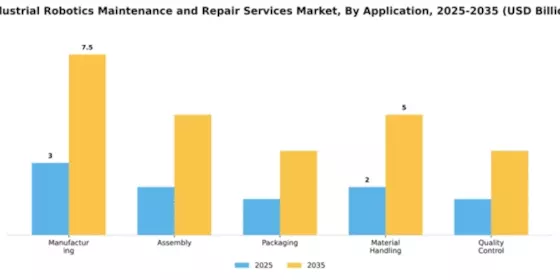
Manufacturing: Dominant vs. Packaging: Emerging
Manufacturing remains the dominant force in the Industrial Robotics Maintenance and Repair Services Market, driven by the need for automation, improved productivity, and stringent quality standards. This segment relies heavily on advanced robotics for operation efficiency, maintenance, and repair services. Conversely, the Packaging sector is emerging rapidly due to the increasing consumer demand for faster and more efficient packaging solutions. As e-commerce continues to grow, packaging applications are adapting with innovative robotic systems that promise agility and reduced operational costs. The interplay between these segments illustrates a broader trend towards automation across various manufacturing processes.
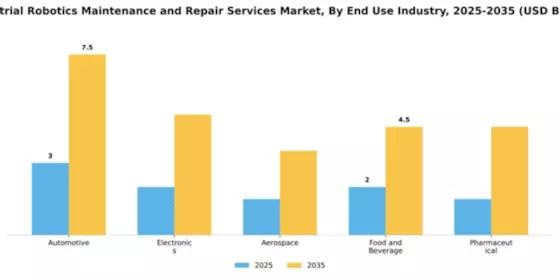
In the Industrial Robotics Maintenance and Repair Services Market, the automotive industry holds the largest market share, driven by the high demand for automation and efficiency in manufacturing processes. Other significant segments include electronics, aerospace, food and beverage, and pharmaceuticals, which collectively contribute to a dynamic market landscape. The automotive sector’s reliance on robotics signifies a steady demand for maintenance and repair services due to the complexity of modern robotic systems and the need for continuous operational efficiency. On the other hand, the electronics industry is emerging as the fastest-growing segment, fueled by rapid advancements in technology and increasing automation in electronics manufacturing. The requirement for precision and reliability in this sector amplifies the demand for specialized maintenance services, thus creating lucrative growth opportunities. Increasing investment in automation across various industries further reinforces the growth potential of all segments, with the electronics sector leading this transformation.
Automotive: Dominant vs. Electronics: Emerging
The automotive sector remains dominant in the Industrial Robotics Maintenance and Repair Services Market due to its extensive use of robotics in production lines, requiring regular maintenance to optimize performance and reduce downtime. This industry is characterized by established players and robust supply chains, ensuring that maintenance services are tailored to meet high standards of efficiency and reliability. Conversely, the electronics sector, labeled as emerging, is rapidly adapting to new technologies and increasing automation trends. This segment is marked by innovative practices and a shift towards smart manufacturing, necessitating advanced maintenance solutions to prevent system failures and maintain production quality. As robotics becomes pivotal in electronics manufacturing, service expectations are evolving, prompting the need for responsive and sophisticated repair services.
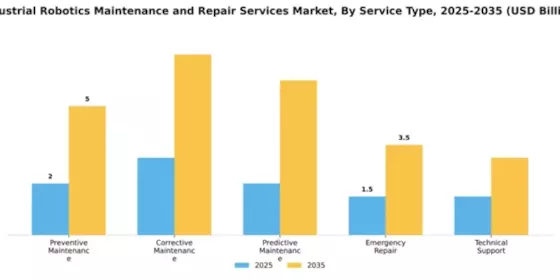
The Industrial Robotics Maintenance and Repair Services Market is segmented into various service types, including Preventive Maintenance, Corrective Maintenance, Predictive Maintenance, Emergency Repair, and Technical Support. Among these, Preventive Maintenance holds the largest market share, as companies prioritize regular upkeep to minimize downtime and enhance operational efficiency. Corrective Maintenance follows, addressing unplanned issues, while Emergency Repair and Technical Support play crucial roles for immediate resolutions. Predictive Maintenance, using advanced analytics, is gaining traction, representing a notable share in the market.
Preventive Maintenance (Dominant) vs. Predictive Maintenance (Emerging)
Preventive Maintenance is a well-established segment in the Industrial Robotics Maintenance and Repair Services Market, focusing on scheduled maintenance to prevent breakdowns and extend the lifespan of robotic systems. It helps organizations reduce long-term costs by minimizing unexpected failures. On the other hand, Predictive Maintenance is emerging as a game changer, leveraging real-time data and AI-driven analytics to anticipate issues before they occur. This proactive approach minimizes downtime and enhances productivity, making it increasingly attractive for manufacturers. As automation escalates, the demand for both preventive and predictive strategies will continue to rise, shaping the future landscape of the market.
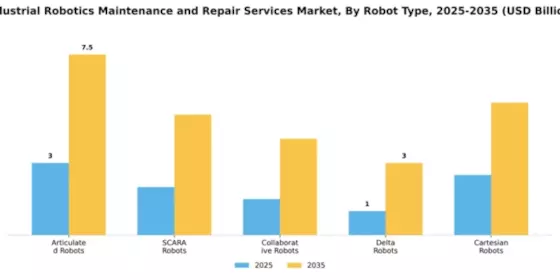
The Industrial Robotics Maintenance and Repair Services Market is witnessing a significant distribution of market share among various robot types. Articulated robots hold the largest share due to their versatility and widespread application in industries such as automotive and manufacturing. Collaboratively, SCARA and Delta robots also contribute to the market but represent smaller segments. The detailed analysis reveals that articulated robots are preferred for complex tasks, whereas SCARA robots excel in precision for assembly tasks, each commanding a unique segment in the market.
Robot Type: Articulated (Dominant) vs. Collaborative (Emerging)
Articulated robots are renowned for their flexibility and multi-degree of freedom, making them the dominant choice in diverse applications ranging from welding to material handling. Their ability to perform intricate tasks in confined spaces significantly enhances their appeal in the industrial landscape. In contrast, collaborative robots, designed to safely work alongside humans, represent an emerging trend in the market. They are rapidly gaining traction due to their ease of programming and deployment, catering to smaller production runs and iterative tasks. This emerging segment is reshaping the industry by promoting automation in environments where human intervention is still essential.
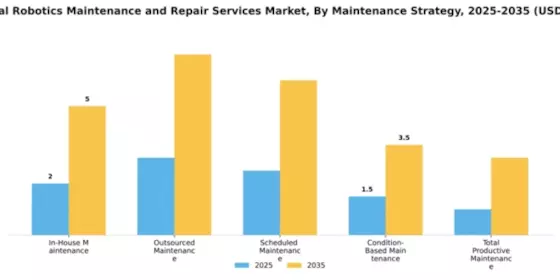
The Industrial Robotics Maintenance and Repair Services Market shows a diverse distribution of maintenance strategies. In-House Maintenance takes the lead as the largest segment, reflecting a preference for manufacturers to manage their robotic systems directly, ensuring immediate access to expertise and quicker response times. Following closely are Outsourced Maintenance services, which are favored for their convenience and cost-effectiveness, while Scheduled Maintenance remains relevant with its routine upkeep model. Condition-Based Maintenance, however, is experiencing significant growth due to advancements in monitoring technologies that allow for timely interventions based on actual equipment conditions.
In-House Maintenance (Dominant) vs. Condition-Based Maintenance (Emerging)
In-House Maintenance is characterized by companies utilizing their own resources and personnel to conduct repairs and maintenance on industrial robots. This strategy emphasizes direct control over robotic systems, fostering operational familiarity and tailored expertise. In contrast, Condition-Based Maintenance is gaining traction as an emerging approach. This method relies on real-time data and analytics to perform maintenance only when necessary, significantly reducing downtime and optimizing performance. As technologies such as IoT and AI continue to evolve, Condition-Based Maintenance is poised to transform how organizations manage their robotic systems, presenting both challenges and opportunities for traditional maintenance models.
Get more detailed insights about Industrial Robotics Maintenance and Repair Services Market Request Free Sample
North America is poised to maintain its leadership in the Industrial Robotics Maintenance and Repair Services Market, holding a market size of $4.0B in 2025. Key growth drivers include the rapid adoption of automation technologies, increased demand for efficiency, and supportive regulatory frameworks. The region's focus on innovation and investment in advanced robotics technologies further fuels market expansion, with a projected growth rate of 8% annually. The competitive landscape is characterized by major players such as Rockwell Automation, Siemens, and ABB, which are driving advancements in robotics maintenance. The U.S. leads the market, supported by a robust manufacturing sector and significant investments in R&D. Canada and Mexico are also emerging as key players, contributing to the region's overall growth and technological advancements.
Europe's Industrial Robotics Maintenance and Repair Services Market is projected to reach $3.0B by 2025, driven by a strong emphasis on innovation and sustainability. The region benefits from stringent regulations promoting automation and efficiency, which are key catalysts for market growth. Countries like Germany and France are at the forefront, with a growing demand for advanced robotics solutions in manufacturing and logistics sectors, leading to an annual growth rate of 7%. Germany stands out as a leader in robotics technology, hosting major players like KUKA and Siemens. The competitive landscape is further enhanced by collaborations between industry and academia, fostering innovation. The European market is characterized by a diverse range of service providers, ensuring a comprehensive approach to maintenance and repair services, which is crucial for sustaining operational efficiency.
The Asia-Pacific region is witnessing significant growth in the Industrial Robotics Maintenance and Repair Services Market, projected to reach $2.5B by 2025. Key drivers include the rapid industrialization in countries like China and India, coupled with increasing investments in automation technologies. The region's market is expected to grow at a rate of 6% annually, fueled by rising labor costs and the need for operational efficiency. China is the dominant player in the market, with substantial investments in robotics and automation. Japan and South Korea also contribute significantly, with established companies like Fanuc and Yaskawa leading the charge. The competitive landscape is evolving, with new entrants focusing on innovative maintenance solutions, enhancing service delivery and operational uptime across various industries.
The Middle East and Africa region is gradually emerging in the Industrial Robotics Maintenance and Repair Services Market, with a projected size of $0.5B by 2025. The growth is driven by increasing investments in automation and a shift towards advanced manufacturing practices. Countries like the UAE and South Africa are leading the charge, with government initiatives aimed at enhancing industrial capabilities and attracting foreign investments, resulting in a growth rate of 5% annually. The competitive landscape is still developing, with a mix of local and international players entering the market. The presence of key players is limited, but there is a growing interest in robotics solutions across various sectors, including oil and gas, manufacturing, and logistics. As the region continues to invest in technology, the potential for growth in maintenance and repair services is significant.
The Industrial Robotics Maintenance and Repair Services Market is characterized by a dynamic competitive landscape, driven by technological advancements and increasing automation across various sectors. Key players such as Fanuc (Japan), KUKA (Germany), and ABB (Switzerland) are at the forefront, each adopting distinct strategies to enhance their market positioning. Fanuc (Japan) emphasizes innovation through continuous investment in R&D, focusing on AI and machine learning to improve service efficiency. KUKA (Germany) has pursued strategic partnerships, particularly in the automotive sector, to expand its service offerings and enhance customer engagement. Meanwhile, ABB (Switzerland) is leveraging digital transformation initiatives to optimize its service delivery, thereby enhancing operational efficiency and customer satisfaction. Collectively, these strategies contribute to a competitive environment that is increasingly focused on technological integration and customer-centric solutions.In terms of business tactics, companies are localizing manufacturing to reduce lead times and optimize supply chains, which is crucial in a market that is moderately fragmented. This localization not only enhances responsiveness to customer needs but also mitigates risks associated with global supply chain disruptions. The competitive structure is shaped by the collective influence of these key players, who are increasingly collaborating to enhance service capabilities and market reach.In November KUKA (Germany) announced a strategic partnership with a leading automotive manufacturer to develop advanced predictive maintenance solutions. This collaboration aims to integrate IoT technologies into KUKA's service offerings, allowing for real-time monitoring and proactive maintenance. The strategic importance of this move lies in its potential to significantly reduce downtime for clients, thereby enhancing operational efficiency and reinforcing KUKA's position as a leader in the automotive sector.In October ABB (Switzerland) launched a new digital platform designed to streamline maintenance processes for industrial robots. This platform utilizes AI algorithms to predict maintenance needs and optimize service schedules. The introduction of this platform is strategically significant as it aligns with the growing trend towards digitalization in the industry, positioning ABB to better meet the evolving demands of its customers.In December Fanuc (Japan) unveiled a new service model that incorporates remote diagnostics and support, leveraging advanced analytics to enhance service delivery. This initiative is particularly noteworthy as it reflects a broader industry trend towards remote service capabilities, which can lead to reduced operational costs and improved service response times. By adopting this model, Fanuc is likely to strengthen its competitive edge in the market.As of December the competitive trends in the Industrial Robotics Maintenance and Repair Services Market are increasingly defined by digitalization, sustainability, and AI integration. Strategic alliances are becoming more prevalent, as companies recognize the need to collaborate to enhance their technological capabilities and service offerings. Looking ahead, competitive differentiation is expected to evolve, shifting from price-based competition to a focus on innovation, technology, and supply chain reliability. This transition underscores the importance of adaptability and forward-thinking strategies in maintaining a competitive advantage in a rapidly changing market.




The Industrial Robotics Maintenance and Repair Services Market is projected to grow at 8.69% CAGR from 2025 to 2035, driven by technological advancements and increasing automation.
New opportunities lie in:
By 2035, the market is expected to be robust, reflecting substantial growth and innovation.
| MARKET SIZE 2024 | 10.0(USD Billion) |
| MARKET SIZE 2025 | 10.87(USD Billion) |
| MARKET SIZE 2035 | 25.0(USD Billion) |
| COMPOUND ANNUAL GROWTH RATE (CAGR) | 8.69% (2025 - 2035) |
| REPORT COVERAGE | Revenue Forecast, Competitive Landscape, Growth Factors, and Trends |
| BASE YEAR | 2024 |
| Market Forecast Period | 2025 - 2035 |
| Historical Data | 2019 - 2024 |
| Market Forecast Units | USD Billion |
| Key Companies Profiled | Fanuc (JP), KUKA (DE), ABB (CH), Yaskawa (JP), Siemens (DE), Rockwell Automation (US), Mitsubishi Electric (JP), Omron (JP), Universal Robots (DK) |
| Segments Covered | Application, End Use Industry, Service Type, Robot Type, Maintenance Strategy |
| Key Market Opportunities | Integration of predictive maintenance technologies enhances efficiency in the Industrial Robotics Maintenance and Repair Services Market. |
| Key Market Dynamics | Rising demand for automation drives growth in industrial robotics maintenance and repair services amid evolving technological advancements. |
| Countries Covered | North America, Europe, APAC, South America, MEA |
The market is projected to reach a valuation of 25.0 USD Billion by 2035.
The overall market valuation was 10.0 USD Billion in 2024.
The expected CAGR during the forecast period 2025 - 2035 is 8.69%.
Key players include Fanuc, KUKA, ABB, Yaskawa, Siemens, Rockwell Automation, Mitsubishi Electric, Omron, and Universal Robots.
Main application segments include Manufacturing, Assembly, Packaging, Material Handling, and Quality Control.
The Automotive sector contributes between 3.0 and 7.5 USD Billion to the market valuation.
Preventive Maintenance services are valued between 2.0 and 5.0 USD Billion.
Included robot types are Articulated Robots, SCARA Robots, Collaborative Robots, Delta Robots, and Cartesian Robots.
Prevalent maintenance strategies include In-House Maintenance, Outsourced Maintenance, Scheduled Maintenance, Condition-Based Maintenance, and Total Productive Maintenance.
The Packaging application segment is projected to reach a valuation between 1.5 and 3.5 USD Billion by 2035.



Kindly complete the form below to receive a free sample of this Report

“This is really good guys. Excellent work on a tight deadline. I will continue to use you going forward and recommend you to others. Nice job”


“Thanks. It’s been a pleasure working with you, please use me as reference with any other Intel employees.”


“Thanks for sending the report it gives us a good global view of the Betaïne market.”


“Thank you, this will be very helpful for OQS.”


“We found the report very insightful! we found your research firm very helpful. I'm sending this email to secure our future business.”


“I am very pleased with how market segments have been defined in a relevant way for my purposes (such as "Portable Freezers & refrigerators" and "last-mile"). In general the report is well structured. Thanks very much for your efforts.”


“I have been reading the first document or the study, ,the Global HVAC and FP market report 2021 till 2026. Must say, good info! I have not gone in depth at all parts, but got a good indication of the data inside!”


“We got the report in time, we really thank you for your support in this process. I also thank to all of your team as they did a great job.”


“The Automotive 48V ECU Components Procurement Intelligence Study” was a complex project, but the Market Research Future (MRFR) team handled it with quality, agility, and customer-centricity. They delivered all requested data on time and within the agreed scope. The team, including Shubhendra Anand and Rahul Gotadki, was always readily available to clarify questions and swiftly implement necessary adjustments, driving the project to a successful conclusion within a very demanding timeframe.
I would also like to specifically commend Akshay Agarwal for his responsiveness and support at every stage—from our initial inquiry on May 6th through to final delivery on June 18th. His dedication made the entire process seamless.”



