Influencer Marketing Market Summary
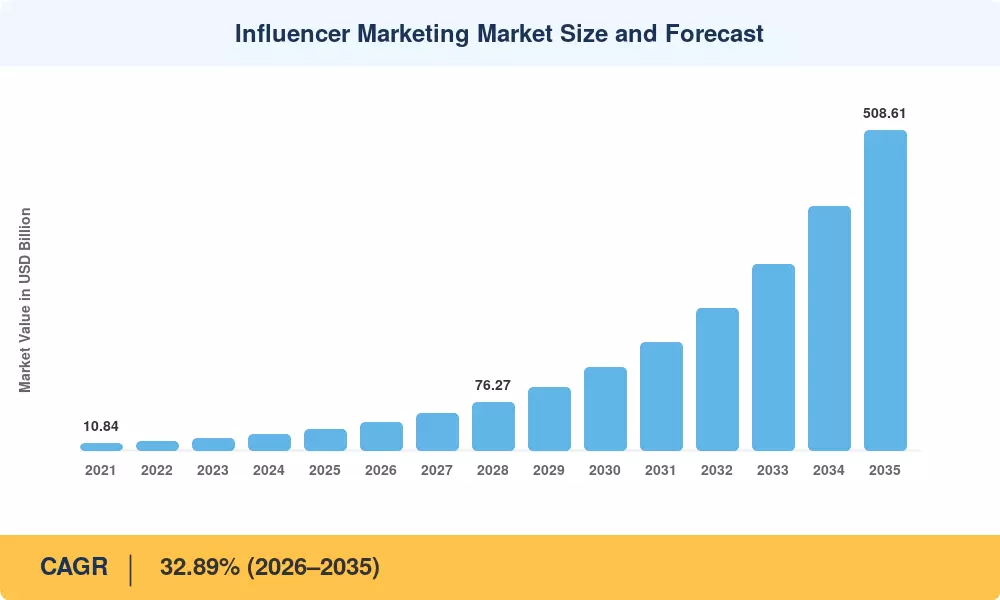
The Influencer Marketing Market reached an estimated USD 33.82 billion in 2025 and is projected to hit USD 43.75 billion in 2026 before climbing to USD 508.61 billion by 2035, reflecting a 32.89% CAGR across the forecast window. Brand ambassador programs have shifted from experimental line items to core acquisition channels, driven by finance teams that now approve multi-year creator budgets after observing blended customer-acquisition costs drop by 30–40% when paid search spend migrates toward content creator partnerships. The U.S. Federal Trade Commission's updated Endorsement Guides, finalized in mid-2023, gave advertisers a compliance baseline that unlocked larger commitments [2].
We’re seeing a structural change: old display-ad buying desks are losing market to platforms that are embedding influencer ROI analytics directly in campaign processes. Southeast Asia and China’s social-commerce super-apps combine discovery, engagement and checkout into a single scroll, making digital word-of-mouth marketing a trackable revenue engine, rather than a brand-awareness proxy. Between 2023 and 2025, about USD 4.2 billion of global ad-tech venture financing flowed into creator-economy infrastructure, a demonstration of strong institutional faith in the longevity of the channel.
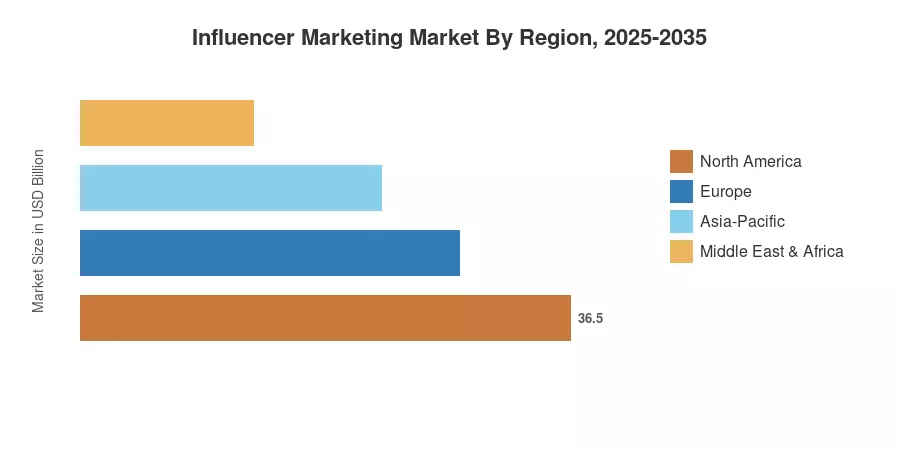
The influencer marketing market in North America is worth $2.76 billion (37.28%) due to mature attribution stacks and transparent disclosure rules. The Asia-Pacific area, the fastest expanding at 36.63% CAGR, is driven by social media influencer efforts that convert inside super-app ecosystems. Europe comes in second with a share of around 24 percent, as GDPR-aligned influencer disclosure rules are allowing regulated sectors such as fintech and pharmaceuticals to experiment with content creator collaborations for the first time The next ten years will reward solutions that bring creative discovery, compliance and influencer market ROI analytics into a single dashboard.
Key Report Takeaways
• By Influencer Type
- Micro influencers (10K–100K followers) captured 42.18% of the Influencer Marketing Market in 2025, reflecting advertisers' preference for engagement-rich brand ambassador programs over celebrity reach
- Nano influencers (1K–10K) are forecast to expand at a 37.68% CAGR through 2035, as small-business budgets increasingly favor hyper-local digital word-of-mouth marketing
• By Social Media Channel
- Instagram accounted for a 31.42% revenue share of the Market in 2025, driven by Reels monetization and shoppable-post integrations
- TikTok is projected to grow at a 39.80% CAGR to 2035, propelled by short-form social media influencer campaigns and in-app commerce
• By Geography
- North America contributed 37.28% of the Market, backed by robust influencer ROI analytics ecosystems
- Asia-Pacific is set to record the highest CAGR of 36.63% during 2026–2035, led by social-commerce adoption in China and India
Market Size and Forecast (2021–2035)
MRFR’s market-size estimations are produced using a mix of bottom-up platform revenue research and top-down advertising-spend triangulation, cross-validated with creator-payout declarations by key social platforms and third-party brand-spend trackers.