×
Request Free Sample ×

Kindly complete the form below to receive a free sample of this Report

Leading companies partner with us for data-driven Insights

clients tt-cursor
Hero Background

Infrared Emitter Receiver Market

ID: MRFR/SEM/27502-HCR
128 Pages
Aarti Dhapte
October 2025

Infrared Emitter Receiver Market Research Report By Product Type (Infrared Emitters, Infrared Receivers, Infrared Transceivers), By Wavelength Range (Near-Infrared (NIR), Mid-Infrared (MIR), Far-Infrared (FIR)), By Application (Security and Surveillance, Industrial Automation, Healthcare, Consumer Electronics, Automotive), By Form Factor (Discrete Components, Integrated Circuits (ICs), Arrays and Modules) and By Regional (North America, Europe, South America, Asia Pacific, Middle East and Africa) - Forecast to 2035.

Share:
Download PDF ×

We do not share your information with anyone. However, we may send you emails based on your report interest from time to time. You may contact us at any time to opt-out.

Infrared Emitter Receiver Market Infographic
Purchase Options

Infrared Emitter Receiver Market Summary

As per MRFR analysis, the Infrared Emitter Receiver Market Size was estimated at 2.35 USD Billion in 2024. The Infrared Emitter Receiver industry is projected to grow from 2.59 USD Billion in 2025 to 6.84 USD Billion by 2035, exhibiting a compound annual growth rate (CAGR) of 10.2 during the forecast period 2025 - 2035.

Key Market Trends & Highlights

The Infrared Emitter Receiver Market is poised for substantial growth driven by technological advancements and increasing applications across various sectors.

  • North America remains the largest market for infrared emitters, driven by robust demand in consumer electronics and automotive applications.
  • Asia-Pacific is recognized as the fastest-growing region, with significant investments in smart home technologies and healthcare solutions.
  • Infrared emitters dominate the market, while infrared receivers are experiencing rapid growth due to their integration with IoT solutions.
  • Technological advancements and rising adoption in automotive applications are key drivers propelling market expansion.

Market Size & Forecast

2024 Market Size 2.35 (USD Billion)
2035 Market Size 6.84 (USD Billion)
CAGR (2025 - 2035) 10.2%

Major Players

Texas Instruments (US), Vishay Intertechnology (US), Sharp Corporation (JP), Osram Licht AG (DE), Honeywell International Inc. (US), FLIR Systems, Inc. (US), STMicroelectronics (FR), Broadcom Inc. (US), Mouser Electronics (US)

Infrared Emitter Receiver Market Trends

The Infrared Emitter Receiver Market is currently experiencing a dynamic evolution, driven by advancements in technology and increasing applications across various sectors. The integration of infrared technology in consumer electronics, automotive systems, and industrial automation is becoming more prevalent. This trend suggests a growing demand for efficient and reliable infrared emitter receivers, which are essential for communication, sensing, and control applications. As industries continue to innovate, the market appears poised for substantial growth, with new applications emerging regularly. Furthermore, the emphasis on energy efficiency and miniaturization is likely to shape product development, leading to more compact and powerful devices that cater to diverse consumer needs. In addition, the Infrared Emitter Receiver Market is witnessing a shift towards enhanced connectivity and smart technologies. The rise of the Internet of Things (IoT) and smart home devices is creating new opportunities for infrared solutions. These technologies require seamless integration and communication, which infrared emitters and receivers can facilitate. As consumers increasingly seek convenience and automation in their daily lives, the demand for sophisticated infrared systems is expected to rise. Overall, the market's trajectory indicates a promising future, characterized by innovation and adaptability to changing consumer preferences.

Technological Advancements

Recent innovations in infrared technology are driving the development of more efficient and versatile emitter receiver systems. These advancements enhance performance and expand the range of applications across various industries.

Growing Demand in Consumer Electronics

The proliferation of smart devices and home automation systems is significantly increasing the need for infrared emitter receivers. This trend reflects a broader shift towards interconnected and user-friendly technology.

Integration with IoT Solutions

The rise of the Internet of Things is fostering the integration of infrared technology into smart devices. This trend highlights the importance of seamless communication and control in modern applications.

Infrared Emitter Receiver Market Drivers

Rising Adoption in Healthcare Sector

The healthcare sector is increasingly utilizing infrared emitter receivers for non-invasive monitoring and diagnostic applications. This trend is contributing to the expansion of the Infrared Emitter Receiver Market, as healthcare providers seek efficient and accurate methods for patient monitoring. Devices such as infrared thermometers and pulse oximeters are becoming commonplace, particularly in clinical settings. The market for infrared devices in healthcare is projected to grow at a compound annual growth rate of around 10% over the next few years. This growth is driven by the need for reliable and quick diagnostic tools, which positions the Infrared Emitter Receiver Market as a vital component in the evolution of healthcare technology.

Integration with Smart Home Technologies

The rise of smart home technologies is significantly impacting the Infrared Emitter Receiver Market. As consumers increasingly seek automation and convenience, infrared devices are being integrated into smart home systems for applications such as remote control and security. The market for smart home devices is expected to reach a valuation of several billion dollars in the coming years, with infrared technology playing a crucial role in this growth. The ability to control various home appliances through infrared emitters enhances user experience and energy efficiency. Consequently, the demand for infrared emitter receivers is likely to surge as more households adopt smart home solutions, further propelling the Infrared Emitter Receiver Market.

Growing Demand in Automotive Applications

The automotive sector is increasingly adopting infrared emitter receivers for various applications, including advanced driver-assistance systems (ADAS) and night vision systems. This trend is significantly influencing the Infrared Emitter Receiver Market, as the demand for enhanced safety features in vehicles continues to rise. According to recent estimates, the automotive segment is expected to account for over 25% of the total market share by 2026. The integration of infrared technology in vehicles not only improves safety but also enhances user experience, making it a critical driver for market growth. As automotive manufacturers prioritize innovation, the Infrared Emitter Receiver Market is likely to see substantial investments aimed at developing cutting-edge solutions.

Increased Focus on Security and Surveillance

The growing emphasis on security and surveillance systems is a key driver for the Infrared Emitter Receiver Market. With rising concerns over safety in both residential and commercial spaces, the demand for advanced surveillance solutions is escalating. Infrared technology is particularly valued for its ability to operate effectively in low-light conditions, making it ideal for security cameras and motion detectors. The market for security and surveillance systems is projected to grow significantly, with infrared devices expected to play a pivotal role. As businesses and homeowners invest in enhanced security measures, the Infrared Emitter Receiver Market is likely to benefit from this trend, leading to increased sales and innovation in infrared technology.

Technological Advancements in Infrared Emitter Receiver Market

The Infrared Emitter Receiver Market is experiencing rapid technological advancements that enhance the performance and efficiency of infrared devices. Innovations in materials and design are leading to improved sensitivity and range, which are critical for applications in various sectors. For instance, the development of high-performance infrared sensors has resulted in a projected market growth rate of approximately 8% annually over the next five years. These advancements not only improve the functionality of existing products but also pave the way for new applications in automation and security systems. As technology continues to evolve, manufacturers are likely to invest in research and development to stay competitive, further driving the growth of the Infrared Emitter Receiver Market.

Market Segment Insights

By Product Type: Infrared Emitters (Largest) vs. Infrared Receivers (Fastest-Growing)

In the Infrared Emitter Receiver Market, the distribution of market share across the various product types highlights a clear dominance of infrared emitters, which are widely utilized across various applications such as remote controls, security systems, and industrial sensors. Infrared receivers follow closely, driven by their integration into consumer electronic devices and automation technology, showcasing significant potential for growth. Meanwhile, infrared transceivers, although currently holding a smaller market share, are gaining traction in applications requiring bidirectional communication. Growth trends for the infrared emitter receiver segment are largely influenced by advancements in technology and an increasing demand for automation solutions. The surge in IoT devices and smart home technologies has made infrared receivers particularly attractive for manufacturers. As applications diversify, infrared transceivers are poised for rapid development, benefitting from innovations that enhance their functionality, efficiency, and connectivity, indicating a promising trajectory for this segment in the forthcoming years.

Product Type: Infrared Emitters (Dominant) vs. Infrared Transceivers (Emerging)

Infrared emitters have established themselves as the dominant product type in the market, recognized for their reliability and versatility in a range of industries, from consumer electronics to automotive applications. They are crucial for providing effective infrared radiation for communication and sensing applications. In contrast, infrared transceivers are an emerging technology, combining the functionality of both emitters and receivers. They cater to the growing need for integrated solutions that can handle bi-directional data transfer. As technological advancements progress, transceivers are expected to become increasingly appealing due to their space-saving designs and enhanced performance capabilities, thereby redefining their position in the infrared technology landscape.

By Wavelength Range: Near-Infrared (NIR) (Largest) vs. Far-Infrared (FIR) (Fastest-Growing)

In the Infrared Emitter Receiver Market, the Near-Infrared (NIR) segment dominates, holding the largest market share due to its widespread applications across various industries such as consumer electronics, healthcare, and automotive. Its high sensitivity and effectiveness in detecting minimal heat signatures make it a preferred choice among manufacturers. Conversely, the Far-Infrared (FIR) segment, while currently smaller in share, is rapidly gaining traction, particularly in sensors and thermal imaging products designed for safety and security applications.

Near-Infrared (NIR) (Dominant) vs. Mid-Infrared (MIR) (Emerging)

Near-Infrared (NIR) technology is characterized by its ability to operate effectively in various environmental conditions, making it well-suited for applications in healthcare diagnostics and industrial monitoring. Its robustness provides a competitive edge over other segments. In contrast, the Mid-Infrared (MIR) segment is emerging with innovative applications in gas detection and spectroscopic analysis. Although it is still establishing its foothold in the market, advancements in material science and semiconductor technology are enhancing its performance, enabling growth and increasing interest from industries focusing on environmental monitoring and safety.

By Application: Security and Surveillance (Largest) vs. Automotive (Fastest-Growing)

In the Infrared Emitter Receiver Market, the 'Security and Surveillance' segment holds the largest market share due to escalating demand for safety and advanced monitoring solutions across residential and commercial sectors. This segment's prominence is largely driven by the increasing adoption of smart home technologies and professional surveillance systems, which integrate infrared technology for improved efficacy in security measures. Conversely, the 'Automotive' segment is recognized as the fastest-growing area, propelled by the rapid advancements in automotive safety features, such as collision avoidance and pedestrian detection systems. With an increasing focus on autonomous vehicles and enhanced driver-assist technologies, the demand for infrared emitters and receivers is expected to surge, indicating a transformative shift within the automotive industry.

Security and Surveillance: Dominant vs. Automotive: Emerging

The 'Security and Surveillance' segment is characterized by its robust demand primarily driven by the need for enhanced safety protocols and surveillance technologies across various applications. This segment utilizes infrared emitters and receivers for applications such as thermal imaging and motion detection, making it a key player in crime prevention and monitoring. In contrast, the 'Automotive' segment is rapidly emerging as a significant contender, primarily due to the integration of infrared technology in advanced driver assistance systems (ADAS). The ability of infrared to function under low-visibility conditions makes it invaluable for automotive safety applications. As automotive manufacturers increasingly adopt innovative designs, the integration of infrared technology is set to rise, indicating a dynamic shift in market preferences.

By Form Factor: Discrete Components (Largest) vs. Integrated Circuits (Fastest-Growing)

In the Infrared Emitter Receiver Market, the form factor segments exhibit a diverse share distribution. Discrete components currently capture the largest market share, owing to their well-established presence and reliability across various applications. Integrated circuits, though they hold a smaller share, are rapidly gaining traction due to their compactness and enhanced functionality, making them the fastest-growing segment in this market. Arrays and modules serve as a strong complementary category, appealing to specialized applications that demand integrated solutions.

Discrete Components (Dominant) vs. Integrated Circuits (Emerging)

Discrete components are recognized as the dominant segment in the form factor market, characterized by their simplicity and robustness. These components are crucial for a wide range of consumer and industrial applications, providing essential infrared functionalities. In contrast, integrated circuits represent an emerging segment, known for their innovation and miniaturization capabilities. The growing demand for compact and efficient designs is propelling the ICs forward, as they facilitate advanced features, lower power consumption, and greater functionality in smaller packages, catering increasingly to modern electronic devices.

Get more detailed insights about Infrared Emitter Receiver Market

Regional Insights

North America : Technology Innovation Leader

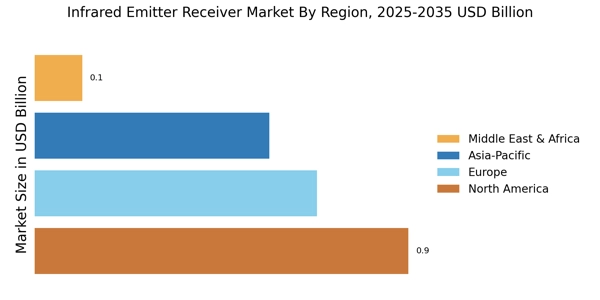
North America is the largest market for infrared emitters and receivers, holding approximately 40% of the global market share. The region's growth is driven by advancements in consumer electronics, automotive applications, and healthcare technologies. Regulatory support for innovation and safety standards further catalyzes market expansion, with increasing demand for smart devices and automation solutions. The United States leads the market, followed by Canada, with significant contributions from key players like Texas Instruments, Honeywell, and FLIR Systems. The competitive landscape is characterized by continuous innovation and strategic partnerships among major companies. The presence of established firms ensures a robust supply chain and technological advancements, positioning North America as a hub for infrared technology development.

Europe : Emerging Market Dynamics

Europe is witnessing a growing demand for infrared emitters and receivers, accounting for approximately 30% of the global market share. The region's growth is propelled by stringent regulations promoting energy efficiency and safety in consumer electronics and automotive sectors. The European Union's commitment to sustainability and innovation is a key driver, fostering advancements in infrared technology. Leading countries include Germany, France, and the UK, with significant contributions from companies like Osram Licht AG and STMicroelectronics. The competitive landscape is marked by a focus on research and development, with firms investing in innovative solutions to meet regulatory standards. This dynamic environment positions Europe as a critical player in the infrared market, driving technological advancements and market growth.

Asia-Pacific : Rapidly Growing Market

Asia-Pacific is emerging as a significant player in the infrared emitter and receiver market, holding around 25% of the global market share. The region's growth is driven by increasing adoption of infrared technology in consumer electronics, industrial automation, and healthcare applications. Rapid urbanization and rising disposable incomes are also contributing to the demand for advanced electronic devices, further boosting market growth. China, Japan, and South Korea are the leading countries in this region, with major companies like Sharp Corporation and Broadcom establishing a strong presence. The competitive landscape is characterized by a mix of local and international players, fostering innovation and collaboration. As the region continues to invest in technology, it is poised for substantial growth in the infrared market.

Middle East and Africa : Emerging Technology Frontier

The Middle East and Africa region is gradually emerging in the infrared emitter and receiver market, holding approximately 5% of the global market share. The growth is driven by increasing investments in technology and infrastructure, particularly in sectors like healthcare and security. Government initiatives aimed at enhancing technological capabilities are also contributing to market expansion, creating new opportunities for infrared solutions. Leading countries in this region include South Africa and the UAE, where there is a growing demand for advanced security systems and smart technologies. The competitive landscape is still developing, with both local and international players vying for market share. As the region continues to embrace technological advancements, the infrared market is expected to grow significantly in the coming years.

Infrared Emitter Receiver Market Regional Image

Key Players and Competitive Insights

Major players in the Infrared Emitter Receiver Market industry are constantly striving to develop and introduce innovative products to gain a competitive edge. Leading Infrared Emitter Receiver Market players are investing heavily in research and development to enhance the performance and efficiency of their products. Strategic partnerships and collaborations are also becoming increasingly common in the Infrared Emitter Receiver Market, as companies seek to expand their market reach and access new technologies. The Infrared Emitter Receiver Market industry is characterized by intense competition, with several major players vying for market share.

Some of the key competitive strategies adopted by these players include product differentiation, cost leadership, and strategic alliances.A leading player in the Infrared Emitter Receiver Market is Broadcom. The company offers a wide range of infrared emitter and receiver products, including high-power infrared emitters, low-power infrared receivers, and infrared transceivers. Broadcom's infrared products are used in a variety of applications, including remote controls, industrial automation, and medical devices. The company has a strong global presence and a reputation for providing high-quality products and reliable service.

Broadcom is committed to innovation and is continuously developing new infrared products to meet the evolving needs of its customers.A competitor company in the Infrared Emitter Receiver Market is Vishay. The company offers a broad portfolio of infrared emitter and receiver products, including infrared diodes, infrared photodiodes, and infrared transceivers. Vishay's infrared products are used in a wide range of applications, including consumer electronics, automotive, and industrial automation. The company has a strong global presence and a reputation for providing high-quality products and reliable service.

Vishay is committed to innovation and is continuously developing new infrared products to meet the evolving needs of its customers.


Key Companies in the Infrared Emitter Receiver Market market include

Industry Developments

The Infrared Emitter Receiver Market is anticipated to witness steady growth over the forecast period, primarily driven by the increasing demand for wireless communication and data transmission systems. The market is expected to be valued at USD 1.76 Billion in 2024 and is projected to reach USD 2.2 Billion by 2032, exhibiting a CAGR of 2.48% during the forecast period. The growing adoption of infrared technology in various industries such as consumer electronics, automotive, and healthcare is fueling the market expansion.

The market is also witnessing advancements in infrared emitter and receiver technologies, leading to the development of products with enhanced performance and efficiency. Additionally, government initiatives and regulations promoting the adoption of energy-efficient technologies are creating favorable conditions for market growth. Overall, the Infrared Emitter Receiver Market is poised for continued expansion in the coming years, driven by technological advancements and increasing demand from various sectors.


Future Outlook

Infrared Emitter Receiver Market Future Outlook

The Infrared Emitter Receiver Market is projected to grow at a 10.2% CAGR from 2024 to 2035, driven by advancements in consumer electronics, automotive applications, and industrial automation.

New opportunities lie in:

  • Development of smart home infrared systems for enhanced automation.
  • Integration of infrared technology in medical devices for non-invasive diagnostics.
  • Expansion of infrared communication solutions in automotive safety systems.

By 2035, the market is expected to achieve substantial growth, reflecting evolving technological demands.

Market Segmentation

Infrared Emitter Receiver Market Application Outlook

  • Security and Surveillance
  • Industrial Automation
  • Healthcare
  • Consumer Electronics
  • Automotive

Infrared Emitter Receiver Market Form Factor Outlook

  • Discrete Components
  • Integrated Circuits (ICs)
  • Arrays and Modules

Infrared Emitter Receiver Market Product Type Outlook

  • Infrared Emitters
  • Infrared Receivers
  • Infrared Transceivers

Infrared Emitter Receiver Market Wavelength Range Outlook

  • Near-Infrared (NIR)
  • Mid-Infrared (MIR)
  • Far-Infrared (FIR)

Report Scope

MARKET SIZE 2024 2.35(USD Billion)
MARKET SIZE 2025 2.59(USD Billion)
MARKET SIZE 2035 6.84(USD Billion)
COMPOUND ANNUAL GROWTH RATE (CAGR) 10.2% (2024 - 2035)
REPORT COVERAGE Revenue Forecast, Competitive Landscape, Growth Factors, and Trends
BASE YEAR 2024
Market Forecast Period 2025 - 2035
Historical Data 2019 - 2024
Market Forecast Units USD Billion
Key Companies Profiled Market analysis in progress
Segments Covered Market segmentation analysis in progress
Key Market Opportunities Integration of advanced sensing technologies enhances applications in smart home and automotive sectors within the Infrared Emitter Receiver Market.
Key Market Dynamics Technological advancements and rising demand for automation drive growth in the infrared emitter receiver market.
Countries Covered North America, Europe, APAC, South America, MEA

Leave a Comment

FAQs

What is the projected market valuation of the Infrared Emitter Receiver Market by 2035?

The Infrared Emitter Receiver Market is projected to reach a valuation of 6.84 USD Billion by 2035.

What was the market valuation of the Infrared Emitter Receiver Market in 2024?

In 2024, the market valuation of the Infrared Emitter Receiver Market was 2.35 USD Billion.

What is the expected CAGR for the Infrared Emitter Receiver Market during the forecast period 2025 - 2035?

The expected CAGR for the Infrared Emitter Receiver Market during the forecast period 2025 - 2035 is 10.2%.

Which product type segment is projected to have the highest valuation by 2035?

By 2035, the Infrared Receivers segment is projected to reach a valuation of 2.4 USD Billion.

What are the key applications driving growth in the Infrared Emitter Receiver Market?

Key applications driving growth include Security and Surveillance, Industrial Automation, and Healthcare.

Which company is a leading player in the Infrared Emitter Receiver Market?

Texas Instruments is among the leading players in the Infrared Emitter Receiver Market.

What is the projected valuation for the Infrared Emitters segment by 2035?

The Infrared Emitters segment is projected to reach a valuation of 1.9 USD Billion by 2035.

How does the valuation of the Near-Infrared segment compare to others by 2035?

The Near-Infrared segment is projected to have the highest valuation at 2.68 USD Billion by 2035.

What form factor segment is expected to show significant growth by 2035?

The Integrated Circuits (ICs) segment is expected to show significant growth, reaching 2.4 USD Billion by 2035.

What was the valuation of the Automotive application segment in 2024?

In 2024, the valuation of the Automotive application segment was 0.3 USD Billion.

Download Free Sample

Kindly complete the form below to receive a free sample of this Report

Compare Licence

×
Features License Type
Single User Multiuser License Enterprise User
Price $4,950 $5,950 $7,250
Maximum User Access Limit 1 User Upto 10 Users Unrestricted Access Throughout the Organization
Free Customization
Direct Access to Analyst
Deliverable Format
Platform Access
Discount on Next Purchase 10% 15% 15%
Printable Versions