Inorganic Salt Market

ID: MRFR/CnM/0327-HCR
140 Pages
Chitranshi Jaiswal
Last Updated: June 07, 2026
Inorganic Salts Market Research Report Information By Type (Sodium Salts, Magnesium Salts, Calcium Salts, Potassium Salts, Ammonium Salts, and Others), By Application (Agriculture, Pharmaceuticals, Cement, Rubber processing, Food, and Others), And By Region (North America, Europe, Asia-Pacific, And Rest Of The World) –Market Forecast Till 2035
Download PDF ×

We do not share your information with anyone. However, we may send you emails based on your report interest from time to time. You may contact us at any time to opt-out.

  1. 1 Market Overview |
    1. 1.1 Study Assumptions & Market Definition |
    2. 1.2 Scope of the Study |
    3. 1.3 Research Methodology
  2. 2 Market Summary & Key Takeaways
  3. 3 Market Dynamics |
    1. 3.1 Market Drivers Analysis | |
      1. 3.1.1 Battery Electrolyte Salt Demand from EV Expansion | |
      2. 3.1.2 Pharmaceutical-Grade Inorganic Salt Consumption Growth | |
      3. 3.1.3 Desalination Capacity Expansion | |
      4. 3.1.4 Precision Agriculture and Specialty Fertilizer Salts | |
      5. 3.1.5 Water-Treatment Regulatory Tightening | |
      6. 3.1.6 Sovereign Critical-Mineral Localization Mandates | |
      7. 3.1.7 Sodium-Ion Battery Commercialization |
    2. 3.2 Market Restraints Analysis | |
      1. 3.2.1 Environmental Compliance Costs on Brine Discharge | |
      2. 3.2.2 Commodity Fertilizer Price Deflation | |
      3. 3.2.3 Geopolitical Supply-Chain Concentration Risk | |
      4. 3.2.4 Substitution of Inorganic Salts by Bio-Based Alternatives | |
      5. 3.2.5 Energy-Cost Volatility in Evaporation-Intensive Production |
    3. 3.3 Market Opportunity Analysis | |
      1. 3.3.1 Direct Lithium Extraction (DLE) Technology | |
      2. 3.3.2 Sodium-Ion Battery Chemistry Commercialization | |
      3. 3.3.3 Circular Brine Valorization and Data-Driven Salt Recovery | |
      4. 3.3.4 Emerging-Market Fertilizer Self-Sufficiency Programs | |
      5. 3.3.5 High-Purity Salts for Semiconductor and Photovoltaic Manufacturing |
    4. 3.4 Industry Value Chain Analysis |
    5. 3.5 Porter's Five Forces Analysis
  4. 4 Global Inorganic Salts Market Size & Forecast (2021–2035) |
    1. 4.1 Historical Market Size (2021–2025) |
    2. 4.2 Current & Forecast Market Size (2026–2035) |
    3. 4.3 Market Size by Revenue (USD Billion) |
    4. 4.4 Year-over-Year Growth Analysis
  5. 5 Segmentation Analysis |
    1. 5.1 By Type | |
      1. 5.1.1 Sodium Salts | |
      2. 5.1.2 Potassium Salts | |
      3. 5.1.3 Calcium Salts | |
      4. 5.1.4 Magnesium Salts | |
      5. 5.1.5 Other Salts (Lithium, Zinc, and More) |
    2. 5.2 By Application | |
      1. 5.2.1 Agrochemicals and Fertilizers | |
      2. 5.2.2 Food and Beverage Processing | |
      3. 5.2.3 Pharmaceuticals and Personal Care | |
      4. 5.2.4 Water and Wastewater Treatment | |
      5. 5.2.5 Other Applications (Energy Storage, Industrial)
  6. 6 Regional Analysis |
    1. 6.1 North America | |
      1. 6.1.1 United States | |
      2. 6.1.2 Canada | |
      3. 6.1.3 Mexico |
    2. 6.2 Europe | |
      1. 6.2.1 Germany | |
      2. 6.2.2 United Kingdom | |
      3. 6.2.3 France | |
      4. 6.2.4 Italy | |
      5. 6.2.5 Spain | |
      6. 6.2.6 Nordic Countries | |
      7. 6.2.7 Russia | |
      8. 6.2.8 Rest of Europe |
    3. 6.3 Asia-Pacific | |
      1. 6.3.1 China | |
      2. 6.3.2 India | |
      3. 6.3.3 Japan | |
      4. 6.3.4 South Korea | |
      5. 6.3.5 ASEAN | |
      6. 6.3.6 Rest of Asia-Pacific |
    4. 6.4 South America | |
      1. 6.4.1 Brazil | |
      2. 6.4.2 Argentina | |
      3. 6.4.3 Rest of South America |
    5. 6.5 Middle East & Africa | |
      1. 6.5.1 Saudi Arabia | |
      2. 6.5.2 UAE | |
      3. 6.5.3 South Africa | |
      4. 6.5.4 Egypt | |
      5. 6.5.5 Rest of MEA
  7. 7 Competitive Landscape |
    1. 7.1 Market Share Analysis (2025) |
    2. 7.2 Competitive Benchmarking Matrix |
    3. 7.3 Company Profiles | |
      1. 7.3.1 K+S AG | |
      2. 7.3.2 Nutrien Ltd. | |
      3. 7.3.3 ICL Group | |
      4. 7.3.4 Tata Chemicals | |
      5. 7.3.5 BASF SE | |
      6. 7.3.6 Albemarle Corporation | |
      7. 7.3.7 SQM | |
      8. 7.3.8 Solvay SA | |
      9. 7.3.9 Compass Minerals | |
      10. 7.3.10 Sumitomo Chemical
  8. 8 Future Outlook & Strategic Recommendations (2026–2035) |
    1. 8.1 AI-Driven Process Optimization in Salt Manufacturing |
    2. 8.2 Electrification Supercycle and Salt-Chemistry Diversification |
    3. 8.3 ESG Reporting and Sustainable Sourcing Mandates |
    4. 8.4 Platform Economics and Salt-as-a-Service Models
  9. 9 Recent Developments & News
  10. 10 Frequently Asked Questions (FAQs)
  11. 11 Report Scope & Methodology |
    1. 11.1 Study Period & Base Year |
    2. 11.2 Data Sources & Citations |
    3. 11.3 Abbreviations
  12. 12 LIST OF TABLES |
  13. TABLE 1 Global Inorganic Salts Market Size & Forecast, by Revenue (USD Billion), 2021–2035 |
  14. TABLE 2 Global Inorganic Salts Market — Year-over-Year Growth Analysis, 2021–2035 |
  15. TABLE 3 Global Inorganic Salts Market — Driver Impact Analysis |
  16. TABLE 4 Global Inorganic Salts Market — Restraint Impact Analysis |
  17. TABLE 5 Global Inorganic Salts Market Size, by Type, 2021–2035 (USD Billion) |
  18. TABLE 6 Global Inorganic Salts Market Size, by Application, 2021–2035 (USD Billion) |
  19. TABLE 7 Global Inorganic Salts Market Size, by Region, 2021–2035 (USD Billion) |
  20. TABLE 8 North America Inorganic Salts Market Size, by Country, 2021–2035 (USD Billion) |
  21. TABLE 9 Europe Inorganic Salts Market Size, by Country, 2021–2035 (USD Billion) |
  22. TABLE 10 Asia-Pacific Inorganic Salts Market Size, by Country, 2021–2035 (USD Billion) |
  23. TABLE 11 South America Inorganic Salts Market Size, by Country, 2021–2035 (USD Billion) |
  24. TABLE 12 Middle East & Africa Inorganic Salts Market Size, by Country, 2021–2035 (USD Billion) |
  25. TABLE 13 Competitive Benchmarking Matrix — Global Inorganic Salts Market, 2025 |
  26. TABLE 14 Company Profiles — Key Players, Global Inorganic Salts Market |
  27. TABLE 15 Recent Developments & Strategic Announcements, 2023–2025 |
  28. TABLE 16 North America Inorganic Salts Market Size, by Type, 2021–2035 (USD Billion) |
  29. TABLE 17 North America Inorganic Salts Market Size, by Application, 2021–2035 (USD Billion) |
  30. TABLE 18 Europe Inorganic Salts Market Size, by Type, 2021–2035 (USD Billion) |
  31. TABLE 19 Europe Inorganic Salts Market Size, by Application, 2021–2035 (USD Billion) |
  32. TABLE 20 Asia-Pacific Inorganic Salts Market Size, by Type, 2021–2035 (USD Billion) |
  33. TABLE 21 Asia-Pacific Inorganic Salts Market Size, by Application, 2021–2035 (USD Billion) |
  34. TABLE 22 South America Inorganic Salts Market Size, by Type, 2021–2035 (USD Billion) |
  35. TABLE 23 South America Inorganic Salts Market Size, by Application, 2021–2035 (USD Billion) |
  36. TABLE 24 Middle East & Africa Inorganic Salts Market Size, by Type, 2021–2035 (USD Billion) |
  37. TABLE 25 Middle East & Africa Inorganic Salts Market Size, by Application, 2021–2035 (USD Billion) |
  38. TABLE 26 Report Scope & Methodology Summary
  39. 13 LIST OF FIGURES |
  40. FIGURE 1 Global Inorganic Salts Market Dynamics — Drivers, Restraints, and Opportunities |
  41. FIGURE 2 Inorganic Salts Industry Value Chain Analysis |
  42. FIGURE 3 Porter's Five Forces Analysis — Global Inorganic Salts Market |
  43. FIGURE 4 Global Inorganic Salts Market Size Trend & Forecast (USD Billion), 2021–2035 |
  44. FIGURE 5 Global Inorganic Salts Market Share, by Type (%), 2025 |
  45. FIGURE 6 Global Inorganic Salts Market Share, by Application (%), 2025 |
  46. FIGURE 7 Global Inorganic Salts Market Share, by Region (%), 2025 |
  47. FIGURE 8 North America Inorganic Salts Market Size (USD Billion), 2021–2035 |
  48. FIGURE 9 Europe Inorganic Salts Market Size (USD Billion), 2021–2035 |
  49. FIGURE 10 Asia-Pacific Inorganic Salts Market Size (USD Billion), 2021–2035 |
  50. FIGURE 11 South America Inorganic Salts Market Size (USD Billion), 2021–2035 |
  51. FIGURE 12 Middle East & Africa Inorganic Salts Market Size (USD Billion), 2021–2035 |
  52. FIGURE 13 Competitive Landscape — Market Share of Top 10 Players (%), 2025

SEGMENTATION QUICK REFERENCE

DimensionSub-SegmentsDominant SegmentFastest Growing Segment
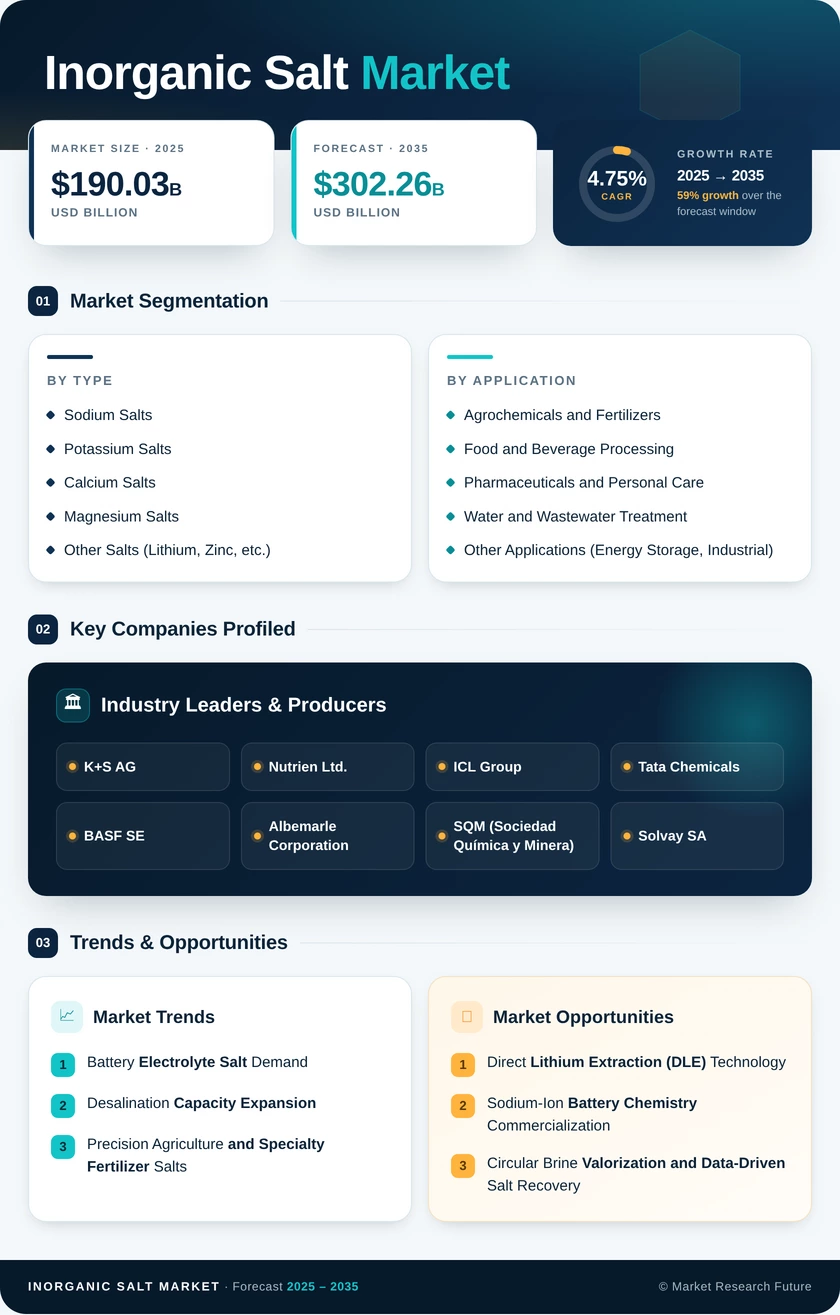
By TypeSodium Salts, Potassium Salts, Calcium Salts, Magnesium Salts, Other Salts (Lithium, Zinc, etc.)Sodium SaltsOther Salts (Lithium, Zinc, etc.)
By ApplicationAgrochemicals & Fertilizers, Food & Beverage Processing, Pharmaceuticals & Personal Care, Water & Wastewater Treatment, Other Applications (Energy Storage, Industrial)Agrochemicals & FertilizersOther Applications (Energy Storage, Industrial)
By GeographyAsia-Pacific, North America, Europe, South America, Middle East & AfricaAsia-PacificAsia-Pacific


MARKET SEGMENTATION OVERVIEW

By Type

Sub-SegmentKey Trend
Sodium SaltsPharma-grade demand accelerating; sodium-ion battery chemistry creating new growth vector
Potassium SaltsPrecision-agriculture blends driving premiumization over commodity MOP
Calcium SaltsConstruction-chemical demand rising in emerging economies; food-fortification regulations expanding
Magnesium SaltsRefractory and flame-retardant applications sustaining stable demand
Other Salts (Lithium, Zinc, etc.)Battery-electrolyte buildout creating fastest value growth; semiconductor-grade purity requirements tightening


Sodium salts remain the volumetric and revenue leader within the type segmentation, reflecting their foundational role in chlor-alkali chemistry, food preservation, and pharmaceutical formulations. The "Other Salts" category — led by lithium and zinc compounds — is expanding most rapidly as EV battery gigafactories and solid-state electrolyte research scale up demand for high-purity metal salt compounds across multiple geographies.

By Application

Sub-SegmentKey Trend
Agrochemicals & FertilizersSubsidy reforms shifting demand from bulk urea toward potassium-enriched specialty blends
Food & Beverage ProcessingClean-label and fortification trends sustaining steady sodium and calcium salt consumption
Pharmaceuticals & Personal CareSupply-chain resilience mandates driving domestic pharma-grade salt capacity investment
Water & Wastewater TreatmentDesalination expansion and stricter effluent regulations increasing coagulant and remineralization salt volumes
Other Applications (Energy Storage, Industrial)Lithium and sodium electrolyte salts capturing the highest per-kilogram value premiums


Agrochemicals and fertilizers dominate by volume, but the application mix is diversifying as energy-storage and water-treatment end uses absorb an increasing share of global inorganic salt production. The pharmaceuticals segment, while smaller in absolute tonnage, generates outsized revenue per unit thanks to stringent purity requirements and regulatory-barrier-protected pricing.