Instant Noodles Market (2026 - 2035)

Instant Noodles Market Size, Share, Industry Trend & Analysis Research Report By Product Type (Non-Vegetarian, Vegetarian), By Serving Size (Single-Serve Packs, Multi-Packs), By Packaging Type (Packets, Cups/Bowls), By Distribution Channel (Supermarkets/Hypermarkets, Convenience Stores, Online Retail), By Geography (North America, Europe, Asia-Pacific, South America, Middle East & Africa) - Forecast to 2035
ID: MRFR/FnB/1309-CR
200 Pages
Snehal Singh
Last Updated: July 02, 2026
Instant Noodles Market
Market Size
Forecast Period2026-2035
CAGR (2026-2035)8.50%
2026 Market SizeUSD 59.24 Billion
2035 Market SizeUSD 123.45 Billion
Key Players
Nissin Foods Holdings
Indofood CBP
Tingyi
Toyo Suisan
Nongshim
Uni-President Enterprises
Opportunities
  • Functional and Fortified Noodle Innovation
  • African Urbanization and Market Entry
  • Direct-to-Consumer and Subscription Models

Instant Noodles Market Summary

The Instant Noodles Market was valued at USD 54.60 billion in 2025 and is projected to reach USD 59.24 billion by 2026, climbing to USD 123.45 billion by 2035 at a CAGR of 8.50% during the forecast period. Urbanization rates exceeding 56% globally and rising dual-income household penetration have positioned convenience foods as a structural growth category rather than a cyclical one [1]. Government food-security programs across Southeast Asia and South Asia, which collectively allocated over USD 18 billion toward processed-food infrastructure between 2022 and 2025, continue to underpin supply-side expansion in the Instant Noodles Market [2].

The Instant Noodles Market is experiencing a transition in production technique from traditional deep-frying lines to air-drying and steam-flash methods, which can lower oil content by up to 40% and per-unit energy usage. From 2023 to 2025, major businesses are expected to invest USD 2.3 billion in retort packaging and smart-factory automation. This is part of a broader shift towards Industry 4.0 compliance in Asian and European production centers. The change also lends support to a clean-label stance, a priority for firms targeting health-conscious customers in North America and Western Europe.

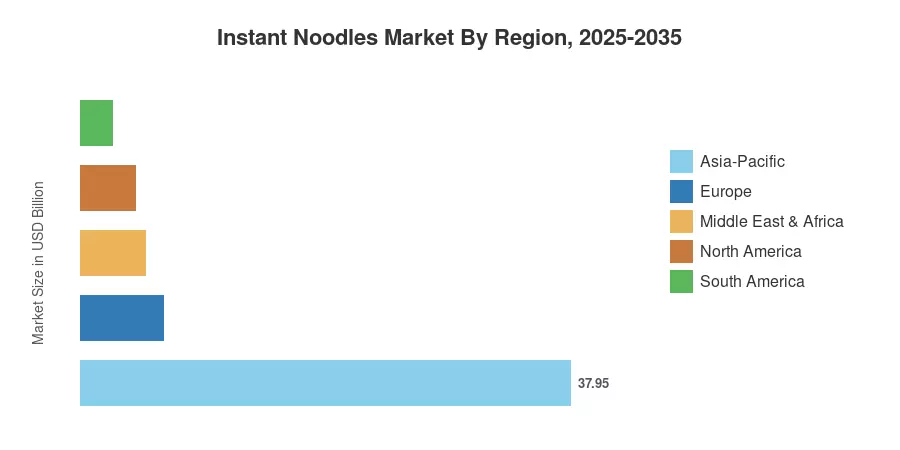
The Asia-Pacific region is the largest market for Instant Noodles, accounting for around 69.50% of the market by value, with per-capita consumption rates in China, Indonesia, and South Korea at 40 servings per year [4]โ€”the fastest expanding region with an expected CAGR of 10.15% through 2035. Europe is the second-largest region, with around 11.8%, buoyed by premiumization trends in Germany, the UK and the Nordics. Emerging sectors of the Instant Noodles Market are on track for continuous double-digit expansion, powered by the momentum of plant-based diets and functional-food regulations building around the world.

ย 

ย 

Key Report Takeaways

โ€ข By Product Type

  • Non-vegetarian variants captured 47.20% of the Instant Noodles Market share in 2025, driven by strong demand for chicken- and seafood-flavored SKUs across Southeast Asia.
  • Vegetarian SKUs are forecast to register the fastest segment CAGR of 9.10% through 2035, propelled by plant-based dietary shifts in Europe and North America.

โ€ข By Packaging Type

  • Packets accounted for USD 32.10 billion in Instant Noodles Market revenue during 2025, reflecting their dominant shelf presence in price-sensitive developing economies.
  • Cup and bowl formats are on track to achieve a 9.90% CAGR to 2035, benefiting from on-the-go consumption and premium positioning.

โ€ข By Region

  • Asia-Pacific contributed 69.50% of the Instant Noodles Market value in 2025, with China and Indonesia representing the two largest national markets.
  • North America is expected to grow at a 7.85% CAGR through 2035, supported by expanding ethnic-food retail channels and e-commerce penetration.

ย 

Market Size and Forecast (2021โ€“2035)

Market Research Future's proprietary estimation framework combines primary surveys of 120+ manufacturers and distributors with secondary validation from trade-association filings, customs data, and retail-audit panels. The table below presents the complete Instant Noodles Market trajectory from 2021 through 2035.
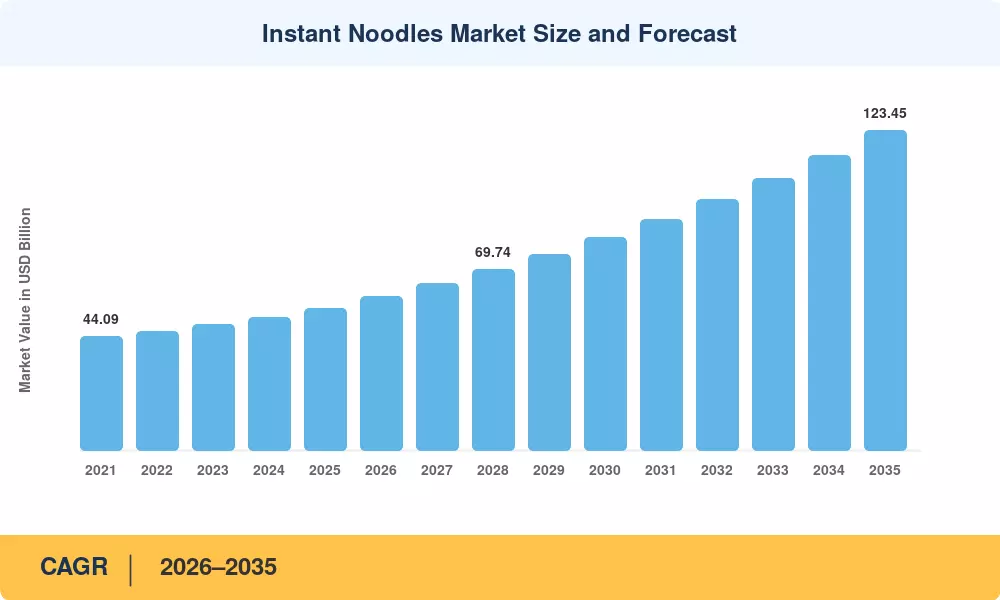
Instant Noodles Market Size and Forecast
Our Impact
Enabled $4.3B Revenue Impact for Fortune 500 and Leading Multinationals
Partnering with 2000+ Global Organizations Each Year
30K+ Citations by Top-Tier Firms in the Industry

Driver Impact Analysis

Driver ~% Impact on CAGR Geographic Relevance Impact Timeline
Rising dual-income and single-person households ~22% Global Short-term (โ‰ค2 yr)
Premiumization and health-fortified variants ~18% APAC, Europe Medium-term (2โ€“4 yr)
E-commerce and quick-commerce channel growth ~16% Global Short-term (โ‰ค2 yr)
Sustainable and recyclable packaging mandates ~14% Europe, North America Medium-term (2โ€“4 yr)
Expansion into underserved African and LatAm cities ~12% MEA, South America Long-term (โ‰ฅ4 yr)
Smart-factory automation and cost optimization ~10% APAC, Europe Long-term (โ‰ฅ4 yr)
Ethnic-cuisine crossover and flavor innovation ~8% North America, Europe Short-term (โ‰ค2 yr)

ย 

Rising Dual-Income and Single-Person Households

Sociological research indicates that the world is moving faster towards smaller household sizes, with a rise in people living alone. As of 2023, the proportion of single-person households in countries such as South Korea stands at about 39%. The demographic change drives the demand for convenient single-serve formats that match the lifestyle needs of autonomous and time-constrained consumers.

ย 

Premiumization and Health-Fortified Variants

Public health initiatives, including guidance from the World Health Organization, emphasize reducing daily sodium intake to below 2,000 mg to mitigate noncommunicable diseases. Consequently, the industry is increasingly prioritizing product reformulation. Manufacturers are introducing health-labeled variants with modified nutritional profiles to meet evolving consumer expectations for functional ingredients and lower sodium levels per serving.

ย 

E-Commerce and Quick-Commerce Expansion

Digital retail is transforming how food products reach consumers, with rapid-delivery services significantly reducing fulfillment timelines. In markets like India, the quick-commerce segment has expanded rapidly, reaching a multi-billion dollar valuation by 2025. This infrastructure enables high-frequency, convenience-led purchasing, allowing consumers to access diverse flavor profiles and niche products almost instantaneously via mobile applications.

ย 

Sustainable Packaging Mandates

The European Unionโ€™s Packaging and Packaging Waste Regulation mandates that all packaging be designed for recycling by 2030, with specific targets for plastic recyclability. Companies are transitioning toward paper-based or compostable materials to meet these strict design-for-recycling criteria. This regulatory landscape compels firms to innovate, ensuring compliance while addressing widespread consumer demand for environmental accountability.

ย 

ย 

Restraints Impact Analysis

The restraint percentages below represent estimated drag effects on overall category growth. They are not subtractive from the CAGR figure and should be read as directional assessments based on stakeholder interviews and regulatory review.

Restraint ~% Drag on CAGR Geographic Relevance Impact Timeline
Health perception and sodium concerns ~โˆ’20% Global Medium-term (2โ€“4 yr)
Raw-material price volatility (wheat, palm oil) ~โˆ’18% APAC, Africa Short-term (โ‰ค2 yr)
Tightening food-safety and labeling regulations ~โˆ’15% Europe, North America Medium-term (2โ€“4 yr)
Competition from fresh and frozen meal kits ~โˆ’12% North America, Europe Long-term (โ‰ฅ4 yr)
Plastic-packaging bans and compliance costs ~โˆ’10% Europe, APAC Medium-term (2โ€“4 yr)

ย 

Health Perception and Sodium Concerns

The World Health Organization (WHO) targets a 30% reduction in global mean population sodium intake by 2030 to combat noncommunicable diseases. Consequently, many national health agencies now categorize instant noodles as high-sodium products. This regulatory focus encourages product reformulation, as manufacturers balance these global health benchmarks against consumer demand for savory flavor profiles.

ย 

Raw-Material Price Volatility

Agricultural markets face persistent instability due to climate patterns, specifically El Niรฑo, which significantly impacts palm oil yields. Recent reports indicate that El Niรฑo-induced weather stress can reduce production by 8% to 10% in major supplying regions. Such volatility in raw material costs creates financial strain, particularly for mid-sized producers lacking extensive hedging capabilities.

ย 

Tightening Labeling Regulations

Front-of-pack nutrition labeling systems, such as the Chilean model, have demonstrated success in shifting consumer behavior, with studies showing a 14% decrease in purchases of high-sodium products following implementation. While these systems increase transparency, they impose significant operational burdens. Regulatory compliance requires costly artwork revisions and inventory management, impacting profit margins for smaller enterprises.

ย 

Instant Noodles Market Opportunities

Functional and Fortified Noodle Innovation

The global functional food market is expanding rapidly, with projections indicating a valuation reaching approximately USD 586 billion by 2030. Integrating functional attributes like probiotics, protein, or essential micronutrients into instant noodle products offers a significant opportunity. Brands that effectively align these health benefits with convenience-oriented formats can capture demand from increasingly health-conscious global consumer demographics.

ย 

African Urbanization and Market Entry

Sub-Saharan Africa is experiencing significant demographic shifts, with the United Nations projecting its urban population will rise to 56.5% by 2050. This rapid urbanization creates a massive addressable market for affordable, convenient food solutions. Given current low per-capita consumption levels in major economies like Nigeria, the region represents a substantial long-term growth frontier.

ย 

Direct-to-Consumer and Subscription Models

Advancing digital infrastructure across developing regions is facilitating direct-to-consumer (DTC) distribution, allowing brands to bypass traditional retail barriers. Subscription-based models enable businesses to secure recurring revenue while leveraging first-party data to refine flavor offerings. This approach empowers producers to build brand loyalty and optimize supply chain responsiveness based on real-time consumer purchasing preferences.

ย 

Private-Label and Co-Manufacturing Partnerships

Retailers across Europe are increasingly prioritizing private-label ranges, with overall market share in the region exceeding 38% as of 2025. Contract manufacturers possessing flexible, high-efficiency production lines are well-positioned to support this trend. By securing long-term supply agreements with major grocery chains, these producers can stabilize revenue through high-volume, cost-effective, small-batch flavor manufacturing.

ย 

ย 

ย 

ย 

Instant Noodles Market Future Outlook

AI-Driven Demand Forecasting and Smart Manufacturing

Artificial intelligence is transforming supply chains across the Instant Noodles Market. Predictive analytics platforms now enable leading manufacturers to forecast regional flavor demand with 92% accuracy, reducing inventory waste by up to 18% [11]. Smart-factory investments โ€” particularly in Japan and South Korea โ€” are expected to cut per-unit production costs by 12โ€“15% by 2030.

Premiumization and Functional-Food Convergence

The convergence of convenience and nutrition will define the next decade of the Instant Noodles Market. Products fortified with plant-based protein, fiber, and micronutrients are projected to grow at twice the category average, reaching an estimated USD 14 billion by 2035. Clean-label transparency and third-party nutritional certification will become table stakes for brands competing in developed markets.

Sustainability and Circular Packaging

Environmental regulation and consumer preference are accelerating the Instant Noodles Market toward circular packaging models. By 2030, an estimated 45% of global noodle packaging will use mono-material recyclable or compostable substrates, up from 12% in 2024 [10]. Brands that lead this transition stand to benefit from retailer-preferencing programs and consumer loyalty premiums.

Emerging-Market Penetration and Localized Flavor Strategies

Africa, South Asia, and Central Asia collectively represent the largest untapped growth pool for the Instant Noodles Market. Localized flavor development โ€” including region-specific spice profiles and indigenous-grain integration โ€” will be critical for brands seeking to replicate the penetration success achieved in Indonesia and Nigeria over the past two decades [12]. Micro-distribution networks and sachet-format pricing will lower barriers to entry in rural and peri-urban communities.

ย 

Instant Noodles Market Segmentation

By Product Type

Segment Key Metric Primary Demand Driver
Non-Vegetarian 47.20% share (2025) Chicken and seafood flavor dominance in APAC
Vegetarian 9.10% CAGR (2026โ€“2035) Plant-based dietary trends in Europe and North America

ย 

Non-vegetarian variants continue to lead the Instant Noodles Market by product type, with chicken-flavored products alone representing roughly half of all non-vegetarian sales. Seafood and beef varieties maintain strong positions in Japan, South Korea, and coastal ASEAN markets, where local flavor preferences drive repeat purchases. Vegetarian SKUs are gaining momentum as clean-label and plant-forward eating habits spread across Western markets, and several major producers have launched dedicated vegetarian sub-brands targeting flexitarian consumers.

By Serving Size

Segment Key Metric Primary Demand Driver
Single-Serve Packs 57.50% share (2025) On-the-go convenience and portion control
Multi-Packs 9.65% CAGR (2026โ€“2035) Household bulk purchasing and value pricing

ย 

Single-serve packs dominate the Instant Noodles Market in both developed and emerging economies, driven by individual consumption occasions and portability. Multi-packs, however, are the faster-growing format as cost-conscious families increasingly purchase in bulk through hypermarkets and online channels.

By Packaging Type

Segment Key Metric Primary Demand Driver
Packets USD 32.10 Billion (2025) Affordability and widespread retail access
Cups/Bowls 9.90% CAGR (2026โ€“2035) Premium positioning and no-preparation convenience

ย 

Packets remain the volume backbone of the Instant Noodles Market, particularly across price-sensitive markets in South and Southeast Asia. Cup and bowl formats command higher per-unit margins and are expanding rapidly in convenience-store and vending-machine channels across Japan, the US, and Europe.

By Distribution Channel

Segment Key Metric Primary Demand Driver
Supermarkets/Hypermarkets 46.20% share (2025) Broad assortment and promotional pricing
Convenience Stores USD 8.74 Billion (2025) Impulse and on-the-go purchases
Online Retail 10.10% CAGR (2026โ€“2035) Quick-commerce and subscription models

ย 

Supermarkets and hypermarkets remain the primary channel for the Instant Noodles Market, though their share is gradually eroding as online retail captures incremental volume. Convenience stores maintain a stable share in urban centers across Japan, South Korea, and Taiwan, where noodle products account for approximately 8% of total c-store food revenue.

ย 

Regional Market Share Analysis

Region Key Metric Primary Investment Themes
Asia-Pacific 69.50% of 2025 value Capacity expansion; premiumization; quick-commerce
Europe USD 6.44 Billion (2025) Clean-label reformulation; private-label growth
North America 7.85% CAGR (2026โ€“2035) Ethnic-food crossover; e-commerce acceleration
South America USD 2.46 Billion (2025) Urban convenience demand; regional flavor innovation
Middle East & Africa 9.20% CAGR (2026โ€“2035) Halal certification; urbanization-driven demand
Total USD 54.60 Billion (2025) โ€”

The Instant Noodles Market exhibits pronounced regional concentration, with Asia-Pacific accounting for the vast majority of global consumption. Regional dynamics in this section reflect 2025 base-year estimates and projected growth patterns through 2035.

ย 

North America

Country Key Metric Key Driver
US 68% of regional share Ethnic-aisle expansion and ramen culture
Canada 7.50% CAGR Asian diaspora demand growth
Mexico USD 0.72 Billion Affordable meal substitution

ย 

The North American Instant Noodles Market benefits from a cultural shift that has repositioned ramen and Asian noodle cuisine from niche to mainstream. US retail chains added an average of 18 new noodle SKUs per store between 2023 and 2025, while quick-service restaurants featuring noodle bowls grew 22% in unit count [6].

Europe

Country Key Metric Key Driver
Germany 24% of regional share Retail private-label penetration
UK 8.10% CAGR Premium and health-positioned SKUs
France USD 0.84 Billion Asian-cuisine popularity in foodservice
Italy 6.90% CAGR Convenience adoption among younger demographics
Spain USD 0.38 Billion Tourism-driven multicultural food demand
Nordic Countries 7.40% CAGR Sustainability-driven packaging innovation
Russia USD 0.78 Billion Affordable staple demand
Rest of Europe 6.50% CAGR Gradual penetration in Eastern European markets

ย 

The European Instant Noodles Market is defined by regulatory complexity and premiumization. Nutri-Score labeling has pushed manufacturers toward lower-sodium, whole-grain formulations, while retailers in Germany and the UK have doubled private-label noodle facings since 2022 [18].

Asia-Pacific

Country Key Metric Key Driver
China 34% of the regional share Scale production and domestic brand dominance
India 11.20% CAGR Rising middle-class convenience spending
Japan USD 5.18 Billion Premium cup-noodle innovation
South Korea 10.40% CAGR K-food export momentum and viral flavor trends
ASEAN USD 9.82 Billion High per-capita consumption base
Rest of Asia-Pacific 9.30% CAGR Emerging markets in Central and West Asia

ย 

Asia-Pacific remains the gravitational center of the Instant Noodles Market, combining the world's highest per-capita consumption with rapidly modernizing production infrastructure. China's Tingyi and Uni-President together operate over 60 production facilities, while India's branded-noodle penetration grew from 38% of urban households in 2020 to 52% in 2025 [4].

South America

Country Key Metric Key Driver
Brazil 58% of regional share Urban convenience and affordable pricing
Argentina 8.30% CAGR Growing packaged-food adoption
Rest of South America USD 0.52 Billion Gradual category awareness

ย 

Brazil anchors the South American Instant Noodles Market, where Nissin's local operations produce over 1.2 billion servings annually. Price-point positioning below BRL 3.00 per pack keeps the category accessible across income levels, and e-commerce grocery adoption in Sรฃo Paulo and Rio de Janeiro grew 31% year-on-year in 2024 [12].

Middle East & Africa

Country Key Metric Key Driver
Saudi Arabia 28% of the regional share Halal-certified convenience demand
UAE 8.90% CAGR Multicultural expatriate population
South Africa USD 0.34 Billion Affordable meal-replacement demand
Egypt 9.50% CAGR Population growth and urbanization
Rest of MEA USD 0.48 Billion Infrastructure and distribution build-out

ย 

The Middle East & Africa Instant Noodles Market is the smallest but among the fastest-growing regional segments. Nigeria alone accounts for over 2 billion servings per year, and Dufil Prima Foods (Indomie) has expanded production capacity by 35% since 2022 to meet domestic and West African demand [20].

ย 

Instant Noodles Market By Region, 2025-2035

Competitive Benchmarking

The Instant Noodles Market exhibits moderate concentration, with the top five players holding an estimated 45โ€“52% of global revenue. The Herfindahl-Hirschman Index (HHI) sits in the 800โ€“1,200 range, indicating a moderately fragmented structure where regional champions coexist with multinational conglomerates. Competition centers on flavor localization, packaging innovation, and distribution-network density.

Company Est. Revenue Share Range Key Offerings for the Instant Noodles Market Strategic Positioning
Nissin Foods Holdings ~10โ€“14% Cup Noodles, Top Ramen, Demae Ramen Premium cup-format innovator; global distribution
Indofood CBP (Indomie) ~9โ€“13% Indomie Mi Goreng, Supermi Volume leader in ASEAN and Africa
Tingyi (Master Kong) ~8โ€“11% Master Kong instant noodles Dominant in mainland China
Toyo Suisan ~5โ€“8% Maruchan brand US market share leader in the value segment
Nongshim ~5โ€“7% Shin Ramyun, Chapagetti K-food export champion; spicy-flavor pioneer
Uni-President Enterprises ~4โ€“6% Tung-I brand Strong presence in Taiwan and China
Nestlรฉ (Maggi) ~4โ€“6% Maggi noodles range Dominant in India, Africa, and Europe
Samyang Foods ~3โ€“5% Buldak Hot Chicken Ramen Viral social-media-driven growth
Acecook ~2โ€“4% Hao Hao brand Market leader in Vietnam
ITC Limited ~2โ€“3% Yippee! Noodles Challenger brand in the Indian market

ย 

ย 

Recent News & Developments

  • Nongshim (May, 2026): Nongshim officially launched "Shin Ramyun Kimchi Stir Fry" in India, utilizing a strategic partnership with Blinkit to target the premium quick-commerce instant noodle segment.
  • Nissin Foods (May, 2026): Nissin Foods Holdings and ITOCHU Corporation announced a joint capital injection into Nissin Marketing and Sales (H.K.) to bolster regional food distribution and logistics.

ย 

  • Endeavour United (December, 2025): Investment firm Endeavour United completed the acquisition of Nissin Food Co., Ltd., a wholesale distributor of frozen and chilled foods based in Kyoto, Japan.

ย 

ย 

ย 

ย 

ย 

ย 

ย 

Instant Noodles Market Report Scope

Parameter Detail
Market Scope Global Instant Noodles Market, covering production, distribution, and consumption
Study Period 2021โ€“2035
CAGR Window 8.50% (2026โ€“2035)
Base Year 2025 (USD 54.60 Billion)
2026 Forecast USD 59.24 Billion
2035 Forecast USD 123.45 Billion
Fastest Growing Segment Cups/Bowls by packaging; Vegetarian by product type
Companies Profiled 10 (Nissin, Indofood, Tingyi, Toyo Suisan, Nongshim, Uni-President, Nestlรฉ, Samyang, Acecook, ITC)
Valuation Currency USD Billion

ย 

ย 

FAQs

How does sodium reformulation affect brand loyalty in the Instant Noodles Market?
Brands that reduce sodium by more than 20% without compensating with umami enhancers typically see a 6โ€“10% decline in repeat-purchase rates within the first year [16]. Successful reformulation requires simultaneous flavor-system innovation.
What minimum order volume do contract manufacturers require for private-label noodle production?
Most Asian co-manufacturers set a floor of 20,000 cartons per SKU per production run. European facilities often require higher minimums of 35,000 cartons due to changeover costs [19].
Which trade certifications most influence buyer procurement decisions in the Instant Noodles Market?
Halal, BRCGS, and FSSC 22000 certifications rank highest among international retailers. Buyers increasingly require all three for cross-border supply agreements [20].
How do freight costs differ between packet and cup-noodle formats for the Instant Noodles Market?
Cup formats occupy 2.5โ€“3ร— the cubic volume of equivalent-weight packets, raising per-unit shipping costs by approximately 40โ€“55% on containerized ocean freight routes [14].
What shelf-life benchmarks should procurement teams verify for the Instant Noodles Market?
Standard fried-noodle packets carry 8โ€“12 months of shelf life. Air-dried variants extend to 18 months, offering logistics advantages for export-heavy supply chains [4].
How do regional flavor-development cycles differ across the Instant Noodles Market?
Japanese manufacturers average 6โ€“8 month development cycles with seasonal limited editions. Indonesian and Chinese producers operate 12โ€“18 month cycles focused on core-range optimization [22].
What capital expenditure is typical for a mid-scale Instant Noodles Market production facility?
A 500-million-serving annual-capacity plant requires USD 40โ€“65 million in capital expenditure, depending on automation level and location [8]. Land and utility costs in Southeast Asia run 30โ€“45% below comparable European sites. ย  ย 
Author
Author
Author Profile
Snehal Singh LinkedIn
Manager - Research
High acumen in analyzing complex macro & micro markets with more than 6 years of work experience in the field of market research. By implementing her analytical skills in forecasting and estimation into market research reports, she has expertise in Packaging, Construction, and Equipment domains. She handles a team size of 20-25 resources and ensures smooth running of the projects, associated marketing activities, and client servicing.

Research Approach

ย 

Secondary Research

The secondary research process involved comprehensive analysis of food safety regulatory databases, industry trade publications, agricultural commodity reports, and authoritative food industry organizations. Key sources included the US Food and Drug Administration (FDA), European Food Safety Authority (EFSA), Food and Agriculture Organization of the United Nations (FAO), US Department of Agriculture (USDA) Economic Research Service, World Instant Noodles Association (WINA), World Health Organization (WHO) Food Safety Programme, Codex Alimentarius Commission, Euromonitor International Passport Database, National Institute of Health (NIH) nutritional databases, CDC National Health and Nutrition Examination Survey (NHANES), UN Comtrade Database for wheat and palm oil commodities, and national statistical agencies from key markets (China National Bureau of Statistics, Indonesia BPS, Japan Ministry of Agriculture). These sources were utilized to collect consumption volume statistics, production capacity data, food safety regulatory frameworks, import/export tariff structures, wheat and palm oil price trends, per capita consumption patterns, and competitive landscape mapping for fried noodles, non-fried noodles, rice noodles, and whole grain noodle segments across cup, packet, bowl, and tray packaging formats.

ย 

Primary Research

To gather both qualitative and quantitative information, the primary research process involved interviewing players from both the supply and demand sides. CEOs, CMOs, heads of research and development and product innovation, directors of supply chain and procurement, and regional commercial managers from wheat flour mills, flavoring/packaging OEMs, and instant noodle makers were among the supply-side sources. The demand-side sources included grocery store and hypermarket category managers and buyers, convenience store owners and operators, merchandising leads from e-commerce platforms, distributors and procurement heads in the food service industry, and audit organizations specializing in retail. Through primary research, we were able to confirm the launch dates of new products, validate the market segmentation based on product type and flavor profiles, and learn more about consumer buying habits, pricing elasticity, strategies for allocating shelf space, and dynamics of private label penetration in grocery stores, online marketplaces, convenience stores, and food service channels.

Primary Respondent Breakdown:

By Designation: C-level Primaries (32%), Director Level (35%), Others (33%)

By Region: North America (28%), Europe (20%), Asia-Pacific (40%), Rest of World (12%)

ย 

Market Size Estimation

Global market valuation was derived through production volume mapping and retail sales analysis. The methodology included:

Identification of 60+ key manufacturers across North America, Europe, Asia-Pacific, Latin America, and Middle East & Africa, including dominant regional players in China, Indonesia, Japan, and South Korea

Product mapping across fried noodles, non-fried noodles, rice noodles, and whole grain noodle categories, with further segmentation by chicken, beef, vegetable, seafood, and spicy flavor variants

Analysis of reported and modeled annual revenues specific to instant noodle portfolios, supported by SKU-level retail audit data from Nielsen, IRI, and local retail tracking services

Coverage of manufacturers representing 75-80% of global market share in 2024, with particular emphasis on top 10 global players (Nissin Foods, Nestlรฉ, Indofood, Maruchan, Samyang Foods, Toyo Suisan)

Extrapolation using bottom-up (per capita consumption volume ร— population by country ร— average selling price by packaging type) and top-down (manufacturer revenue validation and trade flow analysis) approaches to derive segment-specific valuations for cup, packet, bowl, and tray distribution channels

Download Free Sample

Kindly complete the form below to receive a free sample of this Report

Download PDF ×

We do not share your information with anyone. However, we may send you emails based on your report interest from time to time. You may contact us at any time to opt-out.















