×
Request Free Sample ×

Kindly complete the form below to receive a free sample of this Report

* Please use a valid business email

Leading companies partner with us for data-driven Insights

clients tt-cursor
Hero Background

Insulator Market

ID: MRFR/EnP/2498-HCR
111 Pages
Priya Nagrale
October 2025

Insulator Market Research Report By Type (Ceramic, Glass, Polymer, Composite), By Application (Power Transmission, Distribution, Renewable Energy, Railway), By Voltage (Low Voltage, Medium Voltage, High Voltage), By End Use (Utilities, Industrial, Commercial) and By Regional (North America, Europe, South America, Asia Pacific, Middle East and Africa) - Forecast to 2035

Share:
Download PDF ×

We do not share your information with anyone. However, we may send you emails based on your report interest from time to time. You may contact us at any time to opt-out.

Insulator Market Infographic
Purchase Options

Insulator Market Summary

As per MRFR analysis, the Insulator Market Size was estimated at 14.04 USD Billion in 2024. The Insulator industry is projected to grow from 14.63 USD Billion in 2025 to 22.08 USD Billion by 2035, exhibiting a compound annual growth rate (CAGR) of 4.2 during the forecast period 2025 - 2035.

Key Market Trends & Highlights

The Insulator Market is poised for growth driven by sustainability and technological advancements.

  • North America remains the largest market for insulators, driven by extensive infrastructure and power transmission needs.
  • Asia-Pacific is emerging as the fastest-growing region, fueled by rapid urbanization and increasing energy demands.
  • Ceramic insulators continue to dominate the market, while polymer insulators are gaining traction due to their lightweight and flexible properties.
  • Rising demand for renewable energy and infrastructure development projects are key drivers propelling market expansion.

Market Size & Forecast

2024 Market Size 14.04 (USD Billion)
2035 Market Size 22.08 (USD Billion)
CAGR (2025 - 2035) 4.2%

Major Players

Siemens (DE), General Electric (US), Schneider Electric (FR), ABB (CH), Nexans (FR), Mitsubishi Electric (JP), Toshiba (JP), Eaton (IE), Lapp Group (DE)

Insulator Market Trends

The Insulator Market is currently experiencing a dynamic phase characterized by evolving technologies and increasing demand for reliable electrical infrastructure. As the global energy landscape shifts towards renewable sources, the need for high-performance insulators becomes paramount. This market is influenced by various factors, including advancements in materials science, which enhance the durability and efficiency of insulators. Furthermore, the growing emphasis on sustainability and environmental considerations is driving innovation in the production processes of insulators, leading to the development of eco-friendly alternatives. In addition, the Insulator Market is witnessing a surge in investments aimed at upgrading aging electrical grids and expanding transmission networks. This trend is particularly evident in regions where urbanization is accelerating, necessitating robust solutions to meet the rising energy demands. The integration of smart technologies into insulator systems is also gaining traction, as it offers improved monitoring and maintenance capabilities. Overall, the Insulator Market appears poised for growth, with a focus on innovation and sustainability shaping its future trajectory.

Sustainability Initiatives

The Insulator Market is increasingly influenced by sustainability initiatives, as manufacturers seek to reduce their environmental footprint. This trend encompasses the development of biodegradable materials and energy-efficient production methods, aligning with global efforts to combat climate change. Companies are exploring innovative solutions that not only meet performance standards but also adhere to eco-friendly practices.

Technological Advancements

Technological advancements are reshaping the Insulator Market, with new materials and designs enhancing performance and reliability. Innovations such as composite insulators and advanced coatings are being adopted to improve resistance to environmental factors. These developments are crucial for ensuring the longevity and efficiency of electrical systems, particularly in challenging conditions.

Urbanization and Infrastructure Development

Urbanization and infrastructure development are driving demand within the Insulator Market. As cities expand and energy consumption rises, there is a pressing need for upgraded electrical grids and transmission networks. This trend is prompting investments in modern insulator solutions that can support the growing energy requirements of urban areas.

Insulator Market Drivers

Rising Demand for Renewable Energy

The Insulator Market is experiencing a notable surge in demand due to the increasing focus on renewable energy sources. As countries strive to meet energy transition goals, the installation of wind and solar power plants is accelerating. This trend necessitates the use of high-quality insulators to ensure the reliability and efficiency of energy transmission. According to recent data, the renewable energy sector is projected to grow at a compound annual growth rate of over 8% in the coming years. Consequently, the Insulator Market is likely to benefit from this expansion, as insulators play a critical role in maintaining the integrity of electrical systems in renewable energy applications.

Urbanization and Population Growth

Urbanization and population growth are pivotal factors driving the Insulator Market. As urban areas expand, the demand for electricity increases, necessitating the enhancement of existing electrical infrastructure. This growth leads to the construction of new residential and commercial buildings, which require reliable electrical systems supported by high-quality insulators. Recent projections suggest that urban populations will continue to rise, further straining electrical grids. Consequently, the Insulator Market is poised to benefit from this trend, as the need for effective insulators becomes increasingly critical in meeting the energy demands of growing urban centers.

Infrastructure Development Projects

Infrastructure development projects are a significant driver for the Insulator Market. Governments and private entities are investing heavily in modernizing and expanding electrical grids to accommodate growing energy demands. This includes the construction of new transmission lines and substations, which require a substantial quantity of insulators. Recent statistics indicate that infrastructure spending is expected to increase by approximately 5% annually, creating a robust demand for insulators. The Insulator Market stands to gain from these investments, as the need for reliable and durable insulators becomes paramount in supporting enhanced electrical infrastructure.

Technological Innovations in Insulator Design

Technological innovations are reshaping the Insulator Market, leading to the development of advanced materials and designs that enhance performance. Innovations such as composite insulators and smart insulators are gaining traction, offering improved durability and resistance to environmental factors. These advancements not only increase the lifespan of insulators but also reduce maintenance costs for utility companies. The introduction of smart technologies allows for real-time monitoring of insulator conditions, which is becoming increasingly important in maintaining grid reliability. As these technologies evolve, the Insulator Market is likely to see a shift towards more efficient and effective insulator solutions.

Increased Focus on Electrical Safety Standards

The Insulator Market is influenced by the heightened emphasis on electrical safety standards across various regions. Regulatory bodies are implementing stricter guidelines to ensure the safety and reliability of electrical systems. This has led to an increased demand for high-quality insulators that meet or exceed these safety standards. As a result, manufacturers are compelled to innovate and produce insulators that comply with rigorous testing and certification processes. The growing awareness of safety in electrical installations is expected to drive the Insulator Market, as utilities and construction companies prioritize compliance with safety regulations.
Market Segment Insights

By Type: Ceramic (Largest) vs. Polymer (Fastest-Growing)

The insulator market is primarily segmented into four main types: Ceramic, Glass, Polymer, and Composite. Among these, Ceramic insulators hold the largest market share due to their superior electrical insulating properties and resistance to harsh environmental conditions. Polymer insulators, on the other hand, are gaining traction and exhibiting rapid growth owing to their lightweight nature and ease of installation, making them a preferred choice in modern electrical applications.

Material: Ceramic (Dominant) vs. Polymer (Emerging)

Ceramic insulators are recognized as a dominant player in the insulator market, appreciated for their durability and high dielectric strength, making them ideal for high-voltage applications. They are particularly favored in outdoor uses due to their weather resistance. Conversely, Polymer insulators are emerging as a strong alternative, primarily due to their lightweight attributes and adaptability. Their performance in high pollution environments and the ability to be installed in a variety of applications positions them as a forward-looking option in electrical infrastructure, leading to increasing adoption by utilities and industries alike.

By Application: Power Transmission (Largest) vs. Renewable Energy (Fastest-Growing)

The application segment of the insulator market is largely dominated by the power transmission sector, which holds a significant share due to high demand for electricity across the globe. The distribution segment follows closely, as utilities aim to enhance their infrastructure to ensure consistent power delivery. Meanwhile, renewable energy applications are gaining traction as green initiatives and government policies promote sustainable energy sources, driving the need for insulation solutions in wind and solar projects.

Power Transmission: Established vs. Renewable Energy: Innovative

In the insulator market, the power transmission segment is established and widely recognized for its critical role in supporting electrical networks. It predominantly utilizes ceramic and composite insulators that offer high mechanical strength and resistance to environmental factors. On the other hand, the renewable energy segment is innovative, focusing on advanced materials and technologies to meet the specific requirements of solar and wind energy infrastructure. This segment not only aims to improve efficiency and reliability but also aligns with the growing global shift towards cleaner energy sources, thus presenting numerous opportunities for market players.

By Voltage: Low Voltage (Largest) vs. High Voltage (Fastest-Growing)

The Insulator Market exhibits a diverse distribution across various voltage segments. Low Voltage insulators are the largest segment, dominating the market due to their widespread applications in residential, commercial and industrial electrical systems. Meanwhile, Medium and High Voltage segments hold notable shares as well, reflecting their essential roles in transmission and distribution networks. High Voltage insulators have gained attention as a critical component for upgraded power infrastructures, especially with the growing demand for electricity worldwide. Growth trends indicate a significant upsurge in demand for High Voltage insulators, driven by an increase in renewable energy projects and smart grid advancements. This segment is poised to expand rapidly, supported by innovations in materials and technologies that enhance performance and reliability. Low Voltage insulators, on the other hand, continue to thrive owing to ongoing construction and urbanization efforts, further solidifying their market presence as foundational components in the electrical ecosystem.

Low Voltage (Dominant) vs. Medium Voltage (Emerging)

Low Voltage insulators are characterized by their crucial role in the distribution of electricity within residential and commercial applications, making them the dominant force in the Insulator Market. They are typically used in systems up to 1 kV, ensuring safety and reliability at lower voltages. Their technology is well-established, and advancements focus on improving materials for enhanced durability and weather resistance. Conversely, Medium Voltage insulators, operating between 1 kV to 35 kV, are considered an emerging segment with growing relevance. These insulators play a vital role in protecting equipment during electricity distribution in industrial settings. With increasing investments in infrastructure development and grid enhancements, Medium Voltage segments are expected to experience significant growth as they adapt to evolving energy demands.

By End Use: Utilities (Largest) vs. Industrial (Fastest-Growing)

The insulator market is predominantly driven by the utilities segment, which accounts for the largest share, supported by the increasing need for reliable energy transmission and distribution networks. Utility companies are heavily investing in infrastructure upgrades, which fuels the demand for high-performance insulating materials. Meanwhile, the industrial segment is experiencing rapid growth due to heightened manufacturing activities and increased energy efficiency regulations, positioning itself as the fastest-growing part of the market.

Utilities (Dominant) vs. Industrial (Emerging)

Utilities continue to dominate the insulator market, primarily due to the essential nature of electrical utilities in supporting infrastructure. This segment benefits from the ongoing demand for reliable power supply, prompting utility firms to adopt advanced insulating technologies to enhance performance and reduce energy loss. Conversely, the industrial sector is emerging as a key player, driven by advancements in manufacturing processes and a shift toward sustainable practices. Industries are increasingly prioritizing energy-efficient solutions, which is leading to the adoption of innovative insulating materials that offer enhanced thermal performance and safety, thus fostering their growth in the market.

Get more detailed insights about Insulator Market

Regional Insights

North America : Innovation and Demand Surge

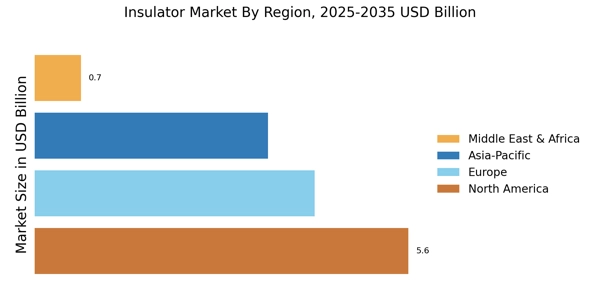
North America is witnessing significant growth in the insulator market, driven by increasing investments in infrastructure and renewable energy projects. The region holds approximately 40% of the global market share, with the United States being the largest market, followed by Canada at around 15%. Regulatory support for clean energy initiatives is further propelling demand for high-performance insulators. The competitive landscape is characterized by the presence of major players such as General Electric and Siemens, which are leading the charge in innovation and technology. The U.S. market is particularly focused on upgrading aging electrical grids and expanding renewable energy sources, creating a robust environment for insulator manufacturers. Companies are also investing in R&D to develop advanced materials that enhance performance and sustainability.

Europe : Sustainability and Innovation Focus

Europe is emerging as a key player in the insulator market, driven by stringent environmental regulations and a strong push towards renewable energy. The region accounts for approximately 30% of the global market share, with Germany and France leading the way. The European Union's commitment to reducing carbon emissions is a significant catalyst for the demand for advanced insulators that support sustainable energy solutions. Leading countries like Germany and France are home to major manufacturers such as Schneider Electric and Nexans, which are at the forefront of innovation. The competitive landscape is marked by a focus on developing eco-friendly materials and technologies. The European market is also characterized by collaborative efforts between governments and private sectors to enhance infrastructure resilience and energy efficiency.

Asia-Pacific : Rapid Urbanization and Growth

The Asia-Pacific region is experiencing rapid growth in the insulator market, fueled by urbanization and industrialization. This region holds approximately 25% of the global market share, with China being the largest market, followed by India. Government initiatives to enhance power infrastructure and increase electricity access are significant drivers of demand for insulators in this region. China's aggressive investments in renewable energy and infrastructure development have positioned it as a leader in the insulator market. Key players like Mitsubishi Electric and Toshiba are actively expanding their operations to meet the growing demand. The competitive landscape is dynamic, with a focus on technological advancements and cost-effective solutions to cater to the diverse needs of the rapidly growing economies in the region.

Middle East and Africa : Emerging Markets and Opportunities

The Middle East and Africa region is witnessing emerging opportunities in the insulator market, driven by infrastructural development and increasing energy demands. This region holds about 5% of the global market share, with countries like South Africa and the UAE leading the charge. Investments in renewable energy projects and smart grid technologies are key growth drivers in this area. South Africa is focusing on upgrading its electrical infrastructure, while the UAE is investing heavily in sustainable energy solutions. The competitive landscape includes local and international players, with companies like ABB and Eaton expanding their presence. The region's market is characterized by a growing emphasis on innovative insulator technologies that can withstand extreme environmental conditions, enhancing reliability and performance.

Insulator Market Regional Image

Key Players and Competitive Insights

The Insulator Market is currently characterized by a dynamic competitive landscape, driven by increasing demand for reliable electrical infrastructure and the ongoing transition towards renewable energy sources. Major players such as Siemens (Germany), General Electric (United States), and ABB (Switzerland) are strategically positioned to leverage their technological expertise and extensive product portfolios. Siemens (Germany) focuses on innovation in smart grid technologies, while General Electric (United States) emphasizes its commitment to sustainability through the development of eco-friendly insulators. ABB (Switzerland) is actively pursuing regional expansion, particularly in emerging markets, to enhance its market presence. Collectively, these strategies not only shape the competitive environment but also indicate a shift towards more sustainable and technologically advanced solutions in the insulator sector.

Key business tactics within the Insulator Market include localizing manufacturing and optimizing supply chains to enhance operational efficiency. The market structure appears moderately fragmented, with several key players exerting considerable influence. This fragmentation allows for a diverse range of products and innovations, fostering competition among established companies and new entrants alike. The collective influence of these key players is significant, as they drive advancements in technology and sustainability practices, which are becoming increasingly critical in the industry.

In August 2025, Siemens (Germany) announced a partnership with a leading renewable energy firm to develop advanced insulator solutions tailored for offshore wind farms. This strategic move underscores Siemens' commitment to supporting the renewable energy sector and positions the company to capitalize on the growing demand for sustainable energy solutions. The collaboration is expected to enhance Siemens' product offerings and strengthen its market position in the renewable energy segment.

In September 2025, General Electric (United States) unveiled a new line of high-performance insulators designed to withstand extreme weather conditions, reflecting the company's focus on resilience in electrical infrastructure. This product launch is particularly significant as it addresses the increasing frequency of severe weather events, thereby enhancing the reliability of power transmission systems. General Electric's proactive approach in this regard may provide a competitive edge in markets prone to such challenges.

In July 2025, ABB (Switzerland) completed the acquisition of a regional insulator manufacturer, which is anticipated to bolster its production capabilities and expand its market reach in Asia. This acquisition aligns with ABB's strategy to enhance its operational footprint in high-growth regions, thereby positioning the company to better serve local markets. The integration of the acquired company is likely to facilitate innovation and improve supply chain efficiencies, further solidifying ABB's competitive stance.

As of October 2025, the Insulator Market is witnessing trends that emphasize digitalization, sustainability, and the integration of artificial intelligence in manufacturing processes. Strategic alliances among key players are increasingly shaping the competitive landscape, fostering innovation and collaboration. The shift from price-based competition to a focus on technological advancement and supply chain reliability is evident, suggesting that companies that prioritize innovation and sustainability will likely emerge as leaders in the evolving market.

Key Companies in the Insulator Market market include

Industry Developments

Recent developments in the Insulator Market have seen a surge in investment and growth driven by the rising demand for energy-efficient solutions. Companies like Siemens and Schneider Electric are focusing on enhancing their product offerings to meet sustainability targets, while 3M and ABB are working on advanced insulating technologies that support electrical safety and efficiency. In the M&A landscape, significant moves include Olex's acquisition of a regional competitor to expand its market presence and NGK Insulators’ strategic partnerships aiming to penetrate untapped markets. Rogers Corporation has been actively investing in R&D to improve its competitive edge in specialty insulation materials.

The valuation of companies in this market has also been positively impacted, with firms like Eaton and General Electric reporting substantial revenue increases due to improved manufacturing capabilities and the adoption of modern insulating solutions in various industries, including automotive and construction. Furthermore, Nexans is exploring opportunities in renewable energy sectors, aligning its growth strategy with energy transition initiatives. The ongoing advancements indicate a robust trajectory for the Insulator Market, as they adapt to evolving industry demands and regulatory frameworks.

Future Outlook

Insulator Market Future Outlook

The Insulator Market is projected to grow at a 4.2% CAGR from 2024 to 2035, driven by increasing demand for renewable energy and infrastructure modernization.

New opportunities lie in:

  • Expansion into smart grid technologies for enhanced efficiency.
  • Development of eco-friendly insulator materials to meet sustainability goals.
  • Investment in R&D for high-voltage insulator innovations.

By 2035, the Insulator Market is expected to achieve robust growth, driven by technological advancements and sustainability initiatives.

Market Segmentation

Insulator Market Type Outlook

  • Ceramic
  • Glass
  • Polymer
  • Composite

Insulator Market End Use Outlook

  • Utilities
  • Industrial
  • Commercial

Insulator Market Voltage Outlook

  • Low Voltage
  • Medium Voltage
  • High Voltage

Insulator Market Application Outlook

  • Power Transmission
  • Distribution
  • Renewable Energy
  • Railway

Report Scope

MARKET SIZE 202414.04(USD Billion)
MARKET SIZE 202514.63(USD Billion)
MARKET SIZE 203522.08(USD Billion)
COMPOUND ANNUAL GROWTH RATE (CAGR)4.2% (2024 - 2035)
REPORT COVERAGERevenue Forecast, Competitive Landscape, Growth Factors, and Trends
BASE YEAR2024
Market Forecast Period2025 - 2035
Historical Data2019 - 2024
Market Forecast UnitsUSD Billion
Key Companies ProfiledMarket analysis in progress
Segments CoveredMarket segmentation analysis in progress
Key Market OpportunitiesIntegration of advanced materials enhances performance and sustainability in the Insulator Market.
Key Market DynamicsTechnological advancements and regulatory changes drive innovation and competition in the insulator market.
Countries CoveredNorth America, Europe, APAC, South America, MEA

Market Highlights

Author
Priya Nagrale
Senior Research Analyst

With an experience of over five years in market research industry (Chemicals & Materials domain), I gather and analyze market data from diverse sources to produce results, which are then presented back to a client. Also, provide recommendations based on the findings. As a Senior Research Analyst, I perform quality checks (QC) for market estimations, QC for reports, and handle queries and work extensively on client customizations. Also, handle the responsibilities of client proposals, report planning, report finalization, and execution

Leave a Comment

FAQs

What is the projected market valuation of the Insulator Market by 2035?

The Insulator Market is projected to reach a valuation of 22.08 USD Billion by 2035.

What was the market valuation of the Insulator Market in 2024?

In 2024, the Insulator Market was valued at 14.04 USD Billion.

What is the expected CAGR for the Insulator Market during the forecast period 2025 - 2035?

The expected CAGR for the Insulator Market during the forecast period 2025 - 2035 is 4.2%.

Which companies are considered key players in the Insulator Market?

Key players in the Insulator Market include Siemens, General Electric, Schneider Electric, ABB, Nexans, Mitsubishi Electric, Toshiba, Eaton, and Lapp Group.

What are the projected valuations for different types of insulators by 2035?

By 2035, ceramic insulators are projected to reach 8.0 USD Billion, glass insulators 5.0 USD Billion, polymer insulators 6.0 USD Billion, and composite insulators 3.08 USD Billion.

How does the Insulator Market perform in the power transmission application segment?

The power transmission application segment is expected to grow from 5.61 USD Billion in 2024 to 8.96 USD Billion by 2035.

What is the expected growth for the renewable energy application segment by 2035?

The renewable energy application segment is projected to grow from 2.81 USD Billion in 2024 to 4.38 USD Billion by 2035.

What are the projected valuations for different voltage segments by 2035?

By 2035, low voltage insulators are expected to reach 8.96 USD Billion, medium voltage 6.73 USD Billion, and high voltage 6.39 USD Billion.

What is the expected market performance for the industrial end-use segment by 2035?

The industrial end-use segment is projected to grow from 4.22 USD Billion in 2024 to 6.73 USD Billion by 2035.

How does the Insulator Market's growth compare across different applications?

The Insulator Market shows varied growth across applications, with power transmission leading at 8.96 USD Billion by 2035, followed by distribution and renewable energy.

Download Free Sample

Kindly complete the form below to receive a free sample of this Report

Compare Licence

×
Features License Type
Single User Multiuser License Enterprise User
Price $4,950 $5,950 $7,250
Maximum User Access Limit 1 User Upto 10 Users Unrestricted Access Throughout the Organization
Free Customization
Direct Access to Analyst
Deliverable Format
Platform Access
Discount on Next Purchase 10% 15% 15%
Printable Versions