Research Methodology on Intelligent Road System Market
1. Introduction
The intelligent road system (IRS) is at the forefront of modern technological development and innovation. Intelligent roads are equipped with technological advancements in the form of sensors, cameras, LiDAR, signal lights, and other such technologies which help in monitoring and reducing traffic congestion and increasing safety on roads.
The growing adoption of advanced technologies such as the Internet of Things (IoT), Artificial Intelligence (AI), and Machine Learning (ML) are driving the intelligent road system market and providing better insight into the quality and safety of operations on roads.
This research report is focused on gaining a comprehensive understanding of the intelligent road system market, including its current and future market trends, its drivers, restraints, segmentation, and market strategies. For this purpose, the study employs several secondary and primary data collection methodologies. Moreover, qualitative and quantitative analysis is used to analyze the collected data and provide a detailed and accurate analysis of the market.
2. Research Objectives
The main objectives of this research are as follows:
- To analyze the market attractiveness of the intelligent road system.
- To provide an in-depth analysis of the key drivers, restraints, and opportunities of the intelligent road system market.
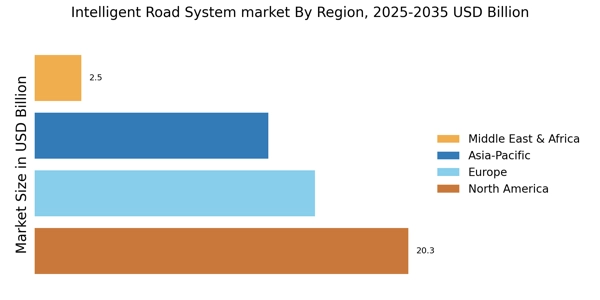
- To study the regional and segment-based market trends and developments in the intelligent road system market.
- To assess the product offerings and demand for intelligent road system products and services.
- To analyze the market size and forecast the estimated growth rates for the intelligent road system market.
- To study and formulate the evolution of market dynamics and competitive strategies in the intelligent road system market.
3. Research Methodology
This research report on the intelligent road system market was developed by utilizing both primary and secondary research methodologies. Primary sources such as interviews with executives, market surveys, and focus group discussions, and secondary sources such as industry experts, newspaper articles, books, journals, and magazines have been used to provide an exhaustive overview of the market.
3.1 Secondary Research
Secondary research is the process of utilizing available market data to obtain the overall market size and forecasting. Through the use of statistical tools such as Porter's Five Force Model, SWOT Analysis, Ansoff Matrix, and Market Trend Analysis, the secondary sources were analyzed to gain insights on the market and obtain the key data regarding the intelligent road system.
3.2 Primary Research
Primary research comprises interviews and surveys conducted to obtain specific information not available through secondary research. In this report, interviews were conducted with industry experts and various professionals from different geographical locations across the globe. Interviews with executives from companies that are active in the intelligent road system market were conducted to gain an in-depth understanding of the current market landscape. The interviews have been used to obtain qualitative and quantitative data on the evolution of the market.
4. Market Model
The market model for the intelligent road system market was formulated taking into account various factors such as drivers, restraints, opportunities, and trends. The model is based on the data gathered from the interviews and surveys as well as from secondary research sources. The model helps to represent the data in a visual format to recognize the key drivers and restraints impacting the market.
5. Market Segmentation
The intelligent road system market can be segmented based on components, applications, end users, and geography.
5.1 Components:
The components segment is further divided into Infrastructure, Networking, Cyber Security Systems, and Controlling Systems.
5.2. Application:
The applications segment is further divided into ITS Public Safety, Connected Bridges and Roadways, Advanced Traffic Management, and Connected Vehicles and ITS.
5.3. End User:
The end user segment is further divided into Railways, Airports, Ports, and Roadways.
5.4 Geography:
The geography segment is further divided into North America, Europe, Asia-Pacific, and Rest of the World.
6. Data Analysis and Interpretation
The qualitative analysis included issues such as drivers, restraints, potential opportunities, and trends in the intelligent road system market. Interviews and surveys were conducted to analyze the qualitative data, while the collected data is subjected to quantitative analysis through the use of statistical tools. The statistical tools used in the quantitative analysis include Porter’s Five Force Model, SWOT Analysis, Ansoff Matrix, and Market Trend Analysis.
7. Assumptions
The assumptions and statistics used in this research report are based on primary and secondary research sources as well as on interviews and surveys conducted with key participants in the intelligent road system market. The assumptions are subject to change, as the data and information available for this report are constantly evolving.
8. Scope of the Study
This report provides an in-depth analysis of the market, including the landscape and market dynamics. The report also provides an overview of the market along with qualitative and quantitative analysis of the drivers, challenges, and opportunities. It also provides an analysis of the different segments of the market.