×
Request Free Sample ×

Kindly complete the form below to receive a free sample of this Report

* Please use a valid business email

Leading companies partner with us for data-driven Insights

clients tt-cursor
Hero Background

Interlocked Armored Cable Market

ID: MRFR/EnP/22156-HCR
100 Pages
Snehal Singh
October 2025

Interlocked Armored Cable Market Research Report By Application (Power Distribution, Oil and Gas, Industrial Control and Automation, Transportation, Telecommunications), By Material (Copper, Aluminium, Steel), By Armor Type (Interlocked, Corrugated, Smooth), By Voltage Range (Low Voltage (LV), Medium Voltage (MV), High Voltage (HV)), By Construction (Single Core, Multi-Core, Shielded) and By Regional (North America, Europe, South America, Asia Pacific, Middle East and Africa) - Industry Forecast to 2035

Share:
Download PDF ×

We do not share your information with anyone. However, we may send you emails based on your report interest from time to time. You may contact us at any time to opt-out.

Interlocked Armored Cable Market Infographic
Purchase Options

Interlocked Armored Cable Market Summary

As per MRFR analysis, the Interlocked Armored Cable Market Size was estimated at 27.26 USD Billion in 2024. The Interlocked Armored Cable industry is projected to grow from 28.26 USD Billion in 2025 to 40.41 USD Billion by 2035, exhibiting a compound annual growth rate (CAGR) of 3.64 during the forecast period 2025 - 2035.

Key Market Trends & Highlights

The Interlocked Armored Cable Market is poised for substantial growth driven by technological advancements and increasing safety standards.

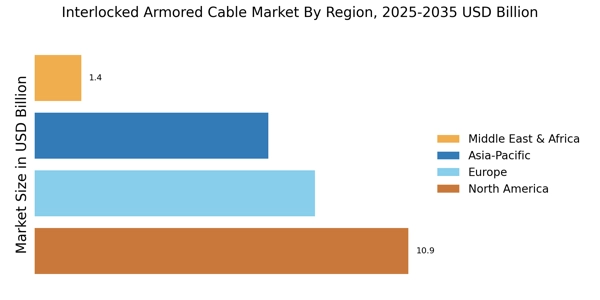
  • The North American region remains the largest market for interlocked armored cables, driven by robust infrastructure development.
  • Asia-Pacific is emerging as the fastest-growing region, fueled by rapid industrialization and urbanization.
  • The power distribution segment continues to dominate the market, while the telecommunications segment is witnessing the highest growth rates.
  • Key market drivers include rising infrastructure development and increased adoption of automation, which are propelling demand for interlocked armored cables.

Market Size & Forecast

2024 Market Size 27.26 (USD Billion)
2035 Market Size 40.41 (USD Billion)
CAGR (2025 - 2035) 3.64%

Major Players

Southwire Company (US), General Cable (US), Nexans (FR), Prysmian Group (IT), AFL (US), Belden Inc. (US), LS Cable & System (KR), Sumitomo Electric Industries (JP), Cablel Wires (IN)

Interlocked Armored Cable Market Trends

The Interlocked Armored Cable Market is currently experiencing a notable evolution, driven by various factors that influence its demand and application across multiple sectors. This market encompasses cables designed with interlocking armor, providing enhanced protection against mechanical damage and environmental factors. Industries such as construction, manufacturing, and energy are increasingly adopting these cables due to their durability and reliability. The growing emphasis on safety standards and regulations further propels the market, as organizations seek to ensure compliance while minimizing risks associated with electrical installations. Moreover, advancements in technology and materials are likely to shape the future landscape of the Interlocked Armored Cable Market. Innovations in manufacturing processes may lead to the development of lighter, more flexible cables that maintain strength and resilience. Additionally, the rising trend of renewable energy projects could create new opportunities for the market, as these cables are essential for connecting various components in solar and wind energy systems. As the global focus shifts towards sustainable practices, the Interlocked Armored Cable Market appears poised for growth, adapting to meet the evolving needs of diverse industries.

Increased Demand in Renewable Energy

The Interlocked Armored Cable Market is witnessing a surge in demand driven by the expansion of renewable energy projects. As countries invest in solar and wind energy, the need for reliable and durable cabling solutions becomes paramount. These cables are essential for connecting various components in renewable energy systems, ensuring efficient energy transmission.

Technological Advancements in Cable Manufacturing

Recent innovations in manufacturing techniques are likely to enhance the performance characteristics of interlocked armored cables. Developments in materials science may lead to the creation of lighter and more flexible cables, which still offer robust protection against environmental hazards. This trend could significantly influence market dynamics.

Growing Emphasis on Safety Standards

The Interlocked Armored Cable Market is increasingly influenced by stringent safety regulations across various industries. Organizations are prioritizing compliance with safety standards, which drives the demand for high-quality armored cables. This focus on safety not only mitigates risks but also enhances the overall reliability of electrical installations.

Interlocked Armored Cable Market Drivers

Focus on Energy Efficiency

The Interlocked Armored Cable Industry. As industries and governments strive to reduce carbon footprints, there is a growing demand for energy-efficient electrical solutions. Interlocked armored cables, which minimize energy loss and enhance system reliability, are increasingly being adopted in various applications. Market analysis indicates that the energy efficiency sector is projected to grow at a rate of around 6% annually, driven by regulatory frameworks and consumer awareness. This trend is likely to boost the demand for interlocked armored cables, as they align with the objectives of energy conservation and sustainable development.

Increased Adoption of Automation

The shift towards automation in various industries, including manufacturing and energy, is likely to propel the Interlocked Armored Cable Market. As industries seek to enhance efficiency and reduce operational costs, the integration of automated systems becomes essential. This transition necessitates reliable and secure electrical connections, which interlocked armored cables provide. Data suggests that the automation market is expected to grow substantially, with a projected increase of around 10% annually. Consequently, the demand for interlocked armored cables, which can withstand harsh conditions and provide consistent performance, is anticipated to rise, further driving market expansion.

Growing Telecommunications Sector

The telecommunications sector's rapid growth is another significant driver for the Interlocked Armored Cable Market. With the increasing demand for high-speed internet and advanced communication networks, the need for reliable cabling solutions has surged. Interlocked armored cables are particularly suited for outdoor installations, where they can endure environmental challenges. Recent statistics indicate that the telecommunications industry is set to expand at a rate of approximately 8% per year, driven by the proliferation of 5G technology and the Internet of Things (IoT). This growth is expected to create substantial opportunities for interlocked armored cable manufacturers, as they cater to the evolving needs of this dynamic sector.

Rising Infrastructure Development

The ongoing expansion of infrastructure projects across various sectors appears to be a primary driver for the Interlocked Armored Cable Market. Governments and private entities are investing heavily in the construction of roads, bridges, and buildings, which necessitates robust electrical systems. This trend is particularly evident in emerging economies, where urbanization is accelerating. According to recent data, the construction sector is projected to grow at a compound annual growth rate of approximately 5% over the next five years. As a result, the demand for interlocked armored cables, known for their durability and protection against environmental factors, is likely to increase significantly, thereby bolstering the market's growth.

Regulatory Compliance and Safety Standards

The stringent regulatory compliance and safety standards in electrical installations are crucial drivers for the Interlocked Armored Cable Market. As safety regulations become more rigorous, industries are compelled to adopt high-quality cabling solutions that meet these standards. Interlocked armored cables are designed to provide enhanced protection against mechanical damage and environmental hazards, making them a preferred choice for many applications. Recent data indicates that the market for safety-compliant electrical products is expected to grow by approximately 7% annually. This trend underscores the importance of interlocked armored cables in ensuring compliance with safety regulations, thereby driving their demand in various sectors.
Market Segment Insights

By Application: Power Distribution (Largest) vs. Telecommunications (Fastest-Growing)

The Interlocked Armored Cable Market showcases varied application segments with Power Distribution leading the domain. This segment captures the largest market share due to its critical role in transmitting electricity efficiently and safely across different infrastructures. Following Power Distribution, segments such as Oil and Gas and Industrial Control and Automation hold substantial shares but are outpaced by the rapid advancements seen in Telecommunications, driven by the need for enhanced connectivity and infrastructure development. Telecommunications emerges as the fastest-growing segment, propelled by the accelerating demand for high-speed internet and robust communication systems. The ongoing advancements in technology and growing urbanization further underpin the significant growth of this segment. Oil and Gas and Industrial Control also see growth, driven by infrastructure upgrades and automation, respectively, yet Telecommunications outstrips them in growth rate, making it a key area of focus for future investments.

Oil and Gas (Dominant) vs. Industrial Control and Automation (Emerging)

The Oil and Gas sector remains a dominant force within the Interlocked Armored Cable Market due to its extensive use in pipelines and drilling operations, requiring high durability and safety standards. These cables are vital for withstanding harsh environmental conditions, which is critical in preventing failures and ensuring safety within hazardous environments. Meanwhile, the Industrial Control and Automation segment represents an emerging area characterized by a rise in automation processes across various industries. As manufacturing and production facilities adopt more sophisticated control systems, the demand for reliable and robust armored cables grows. While Oil and Gas continues to thrive due to established operational practices, Industrial Control and Automation is marked by innovative solutions and technological advancements, positioning it well for future market presence.

By Material: Copper (Largest) vs. Aluminium (Fastest-Growing)

In the Interlocked Armored Cable Market, the material segment is primarily dominated by copper, which is preferred for its excellent conductivity and durability. Copper cables maintain a significant market share, favored in applications requiring high performance and reliability. In contrast, the aluminium segment is experiencing rapid growth due to its cost-effectiveness and lightweight properties, making it an attractive alternative in various installations where weight and budget are critical factors.

Material: Copper (Dominant) vs. Aluminium (Emerging)

Copper is the dominant material in the interlocked armored cable market, known for its superior electrical conductivity, corrosion resistance, and mechanical strength. It is widely used in applications that demand high performance, such as power distribution and telecommunications. On the other hand, aluminium, while traditionally viewed as a secondary option, is becoming emerging due to its lightweight nature and lower cost. This makes aluminium cables increasingly popular in diverse sectors, including solar power installations and residential wiring, where budget and ease of installation are prioritized. As the market evolves, the competition between these materials is set to intensify, reflecting a shift in consumer preferences towards versatility and economic viability.

By Armor Type: Interlocked (Largest) vs. Corrugated (Fastest-Growing)

In the Interlocked Armored Cable Market, the armor type segments reveal a competitive landscape where interlocked cables represent the largest share. Their popularity stems from their robustness and versatility, catering to a wide range of applications, particularly in construction and industrial environments. In contrast, corrugated armored cables, though currently smaller in market share, are gaining traction due to their lightweight design and enhanced flexibility, making them ideal for specific environments that require high adaptability. The growth trends in this segment are driven by the increasing demand for safety and durability in electrical installations. The interlocked armored cables are expected to remain dominant as they meet stringent regulatory requirements in various industries. However, the rapid adoption of corrugated cables is evident, attributed to emerging sectors that prioritize efficient installation and reduced weight, positioning them as the fastest-growing option in the market.

Interlocked (Dominant) vs. Corrugated (Emerging)

Interlocked armored cables are characterized by their capability to withstand harsh environments, providing excellent protection against physical damage and environmental factors. They are widely utilized in settings where durability and reliability are essential, such as in commercial electrical systems. The interlocked design allows for easy handling and installation, contributing to their dominant market position. Conversely, corrugated armored cables, known for their flexibility and lightweight properties, are emerging as a significant choice in specialized applications. They offer a balance of protection and ease of installation, appealing to sectors that require maneuverability without sacrificing safety. As the industry evolves, both segments continue to carve out their niches, with their unique traits catering to diverse market needs.

By Voltage Range: Low Voltage (Largest) vs. High Voltage (Fastest-Growing)

In the Interlocked Armored Cable Market, the voltage range segment is characterized by three primary categories: Low Voltage (LV), Medium Voltage (MV), and High Voltage (HV). Among these, Low Voltage cables dominate the market share due to their extensive application in residential and commercial settings, making them the largest segment. Medium Voltage cables hold a viable share, catering to industrial applications, while High Voltage cables are gaining traction, attributed to high-capacity power transmission needs in utility and infrastructure projects.

Voltage Range: Low Voltage (Dominant) vs. High Voltage (Emerging)

Low Voltage (LV) cables are widely utilized in a variety of electrical systems, extensively powering residential and commercial installations. Their robust design and ability to withstand harsh environmental conditions contribute to their dominant position in the market. In contrast, High Voltage (HV) cables are emerging as a crucial segment, driven by the demand for efficient energy transmission across long distances, especially in renewable energy projects. As industries lean towards sustainable energy solutions, HV cables are projected to experience significant growth, making them a key player in the evolving landscape of the interlocked armored cable market.

By Construction: Single Core (Largest) vs. Multi-Core (Fastest-Growing)

The Interlocked Armored Cable Market is currently dominated by the Single Core segment, which commands a significant share of the market. This segment benefits from its straightforward design, making it a preferred choice for many applications, especially where space constraints are a concern. Multi-Core cables, while not as dominant, are gaining traction due to their versatility and increased demand in complex electrical installations, allowing multiple circuits to be bundled effectively.

Cables: Single Core (Dominant) vs. Multi-Core (Emerging)

Single Core cables are characterized by their simplicity and efficiency, offering reliable performance in various industrial applications. Their design enables easy installation and maintenance, which appeals to contractors and project managers. On the other hand, Multi-Core cables are becoming increasingly popular due to their ability to transmit power and signals through multiple conductors within a single cable. This innovation supports modern electrical systems requiring flexibility and reduced installation time. Both segments cater to different end-user needs and continue to evolve as technology advances.

Get more detailed insights about Interlocked Armored Cable Market

Regional Insights

North America : Market Leader in Innovation

The North American interlocked armored cable market is driven by increasing demand for reliable and durable electrical solutions across various sectors, including construction and renewable energy. The region holds the largest market share at approximately 40%, with the U.S. being the primary contributor. Regulatory support for infrastructure development and energy efficiency initiatives further catalyzes market growth. Key players such as Southwire Company and General Cable dominate the landscape, leveraging advanced technologies to enhance product offerings. The competitive environment is characterized by innovation and strategic partnerships, ensuring a robust supply chain. The presence of established manufacturers and a growing focus on sustainable practices are pivotal in shaping the market dynamics.

Europe : Emerging Market with Regulations

Europe is witnessing significant growth in the interlocked armored cable market, driven by stringent regulations aimed at enhancing safety and energy efficiency. The region holds the second-largest market share at around 30%. Countries like Germany and France are leading the charge, supported by government initiatives promoting renewable energy and infrastructure upgrades. Regulatory frameworks are pivotal in shaping market demand and ensuring compliance with safety standards. The competitive landscape features key players such as Nexans and Prysmian Group, who are investing in R&D to innovate and meet regulatory requirements. The presence of a well-established manufacturing base and a focus on sustainability are critical factors driving market dynamics. Collaboration among industry stakeholders is also enhancing product development and market penetration.

Asia-Pacific : Rapidly Growing Market

The Asia-Pacific region is rapidly emerging as a significant player in the interlocked armored cable market, driven by urbanization and industrialization. Countries like China and India are witnessing a surge in demand, contributing to a market share of approximately 25%. Government initiatives aimed at infrastructure development and energy projects are key growth drivers, alongside increasing investments in renewable energy sources. The competitive landscape is marked by the presence of local and international players, including LS Cable & System and Sumitomo Electric Industries. These companies are focusing on expanding their product portfolios and enhancing distribution networks to capture the growing market. The region's diverse industrial base and increasing adoption of advanced technologies are further propelling market growth.

Middle East and Africa : Emerging Opportunities Ahead

The Middle East and Africa (MEA) region is gradually emerging in the interlocked armored cable market, driven by infrastructural developments and increasing energy demands. The market share is currently around 5%, with countries like the UAE and South Africa leading the way. Government investments in infrastructure and energy projects are crucial for market expansion, alongside a growing focus on renewable energy initiatives. The competitive landscape is characterized by a mix of local and international players, with companies like Cablel Wires making significant inroads. The region's unique challenges, such as regulatory hurdles and economic fluctuations, present both risks and opportunities for market participants. Strategic partnerships and investments in technology are essential for capturing growth in this evolving market.

Interlocked Armored Cable Market Regional Image

Key Players and Competitive Insights

The Interlocked Armored Cable Market is currently characterized by a dynamic competitive landscape, driven by increasing demand for robust and reliable cable solutions across various sectors, including construction, telecommunications, and energy. Key players such as Southwire Company (US), Prysmian Group (IT), and Nexans (FR) are strategically positioning themselves through innovation and regional expansion. Southwire Company (US) has focused on enhancing its product offerings with advanced technology, while Prysmian Group (IT) emphasizes sustainability in its operations, aiming to reduce environmental impact. Nexans (FR) is actively pursuing partnerships to bolster its market presence, indicating a collective shift towards collaborative strategies that enhance competitive advantage.

In terms of business tactics, companies are increasingly localizing manufacturing to reduce lead times and optimize supply chains. The market appears moderately fragmented, with several players vying for market share, yet the influence of major companies is palpable. This competitive structure allows for a diverse range of products and services, catering to various customer needs while fostering innovation through competition.

In August 2025, Southwire Company (US) announced the launch of a new line of interlocked armored cables designed specifically for harsh environmental conditions. This strategic move not only enhances their product portfolio but also positions them as a leader in providing solutions for demanding applications, potentially increasing their market share in sectors such as oil and gas.

In September 2025, Prysmian Group (IT) unveiled its commitment to sustainability by introducing a new eco-friendly interlocked armored cable that utilizes recycled materials. This initiative aligns with global trends towards environmental responsibility and may attract customers who prioritize sustainable practices, thereby enhancing their competitive positioning in the market.

In July 2025, Nexans (FR) entered into a strategic partnership with a leading renewable energy firm to develop specialized interlocked armored cables for offshore wind farms. This collaboration not only expands Nexans' product offerings but also underscores the growing importance of renewable energy solutions, positioning the company favorably in a rapidly evolving market.

As of October 2025, the competitive trends in the Interlocked Armored Cable Market are increasingly defined by digitalization, sustainability, and the integration of advanced technologies such as AI. Strategic alliances are becoming more prevalent, allowing companies to leverage each other's strengths and enhance their market offerings. Looking ahead, it is likely that competitive differentiation will evolve from traditional price-based competition to a focus on innovation, technological advancements, and supply chain reliability, reflecting the changing demands of the market.

Key Companies in the Interlocked Armored Cable Market market include

Industry Developments

The Interlocked Armored Cable Market is anticipated to reach USD 35.0 billion by 2032, exhibiting a CAGR of 3.64% during the forecast period (2025-2034). Increasing demand for reliable and secure power distribution networks, coupled with growing urbanization and industrialization, is driving the market growth. Government initiatives and regulations promoting the use of armored cables in critical infrastructure projects further contribute to the market expansion.

Technological advancements, such as the development of lightweight and flexible cables, are also creating new opportunities in various end-use industries. Key players in the market include Prysmian Group, Nexans, and General Cable, among others. Recent developments include the launch of innovative interlocked armored cables designed for harsh environments and the integration of smart technologies for remote monitoring and control.

Future Outlook

Interlocked Armored Cable Market Future Outlook

The Interlocked Armored Cable Market is projected to grow at a 3.64% CAGR from 2024 to 2035, driven by increasing demand for durable electrical solutions and infrastructure development.

New opportunities lie in:

  • Expansion into renewable energy sectors with specialized armored cables.
  • Development of smart cable monitoring systems for enhanced safety.
  • Partnerships with construction firms for integrated cable solutions in new projects.

By 2035, the market is expected to solidify its position as a key player in electrical infrastructure.

Market Segmentation

Interlocked Armored Cable Market Material Outlook

  • Copper
  • Aluminium
  • Steel

Interlocked Armored Cable Market Armor Type Outlook

  • Interlocked
  • Corrugated
  • Smooth

Interlocked Armored Cable Market Application Outlook

  • Power Distribution
  • Oil and Gas
  • Industrial Control and Automation
  • Transportation
  • Telecommunications

Interlocked Armored Cable Market Construction Outlook

  • Single Core
  • Multi-Core
  • Shielded

Interlocked Armored Cable Market Voltage Range Outlook

  • Low Voltage (LV)
  • Medium Voltage (MV)
  • High Voltage (HV)

Report Scope

MARKET SIZE 202427.26(USD Billion)
MARKET SIZE 202528.26(USD Billion)
MARKET SIZE 203540.41(USD Billion)
COMPOUND ANNUAL GROWTH RATE (CAGR)3.64% (2024 - 2035)
REPORT COVERAGERevenue Forecast, Competitive Landscape, Growth Factors, and Trends
BASE YEAR2024
Market Forecast Period2025 - 2035
Historical Data2019 - 2024
Market Forecast UnitsUSD Billion
Key Companies ProfiledMarket analysis in progress
Segments CoveredMarket segmentation analysis in progress
Key Market OpportunitiesGrowing demand for durable and flexible solutions in renewable energy projects drives the Interlocked Armored Cable Market.
Key Market DynamicsRising demand for durable electrical solutions drives innovation and competition in the interlocked armored cable market.
Countries CoveredNorth America, Europe, APAC, South America, MEA

Leave a Comment

FAQs

What is the projected market valuation of the Interlocked Armored Cable Market by 2035?

The projected market valuation for the Interlocked Armored Cable Market by 2035 is 40.41 USD Billion.

What was the overall market valuation of the Interlocked Armored Cable Market in 2024?

The overall market valuation of the Interlocked Armored Cable Market in 2024 was 27.26 USD Billion.

What is the expected CAGR for the Interlocked Armored Cable Market during the forecast period 2025 - 2035?

The expected CAGR for the Interlocked Armored Cable Market during the forecast period 2025 - 2035 is 3.64%.

Which application segment is projected to have the highest valuation in 2035?

The Power Distribution application segment is projected to reach a valuation of 12.0 USD Billion by 2035.

What are the projected valuations for the Copper and Aluminium material segments by 2035?

By 2035, the Copper material segment is projected to reach 15.0 USD Billion, while Aluminium is expected to reach 12.0 USD Billion.

Which armor type is anticipated to dominate the market by 2035?

The Interlocked armor type is anticipated to dominate the market with a projected valuation of 16.56 USD Billion by 2035.

What is the expected valuation for the Medium Voltage (MV) segment by 2035?

The expected valuation for the Medium Voltage (MV) segment by 2035 is 12.0 USD Billion.

How does the projected valuation of Multi-Core construction compare to Single Core by 2035?

By 2035, the projected valuation for Multi-Core construction is 16.36 USD Billion, surpassing the Single Core's 12.25 USD Billion.

Which key players are leading the Interlocked Armored Cable Market?

Key players in the Interlocked Armored Cable Market include Southwire Company, General Cable, Nexans, and Prysmian Group.

What is the projected valuation for the Oil and Gas application segment by 2035?

The projected valuation for the Oil and Gas application segment by 2035 is 7.5 USD Billion.

Download Free Sample

Kindly complete the form below to receive a free sample of this Report

Compare Licence

×
Features License Type
Single User Multiuser License Enterprise User
Price $4,950 $5,950 $7,250
Maximum User Access Limit 1 User Upto 10 Users Unrestricted Access Throughout the Organization
Free Customization
Direct Access to Analyst
Deliverable Format
Platform Access
Discount on Next Purchase 10% 15% 15%
Printable Versions