Internal Combustion Engine Market (2026 - 2035)

Internal Combustion Engine Market Research Report By Fuel Type (Gasoline, Diesel, Natural Gas, Others (LPG, Dual-Fuel, Hydrogen)), By Application (Automotive (Passenger + Commercial), Industrial / Power Generation, Marine, Aerospace (Piston Engines), Off-Highway / Agriculture), By Engine Type (Four-Stroke, Two-Stroke) and By Regional (North America, Europe, South America, Asia Pacific, Middle East and Africa) - Industry Forecast to 2035
ID: MRFR/EnP/26505-HCR
128 Pages
Anshula Mandaokar
Last Updated: July 10, 2026
Internal Combustion Engine Market
Market Size
Forecast Period2026-2035
CAGR (2026-2035)4.2%
2025 Market SizeUSD 170.2 Billion
2035 Market SizeUSD 256.8 Billion
Key Players
Cummins Inc.
Caterpillar Inc.
Toyota Motor Corporation
Volkswagen Group
INNIO
Wärtsilä Corporation
Opportunities
  • Hydrogen-Blended and Dual-Fuel Combustion Engines
  • Distributed Power Generation in Off-Grid Markets
  • Aftermarket Digital Services and Predictive Maintenance

Internal Combustion Engine Market Summary

The Internal Combustion Engine Market was valued at USD 170.2 billion in 2025 and is projected to reach USD 177.3 billion in 2026 before climbing to USD 256.8 billion by 2035, expanding at a compound annual growth rate of 4.2% during the 2026–2035 forecast period. Two catalysts underpin this trajectory: the accelerating global demand for commercial freight transport, which the International Energy Agency estimates will grow cumulative diesel fuel demand by 18% through 2035 [1], and rising industrial backup power requirements across data-center-heavy economies. The Internal Combustion Engine Market retains its scale not because alternatives are absent but because the installed base, fuel infrastructure, and cost dynamics remain difficult to displace quickly.

A significant technology transformation is reshaping how combustion engines are designed, manufactured, and deployed. Legacy naturally aspirated configurations are giving way to advanced turbocharged, downsized architectures that extract more power per liter while cutting CO₂ output by 15–20%. Governments in the EU, China, and Japan have introduced progressively tighter emissions mandates — the European Commission's Euro 7 standard, effective 2025, alone forced OEMs to invest an estimated EUR 12 billion in powertrain redesign [2]. Hybrid integration is bridging the gap between pure combustion and full electrification across passenger and commercial segments.

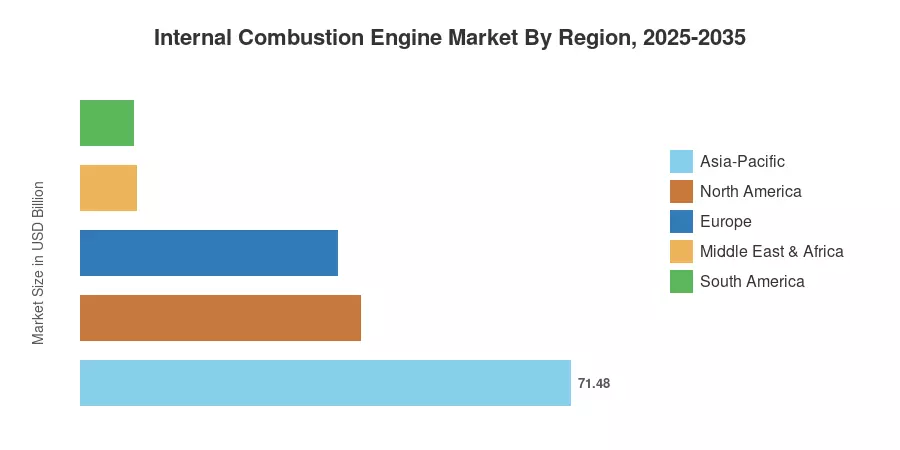
Asia-Pacific dominates the Internal Combustion Engine Market with roughly 42% of global revenue, driven by manufacturing scale in China, India, and Japan. The region also registers the fastest CAGR at 5.1% through 2035. North America holds approximately 24% share, anchored by heavy-duty trucking and oil-and-gas sector demand. Europe contributes around 22%, where stringent emissions rules paradoxically stimulate premium engine innovation. The decade ahead will hinge on how effectively OEMs balance regulatory compliance with profitability across these three regions.


Key Report Takeaways

• By Fuel Type

  • Gasoline engines command the largest share of the Internal Combustion Engine Market at approximately 48% of 2025 revenue, supported by passenger vehicle volume in Asia-Pacific and North America.
  • Diesel engines are projected to grow at a CAGR of 3.8% through 2035, sustained by heavy-duty trucking, marine propulsion, and off-highway equipment demand.
  • Natural gas engines represent a USD 12.4 billion segment in 2025, benefiting from LNG-fueled power generation in the Middle East and Southeast Asia.

• By Application

  • Automotive applications account for approximately 58% of the Internal Combustion Engine Market, with light commercial vehicles driving incremental growth in emerging economies.
  • Industrial and power generation applications are expanding at a CAGR of 5.3%, the fastest among application segments, as data centers and mining operations scale backup capacity.

• By Region

  • Asia-Pacific leads the Internal Combustion Engine Market with 42% revenue share, while North America contributes approximately USD 40.8 billion in 2025.
  • The Middle East & Africa region posts the second-fastest regional CAGR at 4.8%, fueled by oil-and-gas infrastructure and distributed power generation.


Market Size and Forecast (2021–2035)

Market sizing draws on a triangulated methodology combining top-down industry revenue estimates, bottom-up OEM shipment data, and cross-validation against trade statistics from the United Nations Comtrade database and national automotive industry associations. Historical values (2021–2024) reflect audited annual reports and industry body filings; the 2025 base year integrates preliminary OEM guidance and production data through Q3 2025. Forecast values (2026–2035) apply segment-level regression models calibrated against macroeconomic indicators including industrial output, vehicle production forecasts from OICA, and energy demand projections from the IEA [3].
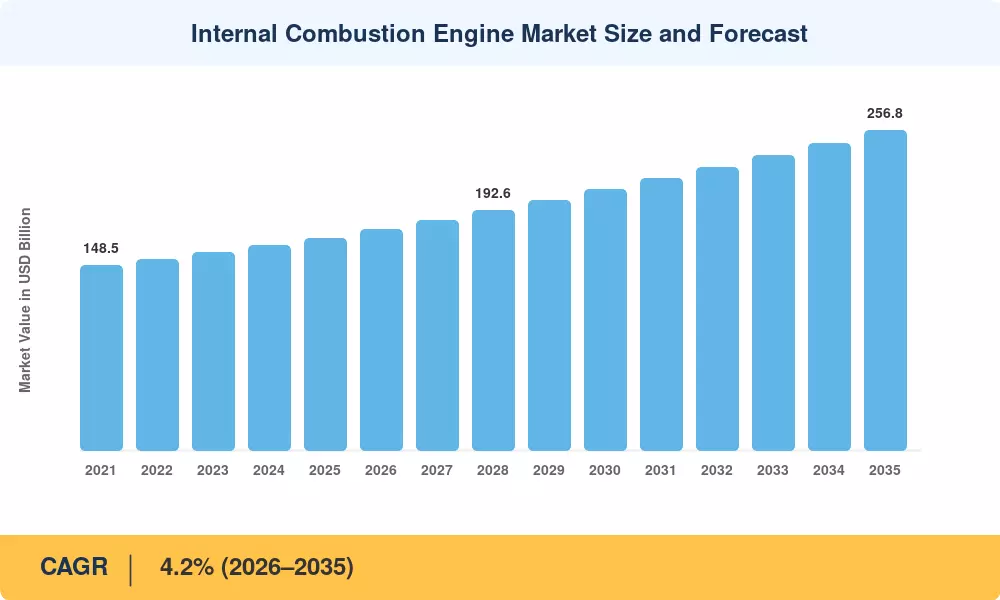
Internal Combustion Engine Market Size and Forecast
Our Impact
Enabled $4.3B Revenue Impact for Fortune 500 and Leading Multinationals
Partnering with 2000+ Global Organizations Each Year
30K+ Citations by Top-Tier Firms in the Industry

Driver Impact Analysis

Driver ~% Impact on CAGR Geographic Relevance Impact Timeline
Heavy-duty commercial vehicle demand +1.2% Global Long-term (≥4 yr)
Emissions regulation capex cycle +0.8% Europe, China Short-term (≤2 yr)
Data center and backup power growth +0.7% North America, APAC Medium-term (2–4 yr)
Marine and off-highway engine renewal +0.5% Global Long-term (≥4 yr)
Hybrid powertrain integration +0.4% Europe, Japan Medium-term (2–4 yr)
Emerging market vehicle population growth +0.4% India, ASEAN, Africa Long-term (≥4 yr)
Natural gas infrastructure buildout +0.3% MEA, North America Medium-term (2–4 yr)


Heavy-Duty Commercial Vehicle Demand

Global freight tonnage is expected to grow 30% by 2035 according to the International Transport Forum, and battery-electric alternatives remain uneconomic for long-haul routes exceeding 500 km [5]. In the United States alone, the Class 8 truck fleet exceeds 3.7 million units, with an average replacement cycle of seven to nine years that guarantees sustained diesel engine procurement. The Internal Combustion Engine Market benefits directly because fleet operators prioritize total cost of ownership, and diesel powertrains still offer a 35–40% capital cost advantage over zero-emission alternatives in heavy-duty applications.

Emissions Regulation Capital Expenditure Cycle

Tighter emissions standards — Euro 7 in Europe, China VII in preparation, and Bharat Stage VII in India — compel OEMs to redesign combustion systems, aftertreatment architecture, and electronic controls. The European Automobile Manufacturers' Association estimated that Euro 7 compliance would require EUR 12 billion in industry-wide R&D and tooling investment between 2024 and 2028 [2]. Each regulatory step-change extends the commercial life of the Internal Combustion Engine Market by incentivizing cleaner, more efficient designs rather than outright phase-outs.

Data Center and Backup Power Growth

The global data center sector consumed roughly 460 TWh of electricity in 2024, a figure the IEA projects will double by 2030 [7]. Regulations in markets such as the United States and Singapore mandate on-site backup generation capacity equal to 100% of critical load, overwhelmingly served by diesel generator sets rated above 1 MW. Tier IV data center standards translate into a USD 4–6 billion annual addressable market for industrial-grade combustion engines, keeping this vertical central to the Internal Combustion Engine Market growth outlook.

Emerging Market Vehicle Population Growth

India's passenger vehicle penetration stands at approximately 35 vehicles per thousand people, compared with over 800 in the United States [10]. As per-capita incomes rise across South Asia, Southeast Asia, and Sub-Saharan Africa, vehicle ownership trajectories resemble China's 2008–2020 expansion — a period during which annual engine production tripled. The Internal Combustion Engine Market captures this growth because charging infrastructure deficits and grid reliability constraints favor combustion powertrains for first-time vehicle buyers.


Restraints Impact Analysis

Restraint ~% Impact on CAGR Geographic Relevance Impact Timeline
EV adoption displacement –0.9% Europe, China Long-term (≥4 yr)
Tightening urban access restrictions –0.4% Europe, East Asia Medium-term (2–4 yr)
Raw material cost volatility –0.3% Global Short-term (≤2 yr)
Decarbonization policy pressure –0.3% EU, California Long-term (≥4 yr)
Skilled labor shortages in precision manufacturing –0.2% North America, Europe Medium-term (2–4 yr)


Battery Electric Vehicle Adoption Displacement

BloombergNEF estimates that EVs will account for roughly 45% of new passenger car sales globally by 2035 [12]. Every incremental EV sale directly displaces a combustion engine, reducing the addressable unit volume for the Internal Combustion Engine Market in the passenger segment. The displacement is most acute in Europe and China, where purchase subsidies, zero-emission zones, and manufacturer fleet-average CO₂ mandates collectively compress ICE market share by an estimated 2–4 percentage points annually.

Urban Access Restrictions

More than 320 European cities have implemented or announced low-emission zones (LEZs) that restrict entry for vehicles failing to meet Euro 6 or equivalent standards [13]. London's Ultra Low Emission Zone expansion, Berlin's diesel bans, and Beijing's Stage VI enforcement shrink the addressable market for older combustion engines and accelerate scrappage cycles. While this creates aftermarket engine upgrade opportunities, the net effect is negative for new ICE unit volumes in urban-centric segments.

Decarbonization Policy Pressure

California's Advanced Clean Fleets rule mandates that all new medium- and heavy-duty vehicles sold in the state be zero-emission by 2036 [15]. Similar regulations are under consideration in Canada, the UK, and several EU member states. Although enforcement timelines remain uncertain and exemptions exist for specialized applications, these policy signals influence fleet procurement planning and capital allocation decisions that dampen long-range Internal Combustion Engine Market forecasts in affected geographies.


Internal Combustion Engine Market Opportunities

Hydrogen-Blended and Dual-Fuel Combustion Engines

Hydrogen-compatible combustion designs are seeing heavy investment from OEMs like as Cummins, MAN Energy Solutions and Toyota. Replacing 20–40% of the diesel input with green hydrogen in hydrogen-blended operation can lower well-to-wheel CO2 by up to 35% without requiring a full powertrain overhaul [17]. This route extends the commercial life of the Internal Combustion Engine Market past 2040 by bringing combustion technology in line with decarbonization standards.


Distributed Power Generation in Off-Grid Markets

Together, Sub-Saharan Africa and island nations in the Pacific host almost 600 million people who lack reliable grid connection [10]. Communities beyond the reach of the power grid are most economically served by gas-fired and diesel generator sets. The World Bank’s Scaling Mini-Grids program has pledged USD 2.1 billion to decentralized generating projects, establishing a reliable revenue stream for industrial combustion engines from 50 kW to 2 MW.


Aftermarket Digital Services and Predictive Maintenance

Connected engine platforms with IoT sensors produce continuous performance information that feeds predictive maintenance models. Caterpillar’s Cat Connect and Wärtsilä’s Expert Insight solutions illustrate that data-driven service contracts may increase engine availability by 12-18% and create recurring software income [18]. The opportunity transforms the Internal Combustion Engine Market from a hardware sale to a better margin service subscription.


Marine Propulsion Retrofit and Compliance

The 2030 interim targets of the International Maritime Organization, under the updated GHG policy, will require current vessel fleets to lower carbon intensity by at least 20% relative to 2008 baselines [8]. The total opportunity for retrofitting marine engines with selective catalytic reduction, exhaust gas recirculation and methanol-ready fuel injection systems through 2035 is USD 8-10 billion . The market for marine-grade combustion engine components remains alive thanks to the retrofit cycle of compliance.


Hybrid Powertrain Upselling in Light Commercial Vehicles

Light commercial vehicles in the 3.5–7.5 ton class operate in urban delivery cycles where full electrification faces payload and range trade-offs. 48V mild-hybrid systems reduce fuel consumption by 10–15% at an incremental cost of only USD 800–1,200 per vehicle [9]. OEMs can capture margin premiums while keeping the Internal Combustion Engine Market unit base intact — a pragmatic bridge strategy validated by Ford, Stellantis, and Hyundai commercial vehicle programs.


Internal Combustion Engine Market Future Outlook

Advanced Combustion and Alternative Fuel Integration

The next decade will see hydrogen, ammonia, and methanol emerge as combustion fuels alongside conventional hydrocarbons. Wärtsilä has already demonstrated ammonia-fueled four-stroke engines for marine applications, while Cummins targets commercial-scale hydrogen combustion engines by 2028 [17]. These developments redefine the Internal Combustion Engine Market as a multi-fuel platform rather than a fossil-fuel-only technology.

Digitalization and Autonomous Engine Management

Artificial intelligence is transforming engine calibration, diagnostics, and fleet management. Real-time combustion optimization algorithms — deployed by Rolls-Royce Power Systems and Caterpillar — dynamically adjust fuel injection timing, turbocharger boost, and exhaust gas recirculation to maximize efficiency under varying load conditions. The Internal Combustion Engine Market will derive increasing value from software layers that differentiate otherwise commoditized hardware.

Regulatory Fragmentation and Market Bifurcation

By 2030, the global regulatory landscape will split into two tiers: markets with aggressive ICE phase-out mandates (Norway, Netherlands, parts of China's Tier 1 cities) and markets where combustion remains the default powertrain for decades (India, Southeast Asia, Africa, Latin America) [15]. This bifurcation means the Internal Combustion Engine Market will contract in premium urban segments while expanding in volume-driven emerging economies — reshaping competitive strategies for global OEMs.

Sustainability Reporting and Carbon Accounting

The Corporate Sustainability Reporting Directive in Europe and SEC climate disclosure rules in the United States will require engine manufacturers and fleet operators to report Scope 3 emissions with greater granularity [23]. Suppliers offering verified low-carbon engine solutions — through efficiency gains, renewable fuel compatibility, or carbon offset integration — will capture pricing premiums. The Internal Combustion Engine Market's long-term competitive positioning depends on transparent lifecycle carbon accounting.


Internal Combustion Engine Market Segmentation

By Fuel Type

Segment Primary Metric Primary Demand Driver
Gasoline 48% revenue share (2025) Light-vehicle production volume
Diesel CAGR 3.8% Heavy-duty trucking; marine; industrial gensets
Natural Gas USD 12.4 B (2025) LNG power generation; fleet conversions
Others (LPG, Dual-Fuel, Hydrogen) CAGR 6.7% Alternative fuel mandates; pilot hydrogen programs


Gasoline engines dominate the Internal Combustion Engine Market by unit volume, driven by passenger vehicle production exceeding 65 million units annually across Asia-Pacific and North America. Turbocharged three- and four-cylinder architectures have become the standard configuration, delivering power densities that match or exceed legacy six-cylinder designs while meeting tightening fuel economy standards. The shift toward smaller-displacement gasoline engines with direct injection has added USD 300–500 in content per engine, improving OEM revenue per unit.

Diesel engines hold their ground in applications where torque density and fuel efficiency remain non-negotiable. The long-haul trucking sector, marine propulsion above 5,000 kW, and off-highway construction equipment collectively consume over 90% of diesel engine output. While passenger diesel has declined sharply in Europe — falling from 52% of new registrations in 2015 to below 15% by 2024 — the Internal Combustion Engine Market for commercial diesel remains structurally resilient, with fleet replacement cycles stretching seven to twelve years.

By Application

Segment Primary Metric Primary Demand Driver
Automotive (Passenger + Commercial) 58% revenue share (2025) Global vehicle production; fleet replacement
Industrial / Power Generation CAGR 5.3% Data center backup; mining; distributed generation
Marine USD 14.7 B (2025) IMO compliance; fleet expansion in LNG carriers
Aerospace (Piston Engines) CAGR 3.1% General aviation; UAV propulsion
Off-Highway / Agriculture 12% revenue share Mechanization in emerging markets


The automotive application remains the volumetric backbone of the Internal Combustion Engine Market, although unit growth is moderating in mature markets due to EV penetration. Light commercial vehicles in the 2–7.5 ton range represent the most dynamic automotive sub-segment, growing faster than passenger cars as e-commerce delivery demand and last-mile logistics expand across India, Brazil, and Southeast Asia.

Industrial and power generation represents the fastest-growing application within the Internal Combustion Engine Market, propelled by the global data center construction boom. Uptime Institute estimates that 95% of data centers worldwide rely on diesel generators as primary backup, and Tier IV facilities typically install 20–40 MW of generator capacity per site [7].

By Engine Type

Segment Primary Metric Primary Demand Driver
Four-Stroke 88% revenue share (2025) Automotive, marine, industrial applications
Two-Stroke CAGR 3.0% Large marine propulsion; small equipment


Four-stroke engines account for the overwhelming majority of the Internal Combustion Engine Market across all major application segments. Two-stroke architecture survives in two niches: ultra-large marine engines above 20,000 kW where MAN Energy Solutions and WinGD dominate, and small handheld equipment such as chainsaws and trimmers.


Regional Market Share Analysis

Region Primary Metric Primary Investment Themes
Asia-Pacific 42% revenue share Automotive manufacturing scale; industrial power generation
North America USD 40.8 B (2025) Heavy-duty trucking; oil-and-gas power; data center backup
Europe 22% revenue share Emissions compliance innovation; marine propulsion
South America CAGR 4.5% Agricultural mechanization; mining fleet expansion
Middle East & Africa CAGR 4.8% Distributed power generation; oil-field support
Total USD 170.2 B (2025)

The Internal Combustion Engine Market spans six major regions with distinct demand profiles shaped by industrial structure, regulatory regimes, and infrastructure maturity.


Asia-Pacific

Country Primary Metric Key Driver
China 46% of regional revenue World's largest vehicle producer; industrial genset base
India CAGR 5.8% Rising vehicle ownership; BS-VII compliance investments
Japan USD 9.2 B (2025) Premium engine technology exports; marine propulsion
South Korea 7% of regional share Commercial vehicle exports; shipbuilding engines
Rest of APAC CAGR 5.3% ASEAN automotive growth; off-grid power in Pacific islands


China's State Council has reaffirmed combustion engine optimization as a strategic technology pillar through its "Dual Carbon" 2030/2060 framework, channeling CNY 48 billion into clean combustion R&D between 2023 and 2028 [19]. India's production-linked incentive scheme for the automotive sector allocates INR 259 billion to domestic powertrain manufacturing, directly expanding the Internal Combustion Engine Market installed base. Japan remains the global benchmark for thermal efficiency, with Toyota and Honda pushing brake thermal efficiency above 50% in production-intent gasoline engines.

North America

Country Primary Metric Key Driver
United States 78% of regional revenue Class 8 trucking; data center backup; oil-and-gas
Canada USD 4.1 B (2025) Mining fleet; pipeline compression stations
Mexico CAGR 4.6% Nearshoring-driven vehicle assembly growth


The United States Department of Energy allocated USD 1.5 billion through the SuperTruck III program to develop next-generation heavy-duty powertrain technology targeting 55% brake thermal efficiency [20]. This program reinforces the Internal Combustion Engine Market in North America by demonstrating that regulatory agencies view advanced combustion as complementary to — not replaced by — electrification in freight applications.

Europe

Country Primary Metric Key Driver
Germany 28% of regional revenue Premium OEM engine platforms; industrial CHP systems
France CAGR 3.4% Marine diesel; agricultural equipment
United Kingdom USD 5.8 B (2025) Off-highway construction; defense propulsion
Rest of Europe 34% of regional share Nordic marine shipping; Eastern European CV assembly


Europe's regulatory environment, while the most restrictive globally, paradoxically strengthens the Internal Combustion Engine Market by forcing continuous technology advancement. The Clean Industrial Deal, announced by the European Commission in early 2025, earmarks EUR 8 billion for industrial decarbonization technologies, including advanced combustion systems paired with carbon capture [21].

South America

Country Primary Metric Key Driver
Brazil 62% of regional revenue Ethanol flex-fuel engines; agricultural machinery
Argentina CAGR 4.3% Agricultural exports; off-highway equipment
Rest of South America USD 3.1 B (2025) Mining operations; distributed generation


Brazil's unique ethanol infrastructure makes it the world's largest flex-fuel vehicle market, with over 80% of new passenger cars sold equipped with combustion engines capable of running on E85 or E100. This structural advantage sustains the Internal Combustion Engine Market in South America well beyond timelines applicable to gasoline-only markets.

Middle East & Africa

Country / Sub-Region Primary Metric Key Driver
Saudi Arabia 32% of regional revenue Industrial gensets; petrochemical facility power
UAE CAGR 5.0% Construction equipment; marine logistics
Sub-Saharan Africa USD 3.8 B (2025) Off-grid diesel generation; mining fleet
Rest of MEA 22% of regional share Oil-field support; distributed microgrids


Grid reliability challenges across the Middle East and Africa make combustion-engine-based generation indispensable. Nigeria alone operates an estimated 60 million small diesel and gasoline generators, representing a replacement and upgrade market that alone exceeds USD 2 billion annually [22]. The Internal Combustion Engine Market in this region will continue expanding as population growth outpaces grid infrastructure investment.


Internal Combustion Engine Market By Region, 2025-2035

Competitive Benchmarking

The Internal Combustion Engine Market is moderately fragmented, with an estimated Herfindahl-Hirschman Index below 800 and the top five players holding a combined revenue share of approximately 28–33%. Competition varies sharply by application: automotive engines are consolidated among a handful of global OEMs, while industrial and marine segments feature specialized manufacturers with deep domain expertise. Strategic positioning increasingly centers on fuel-agnostic platform architectures and digital service revenue.

Company Est. Revenue Share Range Key Offerings for Internal Combustion Engine Market Strategic Positioning
Cummins Inc. ~6–8% Diesel and natural gas engines (heavy-duty, power gen) Broadest power range; hydrogen combustion R&D leader
Caterpillar Inc. ~5–7% Industrial diesel engines; gensets; marine propulsion Integrated equipment + aftermarket service ecosystem
Toyota Motor Corporation ~4–6% Gasoline and hybrid passenger vehicle engines Thermal efficiency benchmark; hybrid architecture pioneer
Volkswagen Group ~4–5% Gasoline and diesel automotive engines Volume scale; modular platform strategy
INNIO (Jenbacher / Waukesha) ~3–4% Gas engines for distributed power and CHP Market leader in gas-fired power generation
Wärtsilä Corporation ~3–4% Medium-speed marine and power plant engines Multi-fuel flexibility; ammonia-ready platforms
MAN Energy Solutions ~2–4% Large-bore two-stroke and four-stroke marine engines Dominates ultra-large container ship propulsion
Rolls-Royce Power Systems (mtu) ~2–3% High-speed diesel for marine, rail, defense, data centers Premium positioning; digital engine management
Stellantis N.V. ~3–5% Gasoline and diesel automotive engines Multi-brand platform sharing; LCV market strength
Weichai Power ~3–5% Heavy-duty diesel engines; natural gas engines Largest Chinese engine manufacturer; vertical integration


Recent News & Developments


  • Caterpillar Inc. (September 2024): Expanded its Cat Dynamic Gas Blending engine lineup for oil-and-gas well service applications, enabling up to 85% natural gas substitution in fracturing operations [11].
  • India Ministry of Heavy Industries (June 2024): Extended the Production-Linked Incentive scheme for automotive components through 2028, allocating an additional INR 50 billion to domestic engine and powertrain manufacturing [10].


Internal Combustion Engine Market Report Scope

Parameter Detail
Market Scope Global Internal Combustion Engine Market covering gasoline, diesel, natural gas, and alternative fuel engines across automotive, industrial, marine, aerospace, and off-highway applications
Study Period 2021–2035
CAGR 4.2% (2026–2035)
Market Size — 2025 USD 170.2 Billion
Market Size — 2035 USD 256.8 Billion
Fastest Growing Segment Industrial / Power Generation (CAGR 5.3%)
Companies Profiled Cummins, Caterpillar, Toyota, Volkswagen, INNIO, Wärtsilä, MAN Energy Solutions, Rolls-Royce Power Systems, Stellantis, Weichai Power
Valuation Currency USD (constant 2025 dollars)


FAQs

How do total cost of ownership economics compare between ICE and battery-electric powertrains in Class 8 trucking?
Diesel Class 8 trucks currently hold a 30–40% capital cost advantage, with break-even against BEV alternatives not expected before 2032 on most long-haul routes. Fuel and maintenance costs narrow the gap but do not close it at current battery prices [5].
What role does aftermarket parts revenue play in ICE manufacturer profitability?
Aftermarket parts and service contracts generate gross margins of 35–50%, roughly double those of original equipment sales. Manufacturers with large installed bases — Cummins, Caterpillar, Wärtsilä — derive 40–55% of operating profit from aftermarket channels [11].
How are emission credit trading systems affecting ICE engine pricing strategies?
OEMs selling combustion-only vehicles in the EU and China must purchase regulatory credits from EV producers, adding USD 500–1,500 per vehicle to effective production costs. This expense is partially absorbed and partially passed to buyers [2].
What procurement criteria should fleet operators prioritize when selecting industrial gensets?
Operators should evaluate brake-specific fuel consumption, time between overhauls, OEM service network density, and multi-fuel capability for future-proofing against fuel supply shifts [7].
How do marine engine emission retrofit costs compare with newbuild compliance costs?
Retrofitting an existing medium-speed marine engine with SCR and EGR systems typically costs 15–25% of a newbuild engine price, making it economically attractive for vessels with remaining service life beyond 2035 [8].
What intellectual property barriers exist for new entrants in the large-bore engine segment?
MAN Energy Solutions and WinGD hold extensive patent portfolios covering two-stroke crosshead architecture, electronic fuel injection, and exhaust valve timing. New entrants face 8–12 year development cycles and certification costs exceeding USD 200 million [8].
How does grid instability in emerging markets sustain demand for combustion-based generation?
Countries with grid reliability below 90% — spanning much of Sub-Saharan Africa and South Asia — drive sustained genset procurement. Roughly 600 million people remain without reliable electricity access, ensuring structural demand [22].    
Author
Author
Author Profile
Anshula Mandaokar LinkedIn
Team Lead - Research
Anshula Mandaokar holds an academic degree in Chemical Engineering and has been contributing to the field for more than 5 years. She has expertise in Market Research and Business Consulting and serves as a Team Lead for a reputed Market Research firm under the Chemicals and Materials domain spectrum. She has worked on multiple projects, generating explicit results in a quick turnaround time. Her understanding of data interpretation justifies her role as a leader.
Download Free Sample

Kindly complete the form below to receive a free sample of this Report

Download PDF ×

We do not share your information with anyone. However, we may send you emails based on your report interest from time to time. You may contact us at any time to opt-out.
















