Download Free Sample
Kindly complete the form below to receive a free sample of this Report
International Arbitration Services Market Research Report Information By Industry (Construction, Energy, Finance, Telecommunications, Healthcare), By Client Type (Corporations, Government Entities, Non-Governmental Organizations, Individuals, Legal Firms), By Service Type (Commercial Arbitration, Investment Arbitration, Construction Arbitration, Employment Arbitration, Consumer Arbitration) And By Region (North America, Europe, Asia-Pacific, And Rest Of The World) – Market Forecast Till 2035.
As per MRFR analysis, the International Arbitration Services Market was estimated at 6.5 USD Billion in 2024. The International Arbitration Services industry is projected to grow from 6.71 USD Billion in 2025 to 9.2 USD Billion by 2035, exhibiting a compound annual growth rate (CAGR) of 3.21% during the forecast period 2025 - 2035.
The International Arbitration Services Market is experiencing robust growth driven by evolving demands and technological advancements.
| 2024 Market Size | 6.5 (USD Billion) |
| 2035 Market Size | 9.2 (USD Billion) |
| CAGR (2025 - 2035) | 3.21% |
Baker McKenzie (US), Hogan Lovells (GB), White & Case (US), Freshfields Bruckhaus Deringer (GB), Sidley Austin (US), King & Spalding (US), Clifford Chance (GB), Latham & Watkins (US), Norton Rose Fulbright (GB)
Our Impact
Enabled $4.3B Revenue Impact for Fortune 500 and Leading Multinationals
Partnering with 2000+ Global Organizations Each Year
30K+ Citations by Top-Tier Firms in the Industry
The International Arbitration Services Market is currently experiencing a dynamic evolution, driven by various factors that shape its landscape. As businesses increasingly seek efficient and effective dispute resolution mechanisms, the demand for arbitration services appears to be on the rise. This trend is likely influenced by the growing complexity of international trade and investment, which necessitates a reliable framework for resolving conflicts. Furthermore, the increasing globalization of markets suggests that companies are more inclined to engage in arbitration as a means to mitigate risks associated with cross-border transactions. The emphasis on confidentiality and the ability to select arbitrators with specific expertise may also contribute to the appeal of arbitration over traditional litigation. In addition, the International Arbitration Services Market seems to be adapting to technological advancements, which could enhance the efficiency of arbitration processes. The integration of digital tools and platforms for case management and communication may streamline procedures, making arbitration more accessible to a broader range of stakeholders. Moreover, the ongoing development of international arbitration rules and guidelines indicates a commitment to improving the framework within which arbitration operates. As the market continues to evolve, it is essential for stakeholders to remain vigilant and responsive to emerging trends and challenges that may influence the future of international arbitration services.
The International Arbitration Services Market is witnessing an increasing preference for alternative dispute resolution methods. Businesses are recognizing the benefits of arbitration, such as speed and confidentiality, which are often more appealing than traditional court proceedings. This shift suggests a broader acceptance of arbitration as a viable option for resolving disputes.
The incorporation of technology into arbitration practices is becoming more prevalent. Digital platforms for case management and virtual hearings are enhancing the efficiency of arbitration. This trend indicates a potential transformation in how arbitration services are delivered, making them more accessible and streamlined.
The regulatory landscape surrounding international arbitration is undergoing significant changes. New guidelines and rules are being developed to address contemporary challenges and improve the arbitration process. This evolution suggests a proactive approach to ensuring that arbitration remains a relevant and effective means of dispute resolution.
The rise in cross-border transactions has been a pivotal driver for the International Arbitration Services Market. As businesses expand their operations internationally, the complexity of legal disputes increases, necessitating effective dispute resolution mechanisms. In 2025, the value of cross-border mergers and acquisitions is projected to reach unprecedented levels, further amplifying the demand for arbitration services. Companies seek to mitigate risks associated with international contracts, and arbitration offers a neutral ground for resolving disputes. This trend indicates a growing reliance on arbitration as a preferred method for conflict resolution, thereby propelling the market forward. The International Arbitration Services Market is likely to benefit from this trend, as more entities recognize the advantages of arbitration over traditional litigation.
The evolution of international trade agreements is a crucial driver for the International Arbitration Services Market. As countries negotiate new trade deals, the inclusion of arbitration clauses becomes increasingly common. These clauses provide a framework for resolving disputes that may arise from trade agreements, thereby fostering a more stable business environment. In 2025, the number of trade agreements featuring arbitration provisions is expected to rise, reflecting a broader trend towards international cooperation. This shift indicates a growing reliance on arbitration as a mechanism for dispute resolution in international trade, which could significantly enhance the demand for arbitration services. The International Arbitration Services Market is poised to benefit from this trend as businesses seek to navigate the complexities of international trade.
There is a notable increase in awareness regarding the benefits of arbitration within the International Arbitration Services Market. Businesses are increasingly recognizing arbitration as a more efficient and cost-effective alternative to litigation. The speed of resolution, confidentiality, and the ability to select arbitrators with specific expertise are compelling advantages that attract companies to arbitration. In recent years, surveys indicate that over 70 percent of businesses prefer arbitration for international disputes due to these factors. This growing awareness is likely to drive demand for arbitration services, as organizations seek to streamline their dispute resolution processes. The International Arbitration Services Market stands to gain from this trend, as more companies prioritize arbitration in their contractual agreements.
Technological advancements are reshaping the landscape of the International Arbitration Services Market. The integration of digital tools and platforms facilitates more efficient arbitration processes, enabling remote hearings and electronic document submissions. In 2025, it is estimated that the adoption of technology in arbitration will increase by over 50 percent, as firms seek to enhance efficiency and reduce costs. These innovations not only expedite the arbitration process but also improve accessibility for parties involved in disputes. As technology continues to evolve, the International Arbitration Services Market is likely to experience significant growth, driven by the demand for modernized arbitration solutions that cater to the needs of a digital economy.
Increased regulatory support for arbitration is emerging as a vital driver for the International Arbitration Services Market. Governments and international organizations are recognizing the importance of arbitration in facilitating trade and investment. In 2025, several jurisdictions are expected to implement reforms that enhance the legal framework for arbitration, making it more attractive for businesses. These reforms may include streamlined procedures, improved enforcement of arbitration awards, and greater recognition of international arbitration standards. Such regulatory support is likely to bolster confidence in arbitration as a reliable dispute resolution mechanism. Consequently, the International Arbitration Services Market may experience growth as more entities turn to arbitration, encouraged by favorable regulatory environments.
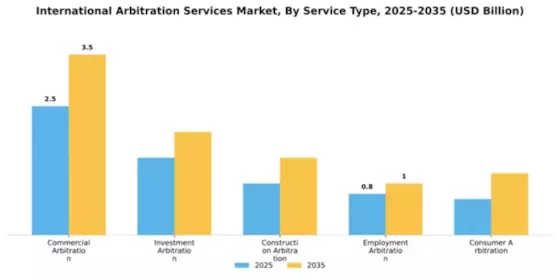
In the International Arbitration Services Market, the distribution of service types reveals that Commercial Arbitration dominates the landscape, appealing to a broad clientele due to its well-established framework and reliability. Meanwhile, Investment Arbitration has emerged as a critical player, catering to disputes arising from international investments and treaties, thereby gaining traction in today’s global economy. The presence of various multinational companies has further fueled its significance in the sector.
Commercial Arbitration (Dominant) vs. Investment Arbitration (Emerging)
Commercial Arbitration remains the dominant service type, characterized by its extensive application in resolving business-related disputes. Its structured processes, including the selection of arbitrators and the administration of hearings, lend it a significant edge in the market. On the other hand, Investment Arbitration is emerging rapidly, primarily driven by the growing number of international investments and the need for a systematic mechanism to resolve disputes. This segment is becoming increasingly relevant as countries seek to protect foreign investments amid political and economic uncertainties, highlighting the importance of attractiveness and stability in international relations.
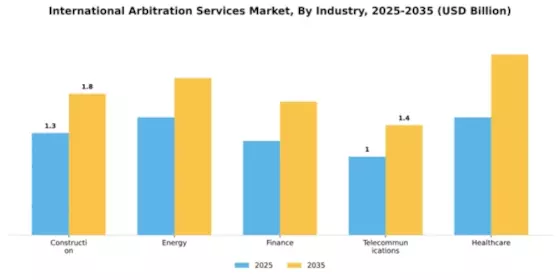
In the International Arbitration Services Market, the industry segment is primarily composed of several key sectors, namely Construction, Energy, Finance, Telecommunications, and Healthcare. Among these, the Construction sector holds the largest market share, driven by the growing number of contractual disputes arising from diverse construction projects globally. Meanwhile, the Energy sector is also gaining traction, capitalizing on rapidly evolving energy regulations and the increasing prevalence of international energy disputes.
Construction: Dominant vs. Energy: Emerging
The Construction sector serves as the dominant player in the International Arbitration Services Market, frequently engaging in arbitration to resolve issues related to project delays, contractual obligations, and quality of materials used. This sector’s complexities and high stakes often necessitate a formal dispute resolution mechanism. Conversely, the Energy sector is emerging rapidly, driven by global innovations in renewable energy and a shift in regulatory frameworks. As international partnerships in the energy arena grow, so does the need for effective arbitration services to navigate the intricate agreements and ensure fair resolution of disputes.
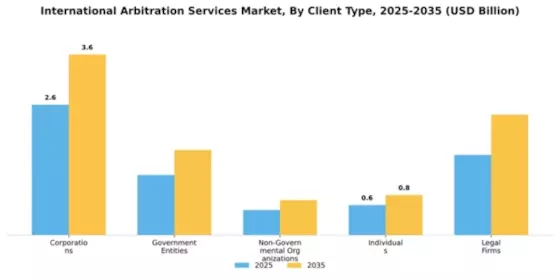
In the International Arbitration Services Market, the client type segmentation reveals a diverse landscape of demand. Corporations represent the largest segment, leveraging arbitration for conflict resolution in international transactions and commercial disputes. Their significant needs for legal expertise in cross-border issues underscore their dominance in the market. Meanwhile, legal firms, which provide specialized arbitration services, are witnessing the fastest growth due to the increasing complexity of disputes and globalization, resulting in a higher demand for skilled arbitration representation.
Corporations: Dominant vs. Legal Firms: Emerging
Corporations dominate the International Arbitration Services Market, utilizing these services for efficient conflict resolution amid global dealings. Their strong market presence stems from the necessity to mitigate risks associated with international contracts and transactions. On the other hand, legal firms are emerging rapidly, driven by an uptick in business disputes and a need for professional arbitration services. Legal firms offer tailored solutions, combining expertise in various jurisdictions to cater to their clients' needs, positioning themselves as indispensable partners for corporations seeking to navigate complex arbitration scenarios.
Get more detailed insights about International Arbitration Services Market Request Free Sample
North America continues to lead the International Arbitration Services Market, holding a significant market share of 3.25 in 2024. The region's growth is driven by a robust legal framework, increasing cross-border trade, and a rising number of complex commercial disputes. Regulatory support and a strong emphasis on alternative dispute resolution mechanisms further catalyze demand for arbitration services. The United States stands out as a key player, hosting major law firms like Baker McKenzie and White & Case. The competitive landscape is characterized by a mix of established firms and emerging players, all vying for a share of the lucrative market. The presence of international arbitration institutions enhances the region's attractiveness, making it a preferred choice for global arbitration cases.
Europe's International Arbitration Services Market is valued at 2.0, reflecting a diverse and evolving landscape. The region benefits from a strong legal tradition and a growing acceptance of arbitration as a preferred dispute resolution method. Regulatory changes aimed at enhancing transparency and efficiency are driving demand, particularly in sectors like finance and construction, where disputes are prevalent. Leading countries such as the UK, Germany, and France are at the forefront, with firms like Hogan Lovells and Freshfields Bruckhaus Deringer playing pivotal roles. The competitive environment is marked by a blend of local and international firms, ensuring a rich array of services. The European market is increasingly seen as a hub for international arbitration, attracting cases from around the globe.
The Asia-Pacific region, with a market size of 1.0, is rapidly emerging as a significant player in the International Arbitration Services Market. The growth is fueled by increasing foreign investments, cross-border trade, and a rising number of commercial disputes. Countries are enhancing their legal frameworks to support arbitration, making it a more attractive option for dispute resolution. Key players in this region include Australia and Singapore, which are becoming preferred venues for arbitration due to their established legal systems and supportive regulatory environments. Firms like King & Spalding and Clifford Chance are expanding their presence, contributing to a competitive landscape that is evolving to meet the needs of international clients. The region's potential for growth is substantial, with increasing recognition of arbitration's benefits.
The Middle East and Africa region, with a market size of 0.25, is in the early stages of developing its International Arbitration Services Market. The growth is driven by increasing foreign investments and a need for effective dispute resolution mechanisms in a rapidly changing economic landscape. Governments are recognizing the importance of arbitration and are implementing regulatory frameworks to support its growth. Countries like the UAE and South Africa are leading the way, with a growing number of arbitration cases being reported. The competitive landscape is characterized by a mix of local and international firms, with players like Norton Rose Fulbright establishing a presence. As the region continues to develop its legal infrastructure, the potential for growth in arbitration services is significant, attracting interest from global players.
The International Arbitration Services Market is characterized by a dynamic competitive landscape, driven by increasing globalization and the need for efficient dispute resolution mechanisms. Major players such as Baker McKenzie (US), Hogan Lovells (GB), and White & Case (US) are strategically positioned to leverage their extensive networks and expertise in various jurisdictions. These firms focus on innovation and digital transformation, enhancing their service offerings to meet the evolving demands of clients. Their collective strategies contribute to a moderately fragmented market, where competition is intensified by the presence of both established firms and emerging players.Key business tactics within this market include localization of services and optimization of operational efficiencies. The competitive structure appears to be moderately fragmented, with a mix of large multinational firms and specialized boutiques. This diversity allows for a range of service offerings, catering to different client needs and preferences. The influence of key players is significant, as they set benchmarks for service quality and operational standards, thereby shaping the overall market dynamics.In November Baker McKenzie (US) announced a strategic partnership with a leading technology firm to enhance its arbitration services through AI-driven analytics. This move is likely to bolster their competitive edge by streamlining case management processes and improving client outcomes. The integration of technology into their service delivery model suggests a forward-thinking approach that aligns with current market trends towards digitalization.In October Hogan Lovells (GB) expanded its international arbitration practice by opening a new office in Singapore, a strategic hub for dispute resolution in Asia. This expansion reflects the firm’s commitment to regional growth and its recognition of the increasing demand for arbitration services in the Asia-Pacific region. Such geographical diversification may enhance their market presence and client accessibility, positioning them favorably against competitors.In September White & Case (US) secured a landmark arbitration victory for a major client in a high-stakes commercial dispute, which not only solidified their reputation but also showcased their expertise in complex arbitration cases. This success is indicative of their strategic focus on high-value disputes, which could attract more clients seeking specialized arbitration services.As of December current competitive trends in the International Arbitration Services Market are increasingly defined by digitalization, sustainability, and the integration of AI technologies. Strategic alliances among firms are shaping the landscape, enabling them to offer more comprehensive and innovative solutions. The shift from price-based competition to a focus on technological advancement and supply chain reliability is evident, suggesting that firms that prioritize innovation and adaptability will likely emerge as leaders in this evolving market.



The International Arbitration Services Market is projected to grow at a 3.21% CAGR from 2025 to 2035, driven by globalization, increasing cross-border disputes, and the need for efficient conflict resolution.
New opportunities lie in:
By 2035, the market is expected to solidify its position as a vital component of global dispute resolution.
| MARKET SIZE 2024 | 6.5(USD Billion) |
| MARKET SIZE 2025 | 6.71(USD Billion) |
| MARKET SIZE 2035 | 9.2(USD Billion) |
| COMPOUND ANNUAL GROWTH RATE (CAGR) | 3.21% (2025 - 2035) |
| REPORT COVERAGE | Revenue Forecast, Competitive Landscape, Growth Factors, and Trends |
| BASE YEAR | 2024 |
| Market Forecast Period | 2025 - 2035 |
| Historical Data | 2019 - 2024 |
| Market Forecast Units | USD Billion |
| Key Companies Profiled | Baker McKenzie (US), Hogan Lovells (GB), White & Case (US), Freshfields Bruckhaus Deringer (GB), Sidley Austin (US), King & Spalding (US), Clifford Chance (GB), Latham & Watkins (US), Norton Rose Fulbright (GB) |
| Segments Covered | Service Type, Industry, Client Type |
| Key Market Opportunities | Integration of artificial intelligence in dispute resolution processes enhances efficiency in the International Arbitration Services Market. |
| Key Market Dynamics | Rising demand for efficient dispute resolution drives innovation and competition in the International Arbitration Services Market. |
| Countries Covered | North America, Europe, APAC, South America, MEA |
The market valuation reached 6.5 USD Billion in 2024.
The market is expected to grow to 9.2 USD Billion by 2035.
The market is projected to experience a CAGR of 3.21% from 2025 to 2035.
Key segments include Commercial Arbitration, Investment Arbitration, Construction Arbitration, Employment Arbitration, and Consumer Arbitration.
In 2024, the valuation of Commercial Arbitration was 2.5 USD Billion.
The Investment Arbitration segment was valued at 1.5 USD Billion in 2024.
Industries such as Construction, Energy, Finance, Telecommunications, and Healthcare are pivotal to market growth.
The Healthcare industry was valued at 1.5 USD Billion in 2024.
Prominent players include Baker McKenzie, Hogan Lovells, White & Case, and Freshfields Bruckhaus Deringer.
Client types include Corporations, Government Entities, Non-Governmental Organizations, Individuals, and Legal Firms.


Kindly complete the form below to receive a free sample of this Report

“This is really good guys. Excellent work on a tight deadline. I will continue to use you going forward and recommend you to others. Nice job”


“Thanks. It’s been a pleasure working with you, please use me as reference with any other Intel employees.”


“Thanks for sending the report it gives us a good global view of the Betaïne market.”


“Thank you, this will be very helpful for OQS.”


“We found the report very insightful! we found your research firm very helpful. I'm sending this email to secure our future business.”


“I am very pleased with how market segments have been defined in a relevant way for my purposes (such as "Portable Freezers & refrigerators" and "last-mile"). In general the report is well structured. Thanks very much for your efforts.”


“I have been reading the first document or the study, ,the Global HVAC and FP market report 2021 till 2026. Must say, good info! I have not gone in depth at all parts, but got a good indication of the data inside!”


“We got the report in time, we really thank you for your support in this process. I also thank to all of your team as they did a great job.”


“The Automotive 48V ECU Components Procurement Intelligence Study” was a complex project, but the Market Research Future (MRFR) team handled it with quality, agility, and customer-centricity. They delivered all requested data on time and within the agreed scope. The team, including Shubhendra Anand and Rahul Gotadki, was always readily available to clarify questions and swiftly implement necessary adjustments, driving the project to a successful conclusion within a very demanding timeframe.
I would also like to specifically commend Akshay Agarwal for his responsiveness and support at every stage—from our initial inquiry on May 6th through to final delivery on June 18th. His dedication made the entire process seamless.”



