Download Free Sample
Kindly complete the form below to receive a free sample of this Report
International Trade and Customs Law Consulting Market Research Report By Industry (Manufacturing, Retail, Pharmaceuticals, Technology, Agriculture), By Client Type (Corporations, Small and Medium Enterprises, Government Agencies, Non-Governmental Organizations, Trade Associations), By Service Type (Advisory Services, Compliance Services, Litigation Support, Training and Education, Risk Management), By Consulting Approach (Strategic Consulting, Operational Consulting, Regulatory Consulting, Transactional Consulting, Crisis Management) And By Region (North America, Europe, Asia-Pacific, And Rest Of The World) – Market Forecast Till 2035.
As per MRFR analysis, the International Trade and Customs Law Consulting Market was estimated at 5.2 USD Billion in 2024. The International Trade and Customs Law Consulting industry is projected to grow from 5.45 USD Billion in 2025 to 8.7 USD Billion by 2035, exhibiting a compound annual growth rate (CAGR) of 4.79% during the forecast period 2025 - 2035.
The International Trade and Customs Law Consulting Market is experiencing a dynamic evolution driven by regulatory complexities and technological advancements.
| 2024 Market Size | 5.2 (USD Billion) |
| 2035 Market Size | 8.7 (USD Billion) |
| CAGR (2025 - 2035) | 4.79% |
Baker McKenzie (US), Deloitte (GB), PwC (GB), KPMG (GB), Ernst & Young (GB), Fragomen (US), Morrison Foerster (US), Hogan Lovells (GB), Squire Patton Boggs (US)
Our Impact
Enabled $4.3B Revenue Impact for Fortune 500 and Leading Multinationals
Partnering with 2000+ Global Organizations Each Year
30K+ Citations by Top-Tier Firms in the Industry
The International Trade and Customs Law Consulting Market is currently experiencing a dynamic evolution, driven by the increasing complexity of global trade regulations and the need for businesses to navigate these challenges effectively. As international trade continues to expand, companies are seeking expert guidance to ensure compliance with diverse customs laws and trade agreements. This market appears to be characterized by a growing demand for specialized consulting services that can address the intricacies of cross-border transactions, tariff classifications, and trade compliance. Furthermore, the rise of e-commerce and digital trade is reshaping the landscape, prompting firms to adapt their strategies to meet new regulatory requirements. In addition, the International Trade and Customs Law Consulting Market is likely to witness a surge in the adoption of technology-driven solutions. Firms are increasingly leveraging data analytics and artificial intelligence to enhance their consulting capabilities, streamline processes, and improve decision-making. This trend suggests a shift towards more efficient and effective consulting practices, as businesses seek to optimize their operations in a competitive global environment. Overall, the market appears poised for growth, with opportunities for firms that can provide innovative solutions and expert insights into the evolving trade landscape.
The International Trade and Customs Law Consulting Market is witnessing a rise in regulatory complexity as countries implement more stringent trade policies. This trend necessitates that businesses seek expert advice to navigate the intricate web of customs regulations and compliance requirements. As trade agreements evolve, firms must stay informed about changes that could impact their operations.
There is a notable shift towards the integration of technology within the International Trade and Customs Law Consulting Market. Firms are increasingly utilizing advanced tools such as data analytics and artificial intelligence to enhance their consulting services. This technological adoption allows for improved efficiency and accuracy in compliance processes, enabling businesses to respond swiftly to regulatory changes.
The International Trade and Customs Law Consulting Market is also seeing a growing emphasis on sustainability in trade practices. Companies are increasingly aware of the environmental impact of their operations and are seeking guidance on how to align their trade activities with sustainable practices. This trend indicates a shift towards responsible trade, where compliance with environmental regulations becomes a priority.
The International Trade and Customs Law Consulting Market is experiencing a notable shift due to the emergence of new trade agreements. These agreements, which often involve complex legal frameworks, necessitate expert consultation to navigate the intricacies of compliance and enforcement. For instance, the recent trade agreements between various nations have introduced new tariffs and regulations that require businesses to adapt swiftly. As companies seek to capitalize on these agreements, the demand for specialized consulting services is likely to increase. This trend indicates a growing need for legal expertise in international trade, as firms aim to mitigate risks associated with non-compliance and optimize their operations within the new regulatory landscape.
The International Trade and Customs Law Consulting Market is increasingly shaped by the need for global supply chain resilience. Recent disruptions have prompted businesses to reassess their supply chain strategies, leading to a greater emphasis on legal compliance and risk management. Companies are now more aware of the potential legal implications of supply chain disruptions, which has resulted in a surge in demand for consulting services. Legal experts play a crucial role in helping businesses navigate the complexities of international trade laws and customs regulations. This focus on resilience is expected to drive growth in the consulting market as firms seek to fortify their operations against future disruptions.
The International Trade and Customs Law Consulting Market is witnessing a transformative phase driven by digitalization. The integration of technology into trade processes has led to increased efficiency and transparency, but it also presents new legal challenges. As businesses adopt digital platforms for trade transactions, they encounter issues related to data privacy, cybersecurity, and intellectual property rights. Consequently, there is a rising demand for legal consultants who can provide guidance on these emerging issues. The market is likely to expand as firms seek to leverage technology while ensuring compliance with international trade laws. This digital transformation highlights the evolving nature of legal consulting in the context of international trade.
In the current landscape, the International Trade and Customs Law Consulting Market is significantly influenced by heightened compliance requirements. Governments are increasingly implementing stringent regulations to ensure that businesses adhere to international standards. This trend is particularly evident in sectors such as pharmaceuticals and technology, where compliance with customs laws is critical. As a result, companies are compelled to seek the assistance of legal consultants to navigate these complex regulations. The market for consulting services is projected to grow as businesses prioritize compliance to avoid penalties and maintain their competitive edge. This heightened focus on compliance underscores the essential role of legal expertise in international trade.
The International Trade and Customs Law Consulting Market is benefiting from the rise of emerging markets, which present new trade opportunities. As countries in Asia, Africa, and Latin America continue to develop economically, they are becoming increasingly attractive for international trade. This shift creates a demand for legal consulting services to help businesses understand the regulatory environments in these regions. Companies looking to expand into emerging markets require expert guidance on customs laws, tariffs, and trade agreements. The potential for growth in these markets is likely to drive the demand for consulting services, as businesses seek to navigate the complexities of international trade in diverse regulatory landscapes.
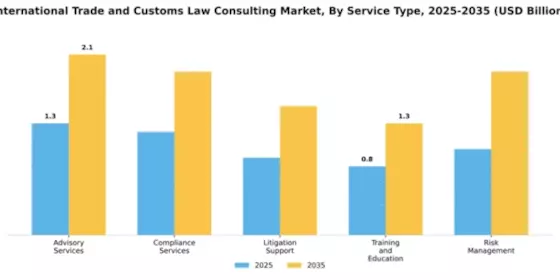
In the International Trade and Customs Law Consulting Market, market share is significantly skewed towards Advisory Services, which holds the largest share due to its critical role in guiding businesses through complex international trade regulations. Compliance Services follow closely behind, representing a growing focus among companies striving to meet regulatory standards efficiently. Both services are evolving to cater to a diverse clientele across various sectors, reflecting their importance in global trade operations. The growth trends indicate that Compliance Services are rapidly gaining traction, largely driven by increasing international trade activities and stringent regulatory environments. The demand for efficient compliance solutions is on the rise, as companies face heightened scrutiny concerning their international operations. Meanwhile, Advisory Services continue to thrive, as firms increasingly seek expert guidance to navigate the complexities of trade regulations, enhancing the overall market dynamics.
Advisory Services (Dominant) vs. Risk Management (Emerging)
Advisory Services remain the dominant force in the International Trade and Customs Law Consulting Market, characterized by a comprehensive approach to providing expert guidance on trade regulations, customs procedures, and international agreements. These services are essential for businesses looking to optimize their operations in the face of complex legal frameworks. In contrast, Risk Management is emerging as a crucial component of the market as firms become more aware of the vulnerabilities associated with global trade. This segment focuses on assessing and mitigating potential risks related to compliance and operational challenges in international markets. Together, these services reflect the evolving landscape of trade law consulting, where informed decision-making and proactive risk management are vital for success.
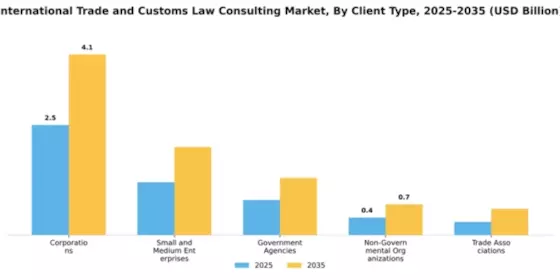
In the International Trade and Customs Law Consulting Market, corporations hold the largest share among client types, leveraging substantial resources for compliance and strategic consulting. Their complex operations and global presence necessitate specialized legal guidance in navigating international regulations. Conversely, small and medium enterprises (SMEs) are increasingly engaging consulting services to streamline trade processes and comply with customs regulations. This trend reflects their growing recognition of the importance of legal expertise in enhancing competitiveness in the global market. The growth of SMEs in this sector is driven by increased globalization and trade liberalization, which present both challenges and opportunities for smaller businesses. These entities are rapidly adopting consulting services to ensure compliance and maintain competitive advantage. Furthermore, the rise of digital trade and e-commerce is prompting SMEs to seek legal assistance, contributing to their position as the fastest-growing client segment in the market.
Corporations: Dominant vs. Non-Governmental Organizations: Emerging
Corporations dominate the International Trade and Customs Law Consulting Market due to their extensive legal needs arising from cross-border operations. They typically engage high-end consulting services, valuing bespoke legal strategies that cater to large-scale compliance, risk management, and negotiation needs. Meanwhile, non-governmental organizations (NGOs) are emerging as significant players, driven by their focus on advocacy and humanitarian efforts in international trade. While they may not require the same extensive legal services as corporations, NGOs seek consultancy support in addressing regulatory challenges and promoting compliance in their operations. This duality highlights the contrasting yet interconnected roles of corporations and NGOs within the market, with the former focusing on large-scale legal strategies and the latter on navigating complex regulations for social impact.
In the International Trade and Customs Law Consulting Market, the manufacturing sector accounts for the largest share due to its extensive cross-border operations and complex regulatory requirements. This segment encompasses various industries that heavily rely on customs and trade regulations, making legal consulting indispensable for compliance and efficiency. Retail, agriculture, and pharmaceuticals also contribute significantly but on a smaller scale compared to manufacturing. The growth trends within the market are being driven by several factors, including the increase in globalization and international trade, which require robust customs law consultation. The fastest growth is observed in the technology sector, fueled by rapid advancements and innovations that necessitate specialized legal insights for navigating international regulations. Moreover, digitalization and e-commerce are reshaping traditional trade dynamics, contributing to heightened demand for consulting services in this area.
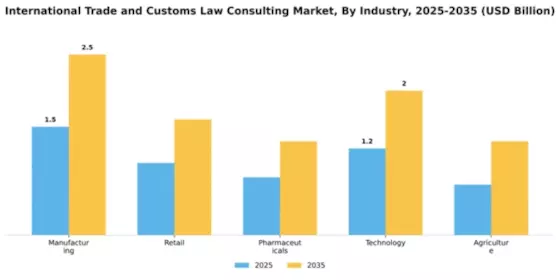
Manufacturing: Established (Dominant) vs. Technology (Emerging)
The manufacturing sector is established and dominant in the International Trade and Customs Law Consulting Market, characterized by its need for precise legal guidance on international compliance and trade agreements. Its extensive supply chains and cross-border logistics ensure a steady demand for consulting services, particularly in tariff classification and customs valuation. On the other hand, the technology sector is emerging as a significant player, driven by innovations and the unique challenges they present in trade regulations. The rapid growth of technology firms that engage in international operations necessitates specialized knowledge regarding intellectual property rights and data protection laws. Both segments illustrate the diverse needs within the consulting market, where established practices meet the evolving demands of emerging industries.
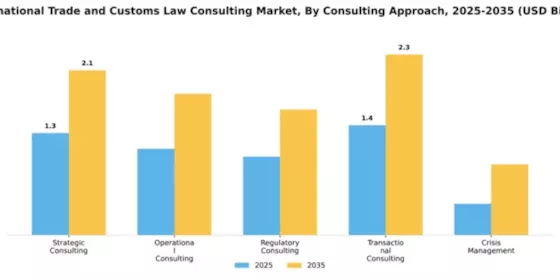
In the International Trade and Customs Law Consulting Market, segment values such as Strategic Consulting, Operational Consulting, Regulatory Consulting, Transactional Consulting, and Crisis Management exhibit distinct market shares. Strategic Consulting emerges as the largest segment, catering to businesses seeking long-term strategic alignment with trade regulations. Crisis Management, on the other hand, is rapidly gaining traction in response to increasing global trade uncertainties, demonstrating its vital role in aiding organizations to manage unexpected disruptions effectively.
Strategic Consulting (Dominant) vs. Crisis Management (Emerging)
Strategic Consulting plays a dominant role in the International Trade and Customs Law Consulting Market, offering organizations a comprehensive approach to align their operational goals with international trade regulations. It focuses on long-term trade strategy, compliance frameworks, and risk management, positioning itself as a trusted advisor for businesses. In sharp contrast, Crisis Management has emerged as a vital segment, particularly in today's volatile economic landscape, where organizations face unprecedented challenges. This segment provides essential support in navigating regulatory emergencies, fostering resilience, and ensuring compliance during crises. As companies prioritize adaptability in their international operations, Crisis Management is poised for significant growth.
Get more detailed insights about International Trade and Customs Law Consulting Market Request Free Sample
North America continues to lead the International Trade and Customs Law Consulting Market, holding a significant market share of 2.6 in 2024. The region's growth is driven by robust regulatory frameworks, increasing cross-border trade, and a rising demand for compliance with international trade laws. The presence of major consulting firms and a strong legal infrastructure further catalyze market expansion. The United States stands out as the primary player, with key firms like Baker McKenzie and Fragomen leading the charge. The competitive landscape is characterized by a mix of established players and emerging firms, all vying for a share of the lucrative market. The region's focus on innovation and technology in legal services enhances its attractiveness, ensuring continued growth in the coming years.
Europe's International Trade and Customs Law Consulting Market is valued at 1.5, reflecting a growing demand for legal expertise in navigating complex trade regulations. The region is experiencing a surge in consulting needs due to evolving trade agreements and compliance requirements. Regulatory catalysts, such as the EU's trade policies, are driving firms to seek specialized legal advice to mitigate risks associated with international trade. Leading countries like Germany, France, and the UK are at the forefront of this market, with firms such as Deloitte and PwC playing pivotal roles. The competitive landscape is marked by a blend of local and international firms, all adapting to the dynamic regulatory environment. The presence of key players ensures a robust consulting ecosystem, catering to diverse client needs across various sectors.
The Asia-Pacific region, with a market size of 0.9, is witnessing a burgeoning demand for International Trade and Customs Law Consulting services. This growth is fueled by increasing trade activities, foreign investments, and the need for compliance with international regulations. Countries in this region are actively enhancing their trade frameworks, creating opportunities for consulting firms to offer specialized services. China, Japan, and Australia are leading the charge, with a mix of local and international firms establishing a presence. The competitive landscape is evolving, with key players like KPMG and Ernst & Young expanding their services to cater to the growing market. As trade dynamics shift, the region is poised for significant growth in consulting services, driven by regulatory changes and economic development.
The Middle East and Africa region, with a market size of 0.2, presents untapped opportunities in the International Trade and Customs Law Consulting Market. The growth is driven by increasing trade activities, economic diversification efforts, and a rising need for compliance with international trade regulations. Governments in the region are actively working to enhance trade frameworks, which is expected to boost demand for consulting services. Countries like South Africa and the UAE are emerging as key players in this market, with a growing number of consulting firms establishing operations. The competitive landscape is still developing, with both local and international firms vying for market share. As the region continues to evolve, the demand for specialized legal consulting services is anticipated to rise significantly, driven by regulatory changes and economic growth.
The International Trade and Customs Law Consulting Market is characterized by a dynamic competitive landscape, driven by globalization, regulatory complexities, and the increasing need for compliance among businesses. Key players such as Baker McKenzie (US), Deloitte (GB), and PwC (GB) are strategically positioned to leverage their extensive networks and expertise in navigating international trade regulations. These firms focus on innovation and digital transformation, enhancing their service offerings through technology-driven solutions. Their collective strategies not only shape the competitive environment but also set benchmarks for operational excellence in the market.In terms of business tactics, firms are increasingly localizing their services to better cater to regional compliance requirements and optimize supply chains. The market appears moderately fragmented, with a mix of large multinational firms and specialized consultancies. The influence of key players is substantial, as they often dictate best practices and compliance standards that smaller firms may follow, thereby reinforcing their market positions.In November Baker McKenzie (US) announced a strategic partnership with a leading technology firm to develop an AI-driven compliance tool aimed at streamlining customs processes for clients. This move is significant as it not only enhances Baker McKenzie’s service capabilities but also positions the firm at the forefront of technological innovation in the consulting space, potentially attracting a broader client base seeking efficiency in compliance.Similarly, in October 2025, Deloitte (GB) expanded its global footprint by acquiring a boutique consulting firm specializing in trade compliance in Asia. This acquisition is indicative of Deloitte's strategy to bolster its regional expertise and enhance its service offerings in a rapidly evolving market. By integrating local knowledge with its global resources, Deloitte aims to provide more tailored solutions to clients navigating complex trade regulations.Moreover, in September 2025, PwC (GB) launched a new initiative focused on sustainability in supply chains, emphasizing the importance of ethical sourcing and compliance with environmental regulations. This initiative reflects a growing trend among consulting firms to align their services with sustainability goals, thereby appealing to clients who prioritize corporate social responsibility in their operations.As of December the competitive trends in the International Trade and Customs Law Consulting Market are increasingly defined by digitalization, sustainability, and the integration of AI technologies. Strategic alliances are becoming more prevalent, as firms recognize the value of collaboration in enhancing service delivery and expanding market reach. Looking ahead, competitive differentiation is likely to evolve from traditional price-based competition to a focus on innovation, technological advancements, and the reliability of supply chains. Firms that can effectively leverage these trends will likely secure a competitive edge in this complex and rapidly changing market.




The International Trade and Customs Law Consulting Market is projected to grow at a 4.79% CAGR from 2025 to 2035, driven by globalization, regulatory changes, and technological advancements.
New opportunities lie in:
By 2035, the market is expected to be robust, reflecting increased demand for specialized consulting services.
| MARKET SIZE 2024 | 5.2(USD Billion) |
| MARKET SIZE 2025 | 5.45(USD Billion) |
| MARKET SIZE 2035 | 8.7(USD Billion) |
| COMPOUND ANNUAL GROWTH RATE (CAGR) | 4.79% (2025 - 2035) |
| REPORT COVERAGE | Revenue Forecast, Competitive Landscape, Growth Factors, and Trends |
| BASE YEAR | 2024 |
| Market Forecast Period | 2025 - 2035 |
| Historical Data | 2019 - 2024 |
| Market Forecast Units | USD Billion |
| Key Companies Profiled | Baker McKenzie (US), Deloitte (GB), PwC (GB), KPMG (GB), Ernst & Young (GB), Fragomen (US), Morrison Foerster (US), Hogan Lovells (GB), Squire Patton Boggs (US) |
| Segments Covered | Service Type, Client Type, Industry, Consulting Approach |
| Key Market Opportunities | Increasing demand for compliance with evolving international trade regulations creates opportunities in the International Trade and Customs Law Consulting Market. |
| Key Market Dynamics | Evolving regulatory frameworks and technological advancements reshape competitive dynamics in the International Trade and Customs Law Consulting Market. |
| Countries Covered | North America, Europe, APAC, South America, MEA |
The projected market valuation for the International Trade and Customs Law Consulting Market in 2035 is 8.7 USD Billion.
The overall market valuation of the International Trade and Customs Law Consulting Market was 5.2 USD Billion in 2024.
The expected CAGR for the International Trade and Customs Law Consulting Market during the forecast period 2025 - 2035 is 4.79%.
The Advisory Services segment is projected to grow from 1.3 USD Billion in 2024 to 2.1 USD Billion by 2035.
Corporations are expected to contribute 4.1 USD Billion to the market by 2035, up from 2.5 USD Billion in 2024.
Compliance Services is anticipated to grow from 1.2 USD Billion in 2024 to 1.9 USD Billion by 2035.
The Manufacturing industry segment is expected to grow from 1.5 USD Billion in 2024 to 2.5 USD Billion by 2035.
Key players such as Baker McKenzie and Deloitte are instrumental in shaping the market landscape through their extensive consulting services.
The Training and Education services segment is projected to increase from 0.8 USD Billion in 2024 to 1.3 USD Billion by 2035.
The Risk Management services segment is expected to evolve from 1.0 USD Billion in 2024 to 1.9 USD Billion by 2035.


Kindly complete the form below to receive a free sample of this Report

“This is really good guys. Excellent work on a tight deadline. I will continue to use you going forward and recommend you to others. Nice job”


“Thanks. It’s been a pleasure working with you, please use me as reference with any other Intel employees.”


“Thanks for sending the report it gives us a good global view of the Betaïne market.”


“Thank you, this will be very helpful for OQS.”


“We found the report very insightful! we found your research firm very helpful. I'm sending this email to secure our future business.”


“I am very pleased with how market segments have been defined in a relevant way for my purposes (such as "Portable Freezers & refrigerators" and "last-mile"). In general the report is well structured. Thanks very much for your efforts.”


“I have been reading the first document or the study, ,the Global HVAC and FP market report 2021 till 2026. Must say, good info! I have not gone in depth at all parts, but got a good indication of the data inside!”


“We got the report in time, we really thank you for your support in this process. I also thank to all of your team as they did a great job.”


“The Automotive 48V ECU Components Procurement Intelligence Study” was a complex project, but the Market Research Future (MRFR) team handled it with quality, agility, and customer-centricity. They delivered all requested data on time and within the agreed scope. The team, including Shubhendra Anand and Rahul Gotadki, was always readily available to clarify questions and swiftly implement necessary adjustments, driving the project to a successful conclusion within a very demanding timeframe.
I would also like to specifically commend Akshay Agarwal for his responsiveness and support at every stage—from our initial inquiry on May 6th through to final delivery on June 18th. His dedication made the entire process seamless.”



