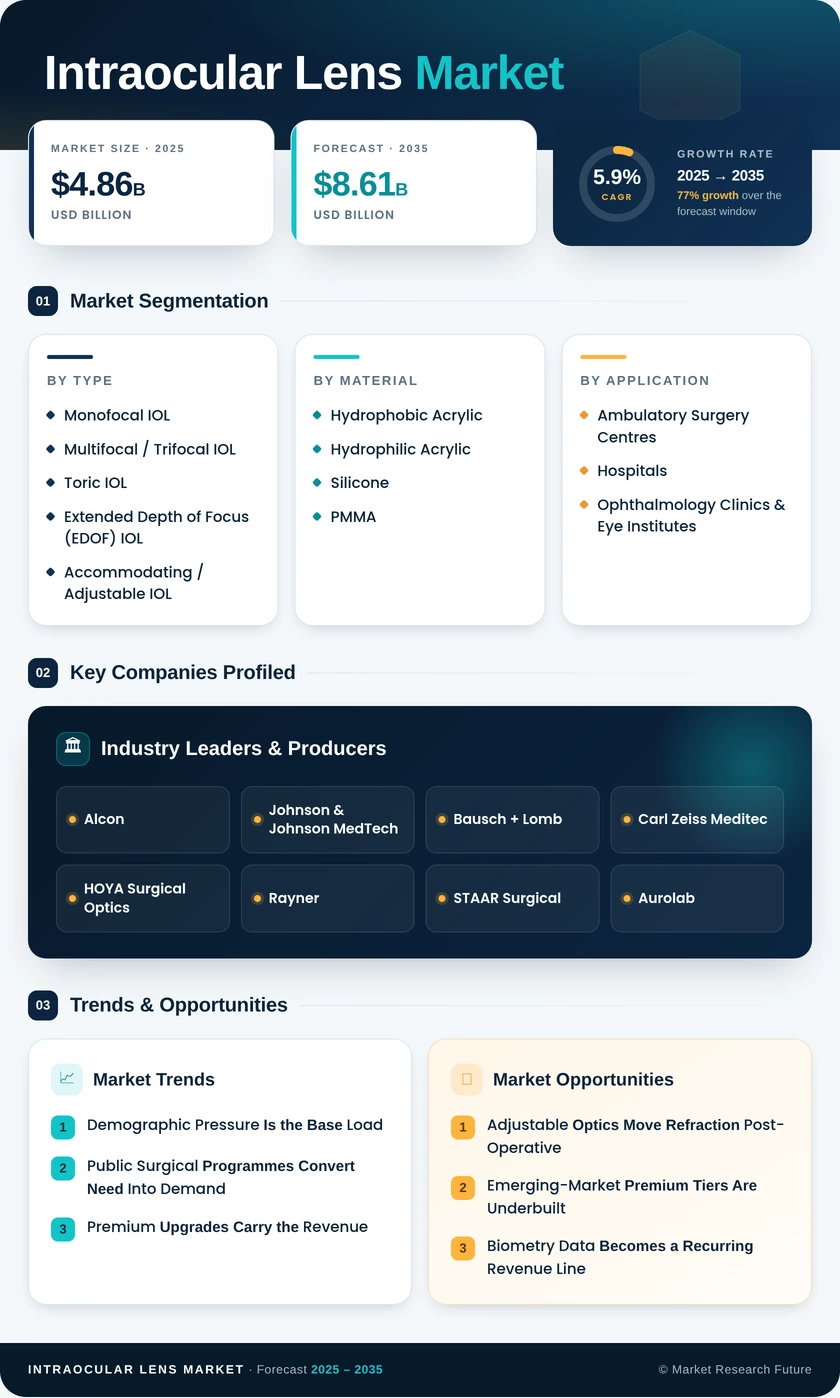
Segmentation Quick Reference
| Dimension | Sub-Segments | Dominant Segment | Fastest Growing Segment |
| By Lens Type | Monofocal IOL; Multifocal / Trifocal IOL; Toric IOL; Extended Depth of Focus (EDOF) IOL; Accommodating / Adjustable IOL; Phakic IOL | Monofocal IOL | Extended Depth of Focus (EDOF) IOL |
| By Material | Hydrophobic Acrylic; Hydrophilic Acrylic; Silicone; PMMA | Hydrophobic Acrylic | Hydrophobic Acrylic |
| By End User | Ambulatory Surgery Centres; Hospitals; Ophthalmology Clinics & Eye Institutes | Ambulatory Surgery Centres | Ophthalmology Clinics & Eye Institutes |
| By Region | North America; Europe; Asia-Pacific; South America; Middle East & Africa | North America | Asia-Pacific |
Market Segmentation Overview
By Lens Type
| Sub-Segment | Key Trend |
| Monofocal IOL | Volume backbone of public tenders; revenue share eroding as mix upgrades |
| Multifocal / Trifocal IOL | Diffractive optimisation reducing halo complaints and widening candidacy. |
| Toric IOL | Improved rotational stability and keratometry accuracy lifting attach rates. |
| Extended Depth of Focus (EDOF) IOL | Fastest-growing optic class; favoured for night-driving and borderline ocular surface |
| Accommodating / Adjustable IOL | Post-implantation refractive tuning creating a distinct premium tier. |
| Phakic IOL | High-myopia refractive correction expanding outside cataract populations |
Lens type is where clinical preference and reimbursement policy collide. Public systems fund the monofocal baseline; everything above it depends on patient willingness to pay or supplementary insurance design, which is why premium penetration varies more by country than by surgeon skill.
By Material
| Sub-Segment | Key Trend |
| Hydrophobic Acrylic | Glistening-free chemistries and sharp posterior edges driving preference |
| Hydrophilic Acrylic | Cost advantage sustaining tender share despite opacification concerns. |
| Silicone | Legacy positions declining steadily across all regions. |
| PMMA | Retained for outreach surgery, paediatric cases and manual small-incision techniques |
Material selection increasingly follows opacification evidence rather than handling preference. Long-term capsulotomy data now carries real procurement weight in systems that measure downstream costs.
By End User
| Sub-Segment | Key Trend |
| Ambulatory Surgery Centres | Throughput economics and physician ownership accelerating premium adoption |
| Hospitals | Committee-driven procurement anchored to price and complex-case capability. |
| Ophthalmology Clinics & Eye Institutes | Self-generated refractive demand producing the fastest channel growth |
Site of care predicts implant mix better than patient demographics. Where the decision-maker shares in per-case economics, premium conversion runs materially higher.