Download Free Sample
Kindly complete the form below to receive a free sample of this Report
Investment Portfolio Management Services Market Research Report By Asset Class (Equities, Fixed Income, Real Estate, Commodities, Alternative Investments), By Client Type (High Net Worth Individuals, Institutional Investors, Retail Investors, Family Offices, Corporations), By Service Type (Discretionary Management, Advisory Services, Robo-Advisory, Wealth Management, Portfolio Analysis), By Investment Horizon (Short Term, Medium Term, Long Term, Lifetime, Retirement), By Investment Strategy (Active Management, Passive Management, Growth Investing, Value Investing, Income Investing) And By Region (North America, Europe, Asia-Pacific, And Rest Of The World) – Market Forecast Till 2035.
As per MRFR analysis, the Investment Portfolio Management Services Market was estimated at 550.0 USD Billion in 2024. The Investment Portfolio Management Services industry is projected to grow from 572.22 USD Billion in 2025 to 850.0 USD Billion by 2035, exhibiting a compound annual growth rate (CAGR) of 4.04% during the forecast period 2025 - 2035.
The Investment Portfolio Management Services Market is experiencing a transformative shift towards personalized and technology-driven solutions.
| 2024 Market Size | 550.0 (USD Billion) |
| 2035 Market Size | 850.0 (USD Billion) |
| CAGR (2025 - 2035) | 4.04% |
BlackRock (US), Vanguard Group (US), Fidelity Investments (US), State Street Global Advisors (US), J.P. Morgan Asset Management (US), BNY Mellon Investment Management (US), Charles Schwab Investment Management (US), Amundi (FR), Deutsche Bank Wealth Management (DE), UBS Asset Management (CH)
Our Impact
Enabled $4.3B Revenue Impact for Fortune 500 and Leading Multinationals
Partnering with 2000+ Global Organizations Each Year
30K+ Citations by Top-Tier Firms in the Industry
The Investment Portfolio Management Services Market is currently experiencing a dynamic evolution, driven by various factors that shape investor behavior and preferences. As individuals and institutions seek to optimize their financial outcomes, the demand for tailored portfolio management solutions appears to be on the rise. This market encompasses a wide array of services, including asset allocation, risk management, and performance analysis, which are increasingly being customized to meet the unique needs of clients. Furthermore, advancements in technology, particularly in data analytics and artificial intelligence, seem to enhance the capabilities of portfolio managers, allowing for more informed decision-making and improved client engagement. In addition, the growing awareness of sustainable investing practices is influencing the Investment Portfolio Management Services Market. Investors are increasingly prioritizing environmental, social, and governance (ESG) factors in their investment strategies, which may lead to a shift in how portfolios are constructed and managed. This trend suggests that portfolio managers must adapt to changing client expectations and incorporate ESG considerations into their offerings. Overall, the Investment Portfolio Management Services Market is poised for continued growth, as it navigates the complexities of evolving investor demands and technological advancements.
The Investment Portfolio Management Services Market is witnessing a notable shift towards personalized investment strategies. Clients are increasingly seeking customized solutions that align with their individual financial goals and risk tolerance. This trend indicates a departure from one-size-fits-all approaches, as portfolio managers strive to deliver tailored services that cater to diverse client needs.
The integration of advanced technology is transforming the Investment Portfolio Management Services Market. Tools such as artificial intelligence and machine learning are being utilized to enhance data analysis and improve investment decision-making processes. This technological evolution suggests that portfolio managers can offer more precise insights and optimize performance through innovative solutions.
There is a growing emphasis on sustainable investing within the Investment Portfolio Management Services Market. Investors are increasingly considering environmental, social, and governance (ESG) factors when making investment decisions. This trend indicates a shift towards responsible investing, compelling portfolio managers to incorporate ESG criteria into their strategies to meet client expectations.
The Investment Portfolio Management Services Market is increasingly emphasizing risk management and resilience in investment strategies. As market volatility becomes more pronounced, investors are prioritizing the protection of their capital. This shift has led to a greater demand for portfolio management services that incorporate robust risk assessment and mitigation strategies. Firms that can demonstrate their ability to navigate uncertain market conditions are likely to attract clients seeking stability. Furthermore, the integration of risk management tools and methodologies into investment processes is expected to enhance the overall appeal of portfolio management services, driving growth in the industry.
The Investment Portfolio Management Services Market is experiencing a shift towards alternative investments, which are gaining traction among investors seeking diversification and higher returns. Asset classes such as private equity, hedge funds, and real estate are becoming more appealing as traditional investment avenues face volatility. This trend is supported by data indicating that alternative investments have outperformed traditional assets in recent years. As investors become more sophisticated, they are likely to seek portfolio management services that can effectively incorporate these alternatives into their strategies. Consequently, firms that adapt to this growing interest may find new opportunities for growth and client acquisition.
The Investment Portfolio Management Services Market is significantly influenced by evolving regulatory frameworks and compliance requirements. Governments and regulatory bodies are implementing stricter guidelines to enhance transparency and protect investors. This shift necessitates that portfolio management firms adapt their strategies to ensure compliance, which may involve investing in advanced compliance technologies and training. As a result, firms that proactively embrace these changes are likely to gain a competitive edge. The market is projected to grow as firms that effectively navigate regulatory landscapes can attract more clients seeking assurance in their investment management practices.
The Investment Portfolio Management Services Market is experiencing a notable surge in demand for wealth management services. As individuals and institutions seek to optimize their investment returns, the need for professional portfolio management has intensified. According to recent data, the assets under management in the wealth management sector have reached unprecedented levels, indicating a growing reliance on expert guidance. This trend is driven by a combination of factors, including rising disposable incomes, an expanding affluent population, and a heightened awareness of investment opportunities. Consequently, firms offering investment portfolio management services are likely to benefit from this increasing demand, as clients prioritize tailored strategies to achieve their financial goals.
The Investment Portfolio Management Services Market is witnessing a transformative phase due to rapid technological advancements. Innovations such as artificial intelligence, machine learning, and big data analytics are reshaping how investment portfolios are managed. These technologies enable firms to analyze vast amounts of data, identify trends, and make informed investment decisions with greater precision. As a result, firms that leverage these technologies can enhance their service offerings, improve client engagement, and optimize portfolio performance. The integration of technology is expected to drive growth in the market, as clients increasingly seek firms that utilize cutting-edge tools to manage their investments.
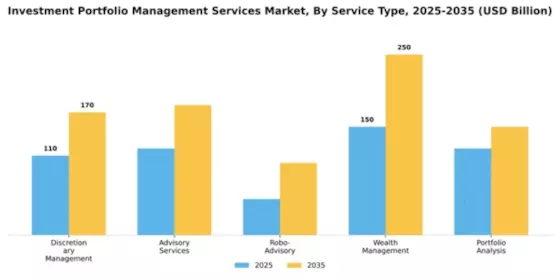
In the Investment Portfolio Management Services Market, the service type segment is diverse and dynamic, consisting of Discretionary Management, Advisory Services, Robo-Advisory, Wealth Management, and Portfolio Analysis. Discretionary Management retains the largest share, appealing to high-net-worth individuals seeking personalized asset management. Meanwhile, Robo-Advisory has captured the attention of younger investors and tech-savvy clients, thus emerging as a rapidly growing alternative in recent years. The growth of the Investment Portfolio Management Services segment is largely driven by the increasing demand for personalized investments and comprehensive wealth management solutions. Factors such as rising disposable incomes and the growing awareness of investment opportunities are leading clients to seek professional management services. The advent of technology, particularly in Robo-Advisory, illustrates how digital services are reshaping client investment behavior and preferences.
Discretionary Management (Dominant) vs. Robo-Advisory (Emerging)
Discretionary Management is characterized by personalized investment strategies tailored for individual clients, making it the dominant service type in portfolio management. This approach is often favored by clients with significant assets seeking hands-off investment solutions. In contrast, Robo-Advisory represents an emerging segment leveraging automated platforms to provide cost-effective investment management. As technology continues to evolve, Robo-Advisory services appeal to a broader demographic, particularly younger investors who prioritize accessibility and transparency. Both service types serve distinct client needs, with Discretionary Management offering personalized expertise while Robo-Advisory democratizes financial advice through digital platforms.
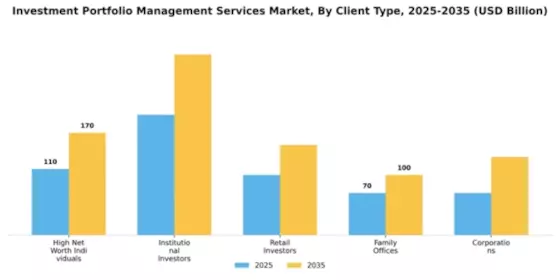
In the Investment Portfolio Management Services Market, the distribution of client types reveals a significant prevalence of High Net Worth Individuals (HNWIs), who hold the largest market share due to their substantial assets and bespoke service needs. Institutional Investors closely follow, utilizing specialized services to manage large capital in pursuit of optimal returns. Family Offices and Corporations also play vital roles, albeit with smaller shares, while Retail Investors represent an essential recovery phase in investment management as technology continues to democratize access to investment services. Growth trends indicate a dynamic shift towards Institutional Investors, which are emerging as the fastest-growing client type in the market. This surge is driven by increasing institutional allocations to alternative assets and a growing emphasis on holistic portfolio strategies. High Net Worth Individuals continue to expand their influence, leveraging personalized management services to navigate complex financial landscapes. Additionally, Family Offices are becoming increasingly involved as they seek tailored investment strategies, presenting opportunities for more innovative service offerings in a competitive market environment.
High Net Worth Individuals: Dominant vs. Retail Investors: Emerging
High Net Worth Individuals (HNWIs) maintain a dominant position in the Investment Portfolio Management Services Market due to their significant financial assets and demand for customized investment strategies. Their requirement for personalized wealth management and estate planning services have led firms to develop bespoke solutions, including tax mitigation strategies and philanthropic advisory. In contrast, Retail Investors, categorized as the emerging segment, are gaining traction as technology-driven platforms become prevalent, enabling easier access to investment opportunities. The growth of robo-advisors and lower barriers to entry is attracting a new generation of Retail Investors. However, they generally require a different approach compared to HNWIs, focusing more on cost-effective, standardized solutions while still seeking growth and stability in their investment portfolios.
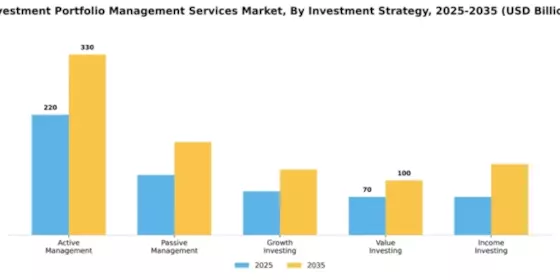
The Investment Portfolio Management Services Market demonstrates a diverse distribution of investment strategies, notably showcasing Active Management as the largest segment. Active Management allows investors to leverage market inefficiencies, thereby enhancing potential returns and attracting significant attention in the market. Conversely, Passive Management, characterized by its low-cost and lower risk strategy of replicating market indices, is rapidly growing. This shift toward a more cost-efficient approach indicates a changing investor mindset towards maximizing returns with reduced expenses. Growth trends in this segment are influenced by an increasing demand for personalized investment strategies and the rising interest in financial literacy among investors. As individuals seek more control over their portfolios, Active Management benefits from a persistent appetite for tailored advice and hands-on portfolio management. On the other hand, Passive Management is thriving as technological advancements streamline investment processes. These factors contribute to a dynamic landscape where both strategies coexist, catering to diverse investor preferences.
Active Management: Dominant vs. Passive Management: Emerging
Active Management continues to dominate the Investment Portfolio Management Services Market by providing investors with tailored strategies that aim to outperform market benchmarks. This strategy thrives on expert analysis and decision-making, often leading to higher returns than passive counterparts. Investors favor Active Management for its adaptability to market conditions and the potential for alpha generation. In contrast, Passive Management, labeled as the emerging strategy, is gaining traction due to its cost-effectiveness and straightforward approach. Investors are increasingly opting for index funds and ETFs as they recognize the benefits of low fees and simplicity. This segment is appealing to those seeking long-term growth without the complexities of active trading, thus solidifying its position as a significant player in the market.
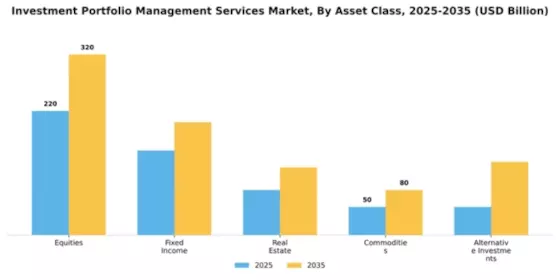
In the Investment Portfolio Management Services Market, the asset class distribution is predominantly influenced by equities, which hold the largest market share. Investors are increasingly leaning towards equities due to their potential for higher returns compared to other asset classes. Following equities, fixed income investments and real estate also represent significant portions of the market, appealing to risk-averse investors seeking stable returns. Commodities and alternative investments, while smaller, are gaining traction as diversifying components in modern investment strategies. The growth trends signify a shift towards alternative investments, which are recognized for their unique risk-return profiles. This segment is driven by increasing investor appetite for diversification and the desire to hedge against market volatility. Factors such as globalization and technological advancements are paving the way for increased accessibility and maturation of alternative investments, making them a compelling choice for forward-thinking investors looking to optimize their portfolio performance.
Equities: Dominant vs. Alternative Investments: Emerging
Equities remain the dominant asset class in the Investment Portfolio Management Services Market, appealing to a broad spectrum of investors for their potential capital appreciation and liquidity. This segment is characterized by market fluctuations that create opportunities for savvy investors. On the other hand, alternative investments are emerging as a significant consideration for investment portfolios, driven by their ability to complement traditional assets and provide uncorrelated returns. These investments, which include private equity, hedge funds, and real assets, often attract institutional investors seeking to improve overall portfolio resilience. As these alternatives become increasingly mainstream, they offer a unique mix of growth potential and risk management, marking a pivotal evolution in investment strategies.
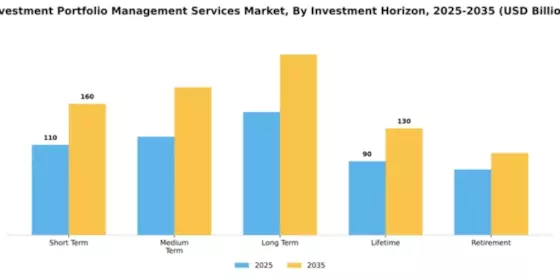
In the Investment Portfolio Management Services Market, the 'Investment Horizon' segment showcases a diverse distribution of preferences among investors. The Long Term investment horizon currently holds the largest market share, favored by individuals seeking to maximize their returns over an extended period, thus allowing for the compounding of profits. On the other hand, the Short Term investment horizon has seen a marked increase in popularity among investors, reflecting a shift towards quick returns, especially in volatile markets where agility can yield substantial short-term gains. The growth trends in this segment are significantly driven by changes in investor behavior and economic factors. Increasing market volatility and uncertainty have prompted many investors to diversify their portfolios, resulting in a stronger preference for Short Term investments. Additionally, the rise of technology platforms has facilitated easier access to short-term trading options, fostering an environment where investors are more willing to engage in rapid investment cycles. This has led to a more dynamic market landscape, where both the Long Term and Short Term horizons are crucial, but the latter is consistently gaining traction.
Long Term (Dominant) vs. Short Term (Emerging)
The Long Term investment horizon is characterized by a focus on strategic growth, where investors allocate resources for several years to capitalize on market trends and compound interest. This segment is particularly appealing to retirement planners and those looking for sustainable wealth accumulation over decades. Investors in this category often choose a diversified portfolio that balances risk and reward, favoring stocks and bonds that could yield higher returns in the long run. In contrast, the Short Term investment horizon caters to those seeking immediate returns, driven by market fluctuations and trading opportunities. It appeals to more risk-tolerant investors who thrive on quick decision-making and agility. The rapid digitalization of trading platforms has bolstered this segment, enabling investors to execute transactions in real-time, which has significantly contributed to its growth.
Get more detailed insights about Investment Portfolio Management Services Market Request Free Sample
North America dominates the Investment Portfolio Management Services Market, holding a significant market share of 275.0. The region's growth is driven by a robust financial infrastructure, increasing demand for diversified investment strategies, and favorable regulatory frameworks. The presence of major financial institutions and a growing trend towards digital investment solutions further catalyze market expansion. Regulatory support for innovation and transparency also plays a crucial role in enhancing investor confidence. The competitive landscape in North America is characterized by key players such as BlackRock, Vanguard Group, and Fidelity Investments, which collectively shape market dynamics. The U.S. remains the leading country, with a well-established investment ecosystem that attracts both domestic and international investors. The focus on sustainable investing and technological advancements in portfolio management are also pivotal in maintaining the region's leadership in the global market.
Europe's Investment Portfolio Management Services Market is valued at 150.0, reflecting a growing interest in diversified investment options. The region benefits from a strong regulatory environment that encourages transparency and investor protection, driving demand for professional portfolio management services. Additionally, the increasing wealth of individuals and institutions is propelling the market forward, as more investors seek expert guidance in navigating complex financial landscapes. Leading countries such as Germany, France, and the UK are at the forefront of this growth, with significant contributions from major players like Amundi and Deutsche Bank Wealth Management. The competitive landscape is evolving, with a focus on innovative investment solutions and sustainable practices. The European market is also witnessing a rise in fintech companies that enhance service delivery and client engagement, further enriching the investment ecosystem.
The Asia-Pacific region, with a market size of 100.0, is rapidly emerging as a key player in the Investment Portfolio Management Services Market. The growth is fueled by increasing disposable incomes, a burgeoning middle class, and a heightened awareness of investment opportunities. Regulatory reforms aimed at enhancing market accessibility and investor protection are also contributing to the region's expansion, making it an attractive destination for both local and foreign investors. Countries like China, Japan, and Australia are leading the charge, with a competitive landscape that includes both traditional financial institutions and innovative fintech startups. Key players such as UBS Asset Management are capitalizing on the growing demand for tailored investment solutions. The region's focus on technology-driven investment strategies is reshaping the market, positioning Asia-Pacific as a formidable force in the global investment landscape.
The Middle East and Africa region, with a market size of 25.0, is gradually evolving in the Investment Portfolio Management Services Market. The growth is primarily driven by increasing wealth among high-net-worth individuals and a growing interest in diversified investment portfolios. Regulatory initiatives aimed at enhancing financial market stability and investor confidence are also playing a crucial role in shaping the market landscape, fostering a more conducive environment for investment services. Leading countries such as the UAE and South Africa are at the forefront of this evolution, with a competitive landscape that includes both local and international players. The presence of firms like J.P. Morgan Asset Management highlights the region's potential for growth. As the market matures, there is a noticeable shift towards innovative investment solutions that cater to the unique needs of investors in this diverse region.
The Investment Portfolio Management Services Market is characterized by a dynamic competitive landscape, driven by factors such as technological advancements, increasing demand for personalized investment solutions, and a growing emphasis on sustainability. Major players like BlackRock (US), Vanguard Group (US), and Fidelity Investments (US) are at the forefront, each adopting distinct strategies to enhance their market positioning. BlackRock (US) focuses on integrating advanced analytics and AI into its investment processes, thereby improving decision-making and client engagement. Vanguard Group (US) emphasizes low-cost investment options and has been expanding its offerings in sustainable investment products, reflecting a broader market trend towards ESG (Environmental, Social, and Governance) criteria. Fidelity Investments (US) is actively pursuing digital transformation initiatives, enhancing its platform capabilities to attract tech-savvy investors, which collectively shapes a competitive environment that prioritizes innovation and client-centric solutions.The market structure appears moderately fragmented, with a mix of large institutional players and smaller niche firms. Key business tactics include localizing services to meet regional demands and optimizing supply chains to enhance operational efficiency. The collective influence of these major players fosters a competitive atmosphere where agility and responsiveness to market changes are paramount. As firms strive to differentiate themselves, the focus on personalized services and technological integration becomes increasingly pronounced.In November J.P. Morgan Asset Management (US) announced a strategic partnership with a leading fintech firm to enhance its digital investment platform. This collaboration aims to leverage cutting-edge technology to provide clients with more tailored investment solutions, thereby positioning J.P. Morgan as a leader in digital investment services. The strategic importance of this move lies in its potential to attract a younger demographic of investors who prioritize technology-driven solutions.In October State Street Global Advisors (US) launched a new suite of ESG-focused investment products, responding to the growing demand for sustainable investment options. This initiative not only aligns with global sustainability trends but also enhances State Street's competitive edge by appealing to socially conscious investors. The launch signifies a strategic pivot towards integrating ESG factors into core investment strategies, which is likely to resonate well with a broadening investor base.In September Amundi (FR) expanded its presence in Asia by acquiring a local asset management firm, thereby enhancing its regional capabilities and market share. This acquisition is strategically significant as it allows Amundi to tap into the rapidly growing Asian market, which is increasingly becoming a focal point for global investment flows. The move underscores the importance of geographical diversification in a competitive landscape where local expertise can provide a substantial advantage.As of December current competitive trends indicate a pronounced shift towards digitalization, sustainability, and AI integration within the Investment Portfolio Management Services Market. Strategic alliances are increasingly shaping the landscape, enabling firms to pool resources and expertise to innovate more effectively. Looking ahead, competitive differentiation is likely to evolve from traditional price-based competition to a focus on innovation, technology, and supply chain reliability, as firms seek to meet the sophisticated demands of a diverse investor base.




The Investment Portfolio Management Services Market is projected to grow at a 4.04% CAGR from 2025 to 2035, driven by technological advancements, increasing investor awareness, and regulatory changes.
New opportunities lie in:
By 2035, the market is expected to be robust, reflecting evolving investor needs and technological integration.
| MARKET SIZE 2024 | 550.0(USD Billion) |
| MARKET SIZE 2025 | 572.22(USD Billion) |
| MARKET SIZE 2035 | 850.0(USD Billion) |
| COMPOUND ANNUAL GROWTH RATE (CAGR) | 4.04% (2025 - 2035) |
| REPORT COVERAGE | Revenue Forecast, Competitive Landscape, Growth Factors, and Trends |
| BASE YEAR | 2024 |
| Market Forecast Period | 2025 - 2035 |
| Historical Data | 2019 - 2024 |
| Market Forecast Units | USD Billion |
| Key Companies Profiled | BlackRock (US), Vanguard Group (US), Fidelity Investments (US), State Street Global Advisors (US), J.P. Morgan Asset Management (US), BNY Mellon Investment Management (US), Charles Schwab Investment Management (US), Amundi (FR), Deutsche Bank Wealth Management (DE), UBS Asset Management (CH) |
| Segments Covered | Service Type, Client Type, Investment Strategy, Asset Class, Investment Horizon |
| Key Market Opportunities | Integration of artificial intelligence enhances personalized investment strategies in the Investment Portfolio Management Services Market. |
| Key Market Dynamics | Rising demand for personalized investment strategies drives competition among portfolio management service providers. |
| Countries Covered | North America, Europe, APAC, South America, MEA |
As of 2024, the market valuation was 550.0 USD Billion.
The market is expected to reach a valuation of 850.0 USD Billion by 2035.
The market is projected to grow at a CAGR of 4.04% from 2025 to 2035.
Wealth Management is projected to reach between 150.0 and 250.0 USD Billion by 2035.
High Net Worth Individuals are expected to account for a market size between 110.0 and 170.0 USD Billion by 2035.
Active Management is anticipated to lead with a valuation between 220.0 and 330.0 USD Billion by 2035.
Equities are expected to dominate, reaching a valuation between 220.0 and 320.0 USD Billion by 2035.
Robo-Advisory services are projected to grow to between 50.0 and 100.0 USD Billion by 2035.
Key players include BlackRock, Vanguard Group, and Fidelity Investments, among others.
Institutional Investors are expected to represent a market size between 200.0 and 300.0 USD Billion by 2035.


Kindly complete the form below to receive a free sample of this Report

“This is really good guys. Excellent work on a tight deadline. I will continue to use you going forward and recommend you to others. Nice job”


“Thanks. It’s been a pleasure working with you, please use me as reference with any other Intel employees.”


“Thanks for sending the report it gives us a good global view of the Betaïne market.”


“Thank you, this will be very helpful for OQS.”


“We found the report very insightful! we found your research firm very helpful. I'm sending this email to secure our future business.”


“I am very pleased with how market segments have been defined in a relevant way for my purposes (such as "Portable Freezers & refrigerators" and "last-mile"). In general the report is well structured. Thanks very much for your efforts.”


“I have been reading the first document or the study, ,the Global HVAC and FP market report 2021 till 2026. Must say, good info! I have not gone in depth at all parts, but got a good indication of the data inside!”


“We got the report in time, we really thank you for your support in this process. I also thank to all of your team as they did a great job.”


“The Automotive 48V ECU Components Procurement Intelligence Study” was a complex project, but the Market Research Future (MRFR) team handled it with quality, agility, and customer-centricity. They delivered all requested data on time and within the agreed scope. The team, including Shubhendra Anand and Rahul Gotadki, was always readily available to clarify questions and swiftly implement necessary adjustments, driving the project to a successful conclusion within a very demanding timeframe.
I would also like to specifically commend Akshay Agarwal for his responsiveness and support at every stage—from our initial inquiry on May 6th through to final delivery on June 18th. His dedication made the entire process seamless.”



